
Aggreva 0,05 mg/ml Injection
Clinical Summary
Quick overview from the medicine insert
Indication
Used for the prevention of thrombotic events in patients with acute coronary syndrome (ACS) and during percutaneous coronary interventions (PCI).
Dosage (summary)
Initial bolus of 0.4 mcg/kg/min for 30 minutes, followed by a continuous infusion of 0.1 mcg/kg/min.
Onset of Action / Duration
Onset of action is typically within 30 minutes, with effects lasting for several hours after discontinuation.
Special Populations
- Elderly patients
- Patients with renal impairment
- Patients with hepatic impairment
Pregnancy & Breastfeeding
Use during pregnancy only if the potential benefit justifies the potential risk to the fetus. Caution is advised when administering to nursing mothers.
Key Drug Interactions
- Increased risk of bleeding with anticoagulants such as warfarin and heparin.
- Caution with antiplatelet agents like aspirin and clopidogrel.
Contraindications
- Active bleeding or a history of bleeding disorders.
- Severe thrombocytopenia.
- Hypersensitivity to tirofiban or any component of the formulation.
Common side effects
- Bleeding complications.
- Thrombocytopenia.
- Nausea.
- Headache.
- Hypotension.
Counselling Points
- Inform patients about the signs of bleeding and when to seek medical attention.
- Advise patients to report any unusual bruising or bleeding.
- Discuss the importance of adhering to follow-up appointments and monitoring.
Important Disclaimer
The Aggreva 0,05 mg/ml Injection professional information leaflet below is the property of Teva Pharmaceuticals and is provided on Medinsert exactly as issued, with no.. alterations or editorial changes. We make every effort to keep content current by updating documents as soon as new versions become available. Medinsert serves as a trusted access point for healthcare professionals, but does not replace official sources or clinical judgement. For more details, please read our full disclaimer. read more>>
 Healthcare Professionals Only
This content is for registered healthcare professionals
Sign in or create a free account to read the full package insert.
Free for HPCSA-registered professionals. Powered by Medinsert.
Clinical Particulars
Section 4 of the official insert — extracted exactly as issued, no alterations
4.1 Therapeutic indications
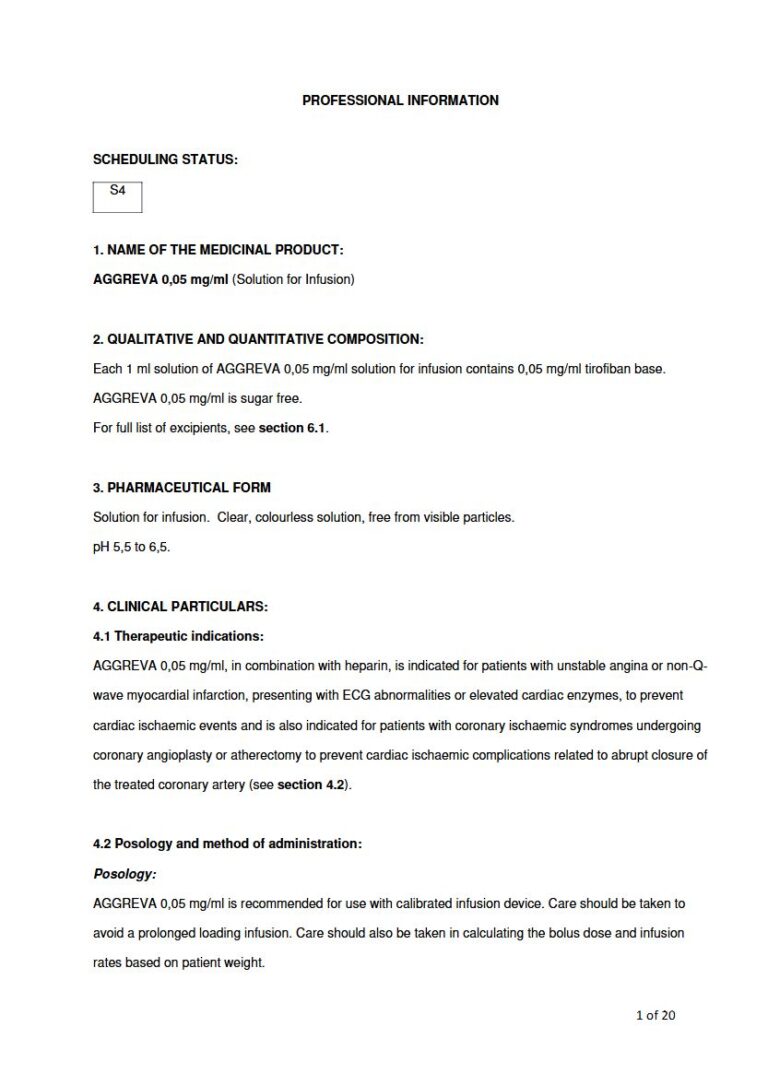
AGGREVA 0,05 mg/ml, in combination with heparin, is indicated for patients with unstable angina or non-Q-wave myocardial infarction, presenting with ECG abnormalities or elevated cardiac enzymes, to prevent cardiac ischaemic events and is also indicated for patients with coronary ischaemic syndromes undergoing coronary angioplasty or atherectomy to prevent cardiac ischaemic complications related to abrupt closure of the treated coronary artery (see section 4.2).
4.2 Posology and method of administration
Posology: AGGREVA 0,05 mg/ml is recommended for use with calibrated infusion device. Care should be taken to avoid a prolonged loading infusion. Care should also be taken in calculating the bolus dose and infusion rates based on patient weight.
In clinical studies patients received aspirin, unless contraindicated.
Unstable Angina Pectoris or Non-Q-Wave Myocardial Infarction: In patients who are to be managed medically for unstable angina/non-Q-wave myocardial infarction and who may continue on to angioplasty or atherectomy, AGGREVA 0,05 mg/ml should be administered intravenously, in combination with heparin, at the initial infusion rate of 0,4 microgram/kg/min for 30 minutes. Upon completion of the initial infusion, AGGREVA 0,05 mg/ml should be continued at a maintenance infusion rate of 0,1 microgram/kg/min. Patients with severe renal insufficiency (creatinine clearance less than 30 ml/min) should receive half the usual rate of infusion.
The table below is provided as a guide to dosage adjustment by weight.
Most Patients Severe Renal Impairment Patient weight (kg) 30 Min Loading Infusion Rate (ml/hr) Maintenance Infusion Rate (ml/hr) 30 Min Loading Infusion Rate (ml/hr) Maintenance Infusion Rate (ml/hr) 30 to 37 16 4 8 2 38 to 45 20 5 10 3 46 to 54 24 6 12 3 55 to 62 28 7 14 4 63 to 70 32 8 16 4 71 to 79 36 9 18 5 80 to 87 40 10 20 5 88 to 95 44 11 22 6 96 to 104 48 12 24 6 105 to 112 52 13 26 7 113 to 120 56 14 28 7 121 to 128 60 15 30 8 129 to 137 64 16 32 8 138 to 145 68 17 34 9 146 to 153 72 18 36 9
AGGREVA 0,05 mg/ml in combination with heparin has been administered for 48 to 108 hours, on average patients received AGGREVA 0,05 mg/ml for 71,3 hours. This infusion can be continued through angiography and should be continued up to 12 to 24 hours post-angioplasty/atherectomy. Arterial sheaths should be removed when the patientu2019s activated clotting time is less than 180 seconds or 2 to 6 hours following cessation of heparin.
Angioplasty/Atherectomy: In patients in whom AGGREVA 0,05 mg/ml is initiated in the setting of angioplasty/atherectomy, AGGREVA 0,05 mg/ml should be administered intravenously, in combination with heparin, as an initial bolus of 10 microgram/kg administered over 3 minutes followed by a maintenance infusion rate of 0,15 microgram/kg/min. Renal insufficiency: Patients with severe renal insufficiency (creatinine clearance less than 30 ml/min) should receive half the usual dosage. The table below is provided as a guide to dosage adjustment by weight.
Most Patients Severe Renal Impairment Patient weight (kg) Bolus to be administered over 3 minutes (ml) Maintenance Infusion Rate (ml/hr) Bolus to be administered over 3 minutes (ml) Maintenance Infusion Rate (ml/hr) 30 to 37 7 6 4 3 38 to 45 8 8 4 4 46 to 54 10 9 5 5 55 to 62 12 11 6 6 63 to 70 13 12 7 6 71 to 79 15 14 8 7 80 to 87 17 15 9 8 88 to 95 18 17 9 9 96 to 104 20 18 10 9 105 to 112 22 20 11 10 113 to 120 23 21 12 11 121 to 128 25 23 13 12 129 to 137 26 24 13 12 138 to 145 28 26 14 13 146 to 153 30 27 15 14
The AGGREVA 0,05 mg/ml maintenance infusion should be administered for 36 hours. Upon completion of the procedure, heparin should be discontinued, and arterial sheaths should then be removed when the patientu2019s activated clotting time is less than 180 seconds.
Other Patient Populations: No dosage adjustment is recommended for elderly patients (see section 4.4 Use in the Elderly) or female patients. Paediatric population: The safety and efficacy of AGGREVA in children have not been established.
Method of administration: AGGREVA 0,05 mg/ml is for intravenous use only using sterile equipment. AGGREVA 0,05 mg/ml may be co-administered with heparin through the same line.
Directions for use: Parenteral medicines should be inspected visually for particulate matter and discolouration prior to use, whenever solution and container permit. AGGREVA 0,05 mg/ml may be administered in the same intravenous line as atropine sulphate, dobutamine, dopamine, epinephrine HCI (adrenaline), furosemide, lidocaine, midazolam HCI, morphine sulphate, nitroglycerin, potassium chloride, propranolol HCI and famotidine injection. AGGREVA 0,05 mg/ml should not be administered in the same intravenous line as diazepam (see section 6.2). Check the expiry date. Do not withdraw solution directly from the container with a syringe.
4.3 Contraindications
- Hypersensitivity to tirofiban or to any of the excipients listed in section 6.1.
- Active internal bleeding or history of bleeding diathesis within the previous 30 days.
- A history of intracranial haemorrhage, intracranial neoplasm, arteriovenous malformation or aneurysm.
- A history of thrombocytopenia following prior exposure to AGGREVA 0,05 mg/ml.
- Major surgical procedure or severe physical trauma within the previous month.
- History of stroke within 30 days or any history of haemorrhagic stroke.
- History, symptoms, or findings suggestive of aortic dissection.
- Severe hypertension (systolic blood pressure more than 180 mmHg and/or diastolic blood pressure more than 110 mmHg).
- Acute pericarditis.
- Concomitant use of another parenteral GP IIb/IIIa.
- Recent epidural procedure.
- Chronic haemodialysis.
- Prolonged INR.
Paediatric use: Safety and effectiveness in children have not been established.
4.4 Special warnings and precautions for use
The administration of AGGREVA 0,05 mg/ml alone without unfractionated heparin is not recommended. There is limited experience with concomitant administration of AGGREVA 0,05 mg/ml with enoxaparin (see section 5.2). The concomitant administration of AGGREVA 0,05 mg/ml with enoxaparin is associated with a higher frequency of cutaneous and oral bleeding events, but not in TIMI bleeds**, when compared with the concomitant administration of AGGREVA 0,05 mg/ml and unfractionated heparin. An increased risk of serious bleeding events associated with the concomitant administration of AGGREVA 0,05 mg/ml and enoxaparin cannot be excluded, particularly in patients given additional unfractionated heparin in conjunction with angiography and/or PCI. The efficacy of AGGREVA 0,05 mg/ml in combination with enoxaparin has not been established. The safety and efficacy of AGGREVA 0,05 mg/ml with other low molecular weight heparins has not been investigated.
There is insufficient experience with the use of AGGREVA 0,05 mg/ml in the following diseases and conditions, however, an increased risk of bleeding is suspected. Therefore, AGGREVA 0,05 mg/ml is not recommended in:
- Traumatic or protracted cardiopulmonary resuscitation, organ biopsy or lithotripsy within the past two weeks.
- Severe trauma or major surgery > 6 weeks but < 3 months previously.
- Active peptic ulcer within the past three months.
- Uncontrolled hypertension (> 180/110 mm Hg).
- Acute pericarditis.
- Active or a known history of vasculitis.
- Suspected aortic dissection.
- Haemorrhagic retinopathy.
- Occult blood in the stool or haematuria.
- Thrombolytic therapy (see section 4.5).
- Concurrent use of medicines that increase the risk of bleeding to a relevant degree (see section 4.5).
There is no therapeutic experience with AGGREVA 0,05 mg/ml in patients for whom thrombolytic therapy is indicated. Consequently, the use of AGGREVA 0,05 mg/ml is not recommended in combination with thrombolytic therapy. AGGREVA 0,05 mg/ml infusion should be stopped immediately if circumstances arise that necessitate thrombolytic therapy (including acute occlusion during PCI) or if the patient must undergo an emergency coronary artery bypass graft (CABG) operation or requires an intra-aortic balloon pump.
Paediatric population: There is no therapeutic experience with AGGREVA 0,05 mg/ml in children, thus, the use of AGGREVA 0,05 mg/ml is not recommended in these patients.
Other precautionary notes and measures: There are insufficient data regarding the re-administration of AGGREVA 0,05 mg/ml. Patients should be carefully monitored for bleeding during treatment with AGGREVA 0,05 mg/ml. If treatment of haemorrhage is necessary, discontinuation of AGGREVA 0,05 mg/ml should be considered (see section 4.9). In cases of major or uncontrollable bleeding, tirofiban hydrochloride should be discontinued immediately.
AGGREVA 0,05 mg/ml should be used with special caution in the following conditions and patient groups:
- Recent clinically relevant bleeding (less than one year).
- Puncture of a non-compressible vessel within 24 hours before administration of AGGREVA 0,05 mg/ml.
- Recent epidural procedure (including lumbar puncture and spinal anaesthesia).
- Severe acute or chronic heart failure.
- Cardiogenic shock.
- Mild to moderate liver insufficiency.
- Platelet count < 150 000/mm 3, known history of coagulopathy or platelet function disturbance or thrombocytopenia.
- Haemoglobin concentration less than 11 g/dl or haematocrit < 34 %.
Special caution should be used during concurrent administration of ticlopidine, clopidogrel, adenosine, dipyridamole, sulfinpyrazone, and prostacyclin.
Elderly patients, female patients, and patients with low body weight: Elderly and/or female patients had a higher incidence of bleeding complications than younger or male patients, respectively. Patients with a low body weight had a higher incidence of bleeding than patients with a higher body weight. For these reasons AGGREVA 0,05 mg/ml should be used with caution in these patients and the heparin effect should be carefully monitored.
Impaired renal function: There is evidence from clinical studies that the risk of bleeding increases with decreasing creatinine clearance and hence also reduced plasma clearance of tirofiban. Patients with decreased renal function (creatinine clearance <60ml/min) should therefore be carefully monitored for bleeding during treatment with AGGREVA 0,05 mg/ml and the heparin effect should be carefully monitored. In severe kidney failure the AGGREVA 0,05 mg/ml dosage should be reduced (see section 4.2).
Femoral artery line: During treatment with AGGREVA 0,05 mg/ml there is a significant increase in bleeding rates, especially in the femoral artery area, where the catheter sheath is introduced. Care should be taken to ensure that only the anterior wall of the femoral artery is punctured. Arterial sheaths may be removed when coagulation has returned to normal, e.g., when activated clotting time (ACT) is less than 180 seconds, (usually 2 to 6 hours after discontinuation of heparin). After removal of the introducer sheath, careful haemostasis should be ensured under close observation.
General nursing care: The number of vascular punctures, and intramuscular injections should be minimised during the treatment with AGGREVA 0,05 mg/ml. I.V. access should only be obtained at compressible sites of the body. All vascular puncture sites should be documented and closely monitored. The use of urinary catheters, nasotracheal intubation and nasogastric tubes should be critically considered.
Monitoring of laboratory values: Platelet count, haemoglobin and haematocrit levels should be determined before treatment with AGGREVA 0,05 mg/ml as well as within 2 to 6 hours after start of therapy with AGGREVA 0,05 mg/ml and at least once daily thereafter while on therapy (or more often if there is evidence of a marked decrease). In patients who have previously received GPIIb/IIIa receptor antagonists (cross reactivity can occur), the platelet count should be monitored immediately e.g., within the first hour of administration after re-exposure (see section 4.8). If the platelet count falls below 90 000/mm 3, further platelet counts should be carried out in order to rule out pseudo-thrombocytopenia. If thrombocytopenia is confirmed, AGGREVA 0,05 mg/ml and heparin should be discontinued. Patients should be monitored for bleeding and treated if necessary (see section 4.9). In addition, activated thromboplastin time (APTT) should be determined before treatment and the anticoagulant effects of heparin should be carefully monitored by repeated determinations of APTT and the dose should be adjusted accordingly (see section 4.2). Potentially life-threatening bleeding may occur especially when heparin is administered with other products affecting haemostasis, such as GPIIb/IIIa receptor antagonists.
Sodium content: AGGREVA 0,05 mg/ml solution for infusion contains approximately 2 412,50 mg of sodium per 250 ml bag which should be taken into consideration by patients on a controlled sodium diet.
**TIMI major bleeds are defined as a haemoglobin drop of > 50g/l with or without an identified site, intracranial haemorrhage, or cardiac tamponade. TIMI minor bleeds are defined as a haemoglobin drop of > 30 g/l but u2264 50 g/l with bleeding from a known site or spontaneous gross haematuria, haematemesis, or haemoptysis. TIMI u201closs no siteu201d is defined as a haemoglobin drop > 40 g/l but < 50 g/l without an identified bleeding site.
4.5 Interaction with other medicines and other forms of interaction
The use of several platelet aggregation inhibitors increases the risk of bleeding, likewise their combination with heparin, warfarin and thrombolytics. Clinical and biological parameters of haemostasis should be regularly monitored.
The concomitant administration of AGGREVA 0,05 mg/ml and aspirin increases the inhibition of platelet aggregation to a greater extent than aspirin alone, as measured by ex vivo APD-induced platelet aggregation test. The concomitant administration of AGGREVA 0,05 mg/ml and unfractionated heparin increases the prolongation of the bleeding time to a greater extent as compared to unfractionated heparin alone. With the concurrent use of AGGREVA 0,05 mg/ml, unfractionated heparin, aspirin, and clopidogrel there was a comparable incidence of bleeding than when only unfractionated heparin, aspirin, and clopidogrel were used together (see sections 4.4 and 4.8). AGGREVA 0,05 mg/ml prolonged bleeding time; however, the combined administration of AGGREVA 0,05 mg/ml and ticlopidine did not additionally affect bleeding time. Concomitant use of warfarin with AGGREVA 0,05 mg/ml plus heparin was associated with an increased risk of bleeding. AGGREVA 0,05 mg/ml is not recommended in thrombolytic therapy - concurrent or less than 48 hours before administration of AGGREVA 0,05 mg/ml or concurrent use of medicines that increase the risk of bleeding to a relevant degree (e.g., oral anticoagulants, other parenteral GP IIb/IIIa inhibitors, dextran solutions). There is insufficient experience with the use of AGGREVA 0,05 mg/ml in these conditions; however, an increased risk of bleeding is suspected. Tirofiban has been used concomitantly in clinical studies with beta-blockers, calcium channel blockers, NSAIDs and nitrate preparations without evidence of clinically significant adverse interactions.
Effects of other medicines: The plasma clearance of tirofiban in patients receiving one of the following medicines was compared to that in patients not receiving that medicine in a sub-set of patients in the PRISM study. There were no substantial (>15 %) effects of these medicines on the plasma clearance of tirofiban: acebutolol, alprazolam, amlodipine, aspirin preparations, atenolol, bromazepam, captopril, diazepam, digoxin, diltiazem, docusate sodium, enalapril, furosemide, glibenclamide, unfractionated heparin, insulin, isosorbide, lorazepam, lovastatin, metoclopramide, metoprolol, morphine, nifedipine, nitrate preparations, oxazepam, paracetamol, potassium chloride, propranolol, ranitidine, simvastatin, sucralfate and temazepam. The pharmacokinetics and pharmacodynamics of AGGREVA 0,05 mg/ml were investigated when concomitantly administered with enoxaparin (1 milligram/kg subcutaneously every 12 hours) and compared with the combination of AGGREVA 0,05 mg/ml and unfractionated heparin. There was no difference in the clearance of AGGREVA 0,05 mg/ml between the two groups.
4.6 Fertility, pregnancy and lactation
Safety and efficacy in pregnancy and lactation has not been established.
Pregnancy: There are no or limited amount of data from the use of tirofiban hydrochloride in pregnant women. Animal studies are insufficient with respect to reproductive toxicity (see section 5.3). AGGREVA 0,05 mg/ml should not be used during pregnancy.
Breastfeeding: It is unknown whether tirofiban hydrochloride is excreted in human milk. Available pharmacodynamic/toxicological data in animals have shown excretion of tirofiban hydrochloride in milk (for details see section 5.3). A risk to the new-born cannot be excluded. AGGREVA 0,05 mg/ml should not be used during lactation.
Fertility: Animal studies are insufficient to draw conclusions with respect to reproductive toxicity in humans.
4.7 Effects on ability to drive and use machines
Not relevant.
4.8 Undesirable effects
a. Summary of safety profile: The most common adverse reaction reported during therapy with AGGREVA 0,05 mg/ml, when used concomitantly with heparin, aspirin and other oral anti-platelet medicines, was bleeding, which usually involved mild mucocutaneous bleeding or mild catheterisation-site bleeding. Gastro-intestinal, retro-peritoneal, intracranial, haemorrhoidal and post-operative bleeding, epidural haematoma in the spinal region, haemopericardium and pulmonary (alveolar) haemorrhage have also been reported. The most serious adverse reaction was fatal bleeding.
b. Tabulated list of adverse reactions:
System Organ Class Frequent Less frequent Frequency unknown Blood and lymphatic system disorders Acute and/or severe (< 20 000/mm 3) decreases in platelet counts. Intracranial bleeding, spinal epidural haematoma Immune system disorders Severe allergic reactions including anaphylactic reactions. Nervous system disorders Headache Cardiac disorders Haemopericardium Vascular disorders Haematoma Respiratory, thoracic and mediastinal disorders Haemoptysis, epistaxis Pulmonary (alveolar) haemorrhage Gastrointestinal disorders Nausea, oral haemorrhage, gingival haemorrhage GI haemorrhage, haematemesis Retroperitoneal bleeding Skin and subcutaneous tissue disorders Ecchymosis Renal and urinary disorders Haematuria General disorders and administration site conditions Fever Injury, poisoning and procedural complications Post-operative haemorrhage*, vessel puncture site haemorrhage Investigations Occult blood in stool or urine, decreases in haematocrit and haemoglobin, platelet counts < 90 000/mm 3 Platelet counts < 50 000/mm 3 *Primarily related to catheterisation sites.
c. Description of selected adverse reactions: Bleeding: Both, with the AGGREVA 0,05 mg/ml 0,4 microgram/kg/min infusion regimen and the 25 microgram/kg dose bolus regimen, rates of major bleeding complications are low and not significantly increased. Thrombocytopenia: During AGGREVA 0,05 mg/ml therapy, acute decreases in platelet count or thrombocytopenia occurred more frequently than in the placebo group. These decreases were reversible upon discontinuation of AGGREVA 0,05 mg/ml. Acute and severe platelet (platelet counts < 20 000/mm 3) decreases have been observed in patients with no prior history of thrombocytopenia upon re-administration of GPIIb/IIIa receptor antagonists and may be associated with chills, low-grade fever or bleeding complications. Allergic reactions: Severe allergic reactions (e.g., bronchospasm, urticaria) including anaphylactic reactions have occurred during initial treatment (also on the first day) and during re-administration of AGGREVA 0,05 mg/ml. Some cases have been associated with severe thrombocytopenia (platelet counts < 10 000/mm 3).
Reporting of suspected adverse reactions: Reporting suspected adverse reactions after authorisation of the medicine is important. It allows continued monitoring of the benefit/risk balance of the medicine. Healthcare providers are asked to report any suspected adverse reactions to SAHPRA via the 6.04 Adverse Drug Reactions Reporting Form, found online under SAHPRAu2019s publications: https://www.sahpra.org.za/Publications/Index/8.
4.9 Overdose
Inadvertent overdose with tirofiban hydrochloride occurred in the clinical studies, up to 50 microgram/kg as a three-minute bolus or 1,2 microgram/kg/min as an initial infusion. Overdose with up to 1,47 microgram/kg/min as a maintenance infusion rate has also occurred.
a) Symptoms of overdose: The symptom of overdose most commonly reported was bleeding, usually mucosal bleeding and localised bleeding at the arterial puncture site for cardiac catheterisation but also single cases of intracranial haemorrhages and retroperitoneal bleedings (see sections 4.4 and 5.1).
b) Measures: Overdose with AGGREVA 0,05 mg/ml should be treated in accordance with the patient's condition and the attending medical practitioneru2019s assessment. If treatment of haemorrhage is necessary, the AGGREVA 0,05 mg/ml infusion should be discontinued. Transfusions of blood and/or thrombocytes should also be considered. AGGREVA 0,05 mg/ml can be removed by haemodialysis.
