
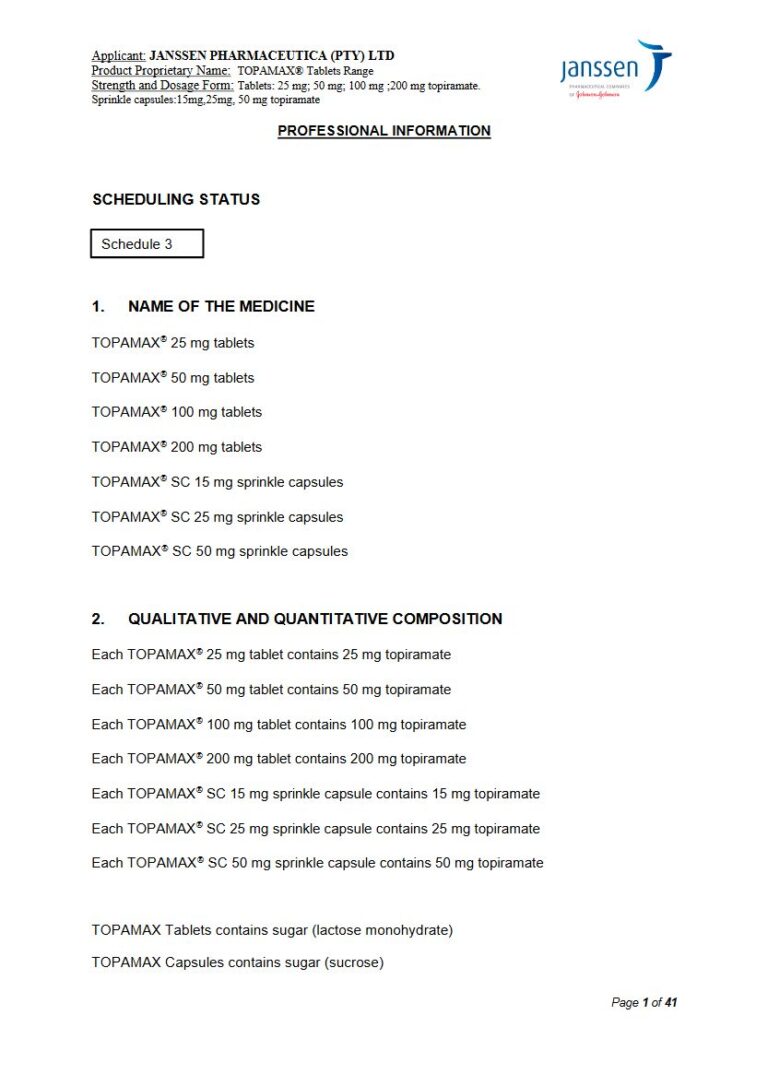
Topamaxa Tablets Range 25 mg, 50 mg, 100 mg, 200 mg Tablet.
PDF Leaflet Revision Date: 03 May 2022
Clinical Summary
Quick overview from the medicine insert
Indication
Monotherapy and adjunctive therapy for epilepsy.
Dosage (summary)
Adults: Start at 25 mg nightly, titrate to 100-500 mg/day. Children: Start at 0.5-1 mg/kg nightly, titrate to 100-400 mg/day.
Special Populations
- Renal impairment
- Hepatic impairment
Pregnancy & Breastfeeding
Teratogenic in animals; potential fetal harm in humans. Use only if benefits outweigh risks.
Key Drug Interactions
- Phenytoin
- Carbamazepine
- Valproic acid
- Oral contraceptives
Contraindications
- Hypersensitivity
- Children under 2 years
Common side effects
- Anorexia
- Dizziness
- Somnolence
- Depression
- Weight decreased
Counselling Points
- Monitor for mood changes
- Maintain hydration
- Avoid CNS depressants
- Report visual disturbances
Serious warnings
- Acute myopia and secondary angle closure glaucoma
- Metabolic acidosis
- Suicidal ideation
- Serious skin reactions
Important Disclaimer
The Topamaxa Tablets Range 25 mg, 50 mg, 100 mg, 200 mg Tablet. professional information leaflet below is the property of Janssen Pharmaceutica and is provided on Medinsert exactly as issued, with no.. alterations or editorial changes. We make every effort to keep content current by updating documents as soon as new versions become available. Medinsert serves as a trusted access point for healthcare professionals, but does not replace official sources or clinical judgement. For more details, please read our full disclaimer. read more>>
 Healthcare Professionals Only
This content is for registered healthcare professionals
Sign in or create a free account to read the full package insert.
Free for HPCSA-registered professionals. Powered by Medinsert.
Clinical Particulars
Section 4 of the official insert — extracted exactly as issued, no alterations
4.1 Therapeutic indications
Epilepsy
TOPA MAX is indicated as monotherapy in patients with newly diagnosed epilepsy or for conversion to monotherapy in patients with epilepsy. TOPA MAX is indicated as adjunctive therapy for adults and children over 4 years old who are inadequately controlled on conventional first line anti-epileptic medicines for:
- partial onset seizures with or without secondarily generalized seizures.
- seizures associated with Lennox-Gastaut syndrome.
- primary generalized tonic clonic seizures.
4.2 Posology and method of administration
For optimal control in both adults and children, it is recommended that therapy be initiated at a low dose, followed by titration to an effective dose. TOPAMAX is available in tablets and a capsule sprinkle formulation. It is recommended that tablets not be broken. The sprinkle formulation is provided for those patients who cannot swallow tablets e.g. paediatrics and the elderly. TOPAMAX sprinkle capsules may be swallowed whole or may be administered by carefully opening the capsule and sprinkling the entire contents on a small amount (teaspoon) of soft food. This medicine/food mixture should be swallowed immediately and not chewed. It should not be stored for future use.
TOPAMAX can be taken without regard to meals.
Posology
MONOTHERAPY
When concomitant AEMs are withdrawn to achieve monotherapy with topiramate, consideration should be given to the effects this may have on seizure control. Unless safety concerns require an abrupt withdrawal of the concomitant AEM, a gradual discontinuation at the rate of approximately one-third of the concomitant AEM dose every 2 weeks is recommended. When enzyme inducing medicines are withdrawn, topiramate levels will increase. A decrease in TOPA MAX dosage may be required if clinically indicated.
Adults: Titration should begin at 25 mg nightly for 1 week. The dosage should then be increased at 1- or 2-week intervals by increments of 25 or 50 mg/day, administered in two divided doses. If the patient is unable to tolerate the titration regimen, smaller increments or longer intervals between increments can be used. Dose and titration rate should be guided by clinical outcome. The recommended initial target dose for topiramate monotherapy in adults is 100 mg/day and the maximum recommended daily dose is 500 mg. Some patients with refractory forms of epilepsy have tolerated topiramate monotherapy at doses of 1 000 mg/day. These dosing recommendations apply to all adults including the elderly in the absence of underlying renal disease.
Children: Treatment of children aged 2 years and above should begin at 0.5 to 1 mg/kg nightly for the first week. The dosage should then be increased at 1- or 2-week intervals by increments of 0.5 to 1 mg/kg/day, administered in two divided doses. If the child is unable to tolerate the titration regimen, smaller increments or longer intervals between dose increments can be used. Dose and dose titration rate should be guided by clinical outcome. The recommended initial target dose range for topiramate monotherapy in children aged two years and above is 100 u2013 400 mg/day. Children with recently diagnosed partial onset seizures have received doses of up to 500 mg/day.
ADJUNCTIVE THERAPY
Adults: Therapy should begin at 25 - 50 mg nightly for one week. Subsequently, at weekly intervals, the dose should be increased by 25 - 50 mg/day and taken in two divided doses. Dose titration should be guided by clinical outcome. Some patients may achieve efficacy with once-a-day dosing. In clinical trials, 200 mg was effective and was the lowest dosage studied. This is therefore considered the minimal effective dose. The usual total daily dose is 200 mg to 400 mg in two divided doses. Some patients may require doses up to 800 mg per day, which is the maximum dose. It is recommended that therapy be initiated at a low dose, followed by titration to an effective dose. These dosing recommendations apply to all adults, including the elderly, in the absence of underlying renal disease. (see section 4.4 u2013 Renal impairment).
Children 4 years and over: The recommended total daily dose of TOPA MAX as adjunctive therapy is approximately 5 to 9 mg/kg/day in two divided doses. Titration should begin at 25 mg (or less, based on a range of 1 to 3 mg/kg/day) nightly for the first week. The dosage should then be increased at 1- or 2-week intervals by increments of 1 to 3 mg/kg/day (administered in two divided doses), to achieve optimal clinical response. Dose titration should be guided by clinical outcome.
4.3 Contraindications
Hypersensitivity to any component of this product. The safety and efficacy of TOPA MAX in children under 2 years has not yet been established. Pregnancy and lactation, as topiramate is teratogenic in animals, whilst there are no adequate data in humans. (see section 4.6)
4.4 Special warnings and precautions for use
Acute Myopia and Secondary Angle Closure Glaucoma
A syndrome consisting of acute myopia associated with secondary angle closure glaucoma has been reported in patients receiving TOPA MAX. Symptoms include acute onset of decreased visual acuity and/or ocular pain. Ophthalmologic findings can include myopia, anterior chamber shallowing, ocular hyperemia (redness) and increased intraocular pressure. Mydriasis may or may not be present. This syndrome may be associated with supraciliary effusion resulting in anterior displacement of the lens and iris, with secondary angle closure glaucoma. Symptoms typically occur within 1 month of initiating TOPA MAX therapy. In contrast to primary narrow angle glaucoma, which is rare under 40 years of age, secondary angle closure glaucoma associated with topiramate has been reported in paediatric patients as well as adults. Treatment includes discontinuation of TOPA MAX, as rapidly as possible in the judgment of the treating physician, and appropriate measures to reduce intraocular pressure. These measures generally result in a decrease in intraocular pressure.
Oral contraceptives
Contraceptive efficacy can be decreased even in the absence of breakthrough bleeding, see section 4.5.
Visual field defects
Visual field defects have been reported in patients receiving TOPA MAX independent of elevated intraocular pressure. In clinical trials, most of these events were reversible after TOPA MAX discontinuation. If visual problems occur at any time during TOPA MAX treatment, consideration should be given to discontinuing the medicine.
Metabolic Acidosis and sequelae
Hyperchloraemic, non-anion gap, metabolic acidosis (i.e. decreased serum bicarbonate below the normal reference range in the absence of respiratory alkalosis) is associated with topiramate treatment. This decrease in serum bicarbonate is due to the inhibitory effect of topiramate on renal carbonic anhydrase and consequent renal bicarbonate wasting. These decreases are usually mild to moderate (average decrease of 4 mmol/L at doses of 100 mg/day or above in adults and at approximately 6 mg/kg/day in paediatric patients. However, patients have experienced decreases to values below 10 mmol/L. Conditions or therapies that predispose to acidosis (such as renal disease, severe respiratory disorders, status epilepticus, diarrhoea, surgery, ketogenic diet, or certain medicines) may be additive to the bicarbonate lowering effects of topiramate. Chronic, untreated metabolic acidosis may increase the risk of nephrolithiasis or nephrocalcinosis (see section 4.4 - Nephrolithiasis).
Chronic metabolic acidosis in paediatric patients can reduce growth rates. A one year, open-label study in pediatric patients aged 6 to 15 years including 63 subjects with recent or new onset of epilepsy was conducted to assess the effects of topiramate (28 subjects) versus levetiracetam on growth, development, and bone mineralization. Continued growth was observed in both treatment groups but the topiramate group showed statistically significant reductions in mean annual change from baseline in body weight and bone mineral density compared to the levetiracetam group. A similar trend was also observed for height and height velocity but were not statistically significant. Growth-related changes were not clinically significant nor treatment limiting. Other confounding factors cannot be excluded. Chronic metabolic acidosis can lead to nephrolithiasis and increased risk for fractures. Evaluation of serum bicarbonate levels is recommended with topiramate therapy. If metabolic acidosis develops and persists, consideration should be given to reducing the dose or discontinuing topiramate (using dose tapering).
Hyperammonemia and encephalopathy
Hyperammonemia with or without encephalopathy has been reported with topiramate treatment (See section 4.8). The risk for hyperammonemia with topiramate appears dose-related. Hyperammonemia has been reported more frequently when topiramate is used concomitantly with valproic acid (See section 4.5). Clinical symptoms of hyperammonemic encephalopathy often include acute alterations in level of consciousness and/or cognitive function with lethargy. In most cases, hyperammonemic encephalopathy abated with discontinuation of treatment. In patients who develop unexplained lethargy, or changes in mental status associated with topiramate monotherapy or adjunctive therapy, it is recommended to consider hyperammonemic encephalopathy and measuring ammonia levels.
Women of childbearing potential
TOPAMAX may cause foetal harm when administered to a pregnant woman. There is an increased risk of pre-term labour and premature delivery associated with the use of Antiepileptic Medicines (AEMs) including topiramate.
Withdrawal of TOPA MAX
In patients with or without a history of seizures or epilepsy, antiepileptic medicines, including TOPA MAX, should be gradually withdrawn to minimise the potential for seizures or increased seizure frequency. In clinical trials, daily dosages were decreased in weekly intervals by 50 u2013 100 mg in adults with epilepsy. In clinical trials of children, TOPA MAX was gradually withdrawn over a 2 u2013 8 week period. In situations where rapid withdrawal of TOPA MAX is medically required, appropriate monitoring is recommended.
Renal impairment
Renal elimination is dependent on renal function and is independent of age. Patients with moderate or severe renal impairment may take 10 to 15 days to reach steady-state plasma concentrations as compared to 4 to 8 days in patients with normal renal function. As with all patients, the titration schedule should be guided by clinical outcome (i.e. seizure control, avoidance of side-effects) with the knowledge that subjects with known renal impairment may require a longer time to reach steady state at each dose.
Hydration
Oligohidrosis (decreased sweating) and anhidrosis have been reported in association with the use of TOPAMAX. Decreased sweating and hyperthermia (rise in body temperature) may occur especially in young children exposed to high ambient temperatures. Adequate hydration while using TOPA MAX is very important. Hydration can reduce the risk of nephrolithiasis (see below). Proper hydration prior to and during activities such as exercise or exposure to warm temperatures may reduce the risk of heat-related adverse events (see section 4.8). Patients should be warned about this.
Mood Disturbances/Depression
An increased incidence of mood disturbances and depression has been observed during topiramate treatment.
Suicide / Suicidal Ideation
In double-blind clinical trials with TOPA MAX suicide related events (suicidal ideation, suicide attempts and suicide) occurred at a frequency of 0.5 % in topiramate treated patients (46 out of 8 652 patients treated) compared to 0.2 % treated with placebo (8 out of 4 045 patients treated). One completed suicide was reported in a bipolar disorder double-blind trial in a patient on topiramate. Patients therefore should be monitored for signs of suicidal ideation and behaviour and appropriate treatment should be considered. Patients (and, when appropriate, caregivers of patients) should be advised to seek immediate medical advice should signs of suicidal ideation or behaviour emerge.
Serious skin reactions
Serious skin reactions (Stevens-Johnson Syndrome (SJS) and Toxic Epidermal Necrolysis (TEN)) have been reported in patients receiving TOPAMAX (see section 4.8). The majority of cases have occurred in patients concurrently taking other medications that are known to be associated with SJS and TEN. There have also been several cases in patients receiving monotherapy.
It is recommended that patients be informed about the signs of serious skin reactions. If SJS or TEN are suspected, use of TOPAMAX should be discontinued.
Nephrolithiasis
Some patients, especially those with a predisposition to nephrolithiasis, are at increased risk for renal stone formation and associated signs and symptoms such as renal colic, renal pain or flank pain. Risk factors for nephrolithiasis include stone formation, a family history of nephrolithiasis and hypercalciuria (see section 4.4 u2013 Metabolic acidosis and sequelae). None of these risk factors can reliably predict stone formation during topiramate treatment. In addition, patients taking other medication associated with nephrolithiasis may be at increased risk. Concomitant use of TOPA MAX with agents predisposing to nephrolithiasis (renal stone formation) should be avoided.
Hepatic impairment
In hepatically impaired patients, topiramate should be administered with caution as the clearance of topiramate may be decreased. Reports of hepatotoxicity and less commonly liver failure in patients taking TOPA MAX with and without other medications have been received. Isolated reports have been received of hepatitis and hepatic failure occurring in patients taking multiple medications while being treated with TOPA MAX.
Lactose intolerance and lactase deficiency
TOPAMAX tablets contains lactose and TOPAMAX capsules contains sucrose which may have an effect on the glycaemic control of patients with diabetes mellitus. TOPAMAX tablets contains lactose. Patients with rare hereditary problems of galactose intolerance, the Lapp lactase deficiency or glucose-galactose malabsorption should not take TOPAMAX tablets. TOPAMAX capsules contains sucrose. Patients with rare hereditary conditions such as fructose intolerance, glucose-galactose mal-absorption should not take TOPAMAX SC.
4.5 Interactions with other medicines
For purposes of this section, a no effect dose is defined as a u2264 15 % change.
Effects of TOPA MAX on Other Antiepileptic Medicines
The addition of TOPAMAX to other antiepileptic medicines (phenytoin, carbamazepine, valproic acid, phenobarbital, primidone) has no effect on their steady-state plasma concentrations, except in the occasional patient, where the addition of TOPAMAX to phenytoin may result in an increase of plasma concentrations of phenytoin. This is possibly due to inhibition of a specific enzyme polymorphic isoform (CYP2C19). Consequently, any patient on phenytoin should have phenytoin levels monitored.
A pharmacokinetic interaction study of patients with epilepsy indicated the addition of TOPAMAX to lamotrigine had no effect on steady state plasma concentration of lamotrigine at TOPAMAX doses of 100 to 400 mg/day. In addition, there was no change in steady state plasma concentration of TOPAMAX during or after removal of lamotrigine treatment (mean dose of 327 mg/day). However the incidence of adverse effects was meaningfully increased on the combination.
Effects of Other Antiepileptic Medicines on TOPA MAX
Phenytoin and carbamazepine decrease the plasma concentration of TOPAMAX. The addition or withdrawal of phenytoin or carbamazepine to TOPAMAX therapy may require an adjustment in dosage of the latter. This should be done by titrating to clinical effect. The addition or withdrawal of valproic acid does not produce clinically significant changes in plasma concentrations of TOPAMAX and, therefore, does not warrant dosage adjustment of TOPAMAX.
The above interactions are summarised in the following table:
AEM Coadministered AEM Concentration TOPA MAX Concentration
Phenytoin uf0ab ** uf0af (48 %)
Carbamazepine (CBZ) uf0ab uf0af (40 %)
Valproic acid uf0ab uf0ab
Lamotrigine uf0ab uf0ab
Phenobarbital uf0ab NS
Primidone uf0ab NS
uf0ab = No effect on plasma concentration (u2264 15 % change)
** = Plasma concentrations increase in individual patients
uf0af = Plasma concentrations decrease
NS = Not studied
AEM = Antiepileptic medicine
Other Medicine Interactions
Digoxin: Concomitant administration has shown a decrease in serum digoxin. When TOPA MAX is added or withdrawn in patients on digoxin therapy, careful attention should be given to the routine monitoring of serum digoxin.
Oral Contraceptives: In a pharmacokinetic interaction study in healthy volunteers with a concomitantly administered combination oral contraceptive product containing 1 mg norethindrone (NET) plus 35 mcg ethinyl estradiol (EE), TOPAMAX given in the absence of other medications at doses of 50 to 200 mg/day was not associated with statistically significant changes in mean exposure (AUC) to either component of the oral contraceptive. In another study, exposure to EE was statistically significantly decreased at doses of 200, 400 and 800 mg/day (18 %, 21 %, and 30 %, respectively) when given as adjunctive therapy in patients taking valproic acid. In both studies, TOPAMAX (50 mg/day to 800 mg/day) did not significantly effect exposure to NET. Although there was a dose dependent decrease in EE exposure for doses between 200 - 800 mg/day, there was no significant dose dependent change in EE exposure for doses of 50 - 200 mg/day. The clinical significance of the changes observed is not known. The possibility of decreased contraceptive efficacy and increased breakthrough bleeding should be considered in patients taking combination oral contraceptive products with TOPAMAX. Patients taking estrogen-containing contraceptives should be asked to report any change in their bleeding patterns. Contraceptive efficacy can be decreased even in the absence of breakthrough bleeding.
Lithium: In patients with bipolar disorder, the pharmacokinetics of lithium were unaffected during treatment with TOPAMAX at doses of 200 mg/day; however, there was an observed increase in systemic exposure (26 % for AUC) following TOPAMAX doses of up to 600 mg/day. Lithium levels should be monitored when co-administered with TOPAMAX.
Risperidone: Interaction studies conducted under single and multiple dose conditions in healthy volunteers and patients with bipolar disorder yielded similar results. When administered concomitantly with TOPAMAX at escalating doses of 100, 250 and 400 mg/day there was a reduction in risperidone (administered at doses ranging from 1 to 6 mg/day) systemic exposure (16 % and 33 % for steady-state AUC at the 250 and 400 mg/day doses, respectively). Minimal alterations in the pharmacokinetics of the total active moiety (risperidone plus 9-hydroxyrisperidone) and no alterations for 9-hydroxyrisperidone were observed. There were no clinically significant changes in the systemic exposure of the risperidone total active moiety or of TOPAMAX, therefore this interaction is not likely to be of clinical significance.
Hydrochlorothiazide (HCTZ): An interaction study conducted in healthy volunteers evaluated the steady-state pharmacokinetics of HCTZ (25 mg q24h) and TOPAMAX (96 mg q12h) when administered alone and concomitantly. The results of this study indicate that TOPAMAX C max increased by 27 % and AUC increased by 29 % when HCTZ was added to TOPAMAX. The clinical significance of this change is unknown. The addition of HCTZ to TOPAMAX therapy may require an adjustment of the TOPAMAX dose. The steady-state pharmacokinetics of HCTZ were not significantly influenced by the concomitant administration of TOPAMAX. Clinical laboratory results indicated decreases in serum potassium after TOPAMAX or HCTZ administration, which were greater when HCTZ and TOPAMAX were administered in combination.
Metformin: An interaction study conducted in healthy volunteers evaluated the steady-state pharmacokinetics of metformin and TOPAMAX in plasma when metformin was given alone and when metformin and TOPAMAX were given simultaneously. The results of this study indicated that metformin mean C max and mean AUC 0 - 12h increased by 18 % and 25 %, respectively, while mean CL/F decreased 20 % when metformin was co-administered with TOPAMAX. TOPAMAX did not affect metformin t max. The clinical significance of the effect of TOPAMAX on metformin pharmacokinetics is unclear. Oral plasma clearance of TOPAMAX appears to be reduced when administered with metformin. The extent of change in the clearance is unknown. The clinical significance of the effect of metformin on TOPAMAX pharmacokinetics is unclear. When TOPAMAX is added or withdrawn in patients on metformin therapy, careful attention should be given to the routine monitoring for adequate control of their diabetic disease state.
Pioglitazone: An interaction study conducted in healthy volunteers evaluated the steady-state pharmacokinetics of TOPAMAX and pioglitazone when administered alone and concomitantly. A 15 % decrease in the AUC u03c4, ss of pioglitazone with no alteration in C max,ss was observed. This finding was not statistically significant. In addition, a 13 % and 16 % decrease in C max,ss and AUC u03c4,ss respectively, of the active hydroxy-metabolite was noted as well as a 60 % decrease in C max,ss and AUC u03c4,ss of the active keto-metabolite. The clinical significance of these findings is not known. When TOPAMAX is added to pioglitazone therapy or pioglitazone is added to TOPAMAX therapy, careful attention should be given to the routine monitoring of patients for adequate control of their diabetic disease state.
Glyburide: An interaction study conducted in patients with type 2 diabetes evaluated the steady-state pharmacokinetics of glyburide (5 mg/day) alone and concomitantly with TOPAMAX (150 mg/day). There was a 25 % reduction in glyburide AUC 24 during TOPAMAX administration. Systemic exposure of the active metabolites, 4-trans-hydroxy-glyburide (M1) and 3-cis-hydroxylglyburide (M2), were also reduced by 13 % and 15 %, respectively. The steady-state pharmacokinetics of TOPAMAX were unaffected by concomitant administration of glyburide. When TOPAMAX is added to glyburide therapy or glyburide is added to TOPAMAX therapy, careful attention should be given to the routine monitoring of patients for adequate control of their diabetic disease state.
CNS Depressants: Concomitant use of TOPA MAX with alcohol or other central nervous system (CNS) depressant medicines should be avoided.
Other forms of interactions: Agents predisposing to nephrolithiasis TOPA MAX, when used concomitantly with other agents predisposing to nephrolithiasis, may increase the risk of nephrolithiasis. While using TOPA MAX, agents like these should be avoided since they may create a physiological environment that increases the risk of renal stone formation.
Valproic Acid Concomitant administration of TOPAMAX and valproic acid has been associated with hyperammonemia with or without encephalopathy in patients who have tolerated either medicine alone. In most cases, symptoms and signs abated with discontinuation of either medicine. (See section 4.4) This adverse reaction is not due to a pharmacokinetic interaction. Hypothermia, defined as an unintentional drop in body core temperature to < 35 u00b0C, has been reported in association with concomitant use of TOPAMAX and valproic acid (VPA) both in conjunction with hyperammonemia and in the absence of hyperammonemia. This adverse event in patients using concomitant TOPAMAX and valproate can occur after starting TOPAMAX treatment or after increasing the daily dose of TOPAMAX.
Vitamin K-antagonist anticoagulant medications Decreased Prothrombin Time/International Normalised Ratio (PT/INR) responses have been reported following concomitant administration of topiramate with vitamin K-antagonist anticoagulant medications. Closely monitor INR during concomitant administration of topiramate therapy with K-antagonist anticoagulant medications.
4.6 Fertility, pregnancy and lactation
Pregnancy
Studies in animals and humans have shown reproductive toxicity. In rats, topiramate crosses the placental barrier. In humans, topiramate crosses the placenta and similar concentrations have been reported in the umbilical cord and maternal blood. There are no adequate and well-controlled studies using TOPA MAX in pregnant women. TOPA MAX can cause fetal harm when administered to a pregnant woman. Data from pregnancy registries indicate that infants exposed to topiramate in utero have an increased risk of congenital malformations (e.g., craniofacial defects, such as cleft lip/palate, hypospadias, and anomalies involving various body systems). This has been reported with topiramate monotherapy and topiramate as part of a polytherapy regimen. In addition, data from other studies indicate that, compared with monotherapy, there is an increased risk of teratogenic effects associated with the use of AEMs (Anti-epileptic medications) in combination therapy. The risk has been observed in all doses and effects were reported to be dose-dependent. In women treated with topiramate who have had a child with congenital malformation, there appears to be an increased risk of malformations in subsequent pregnancies when exposed to topiramate. There is an increased risk of pre-term labour and premature delivery associated with the use of AEMs, including topiramate. Compared with a reference group not taking antiepileptic medicines, registry data for TOPAMAX monotherapy showed a higher prevalence of low birth weight (< 2 500 grams).
One pregnancy registry reported an increased frequency of infants who were small for gestational age (SGA; defined as birth weight below the 10th percentile corrected for their gestational age, stratified by sex) among those exposed to TOPAMAX monotherapy in utero. SGA has been observed in all doses and is dose-dependent. The prevalence of SGA is greater in women who received higher doses of topiramate during pregnancy. In addition, the prevalence of SGA for women who continued topiramate use later in pregnancy is higher compared to women who stopped its use before the third trimester. The long-term consequences of the SGA findings could not be determined. A causal relationship for low birth weight and SGA has not been established. TOPAMAX should be used during pregnancy only if potential benefit justifies the potential risk to the foetus. In treating and counselling women of childbearing potential, the prescribing physician should weigh the benefits of therapy against the risks and consider alternative therapeutic options. If this medicine is used during pregnancy or if the patient becomes pregnant while taking this medicine, the patient should be apprised of the potential hazard to the foetus.
Breastfeeding
The excretion of topiramate in human milk has not been evaluated in controlled studies. Limited observations in patients suggest an extensive excretion of topiramate into breast milk. Diarrhoea and somnolence have been reported in breastfed infants whose mothers receive topiramate treatment.
4.7 Effects on ability to drive and use machines
TOPAMAX may produce central nervous system related events such as: drowsiness, dizziness or other related symptoms. It may also cause visual disturbances and/or blurred vision. These adverse events could potentially be dangerous in patients driving a vehicle or operating machinery, particularly until such time as the individual patientu2019s experience with the medicine is established. TOPAMAX may be more sedating than other antiepileptic medicines.
4.8 Undesirable effects
Adverse events identified in clinical trials, are listed by their incidence in Table 1. Assigned frequencies are as follows: Very common u22651/10 Common u22651/100 to <1/10 Uncommon u22651/1 000 to <1/100 Rare u22651/10,000 to 5 % and greater than that observed in placebo in at least 1 indication in double-blind controlled studies with TOPA MAX) include: anorexia, decreased appetite, bradyphrenia, depression, expressive language disorder, insomnia, coordination abnormal, disturbance in attention, dizziness, dysarthria, dysgeusia, hypoesthesia, lethargy, memory impairment, nystagmus, paresthesia, somnolence, tremor, diplopia, vision blurred, diarrhoea, nausea, fatigue, irritability, and weight decreased.
Paediatric population
Adverse events reported more frequently (u2265 2-fold) in children than in adults in double-blind controlled studies include: decreased appetite, increased appetite, acidosis hyperchloraemic, hypokalaemia, abnormal behaviour, aggression, apathy, initial insomnia, suicidal ideation, disturbance in attention, lethargy, circadian rhythm sleep disorder, poor quality sleep, lacrimation increased, sinus bradycardia, feeling abnormal, and gait disturbance. Adverse events that were reported in children but not in adults in double-blind controlled studies include: eosinophilia, psychomotor hyperactivity, vertigo, vomiting, hyperthermia, pyrexia, and learning disability.
4.9 Overdose
Signs and Symptoms
Overdosage of topiramate have been reported. Signs and symptoms included: convulsions, drowsiness, speech disturbances, blurred vision, diplopia, mentation impaired, lethargy, abnormal coordination, stupor, hypotension, abdominal pain, agitation, dizziness and depression. The clinical consequences were not severe in most cases, but deaths have been reported after polydrug overdoses involving topiramate. Topiramate overdose can result in severe metabolic acidosis (see Section 4.4). The highest topiramate overdose reported was calculated to be between 96 and 110 g and resulted in coma lasting 20 to 24 hours followed by full recovery after 3 to 4 days.
Treatment
In the event of overdose, topiramate should be discontinued and general supportive treatment given until clinical toxicity has been diminished or resolved. Heamodialysis has been shown to be an effective means of removing topiramate from the body. The patient should be well hydrated. It is advisable to contact a poison control centre to obtain the latest recommendations for the management of an overdose.
