
Dolotram Capsules 50 mg Capsules.
PDF Leaflet Revision Date: 13 May 2025
Clinical Summary
Quick overview from the medicine insert
Indication
Management of moderate to severe pain.
Dosage (summary)
Adults: 50 mg initially, then 50-100 mg every 4-6 hours; max 400 mg/day.
Onset of Action / Duration
Onset: 1 hour, Duration: ~6 hours
Special Populations
- Elderly
- Renal impairment
- Hepatic impairment
Pregnancy & Breastfeeding
Contraindicated in pregnancy and breastfeeding.
Key Drug Interactions
- MAO inhibitors
- CNS depressants
- Carbamazepine
Contraindications
- Children <12 years
- Post-operative use in children <18 years
- Hypersensitivity to tramadol
- Acute intoxication with CNS depressants
Common side effects
- Dizziness
- Nausea
- Constipation
- Somnolence
Counselling Points
- Avoid driving or operating machinery
- Monitor for signs of respiratory depression
- Do not exceed prescribed dose
Serious warnings
- Risk of respiratory depression
- Potential for addiction
- Seizure risk
Important Disclaimer
The Dolotram Capsules 50 mg Capsules. professional information leaflet below is the property of Ranbaxy Pharmaceuticals and is provided on Medinsert exactly as issued, with no.. alterations or editorial changes. We make every effort to keep content current by updating documents as soon as new versions become available. Medinsert serves as a trusted access point for healthcare professionals, but does not replace official sources or clinical judgement. For more details, please read our full disclaimer. read more>>
 Healthcare Professionals Only
This content is for registered healthcare professionals
Sign in or create a free account to read the full package insert.
Free for HPCSA-registered professionals. Powered by Medinsert.
Clinical Particulars
Section 4 of the official insert — extracted exactly as issued, no alterations
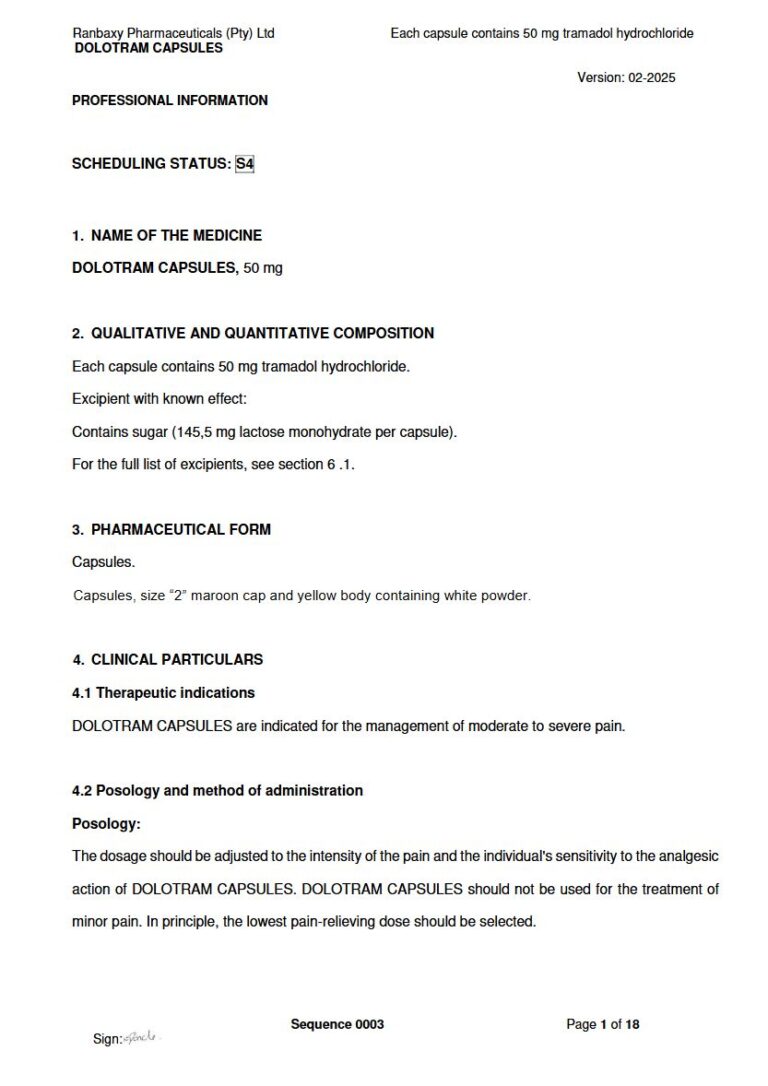
4.1 Therapeutic indications
DOLOTRAM CAPSULES are indicated for the management of moderate to severe pain.
4.2 Posology and method of administration
Posology: The dosage should be adjusted to the intensity of the pain and the individual's sensitivity to the analgesic action of DOLOTRAM CAPSULES. DOLOTRAM CAPSULES should not be used for the treatment of minor pain. In principle, the lowest pain-relieving dose should be selected.
DOLOTRAM CAPSULES should be taken as follows:
- Adults and children over the age of 12 years:
Moderate pain: Initial dose of 50 mg of DOLOTRAM CAPSULES, followed by 50 mg or 100 mg 4 - 6 hourly.
Severe pain: Initial dose of 100 mg followed by 50 mg or 100 mg 4 - 6 hourly.
A total daily dose of more than 400 mg per day (equivalent to 8 DOLOTRAM CAPSULES) must not be exceeded.
Special populations
- Elderly: In patients 75 years of age and over, a downward adjustment of the dose and/or prolongation of the interval between doses are recommended.
- Renal insufficiency/dialysis: The elimination of DOLOTRAM CAPSULES may be delayed in patients with renal insufficiency. The usual initial dose should be used, but for patients with creatinine clearance < 30 mL/min, the dosage interval (with careful consideration according to the patientu2019s requirements) should be increased to 12 hours. In cases of severe renal insufficiency DOLOTRAM CAPSULES are not recommended.
- Hepatic insufficiency: The elimination of DOLOTRAM CAPSULES may be delayed in patients with hepatic insufficiency. The usual initial dose should be used, but in severe hepatic impairment, the dosage interval (with careful consideration according to the patientu2019s requirements) should be increased to 12 hours. In cases of severe hepatic insufficiency DOLOTRAM CAPSULES are not recommended.
- Paediatric population: On account of the high dosage strength, DOLOTRAM CAPSULES are not intended for children below the age of 12 years.
Duration of treatment: Under no circumstances should DOLOTRAM CAPSULES be given for longer than necessary. If the nature and severity of the disease requires long-term pain treatment with DOLOTRAM CAPSULES, careful checks should be carried out initially and at regular intervals to assess efficacy and adverse events, and to what extent further treatment is necessary.
Method of administration: For oral administration. Capsules are to be taken whole, not divided or chewed, with sufficient liquid, with or without food.
4.3 Contraindications
- Children younger than 12 years of age (see section 4.4).
- Post-operative management in children younger than 18 years of age following tonsillectomy and/or adenoidectomy.
- Hypersensitivity to tramadol hydrochloride or opioids, or any of the inactive ingredients (see section 6.1).
- Acute intoxication with alcohol, hypnotics, analgesics, opioids or psychotropic medicines (due to the risk of respiratory depression).
- Patients taking monoamine oxidase (MAO) inhibitors or within two weeks of their discontinuation (see section 4.5).
- DOLOTRAM CAPSULES should not be given to patients with epilepsy not adequately controlled by treatment.
- DOLOTRAM CAPSULES must not be used for narcotic withdrawal treatment.
- Respiratory depression especially in the presence of cyanosis and excessive bronchial secretions.
- Increased intracranial pressure or central nervous depression due to head injury or cerebral disease.
- DOLOTRAM CAPSULES should not be used in pregnant and breastfeeding women (see section 4.6).
4.4 Special warnings and precautions for use
Avoid the use of DOLOTRAM CAPSULES in patients with a history of addiction, as physical dependence of the morphine-type (u03bc opioid) may develop especially after long-term use. Reinstatement of physical dependence in patients that have previously been dependent may occur with DOLOTRAM CAPSULES.
Use with caution in patients with a history of epilepsy or those susceptible to seizures (e.g. patients taking neuroleptics, tricyclic antidepressants or other tricyclic compounds such as promethazine, selective serotonin reuptake inhibitors, MAO inhibitors and other medicines that reduce the seizure threshold. Use with caution in patients with hepatic or renal impairment and in patients prone to convulsive disorders or in shock; avoid if severe (see section 4.2).
DOLOTRAM CAPSULES is not suitable for children under the age of 12 years. The administration of DOLOTRAM CAPSULES concurrently with other central nervous system medicines is likely to intensify and prolong CNS effects (see section 4.5). The possibility of respiratory depression cannot be excluded if the recommended dose is significantly exceeded, or other centrally depressant medicines are given concomitantly. DOLOTRAM CAPSULES should not be used for the treatment of minor pain.
Drug abuse and dependence: DOLOTRAM CAPSULES may only be used with particular caution in opioid-dependent patients (or in patients sensitive to opiates), patients with head injury, shock, a reduced level of consciousness of uncertain origin, disorders of the respiratory centre or function or increased intracranial pressure. In patients with a tendency to drug abuse or dependence, treatment with DOLOTRAM CAPSULES is not recommended, and should only be carried out for short periods under strict medical supervision. Caution should be advised in patients with a personal or family history of mental health disorders as tramadol in DOLOTRAM CAPSULES has an increased risk for addiction and abuse.
Withdrawal/discontinuation: When a patient no longer requires therapy with DOLOTRAM CAPSULES, it may be advisable to taper the dose gradually to prevent symptoms of withdrawal. The following symptoms of withdrawal reactions, similar to those occurring during opiate withdrawal, may occur: agitation, anxiety, nervousness, insomnia, hyperkinesia, tremor and gastro-intestinal symptoms. Other symptoms that have been seen with DOLOTRAM CAPSULES discontinuation include: panic attacks, severe anxiety, hallucinations, paraesthesias, tinnitus and unusual CNS symptoms (i.e. confusion, delusions, depersonalisation- derealisation and paranoia). DOLOTRAM CAPSULES is not suitable as a substitute in opioid-dependent patients. Although it is an opioid agonist, DOLOTRAM CAPSULES cannot suppress morphine withdrawal symptoms.
Seizures: Convulsions have been reported in patients receiving DOLOTRAM CAPSULES at the recommended dose levels. The risk may be increased when doses of DOLOTRAM CAPSULES exceed the recommended upper daily dose limit (400 mg). In addition, DOLOTRAM CAPSULES may increase the seizure risk in patients taking other medicines that lower the seizure threshold (see section 4.5). Patients with epilepsy or those susceptible to seizures should only be treated with DOLOTRAM CAPSULES if there are compelling circumstances.
CYP2D6 metabolism: DOLOTRAM CAPSULES is metabolised by the liver enzyme CYP2D6. If a patient has a deficiency or is completely lacking this enzyme an adequate analgesic effect may not be obtained. Estimates indicate that up to 7 % of the Caucasian population and 29 % of the African/Ethiopian population may have this deficiency. However, if the patient is an ultra-rapid metaboliser there is a risk of developing side effects of opioid toxicity even at commonly prescribed doses. Alternative medication, dose reduction and/or increased monitoring for signs of DOLOTRAM CAPSULES overdose, such as respiratory depression is recommended in patients known to be CYP2D6 ultra-rapid metabolisers.
General symptoms of opioid toxicity include confusion, somnolence, shallow breathing, constricted pupils, nausea, vomiting, constipation and lack of appetite. In severe cases this may include symptoms of circulatory and respiratory depression, which may be life threatening and very rarely fatal.
Post-operative use in children: There have been reports in the published literature that DOLOTRAM CAPSULES given post-operatively in children after tonsillectomy and/or adenoidectomy for obstructive sleep apnoea, led to rare, but life-threatening adverse events. Extreme caution should be exercised when DOLOTRAM CAPSULES is administered to children for post-operative pain relief and should be accompanied by close monitoring for symptoms of opioid toxicity including respiratory depression.
Children with compromised respiratory function: DOLOTRAM CAPSULES is not recommended for use in children in whom respiratory function might be compromised including neuromuscular disorders, severe cardiac or respiratory conditions, upper respiratory or lung infections, multiple trauma or extensive surgical procedures. These factors may worsen symptoms of opioid toxicity.
Risk from concomitant use of sedative medicines such as benzodiazepines or related medicines: Concomitant use of DOLOTRAM CAPSULES and sedative medicines such as benzodiazepines or related medicines may result in sedation, respiratory depression, coma and death. Because of these risks, concomitant prescribing with these sedative medicines should be reserved for patients for whom alternative treatment options are not possible. If a decision is made to prescribe DOLOTRAM CAPSULES concomitantly with sedative medicines, the lowest effective dose should be used, and the duration of treatment should be as short as possible.
The patients should be followed closely for signs and symptoms of respiratory depression and sedation. In this respect, it is strongly recommended to inform patients and their caregivers to be aware of these symptoms (see section 4.5).
Sleep-related breathing disorders: Opioids can cause sleep-related breathing disorders including central sleep apnoea (CSA) and sleep-related hypoxaemia. Opioid use increases the risk of CSA in a dose-dependent fashion. In patients who present with CSA, consider decreasing the total opioid dosage.
Adrenal insufficiency: Opioid analgesics may occasionally cause reversible adrenal insufficiency requiring monitoring and glucocorticoid replacement therapy. Symptoms of acute or chronic adrenal insufficiency may include severe abdominal pain, nausea and vomiting, low blood pressure, extreme fatigue, decreased appetite, and loss of body mass.
Serotonin syndrome: Serotonin syndrome, a potentially life-threatening condition, has been reported in patients receiving DOLOTRAM CAPSULES in combination with other serotonergic medicines or DOLOTRAM CAPSULES alone (see sections 4.5, 4.8 and 4.9). If concomitant treatment with other serotonergic medicines is clinically warranted, careful observation of the patient is advised, particularly during treatment initiation and dose escalations. Symptoms of serotonin syndrome may include mental status changes, autonomic instability, neuromuscular abnormalities and/or gastrointestinal symptoms. If serotonin syndrome is suspected, a dose reduction or discontinuation of therapy should be considered depending on the severity of the symptoms. Withdrawal of the serotonergic medicines usually brings about a rapid improvement.
Hyponatraemia: Hyponatraemia has been reported with the use of DOLOTRAM CAPSULES, usually in patients with predisposing risk factors, such as elderly patients and/or patients using concomitant medications that may cause hyponatraemia. This hyponatraemia appeared to be the result of the syndrome of inappropriate antidiuretic hormone secretion (SIADH) and resolved with discontinuation of DOLOTRAM CAPSULES and appropriate treatment (e.g. fluid restriction). During DOLOTRAM CAPSULES treatment, monitoring for signs and symptoms of hyponatraemia is recommended for patients with predisposing risk factors.
Opioid-induced hyperalgesia: Opioid-induced hyperalgesia (OIH) is a paradoxical response to an opioid in which there is an increase in pain perception despite stable or increased opioid exposure. It differs from tolerance, in which higher opioid doses are required to achieve the same analgesic effect or treat recurring pain. OIH may manifest as increased levels of pain, more generalised pain (i.e. less focal), or pain from ordinary (i.e. non-painful) stimuli (allodynia) with no evidence of disease progression. When OIH is suspected, the dose of opioid should be reduced or tapered off, if possible.
Lactose monohydrate: Contains lactose monohydrate. Patients with the rare hereditary problems of galactose intolerance, total lactase deficiency or glucose-galactose malabsorption should not take DOLOTRAM CAPSULES.
4.5 Interaction with other medicines and other forms of interaction
Monoamine oxidase inhibitors (MAOIs): Because of its inhibitory effect on serotonin uptake, DOLOTRAM CAPSULES should not be used concomitantly or within 14 days after discontinuing such treatment (see section 4.3). In patients treated with MAO inhibitors in the 14 days prior to the use of the opioid pethidine, life-threatening interactions on the central nervous system, respiratory and cardiovascular function have been observed. The same interactions with MAO inhibitors cannot be ruled out during treatment with DOLOTRAM CAPSULES.
Central nervous system (CNS) depression-producing medicines, including alcohol and anaesthetics: Caution is recommended because concurrent use may potentiate the CNS depressant effects (see sections 4.3 and 4.8). The duration of anaesthesia may be prolonged when DOLOTRAM CAPSULES are combined with barbiturates.
Carbamazepine (enzyme inducer): Serum concentrations of DOLOTRAM CAPSULES are reduced by carbamazepine, resulting in diminished analgesic activity of DOLOTRAM CAPSULES. The results of pharmacokinetic studies have so far shown that on the concomitant or previous administration of cimetidine (enzyme inhibitor) clinically relevant interactions are unlikely to occur.
The combination of mixed agonist/antagonists (e.g. buprenorphine, nalbuphine, pentazocine) and DOLOTRAM CAPSULES is not advisable, because the analgesic effect of a pure agonist may be theoretically reduced in such circumstances.
DOLOTRAM CAPSULES can induce convulsions and increase the potential for selective serotonin reuptake inhibitors (SSRIs), serotonin-norepinephrine reuptake inhibitors (SNRIs), tricyclic antidepressants, antipsychotics and other seizure threshold-lowering medicines (such as bupropion, mirtazapine, tetrahydrocannabinol) to cause convulsions.
Concomitant therapeutic use of DOLOTRAM CAPSULES and serotonergic medicines, such as selective serotonin reuptake inhibitors (SSRIs), serotonin-norepinephrine reuptake inhibitors (SNRIs), MAO inhibitors (see section 4.3), tricyclic antidepressants and mirtazapine may cause serotonin toxicity, a potentially life-threatening condition (see sections 4.4 and 4.8). Caution should be exercised during concomitant treatment with DOLOTRAM CAPSULES and coumarin derivatives (e.g. warfarin) due to reports of increased INR with major bleeding and ecchymoses in some patients.
The inhibition of one or both types of isoenzymes CYP3A4 and CYP2D6 involved in the biotransformation of DOLOTRAM CAPSULES may affect the plasma concentration of DOLOTRAM CAPSULES or its active metabolite. Inhibitors of CYP3A4, such as ketoconazole, ritonavir and erythromycin, inhibit the metabolism of DOLOTRAM CAPSULES (N-demethylation) and probably also the metabolism of the active O-demethylated metabolite. The clinical importance of such an interaction has not been studied (see sections 4.8 and 5.2).
The antiemetic 5-HT3 antagonist ondansetron increases the requirement of DOLOTRAM CAPSULES in patients with pre- or post-operative pain. DOLOTRAM CAPSULES may decrease the antiemetic efficacy of ondansetron.
Sedative medicines such as benzodiazepines or related medicines: The concomitant use of opioids with sedative medicines such as benzodiazepines or related medicines increases the risk of sedation, respiratory depression, coma and death because of additive CNS depressant effect. The dose and duration of concomitant use should be limited (see section 4.4).
4.6 Fertility, pregnancy and lactation
Pregnancy: DOLOTRAM CAPSULES are contraindicated in pregnancy (see section 4.3). Tramadol hydrochloride, as in DOLOTRAM CAPSULES, crosses the placenta. DOLOTRAM CAPSULES administered before or during birth does not affect uterine contractility. In newborn infants it may induce changes in the respiratory rate which are usually not clinically relevant. The administration of DOLOTRAM CAPSULES during pregnancy may lead to habituation in the unborn child. Chronic use during pregnancy may lead to neonatal withdrawal symptoms (see section 4.3).
Breastfeeding: DOLOTRAM CAPSULES are contraindicated in lactation (see section 4.3). DOLOTRAM CAPSULES passes into breast milk. Mothers on DOLOTRAM CAPSULES should not breastfeed their infants.
4.7 Effects on ability to drive and use machines
Patients should be warned not to operate dangerous machinery or drive a vehicle while taking DOLOTRAM CAPSULES.
4.8 Undesirable effects
System Organ Class Frequency Adverse event Immune system disorders Less frequent Frequency unknown Allergic reactions (e.g. dyspnoea, wheezing, angioedema, bronchospasm), anaphylaxis and anaphylactoid reactions. These reactions may occur after the first dose. Allergic reactions (e.g. difficulty in breathing, bronchospasm and rapid swelling of the dermis, subcutaneous tissue, mucosa, submucosal tissues) and anaphylaxis (sudden systematic allergic reaction) have occurred in rare cases.
Metabolism and nutrition disorders Less frequent Frequency unknown Changes in appetite Hypoglycaemia Psychiatric disorders Less frequent Frequency unknown Hallucinations, confusion, anorexia, sleep disturbance, unusual CNS symptoms (i.e. confusion, delusions, nightmares, anxiety, depersonalisation-derealisation, paranoia). Psychic side effects may occur following administration of DOLOTRAM CAPSULES. These include changes in mood (usually elation, occasionally dysphoria), changes in activity (mostly reduced, occasionally increased) and changes in cognitive and sensorial ability (e.g. decision behaviour, perception disorders). Dependence may occur (see section 4.4).
Medicine dependence: (see section 4.4) Nervous system disorders Frequent Less frequent Dizziness, headache, somnolence Changes in appetite, paraesthesia, tremor, respiratory depression, drowsiness, seizures (epileptiform convulsions), amnesia, abnormal coordination, involuntary muscle contractions, syncope, sedation, speech disorders.
Frequency unknown Serotonin syndrome If the recommended doses are considerably exceeded and other centrally depressant medicines are administered concomitantly (see section 4.5), respiratory depression may occur. Epileptiform convulsions occurred mainly after administration of high doses of DOLOTRAM CAPSULES or after concomitant treatment with medicines which can lower the seizure threshold (see sections 4.4 and 4.5).
Eye disorders: Less frequent Blurred vision, miosis and mydriasis Cardiac disorders Less frequent Dysrhythmias, bradycardia, cardiovascular regulation, palpitations, tachycardia, postural hypotension, increased blood pressure or cardiovascular collapse. These adverse effects may occur especially in connection with intravenous administration and if the patient is experiencing physical stress.
Vascular disorders Less frequent Flushing, increase in blood pressure Respiratory, thoracic and mediastinal disorders Less frequent Frequency unknown Respiratory depression, dyspnoea, bronchospasm Shortness of breath, hiccups, worsening of asthma has also been reported, but it has not been established whether it was caused by the active substance tramadol hydrochloride.
Gastrointestinal disorders Frequent Less frequent Frequency unknown Nausea, vomiting, dry mouth, constipation Urge to vomit (retching), stomach trouble or gastrointestinal irritation (e.g. feeling of pressure in stomach, bloating), diarrhoea. Dyspepsia, abdominal pain.
Hepato-biliary disorders Less frequent Increase in liver enzyme values. In a few isolated cases an increase in liver enzyme values has been reported in a temporal connection with the therapeutic use of tramadol hydrochloride.
Skin and subcutaneous tissue disorders Frequent Less frequent Frequency unknown Sweating (hyperhidrosis) Skin rashes, urticaria, vesicles, pruritus Toxic epidermal necrolysis and Steven-Johnson syndrome have been reported.
Musculoskeletal and connective tissue disorders Less frequent Weak muscles Renal and urinary disorders Less frequent Micturition disorders (dysuria, difficulty in passing urine and urinary retention), urinary frequency General disorders and administration site conditions Frequent Less frequent Fatigue Allergic reactions (e.g. dyspnoea, bronchospasm, wheezing, angioneurotic oedema) and anaphylaxis; symptoms of withdrawal reactions, similar to those occurring during opiate withdrawal, may occur as follows: agitation, anxiety, nervousness, insomnia, hyperkinesia, tremor and gastrointestinal symptoms. For other symptoms that have very rarely been seen with DOLOTRAM CAPSULES discontinuation, see section 4.4.
Post-marketing experience: The following post-marketing experiences have been reported: System Organ Class Frequency Adverse Event Nervous system disorders Frequency unknown Speech disorders Eye disorders Frequency unknown Mydriasis Skin and subcutaneous tissue disorders Frequency unknown Stevens-Johnson syndrome, toxic epidermal necrolysis Cases of hyponatraemia and/or SIADH have been reported in patients taking DOLOTRAM CAPSULES, usually in patients with predisposing risk factors, such as the elderly or those using concomitant medications that may cause hyponatraemia.
Gastro-intestinal disorders Less frequent Increased risk of abdominal pain, including pancreatitis has been reported.
Reporting of suspected adverse reactions: Reporting suspected adverse reactions after authorisation of DOLOTRAM CAPSULES is important. It allows continued monitoring of the benefit/risk balance of DOLOTRAM CAPSULES. Health care providers are requested to report any suspected adverse drug reactions to SAHPRA via the Med Safety APP (Medsafety X SAHPRA) and eReporting platform (who-umc.org) found on SAHPRA website.
4.9 Overdose
Symptoms of overdosage: Symptoms are typical of other centrally acting analgesics (opioids) and include pinpoint pupils (miosis), vomiting, slow heartbeat, slow or troubled breathing, weakness, seizures and cold, clammy skin, cardiovascular collapse, consciousness disorders up to coma, convulsions and respiratory depression up to respiratory arrest. Side effects of DOLOTRAM CAPSULES may be exacerbated (see section 4.8). Serotonin syndrome has also been reported.
Treatment of overdose: Supportive measures such as maintaining the patency of the airway and maintaining cardiovascular function should be instituted. The stomach is to be emptied by emesis (conscious patient). Treatment of restlessness is symptomatic and supportive.
Naloxone (a pure opiate antagonist) should be used to reverse some, but not all, symptoms caused by overdosage with DOLOTRAM CAPSULES. Administration of naloxone should be done with caution because it may precipitate seizures.
Diazepam has been found to be effective in treating convulsions caused by DOLOTRAM CAPSULES toxicity. In cases of intoxication with oral formulation, gastrointestinal decontamination with activated charcoal is only recommended within 2 hours after DOLOTRAM CAPSULES intake. Gastrointestinal decontamination at a later time point may be useful in case of intoxication with exceptionally large quantities.
Haemodialysis or haemofiltration is not recommended in overdose, since it removes less than 7 % of the administered dose of DOLOTRAM CAPSULES in a 4-hour dialysis period. Therefore, treatment of acute intoxication with tramadol with haemodialysis or haemofiltration alone is not suitable for detoxification.
