
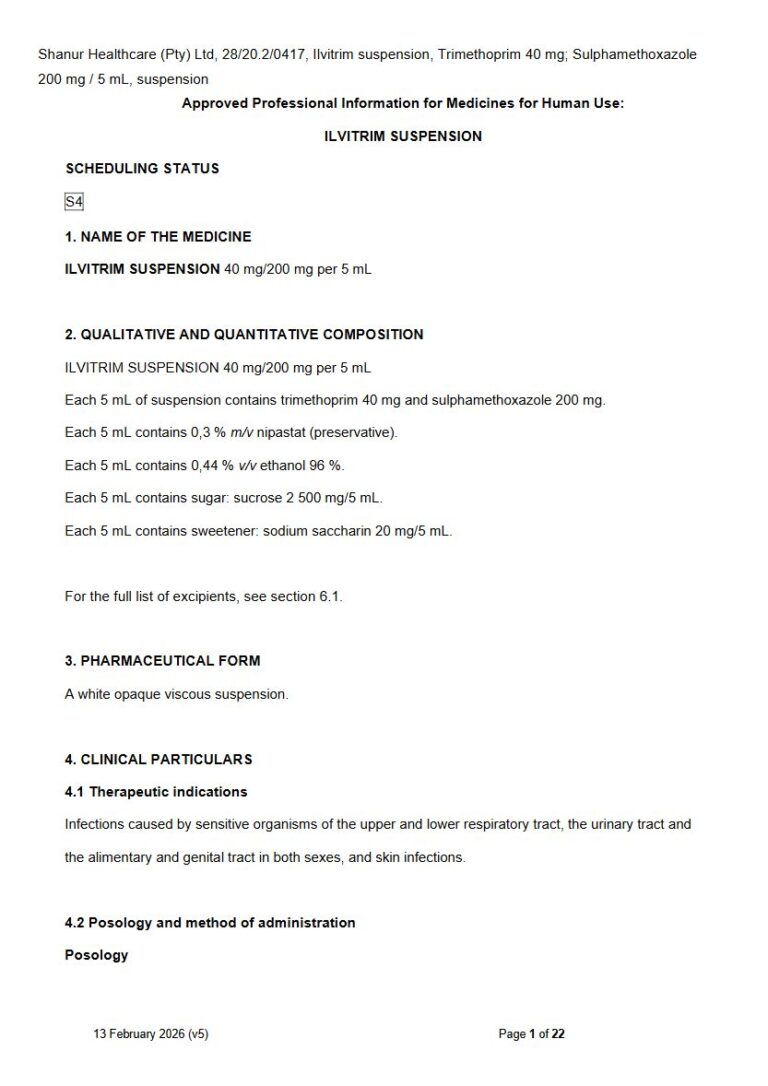
Ilvitrim Suspension 40 mg/200 mg per 5 mL
PDF Leaflet Revision Date: 13 February 2026
Clinical Summary
Quick overview from the medicine insert
Indication
Infections caused by sensitive organisms in various body systems.
Dosage (summary)
Infants: 2.5 mL every 12 hours; Children: 5-10 mL every 12 hours; Adults: standard dosage.
Special Populations
- Renal impairment
- Elderly patients
Pregnancy & Breastfeeding
Contraindicated in pregnancy and breastfeeding; crosses placenta and excreted in breast milk.
Key Drug Interactions
- Warfarin
- Phenytoin
- Digoxin
- Zidovudine
- Ciclosporin
Contraindications
- Hypersensitivity to components
- Porphyria
- Severe renal insufficiency
- Pregnancy
- Breastfeeding
Common side effects
- Nausea
- Diarrhoea
- Rash
- Headache
- Dizziness
Counselling Points
- Take after food
- Monitor for skin reactions
- Maintain adequate fluid intake
- Avoid sunlight exposure
Serious warnings
- Severe skin reactions (SJS, TEN)
- Life-threatening hypersensitivity
- Respiratory toxicity
Important Disclaimer
The Ilvitrim Suspension 40 mg/200 mg per 5 mL professional information leaflet below is the property of Shanur Healthcare and is provided on Medinsert exactly as issued, with no.. alterations or editorial changes. We make every effort to keep content current by updating documents as soon as new versions become available. Medinsert serves as a trusted access point for healthcare professionals, but does not replace official sources or clinical judgement. For more details, please read our full disclaimer. read more>>
 Healthcare Professionals Only
This content is for registered healthcare professionals
Sign in or create a free account to read the full package insert.
Free for HPCSA-registered professionals. Powered by Medinsert.
Clinical Particulars
Section 4 of the official insert — extracted exactly as issued, no alterations
4.1 Therapeutic indications
Infections caused by sensitive organisms of the upper and lower respiratory tract, the urinary tract and the alimentary and genital tract in both sexes, and skin infections.
4.2 Posology and method of administration
Posology
Infants: 6 weeks to 5 months: Half a medicine measure (2,5 mL) every 12 hours.
Children: 6 months to 5 years: One medicine measure (5 mL) every 12 hours.
6 years to 12 years: Two medicine measure (10 mL) every 12 hours.
In the treatment of acute infections ILVITRIM SUSPENSION should be administered for at least 5 days or for at least 2 days after the symptoms have disappeared. If clinical improvement is not evident after 7 days therapy, the patient should be reassessed.
Special populations
Renal impairment
If ILVITRIM SUSPENSION is indicated for patients with renal impairment, the following dosage scheme, based on creatinine clearance is suggested:
Above 25 mL/min: Standard dosage
15 - 25 mL/min: Standard dosage for a maximum of 3 days followed by half the standard daily dosage.
Below 15 mL/min: Not to be administered unless haemodialysis facilities are available when half the standard daily dosage may be given.
Measurements of plasma concentrations of sulfamethoxazole at intervals of 2 days are recommended in samples obtained 12 hours after administration of ILVITRIM SUSPENSION. If the concentration of total sulfamethoxazole exceeds 150 ug/mL then treatment should be interrupted until the value falls below 120 ug/mL. No Information is available for children with renal failure.
Method of administration
ILVITRIM SUSPENSION is for oral administration. ILVITRIM SUSPENSION must be taken by mouth, after food. Shake bottle well before use.
4.3 Contraindications
- Hypersensitivity to sulphamethoxazole, sulphonamide or trimethoprim or to any of the excipients listed in section 6.1.
- Patients suffering from porphyria.
- Liver parenchymal damage.
- Megaloblastic anaemia due to vitamin B 12 and folic acid deficiency or blood dyscrasia.
- Patients receiving anticonvulsant medicines.
- Severe renal insufficiency.
- ILVITRIM SUSPENSION should not be used during pregnancy, in women prior to delivery or by breastfeeding woman.
- In premature or new-born infants during the first 6 weeks of life.
4.4 Special warnings and precautions for use
Life-threatening adverse reactions
Erythema multiforme, toxic dermal necrolysis or allergic vasculitis may occur. Treatment should be discontinued immediately when a rash appears because of the danger of severe allergic reactions.
Fatalities, although very rare, have occurred due to severe reactions including Stevens-Johnson syndrome, toxic epidermal necrolysis, fulminant hepatic necrosis, agranulocytosis, aplastic anaemia, other blood dyscrasias and hypersensitivity of the respiratory tract.
Life-threatening cutaneous reactions Stevens-Johnson syndrome (SJS), toxic epidermal necrolysis (TEN) and drug reaction with eosinophilia and systemic symptoms (DRESS) have been reported.
Patients should be advised of the signs and symptoms and monitored closely for skin reactions.
The highest risk for occurrence of SJS or TEN is within the first weeks of treatment.
If symptoms or signs of SJS, TEN (e.g. progressive skin rash often with blisters or mucosal lesions) or DRESS (e.g. fever, eosinophilia) are present, treatment should be discontinued (see section 4.8).
The best results in managing SJS, TEN and DRESS come from early diagnosis and immediate discontinuation of any suspect medicine. Early withdrawal is associated with a better prognosis.
If the patient has developed SJS, TEN and DRESS with the use of this medicine, treatment with this medicine must not be re-started in this patient at any time.
At the start of treatment, the occurrence of a generalised febrile erythema associated with pustules, should raise the suspicion of acute generalised exanthematous pustulosis (AGEP) (see section 4.8); it requires cessation of treatment and contraindicates any new administration of ILVITRIM SUSPENSION alone or in combination with other medicines.
Direct exposure to sunlight should be avoided as it facilitates development of sensitisation dermatitis.
Haemophagocytic lymphohistiocytosis (HLH)
Cases of HLH have been reported very rarely in patients treated with this medicine. HLH is a life-threatening syndrome of pathologic immune activation characterised by clinical signs and symptoms of an excessive systemic inflammation (e.g. fever, hepatosplenomegaly, hypertriglyceridaemia, hypofibrinogenaemia, high serum ferritin, cytopenias and haemophagocytosis). Patients who develop early manifestations of pathologic immune activation should be evaluated immediately. If diagnosis of HLH is established, treatment should be discontinued.
Respiratory toxicity
Very rare, severe cases of respiratory toxicity, sometimes progressing to Acute Respiratory Distress Syndrome (ARDS) have been reported during treatment. The onset of pulmonary signs such as cough, fever, and dyspnoea in association with radiological signs of pulmonary infiltrates, and deterioration in pulmonary function may be preliminary signs of ARDS. In such circumstances, ILVITRIM should be discontinued, and appropriate treatment given.
Elderly patients
Particular care is always advisable when treating older patients because, as a group, they are more susceptible to adverse reactions and more likely to suffer serious effects as a result particularly when complicating conditions exist, e.g. impaired kidney and/or liver function and/or concomitant use of other medicines.
Renal impairment
ILVITRIM SUSPENSION should be used cautiously and in reduced dosage in patients with impaired renal function (see section 4.2). Because of the risk of crystalluria, an adequate fluid intake should be maintained, and the administration of alkalis may be necessary if very large doses are used.
Urinary output
An adequate urinary output should be maintained at all times. Evidence of crystalluria in vivo is rare, although sulphonamide crystals have been noted in cooled urine from treated patients. In patients suffering from malnutrition the risk may be increased.
Folate
Regular monthly blood counts are advisable when ILVITRIM SUSPENSION is given for long periods, or to folate deficient patients or to older patients, since there exists a possibility of asymptomatic changes in haematological laboratory indices due to lack of available folate. Supplementation with folinic acid may be considered during treatment but this should be initiated with caution due to possible interference with antimicrobial efficacy (see section 4.5).
4.5 Interactions with other medicines
Interaction with laboratory tests: Trimethoprim may interfere with the estimation of serum/plasma creatinine when the alkaline picrate reaction is used. This may result in overestimation of serum/plasma creatinine of the order of 10 %. The creatinine clearance is reduced: the renal tubular secretion of creatinine is decreased from 23 % to 9 % whilst the glomerular filtration remains unchanged.
Zidovudine: in some situations, concomitant treatment with zidovudine may increase the risk of haematological adverse reactions to ILVITRIM SUSPENSION. If concomitant treatment is necessary, consideration should be given to monitoring of haematological parameters.
Ciclosporin: reversible deterioration in renal function has been observed in patients treated with ILVITRIM SUSPENSION and cyclosporin following renal transplantation.
Rifampicin: concurrent use of rifampicin and ILVITRIM SUSPENSION results in a shortening of the plasma half-life of trimethoprim after a period of about one week. This is not thought to be of clinical significance.
When trimethoprim is administered simultaneously with medicines that form cations at physiological pH and are also partly excreted by active renal secretion (e.g. procainamide, amantadine), there is the possibility of competitive inhibition of this process which may lead to an increase in plasma concentration of one or both of the medicines.
Diuretics (thiazides): in older patients concurrently receiving diuretics, mainly thiazides, there appears to be an increased risk of thrombocytopenia with or without purpura.
Pyrimethamine: occasional reports suggest that patients receiving pyrimethamine at doses in excess of 25 mg weekly may develop megaloblastic anaemia should ILVITRIM SUSPENSION be prescribed concurrently.
Warfarin: ILVITRIM SUSPENSION has been shown to potentiate the anticoagulant activity of warfarin via stereo-selective inhibition of its metabolism. Sulfamethoxazole may displace warfarin from plasma-albumin protein-binding sites in vitro. Careful control of the anticoagulant therapy during treatment with ILVITRIM SUSPENSION is advisable.
Phenytoin: ILVITRIM SUSPENSION prolongs the half-life of phenytoin and if co-administered could result in excessive phenytoin effect. Close monitoring of the patient's condition and serum phenytoin levels are advisable.
Digoxin: concomitant use of trimethoprim with digoxin has been shown to increase plasma digoxin levels in a proportion of older patients.
Methotrexate: ILVITRIM SUSPENSION may increase the free plasma levels of methotrexate. If ILVITRIM SUSPENSION is considered appropriate therapy in patients receiving other anti-folate medicines such as methotrexate, a folate supplement should be considered (see section 4.4).
Trimethoprim interferes with assays for serum methotrexate when dihydrofolate reductase from Lactobacillus casei is used in the assay. No interference occurs if methotrexate is measured by radioimmuno assay.
Lamivudine: administration of trimethoprim/sulfamethoxazole 160 mg/800 mg (ILVITRIM SUSPENSION) causes a 40 % increase in lamivudine exposure because of the trimethoprim component. Lamivudine has no effect on the pharmacokinetics of trimethoprim or sulfamethoxazole.
Interaction with sulphonylurea hypoglycaemic agents is uncommon but potentiation has been reported.
Repaglinide: trimethoprim may increase the exposure of repaglinide which may result in hypoglycaemia.
Hyperkalaemia: caution should be exercised in patients taking any other medicines that can cause hyperkalaemia, for example ACE inhibitors, angiotensin receptor blockers and potassium-sparing diuretics such as spironolactone. Concomitant use of trimethoprim-sulfamethoxazole (ILVITRIM SUSPENSION) may result in clinically relevant hyperkalaemia.
Folinic acid: folinic acid supplementation has been shown to interfere with the antimicrobial efficacy of trimethoprim-sulfamethoxazole. This has been observed in Pneumocystis jirovecii pneumonia prophylaxis and treatment.
Contraceptives: oral contraceptive failures have been reported with antibiotics. The mechanism of this effect has not been elucidated. Women on treatment with antibiotics should temporarily use a barrier method in addition to the oral contraceptive or choose another method of contraception.
Azathioprine: There are conflicting clinical reports of interactions between azathioprine and trimethoprim-sulfamethoxazole, resulting in serious haematological abnormalities.
4.6 Fertility, pregnancy and lactation
Pregnancy
Trimethoprim and sulfamethoxazole as in ILVITRIM SUSPENSION cross the placenta and their safety in pregnant women has not been established. ILVITRIM SUSPENSION should not be used during pregnancy (see section 4.3).
Breastfeeding
The components of ILVITRIM SUSPENSION (trimethoprim and sulfamethoxazole) are excreted in breast milk. Administration of ILVITRIM SUSPENSION should be avoided in late pregnancy and in breastfeeding mothers where the mother or infant has, or is at particular risk of developing, hyperbilirubinemia. ILVITRIM SUSPENSION should not be given to the new-born infant during the first weeks of life (see section 4.3)
Fertility
There is no fertility data available.
4.7 Effects on ability to drive and use machines
It is not always possible to predict to what extent ILVITRIM SUSPENSION may interfere with the daily activities of a patient. ILVITRIM SUSPENSION can cause hallucinations, headache, dizziness and vertigo (see section 4.8). Patients should ensure that they do not engage in the above activities until they are aware of the measure to which ILVITRIM SUSPENSION affects them.
4.8 Undesirable effects
a) Tabulated list of adverse reactions
System Organ Class Frequency Frequent Less Frequent Not known Infections and infestations Overgrowth fungal Pseudomembranous colitis Blood and lymphatic system disorders Leukopenia, neutropenia, thrombocytopenia, agranulocytosis, anaemia megaloblastic, aplasticanaemia, haemolytic anaemia, methaemoglobinaemia (with cyanosis) or sulphaemoglobinaemia, eosinophilia, purpura, haemolysis in certain susceptible G - 6 - PD deficient patients Immune system disorders Serum sickness, anaphylactic reaction, allergic myocarditis, hypersensitivity vasculitis resembling Henoch - Schoenlein purpura, periarteritis nodosa, systemic lupus erythematosus. Severe hypersensitivity reactions associated with PJP*, rash, pyrexia, neutropenia, thrombocytopenia, hepatic enzyme increased, hyperkalaemia, hyponatraemia, rhabdomyolysis Endocrine disorders hypothyroidism Metabolism and nutrition disorders Hyperkalaemia Hypoglycaemia, hyponatraemia, decreased appetite, metabolic acidosis Psychiatric disorders Depression, hallucinations Psycho tic disorder Nervous system disorders Headache Meningitis aseptic*, seizure, neuropathy peripheral, ataxia, dizziness, drug fever, fatigue, insomnia, nightmares, confusion Eye disorders Optic neuropathy, transient myopia, uveitis Ear and labyrinth disorders Vertigo, tinnitus Vascular disorders Polyarteritis nodosa Respiratory, thoracic and mediastinal disorders Cough*, dyspnoea*, lung infiltration*, goitre Gastrointestinal disorders Nausea, diarrhoea, anorexia Vomiting, glossitis, stomatitis, pancreatitis Hepatobiliary disorders Jaundice cholestatic *, hepatic necrosis*, transaminases increased, blood bilirubin increased Skin and subcutaneous tissue disorders Rash Photosensitivity, dermatitis exfoliative, angioedema, fixed drug eruption, erythema multiforme, Stevens - Johnson syndrome (SJS) and toxic epidermal necrolysis (TEN)*, acute generalised exanthematous pustulosis (AGEP). Acute febrile neutrophilic dermatosis (Sweet's syndrome), Drug reaction with eosinophilia and systemic symptoms (DRESS)* Musculoskeletal and connective tissue disorders Arthralgia, myalgia Renal and urinary disorders Renal impairment (sometimes reported as renal failure), tubulointerstitial nephritis and uveitis syndrome, renal tubular acidosis.
* See description of selected adverse reactions
b) Description of selected adverse reactions
Aseptic meningitis Aseptic meningitis was rapidly reversible on withdrawal of the medicine but recurred in a number of cases on re-exposure to either co-trimoxazole or to trimethoprim alone. Pulmonary hypersensitivity reactions Cough, dyspnoea and lung infiltration may be early indicators of respiratory hypersensitivity which, while very rare, has been fatal. Hepatobiliary disorders Jaundice cholestatic and hepatic necrosis may be fatal. Severe cutaneous adverse reactions (SCARs) Stevens-Johnson syndrome (SJS), toxic epidermal necrolysis (TEN) and drug reaction with eosinophilia and systemic symptoms (DRESS) have been reported to be life-threatening (see section 4.4). As with any other medicine, allergic reactions such as an itchy rash and hives may occur in patients with hypersensitivity to the components of the medicine. Very rare cases of acute generalised exanthematous pustulosis (AGEP) have been observed (see section 4.4).
Effects associated with Pneumocystis jirovecii Pneumonitis (PJP) management Severe hypersensitivity reactions, rash, pyrexia, neutropenia, thrombocytopenia, hepatic enzyme increased, hyperkalaemia, hyponatraemia and rhabdomyolysis. At the high dosages used for PJP management severe hypersensitivity reactions have been reported, necessitating cessation of therapy. Severe hypersensitivity reactions have been reported in PJP patients on re-exposure to co-trimoxazole, sometimes after a dosage interval of a few days. Rhabdomyolysis has been reported in HIV positive patients receiving co-trimoxazole for prophylaxis or treatment of PJP.
Reporting of suspected adverse reactions
Reporting suspected adverse reactions after authorisation of the medicine is important. It allows continued monitoring of the benefit/risk balance of the medicine. Healthcare providers are asked to report any suspected adverse drug reactions to SAHPRA via the Med Safety APP (Medsafety X SAHPRA) and eReporting platform (who-umc.org) found on SAHPRA website. Suspected adverse reactions can also be reported directly to the HCR via [email protected].
4.9 Overdose
Signs and symptoms
Nausea, vomiting, dizziness, confusion, cyanosis, haematuria, oliguria or anuria and allergic skin reactions (skin rashes, anaphylaxis, etc.). Bone marrow depression has been reported in acute trimethoprim overdosage.
Treatment
Treatment is supportive and symptomatic. If vomiting has not occurred, induction of vomiting may be desirable. Dependant on the status of renal function administration of fluids is recommended if urine output is low. Both trimethoprim and active sulfamethoxazole are moderately dialysable by haemodialysis. Peritoneal dialysis is not effective.
