
Gonapeptyl Daily 100 microgram/1 ml Solution for injection
PDF Leaflet Revision Date: 31 August 2023
Clinical Summary
Quick overview from the medicine insert
Indication
Down-regulation and prevention of premature LH surges in women undergoing ART.
Dosage (summary)
100 micrograms once daily as a subcutaneous injection.
Special Populations
- Renal impairment
- Hepatic impairment
Pregnancy & Breastfeeding
Contraindicated in pregnancy and lactation; pregnancy must be excluded before treatment.
Contraindications
- Hypersensitivity to triptorelin
- Pregnancy
- Lactation
Common side effects
- Headache
- Abortion
- Dysmenorrhoea
- Ovarian hyperstimulation syndrome
- Injection site inflammation
Counselling Points
- Monitor for allergic reactions
- Self-injection technique training required
- Use non-hormonal contraception during therapy
Serious warnings
- Risk of multiple pregnancies
- Risk of ovarian hyperstimulation syndrome
- Mood changes including depression
Important Disclaimer
The Gonapeptyl Daily 100 microgram/1 ml Solution for injection professional information leaflet below is the property of Ferring and is provided on Medinsert exactly as issued, with no.. alterations or editorial changes. We make every effort to keep content current by updating documents as soon as new versions become available. Medinsert serves as a trusted access point for healthcare professionals, but does not replace official sources or clinical judgement. For more details, please read our full disclaimer. read more>>
 Healthcare Professionals Only
This content is for registered healthcare professionals
Sign in or create a free account to read the full package insert.
Free for HPCSA-registered professionals. Powered by Medinsert.
Clinical Particulars
Section 4 of the official insert — extracted exactly as issued, no alterations
4.1 Therapeutic indications
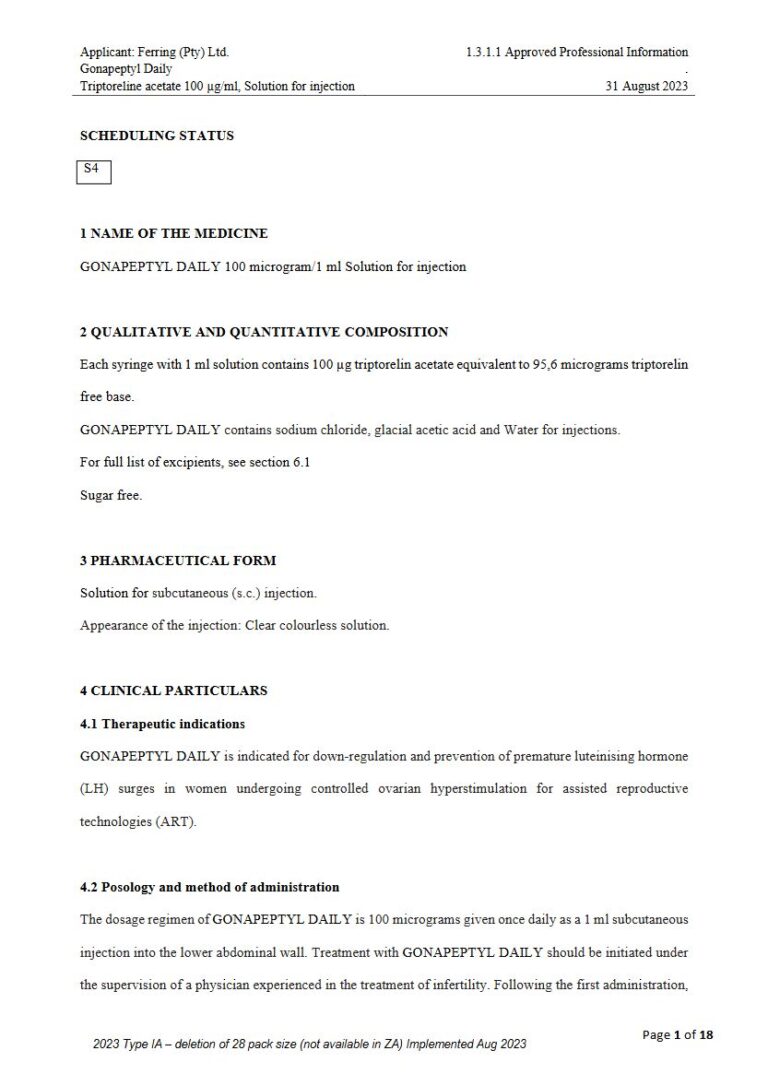
GONAPEPTYL DAILY is indicated for down-regulation and prevention of premature luteinising hormone (LH) surges in women undergoing controlled ovarian hyperstimulation for assisted reproductive technologies (ART).
4.2 Posology and method of administration
The dosage regimen of GONAPEPTYL DAILY is 100 micrograms given once daily as a 1 ml subcutaneous injection into the lower abdominal wall. Treatment with GONAPEPTYL DAILY should be initiated under the supervision of a physician experienced in the treatment of infertility. Following the first administration, it is advised that the patient be kept under medical supervision for 30 minutes to ensure there is no allergic/ pseudo-allergic reaction to the injection. Subsequent injections of GONAPEPTYL DAILY may be self-administered by the patient. In this instance the patient should first be instructed on appropriate self-injection technique and be made aware of the signs and symptoms that may indicate hypersensitivity, the consequences of such a reaction and the need for immediate medical intervention should such a reaction occur. For detailed information on how to inject GONAPEPTYL DAILY, the patient should refer to the u201cPatient Information Leafletu201d provided with the product. Treatment can be started in the early follicular phase (day 2 or 3 of the menstrual cycle) or in the mid-luteal phase (day 21-23 of the menstrual cycle or 5-7 days before expected start of menses). Controlled ovarian hyperstimulation with gonadotropins should be started after approximately 2-4 weeks of GONAPEPTYL DAILY treatment. Ovarian response should be monitored clinically (including ovarian ultrasound alone or preferably in combination with measurement of oestradiol levels) and the dose of gonadotropins adjusted accordingly. When a suitable number of follicles have reached an appropriate size, treatment with GONAPEPTYL DAILY and gonadotropin is stopped and a single injection of human chorionic gonadotrophin (hCG) is administered to induce the final follicular maturation. If down-regulation is not confirmed after 4 weeks (determined by ultrasound documentation of a shedded endometrium alone or preferably in combination with measurement of oestradiol levels), discontinuation of GONAPEPTYL DAILY should be considered. The total duration of treatment is usually 4-7 weeks. When using GONAPEPTYL DAILY, luteal phase support should be provided according to the reproductive medical centreu2019s practice.
Special populations No specific dose recommendations are given for subjects with renal or hepatic impairment. A clinical study indicated that the risk of accumulation of triptorelin in patients with severe liver and renal impairment is small (see Pharmacokinetics).
Method of administration Subcutaneous Injection. Injecting the medicine 1. Remove the protective foil and take the syringe out of the blister packaging 2. Keep the syringe upright with the grey protective cap facing up 3. Remove the grey protective cap 4. Gently push the plunger until the first drops of liquid appear at the needle tip 5. The medicine is to be injected under the skin of the lower abdomen. Clean the injection site with an antiseptic swab immediately prior to injection 6. Lift up a fold of skin between thumb and forefinger. With your free hand hold the syringe at a right angle to the skin like a dart and quickly insert the needle all the way into the skinfold. Press down slowly on the plunger to inject the contents of the syringe 7. Remove the syringe and needle from the skin and discard this immediately into a sharps disposal unit 8. For each dose, choose a different injection site along the lower abdomen.
4.3 Contraindications
GONAPEPTYL DAILY is contraindicated in cases of:
- Hypersensitivity to triptorelin or to any of the excipients in GONAPEPTYL DAILY
- Hypersensitivity to gonadotropin-releasing hormone (GnRH) or any other GnRH analogue
- Pregnancy and lactation
- Women of childbearing potential should be examined carefully before treatment to exclude pregnancy.
4.4 Special warnings and precautions for use
GONAPEPTYL DAILY is associated with an increased risk of multiple pregnancies, pregnancy loss, ectopic pregnancies and congenital malformations. These risks are also valid with usage of GONAPEPTYL DAILY as adjunct therapy in controlled ovarian hyperstimulation. Follicular recruitment, induced by the use of GONAPEPTYL DAILY and gonadotropins, may be markedly increased in a minority of predisposed patients, particularly in case of Polycystic Ovarian Syndrome (PCOS). Ovarian stimulation should be conducted under strict medical supervision.
Ovarian Hyperstimulation Syndrome The use of GONAPEPTYL DAILY in controlled ovarian hyperstimulation may increase the risk of ovarian hyperstimulation syndrome (OHSS) and ovarian cysts. There have been reports of OHSS associated with the use of GONAPEPTYL DAILY in combination with gonadotropins. OHSS is a medical event distinct from uncomplicated ovarian enlargement. OHSS is a syndrome that can manifest itself with increasing degrees of severity. It comprises marked ovarian enlargement, high serum sex steroids, and an increase in vascular permeability which can result in an accumulation of fluid in the peritoneal, pleural and, rarely, in the pericardial cavities. The following symptoms may be observed in severe cases of OHSS: abdominal pain, abdominal distension, severe ovarian enlargement, weight gain, dyspnoea, oliguria and gastrointestinal symptoms including nausea, vomiting and diarrhoea. Clinical evaluation may reveal hypovolaemia, haemoconcentration, electrolyte imbalances, ascites, haemoperitoneum, pleural effusions, hydrothorax, acute pulmonary distress, and thromboembolic events. Excessive ovarian response to GONAPEPTYL DAILY treatment seldom gives rise to OHSS unless hCG is administered to trigger ovulation. Therefore in cases of OHSS it is prudent to withhold hCG and advise the patient to refrain from coitus or to use barrier methods for at least 4 days. OHSS may progress rapidly (within 24 hours to several days) to become a serious medical event, therefore patients should be followed for at least two weeks after the hCG administration.
OHSS may be more severe and more protracted if pregnancy occurs. This syndrome occurs with higher incidence in patients with polycystic ovarian disease. Most often, OHSS occurs after hormonal treatment has been discontinued and reaches its maximum severity at about seven to ten days following treatment. Usually, OHSS resolves spontaneously with the onset of menses. If severe OHSS occurs, gonadotropin treatment should be stopped if still ongoing, the patient hospitalised and specific therapy for OHSS started e.g. with rest, intravenous infusion of electrolyte solutions or colloids and heparin. The risk of OHSS might be higher with use of GONAPEPTYL DAILY in combination with gonadotropins than with use of gonadotropins alone. In two clinical studies (MFK/ IVF/0399E and FE999906 CS003), GnRH agonists, including GONAPEPTYL DAILY, were used in combination with gonadotropins, OHSS was reported in 6,5 % and 3,1 % of patients respectively.
Ovarian cysts Ovarian cysts may occur during the initial phase of treatment with GONAPEPTYL DAILY. They are usually asymptomatic and non-functional.
Bone loss Long term use of GONAPEPTYL DAILY may cause reduction in bone mineral density. Patients with known risk of osteopenia should discuss this with the treating physician.
Medicine/conditions affecting pituitary secretion Treatment with GONAPEPTYL DAILY may reveal the presence of a previously unknown gonadotroph cell pituitary adenoma. These patients may present with a pituitary apoplexy characterised by sudden headache, vomiting, visual impairment and ophthalmoplegia. When GONAPEPTYL DAILY is co-administered with medicine affecting pituitary secretion of gonadotropins caution should be exercised and it is recommended that the patientu2019s hormonal status should be supervised.
Mood changes Mood changes, including depression have been reported during long term use of GONAPEPTYL DAILY. Patients with known depression should be monitored closely during therapy.
Hepatic/renal impairment In patients with renal or hepatic impairment, triptorelin has a mean terminal half-life of 7-8 hours compared to 3-5 hours in healthy subjects (see Pharmacokinetics). Despite this prolonged exposure, triptorelin contained in GONAPEPTYL DAILY is not expected to be present in circulation at the time of embryo transfer.
Use in atopic patients Special care should be taken in women with signs and symptoms of active allergic conditions or known history of allergic predisposition. Treatment with GONAPEPTYL DAILY is not advised in women with severe allergic conditions.
4.5 Interaction with other medicines and other forms of interaction
Interactions of GONAPEPTYL DAILY with other medicines have not been investigated for this indication.
4.6 Fertility, pregnancy and lactation
Pregnancy GONAPEPTYL DAILY is contraindicated during pregnancy (see CONTRAINDICATIONS). Pregnancy must be excluded before initiation of fertilisation treatment. Non-hormonal methods of contraception should be employed during therapy until menses resume. If a patient becomes pregnant while receiving GONAPEPTYL DAILY, therapy should be discontinued. Limited clinical data on the use of GONAPEPTYL DAILY during pregnancy does not indicate an increased risk of congenital malformations. Treatment of pregnant rats with triptorelin acetate at 10 micrograms/kg/day by subcutaneous administration during early pregnancy resulted in retardation of foetal development and treatment in mid-pregnancy resulted in inhibition of parturition with frequent stillbirths.
Administration of the medicine during the period of organogenesis revealed no evidence of teratogenicity in rats or rabbits at subcutaneous doses up to 10 and 50 micrograms/kg/day, respectively (0,9 and 9 times the clinical dose on a body surface area basis). Based on the pharmacological effects, disadvantageous influence on the pregnancy and the offspring cannot be excluded.
Lactation GONAPEPTYL DAILY is contraindicated for use during lactation (see CONTRAINDICATIONS).
4.7 Effects on ability to drive and use machines
No studies on the effects of the ability to drive and use machines have been performed. However, due to its pharmacological profile GONAPEPTYL DAILY is likely to have no or negligible influence on the patientu2019s ability to drive and use machines.
4.8 Undesirable effects
Summary of the safety profile The information presented in Table 1 is based on adverse events (AEs) and adverse drug reactions (ADRs), and their frequencies, reported in 7 clinical trials of GONAPEPTYL DAILY in down-regulation and prevention of premature LH surges (N=1329) combined with the post marketing experience (presented in the not known category). The following criteria were used in the selection of AEs/ADRs that are presented throughout this section. 1. Clinical trials: Treatment-Emergent AEs reported by at least 1% of the ART subjects receiving GONAPEPTYL DAILY 100 micrograms daily. 2. Post-marketing safety surveillance: > 3 ADR reports of the ART subjects receiving GONAPEPTYL DAILY 100 micrograms daily. The most frequent adverse events reported in clinical trials and from post-marketing use are headache (5 %), abortion (4 %), dysmenorrhoea (2%), ovarian hyperstimulation syndrome (2 %), injection site inflammation (1 %) and nausea.
No anaphylactic reactions have been seen in clinical trials, and only very few cases of hypersensitivity reactions have been reported from post-marketing use.
Table 1: Listing of AEs/ADRs reported in clinical trials and from post-marketing use, according to frequency, in patients who received GONAPEPTYL DAILY 100 micrograms daily.
MedDRA System organ class Common ( u2265 1/100 to <1/10) Uncommon ( u2265 1/1 000 to u2264 1/100) Not known Infections and infestations Upper respiratory tract infection, Pharyngitis Immune system disorders Allergic reaction, Hypersensitivity Nervous system disorders Dizziness Vascular disorders Hot flushes Gastrointestinal disorders Abdominal pain, Nausea, Vomiting Musculoskeletal and connective tissue disorders Back pain Pregnancy, puerperium and perinatal conditions Abortion Reproductive system and breast disorders Ovarian hyperstimulation syndrome, Pelvic pain, Ovarian cyst Dysmenorrhoea General disorders and administration site conditions Injection site inflammation Injection site pain, Injection site reaction, Fatigue Medicine ineffective Because clinical trials are conducted under very specific conditions the adverse reaction rates observed in the clinical trials may not reflect the rates observed in practice and should not be compared to the rates in the clinical trials of another medicine. Adverse drug reaction information from clinical trials is useful for identifying medicine-related adverse events and for approximating rates.
Studies MFK/IVF/0399E and FE999906 CS003 listed in Table 2 were not prospectively designed to test triptorelin and AEs reported during stimulation may not reflect events associated with triptorelin.
Table 2. Treatment-Emergent AEs reported by at least 1 % of the IVF/ICSI patients receiving GONAPEPTYL DAILY 100 micrograms daily in studies MFK/IVF/0399E and FE999906 CS003.
MedDRA Preferred term MFK/IVF/0399E n (%) FE999906 CS003 n (%) Onset During Down-regulation with triptorelin N=113 Onset During Stimulation N=113 Onset During Down-regulation with triptorelin N=781 Onset During Stimulation N=731 Headache 30 (27 %) 31 (27 %) 29 (4 %) 36 (5 %) Dizziness 5 (4 %) 6 (5 %) Dysmenorrhoea 7 (6 %) 2 (2 %) 20 (3 %)
Vaginal Haemorrhage 2 (2 %) 176 (24 %) Pelvic Pain 43 (6 %) Leucorrhoea 2 (2%) Application site disorders All events Inj. site inflammation Inj. site pain Inj. site bruising Inj. site reaction 16 (14 %) 13 (12 %) 5 (4 %) -- 2 (2 %) 20 (18 %) 11 (10 %) 8 (7 %) 3 (3 %) 3 (3 %) Abdominal pain 10 (9 %) 17 (15 %) Abdominal distension 18 (2 %) Nausea 6 (5 %) 11 (10 %) 20 (3 %) Vomiting 3 (3 %) Diarrhoea 2 (2 %) Ovarian cyst 10 (1 %) 8 (1 %) Abortion spontaneous 48 (7 %) Abortion missed 15 (2 %) OHSS 23 (3 %) Adnexa Uteri Pain 12 (2 %) Upper respiratory tract infection 4 (4 %) Dyspnoea 2 (2 %) Influence-like symptoms Pharyngitis 3 (3 %) Rhinitis 2 (2 %) Fatigue 3 (3 %) 4 (4 %) Hot flushes 2 (2 %) Malaise 2 (2 %) Back pain 3 (3 %) 3 (3 %) Flushing 4 (4 %) Post procedural pain 26 (4 %) Post-operative pain 3 (3 %)
Post-marketing experience This post-marketing safety summary provides information on the daily dosing of triptorelin, formulation for ART indication, covering the period 1 January 1989 to 31 December 2020. A total of 91 adverse drug reaction cases have been reported to Ferring in this period. Out of 91 cases, 45 were reported as serious (14 unlisted and 29 listed) and 46 cases non-serious. Among the serious unlisted cases reported, there were two cases of OHSS reported in which other serious unlisted events were also reported (cerebral artery thrombosis, and ovarian haemorrhage). Also two serious unlisted cases each comprising ectopic pregnancy and paraesthesia were reported. In the remaining 10 serious unlisted cases, the following preferred terms were reported: pulmonary oedema, medicine ineffective, pelvic inflammatory disease, exposure during pregnancy, genital pain, bundle branch block, hyperemesis gravidarum, cerebellar syndrome, thrombocytopenia, and blood pressure increased. In three cases the subjects were exposed to daily dosing of triptorelin during the pregnancy. In two of these cases, the outcome of the pregnancy was a normal healthy baby was delivered. One case was confounded by the co-suspected medicine clomipramine, used for obsessive compulsive disorder during pregnancy. The baby was discovered to have Downu2019s syndrome and an abortion was chosen.
In general, injection site reactions (inflammation and pain) were reported as non-serious, mild and reversible.
Reporting of suspected adverse reactions Reporting suspected adverse reactions after authorisation of GONAPEPTYL DAILY is important. It allows continued monitoring of the benefit/risk balance of GONAPEPTYL DAILY. Healthcare providers are asked to report any suspected adverse reactions to SAHPRA via the u201c6.04 Adverse Drug Reactions Reporting Formu201d, found online under SAHPRAu2019s publications: https://www.sahpra.org.za/Publications/Index/8
4.9 Overdose
Overdose in humans may result in a prolonged duration of action. In case of overdose, GONAPEPTYL DAILY treatment should be (temporarily) discontinued. Patients should be advised to immediately contact their doctor if they are concerned that they have given themselves too much GONAPEPTYL DAILY. No adverse reaction has been reported as a consequence of overdose.
