
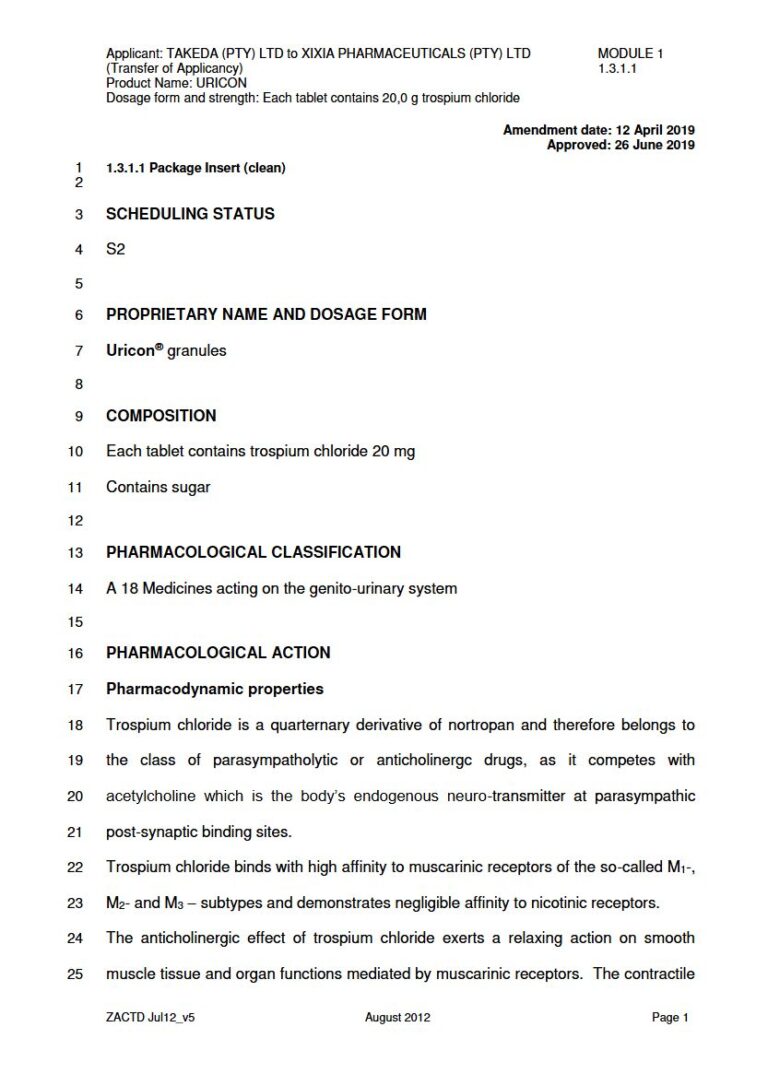
Uricon 20mg Granules
PDF Leaflet Revision Date: 12 April 2019
Clinical Summary
Quick overview from the medicine insert
Indication
Treatment of detrusor instability/overactivity in adults.
Dosage (summary)
One tablet (20 mg) twice daily; 20 mg once daily in moderate renal impairment.
Onset of Action / Duration
Onset: 4-6 hours, Duration: 10-20 hours
Special Populations
- Moderate renal impairment
- Severe renal impairment
- Hepatic impairment
Pregnancy & Breastfeeding
Safety in pregnancy and lactation not established.
Key Drug Interactions
- Anticholinergic drugs
- u03b2-sympathomimetics
- Prokinetic agents
Contraindications
- Urinary retention
- Narrow-angle glaucoma
- Tachyarrhythmia
- Myasthenia gravis
- Severe ulcerative colitis
Common side effects
- Dry mouth
- Constipation
- Tachycardia
- Nausea
Counselling Points
- Swallow whole with water before meals
- Monitor for anticholinergic effects
- Avoid driving if vision is affected
Serious warnings
- Caution in autonomic neuropathy
- Not recommended under 18 years
Important Disclaimer
The Uricon 20mg Granules professional information leaflet below is the property of Takeda and is provided on Medinsert exactly as issued, with no.. alterations or editorial changes. We make every effort to keep content current by updating documents as soon as new versions become available. Medinsert serves as a trusted access point for healthcare professionals, but does not replace official sources or clinical judgement. For more details, please read our full disclaimer. read more>>
 Healthcare Professionals Only
This content is for registered healthcare professionals
Sign in or create a free account to read the full package insert.
Free for HPCSA-registered professionals. Powered by Medinsert.
Clinical Particulars
Section 4 of the official insert — extracted exactly as issued, no alterations
4.1 Therapeutic indications
Uricon u00ae is indicated for the treatment of adults with detrusor instability / over activity and associated symptoms of urinary frequency, urgency or urge incontinence.
4.2 Posology and method of administration
The tablets should be swallowed whole with a glass of water before meals. One tablet twice daily (equivalent to 40 mg of trospium chloride per day).
In patients with moderate renal impairment the recommended dosage is: One tablet per day (equivalent to 20 mg of trospium chloride per day)
4.3 Contraindications
Urinary retention, including urinary retention due to prostatic disease (e.g. benign prostatic hyperplasia) and bladder neck and / or urethral stenosis, narrow-angle glaucoma, tachyarrhythmia, myasthenia gravis, severe ulcerative colitis, toxic megacolon, dialysed renal insufficiency, (creatinine clearance < 10 ml/min/1,73 m2). Mechanical stenosis or obstructive lesions of the gastro-intestinal tract. Severe impairment of hepatic function.
4.4 Special warnings and precautions for use
Trospium chloride should be used with caution by patients who suffer from:
- Autonomic neuropathy
- Hiatus hernia associated with reflux oesophagitis
Not recommended for use in patients under 18 years of age as insufficient data is available.
4.5 Interactions with other medicines
Possible potentiation of effects of drugs with anticholinergic action such as amantadine, tricyclic antidepressants, quinidine, antihistamines and disopyramide. Enhancement of tachycardiac action of u03b2-sympathomimetics. Decrease in efficacy of pro-kinetic agents, e.g. metoclopramide and cisapride.
4.6 Fertility, pregnancy and lactation
Safety of use in pregnancy and lactation has not been established.
4.7 Effects on ability to drive and use machines
Disorders of accommodation can lower the ability to operate machinery and drive motor vehicles.
4.8 Undesirable effects
Very common (10 %); common (1 % - < 10 %); uncommon (0,1 % - < 1 %); rare (0,01 % - < 0,1 %); very rare (< 0,01 %) including isolated cases.
Anticholinergic effects may occur during the treatment with trospium chloride.
Cardiovascular disorders
- Uncommon: Tachycardia
- Rare: Tachyarrhythmia
Gastro-intestinal disorders
- Common: Dryness of the mouth, dyspepsia, abdominal pain, nausea, constipation
- Uncommon: Diarrhoea, flatulence, vomiting
Hepatobiliary disorders
- Rare: Mild to moderate increase in serum transaminase levels
Nervous system disorders:
- Uncommon: Vision disorders, such as disorders of accommodation
Renal and urinary system disorders
- Uncommon: Micturition disorders, e.g. residual urine
- Rare: Urinary retention
Reproductive disorders
- Common: Decrease bronchial mucous production
- Uncommon: Dyspnoea
Skin and subcutaneous tissue disorders
- Common: Decreased sweating
- Uncommon: Rash
- Rare: Angio-oedema
Whole body disorders
- Uncommon: Asthenia, chest pain, tiredness, headache, somnolence or sleep disorder
4.9 Overdose
After administration of a maximum single dose of 360 mg trospium chloride to healthy volunteers, dryness of the mouth, tachycardia and disorders of micturition were observed to an increased extent. No manifestations of severe overdosage or toxicity in humans have been reported to date. Increased anticholinergic symptoms are to be expected as signs of toxicity. In the case of toxicity, the following measures should be taken:
- gastric lavage and reduction of absorption, e.g activated charcoal
- local administration of pilocarpine to glaucoma patients
- catheterisation in patients with urinary retention
- treatment with a parasympathomimetic agent, e.g. neostigmine, in the case of severe symptoms
- administration of beta-blockers in the case of insufficient response, pronounced tachycardia and/or circulatory instability, e.g. initially 1 mg propranolol intravenous along with monitoring of ECG and blood pressure.
