
Onvara 0,5 ml Powder
PDF Leaflet Revision Date: 06 August 2024
Clinical Summary
Quick overview from the medicine insert
Indication
Vaccination against varicella in individuals from 12 months of age.
Dosage (summary)
0.5 ml subcutaneously for all ages; second dose at least 3 months later for children, 4-8 weeks later for adolescents/adults.
Special Populations
- Immunocompromised
- Pregnant women
- Children with HIV
Pregnancy & Breastfeeding
Not recommended during pregnancy; caution advised during breastfeeding.
Key Drug Interactions
- Avoid salicylates for 6 weeks post-vaccination
- Defer vaccination for 5 months after blood/plasma transfusions
Contraindications
- Hypersensitivity to vaccine components
- Immunosuppressive therapy
- Active untreated tuberculosis
- Febrile illness >38.5u00b0C
Common side effects
- Injection site pain
- Fever
- Varicella-like rash
Counselling Points
- Administer immediately after reconstitution
- Avoid close contact with high-risk individuals for 6 weeks post-vaccination
- Discard if not used within 30 minutes after reconstitution
Serious warnings
- Risk of anaphylactoid reactions
- Transmission of vaccine virus possible
Important Disclaimer
The Onvara 0,5 ml Powder professional information leaflet below is the property of Msd and is provided on Medinsert exactly as issued, with no.. alterations or editorial changes. We make every effort to keep content current by updating documents as soon as new versions become available. Medinsert serves as a trusted access point for healthcare professionals, but does not replace official sources or clinical judgement. For more details, please read our full disclaimer. read more>>
 Healthcare Professionals Only
This content is for registered healthcare professionals
Sign in or create a free account to read the full package insert.
Free for HPCSA-registered professionals. Powered by Medinsert.
Clinical Particulars
Section 4 of the official insert — extracted exactly as issued, no alterations
4.1 Therapeutic indications
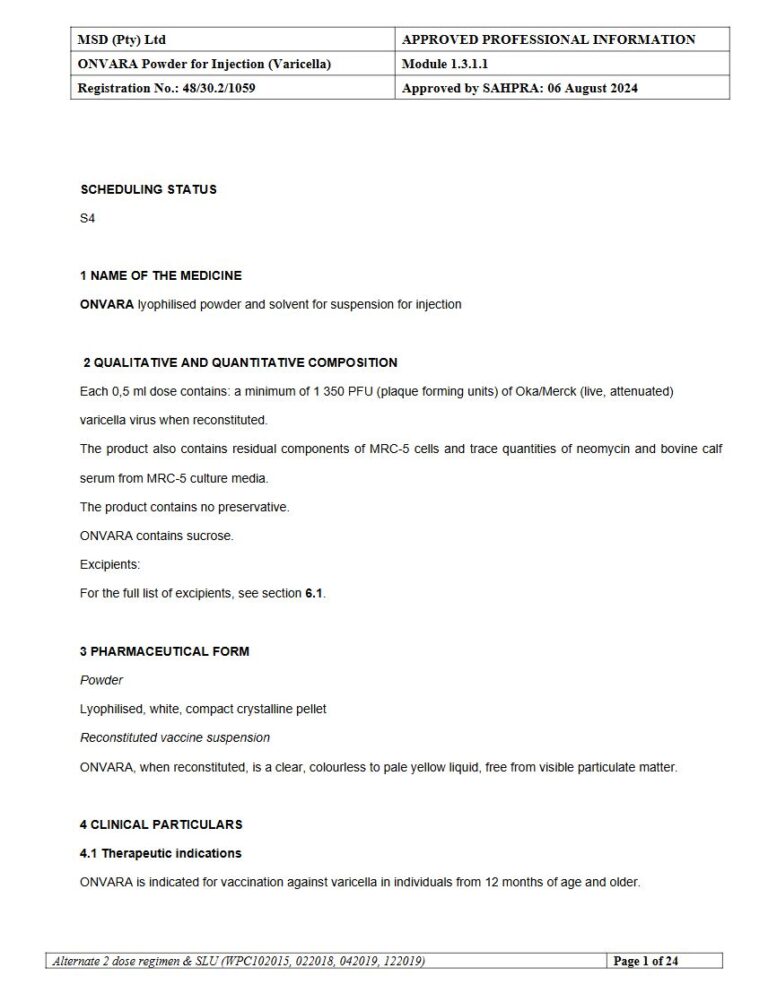
ONVARA is indicated for vaccination against varicella in individuals from 12 months of age and older.
4.2 Posology and method of administration
FOR SUBCUTANEOUS ADMINISTRATION. Do not inject intravenously. Children (12 months to 12 years of age) should receive a 0,5 ml dose administered subcutaneously. Adolescents (13 years of age and older) and adults should receive a 0,5 ml dose administered subcutaneously. If a second dose is administered, children (12 months to 12 years of age) should receive the second dose at least 3 months following the initial dose. For those 13 years of age and older, the second dose should be administered 4 to 8 weeks after the initial dose. The outer aspect of the upper arm (deltoid area) is the preferred site of injection.
Method of administration
The diluent should be stored separately at room temperature (20 to 25 u00b0C), or in the refrigerator. To reconstitute the vaccine, first withdraw 0,7 ml of diluent into the syringe to be used for reconstitution. Inject all of the diluent in the syringe into the vial of lyophilized vaccine and gently agitate to mix thoroughly. Do not remove the syringe that has been used to inject the diluent into the vial of ONVARA as the reconstituted ONVARA will be withdrawn with the same syringe for administration to the patient. Withdraw the entire contents into a syringe and inject the total volume (about 0.5 mL) of reconstituted vaccine subcutaneously, preferably into the outer aspect of the upper arm (deltoid region) or the anterolateral thigh. IT IS RECOMMENDED THAT THE VACCINE BE ADMINISTERED IMMEDIATELY AFTER RECONSTITUTION, TO MINIMIZE LOSS OF POTENCY. DISCARD IF RECONSTITUTED VACCINE IS NOT USED WITHIN 30 MINUTES. Do not freeze reconstituted vaccine.
4.3 Contraindications
History of hypersensitivity to any component of the vaccine, including gelatine. History of anaphylactoid reaction to neomycin (each dose of reconstituted vaccine contains trace quantities of neomycin). Blood dyscrasias, leukaemia, lymphomas of any type, or other malignant neoplasms affecting the bone marrow or lymphatic systems. Immunosuppressive therapy (including high-dose corticosteroids); however, ONVARA is not contraindicated for use with topical corticosteroids or low-dose corticosteroids, as are commonly used for asthma prophylaxis. Individuals who are on immunosuppressant drugs are more susceptible to infections than healthy individuals. Vaccination with live attenuated varicella vaccine can result in a more extensive vaccine-associated rash or disseminated disease in individuals on immunosuppressant doses of corticosteroids. Primary and acquired immunodeficiency states, including immunosuppression in association with AIDS or other clinical manifestations of infection with human immunodeficiency virus, except immunosuppression in asymptomatic children with CD4 T-lymphocyte percentages u2265 25 %. Family history of congenital or hereditary immunodeficiency, unless the immune competence of the potential vaccine recipient is demonstrated. Active untreated tuberculosis. Any active febrile illness with fever >38.5u00b0C (>101.3u00b0F); however, low-grade fever itself is not a contraindication to vaccination. Pregnancy (refer to section 4.6)
4.4 Special warnings and precautions for use
Adequate treatment provisions, including epinephrine (adrenaline) injection (1:1000), should be available for immediate use should an anaphylactoid reaction occur. The duration of protection from varicella infection after vaccination with ONVARA is unknown. The safety and efficacy of ONVARA have not been established in children and young adults who are known to be infected with human immunodeficiency virus with and without evidence of immunosuppression (see also section 4.3).
Transmission
Post-marketing experience suggests that transmission of varicella vaccine virus (Oka/Merck) resulting in varicella infection including disseminated disease may occur rarely between vaccine recipients (who develop or do not develop a varicella-like rash) and contacts susceptible to varicella including healthy as well as high-risk individuals. Therefore, vaccine recipients should attempt to avoid, whenever possible, close association with susceptible high-risk individuals for up to six weeks. In circumstances where contact with high-risk individuals is unavoidable, the potential risk of transmission of vaccine virus should be weighed against the risk of acquiring and transmitting wild-type varicella virus. Susceptible high-risk individuals include:
- immunocompromised individuals
- pregnant women without documented history of varicella or laboratory evidence of prior infection
- newborn infants of mothers without documented history of varicella or laboratory evidence of prior infection.
4.5 Interaction with other medicinal products and other forms of interaction
Vaccination should be deferred for at least 5 months following blood or plasma transfusions, or administration of immune globulin or varicella zoster immune globulin (VZIG). Following administration of ONVARA, any immune globulin including VZIG should not be given for 2 months thereafter unless its use outweighs the benefits of vaccination. Vaccine recipients should avoid use of salicylates for 6 weeks after vaccination with ONVARA (Refrigerated) as Reye syndrome has been reported following the use of salicylates during wild-type varicella infection.
Concomitant administration with other vaccines
ONVARA has been administered to toddlers at the same time as, but at a different injection site from, a combined measles, mumps, and rubella vaccine, Haemophilus influenzae type b conjugate combined vaccine, or Haemophilus influenzae type b Conjugate (Meningococcal Protein Conjugate), Hepatitis B (Recombinant) combined vaccine, diphtheria/tetanus/whole-cell pertussis vaccine, and oral polio virus vaccine. There was no evidence of a clinically relevant difference in the immune responses to any of the antigens when co-administered with ONVARA. If varicella vaccine (live) (Oka/Merck strain) is not given concomitantly with measles, mumps, and rubella virus vaccine live, a 1-month interval between the 2 live virus vaccines should be observed. Concurrent administration of ONVARA and tetravalent, pentavalent or hexavalent (diphtheria, tetanus, and acellular pertussis [DTaP])-based vaccines has not been evaluated.
4.6 Fertility, pregnancy and lactation
Pregnancy
There are no adequate and well-controlled studies in pregnant women. It is not known whether ONVARA (Refrigerated) can cause foetal harm when administered to a pregnant woman or can affect reproduction capacity. Therefore, ONVARA (Refrigerated) should not be administered to pregnant females; furthermore, pregnancy should be avoided for three months following vaccination (refer to section 4.3).
Breastfeeding
It is not known whether varicella vaccine virus is secreted in human milk. Therefore, because some viruses are secreted in human milk, caution should be exercised if ONVARA (Refrigerated) is administered to a nursing woman.
4.7 Effects on ability to drive and use machines
No studies on the effects on the ability to drive and use machines have been performed.
4.8 Undesirable effects
Summary of the safety profile
Clinical Studies
In clinical trials, varicella vaccine (Oka/Merck), was administered to over 15 000 healthy children, adolescents, and adults. Varicella vaccine (Oka/Merck), was generally well tolerated.
In a double-blind placebo-controlled study among 956 healthy children and adolescents, 914 of whom were serologically confirmed to be susceptible to varicella, the only adverse reactions that occurred at a significantly (p<0.05) greater rate in vaccine recipients than in placebo recipients were pain and redness at the injection site and varicella-like rash.
Children 1 to 12 Years of Age
One-Dose Regimen in Children
In clinical trials involving healthy children monitored for up to 42 days after a single dose of varicella vaccine (Oka/Merck), the frequency of fever, injection-site complaints, or rashes was reported as follows:
Table 1 Fever, Local Reactions, or Rashes (%) in Children 0 to 42 Days Postvaccination
Reaction N Post Dose 1 Peak Occurrence in Postvaccination Days
Fever u2265 102 u00b0F (38.9 u00b0 C) Oral 8 824 14.7 % 0-42
Injection-site complaints (pain/soreness, swelling and/or erythema, rash, pruritus, hematoma, induration, stiffness) 8 913 19.3 % 0-2
Varicella-like rash (injection site) 8 913 3.4 % 8-19
Median number of lesions 2
Varicella-like rash (generalized) 8 913 3.8 % 5-26
Median number of lesions 5
In addition, the most frequently (u2265 1 %) reported adverse experiences, without regard to causality, are listed in decreasing order of frequency: upper respiratory illness, cough, irritability/nervousness, fatigue, disturbed sleep, diarrhea, loss of appetite, vomiting, otitis, diaper rash/contact rash, headache, teething, malaise, abdominal pain, other rash, nausea, eye complaints, chills, lymphadenopathy, myalgia, lower respiratory illness, allergic reactions (including allergic rash, hives), stiff neck, heat rash/prickly heat, insect bites, arthralgia, eczema/dry skin/dermatitis, constipation, itching. Pneumonitis has been reported rarely (< 1 %) in children vaccinated with varicella vaccine (Oka/Merck); a causal relationship has not been established. Febrile seizures have occurred rarely (< 0.1 %) in children vaccinated with varicella vaccine (Oka/Merck); a causal relationship has not been established.
Clinical safety of refrigerator-stable varicella vaccine (Oka/Merck) (n=635) was compared with that of the licensed frozen formulation of varicella vaccine (Oka/Merck) (n=323) for 42 days postvaccination in children 12 to 23 months of age. The safety profiles were comparable for the two different formulations. Pain/tenderness/soreness and erythema were the most commonly reported local reactions. The most common systemic adverse events (reported by u2265 10 % of subjects, irrespective of causality) were reported in decreasing order of frequency as follows: fever u2265 102.0 u00b0F (38.9 u00b0C) oral; upper respiratory infection; otitis media; cough; rhinorrhoea and irritability. Six subjects reported serious adverse events.
Two-Dose Regimen in Children
In a clinical trial, 981 children received 2 doses of varicella vaccine (Oka/Merck) 3 months apart and were actively followed for 42 days after each dose. The 2-dose regimen of varicella vaccine had a safety profile comparable to that of the 1-dose regimen. The overall incidence of injection-site clinical complaints (primarily erythema and swelling) observed in the first 4 days following vaccination was 25.4 % Postdose 2 and 21.7 % Postdose 1, whereas the overall incidence of systemic clinical complaints in the 42-day follow-up period was lower Postdose 2 (66.3 %) than Postdose 1 (85.8 %).
Adolescents and Adults 13 Years of Age and Older
In clinical trials involving healthy adolescents and adults, the majority of whom received two doses of varicella vaccine (Oka/Merck) and were monitored for up to 42 days after any dose, the frequency of fever, injection-site complaints, or rashes was reported as follows:
Table 2 Fever, Local Reactions, or Rashes (%) in Adolescents and Adults 0 to 42 Days Postvaccination
Reaction N Post Dose 1 Peak Occurrence in Postvaccination Days N Post Dose 2 Peak Occurrence in Postvaccination Days
Fever u2265 100u00b0F (37.8 u00b0 C) Oral 1 584 10.2 % 14-27 956 9.5 % 0-42
Injection-site complaints (soreness, erythema, swelling, rash, pruritus, pyrexia, hematoma, induration, numbness) 1 606 24.4 % 0-2 955 32.5 % 0-2
Varicella-like rash (injection site) 1 606 3.1 % 6-20 955 1.0 % 0-6
Median number of lesions 2 2
Varicella-like rash (generalized) 1 606 5.5 % 7-21 955 0.9 % 0-23
Median number of lesions 5 5.5
In addition, the most frequently (u2265 1 %) reported adverse experiences, without regard to causality, are listed in decreasing order of frequency: upper respiratory illness, headache, fatigue, cough, myalgia, disturbed sleep, nausea, malaise, irritability/nervousness, diarrhoea, stiff neck, lymphadenopathy, chills, eye complaints, abdominal pain, loss of appetite, arthralgia, otitis, itching, vomiting, other rashes, constipation, lower respiratory illness, allergic reactions (including allergic rash, hives), contact rash, cold/canker sore, dizziness, and insect bites.
Post-Marketed Clinical Studies
In a post-marketing study conducted to evaluate short-term safety (follow-up of 30 or 60 days) in approximately 86 000 children, 12 months to 12 years of age, and in approximately 3 600 adolescents and adults, 13 years of age and older, varicella vaccine (Oka/Merck) was generally well tolerated. No serious vaccine-related adverse events were reported. As with any vaccine, there is the possibility that broad use of the vaccine could reveal adverse reactions not observed in clinical trials.
Post-marketing Experience
The following additional side effects have been reported regardless of causality since the vaccine has been marketed: Body As A Whole: Anaphylaxis (including anaphylactic shock) and related phenomena such as angioneurotic oedema, facial oedema, and peripheral oedema; anaphylaxis in individuals with or without an allergic history. Eye Disorders: Necrotizing retinitis (reported only in immunocompromised individuals). Gastrointestinal Disorders: Nausea; vomiting. Hemic and Lymphatic System: Aplastic anaemia; thrombocytopenia (including idiopathic thrombocytopenic purpura (ITP)). Infections and Infestations: Varicella (vaccine strain). Nervous/Psychiatric: Encephalitis u2020 ; cerebrovascular accident; transverse myelitis; Guillain-Barru00e9 syndrome; Bellu2019s palsy; ataxia; febrile and non-febrile seizures; aseptic meningitis; meningitis u2020 ; dizziness; paresthesia; irritability. Respiratory: Pharyngitis; pneumonia/pneumonitis, upper respiratory tract infection. Skin: Stevens-Johnson syndrome; erythema multiforme; Henoch-Schu00f6nlein purpura; secondary bacterial infections of skin and soft tissue, including impetigo and cellulitis; herpes zoster. u2020Cases caused by wild-type varicella or vaccine strain varicella have been reported in immunocompromised or immunocompetent individuals.
4.9 Overdose
There are no data with regard to overdose.
