
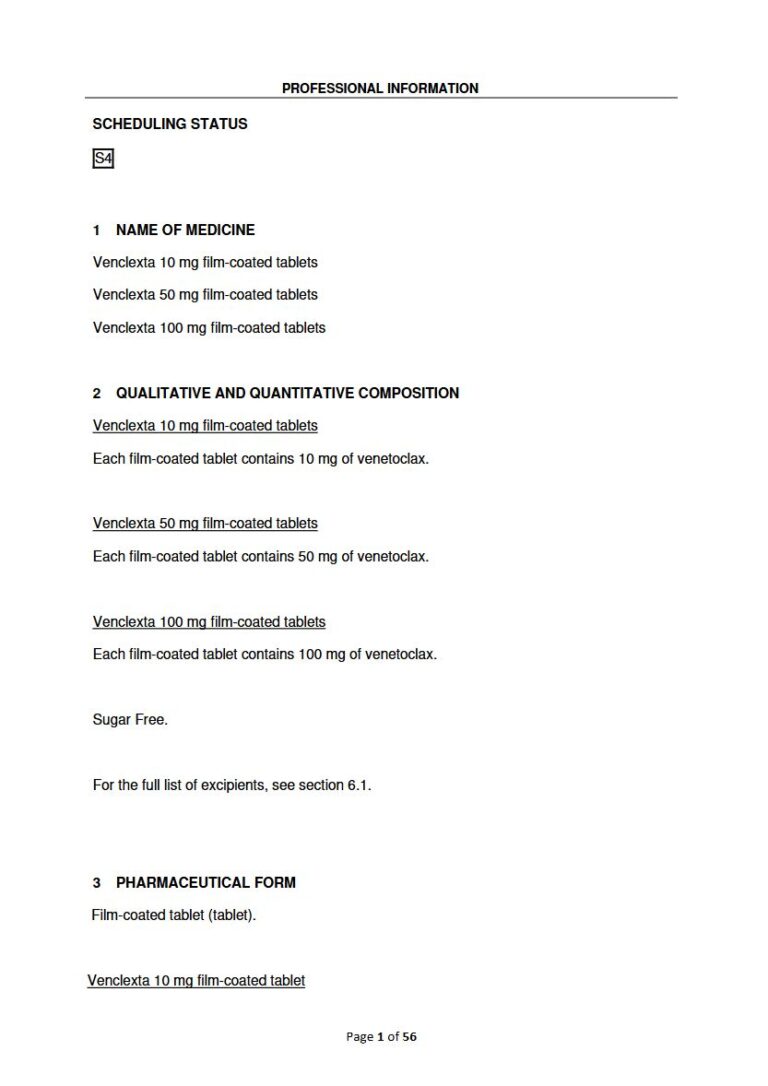
Venclexta 10 Mg/50 Mg/100 Mg Film-Coated Tablets
PDF Leaflet Revision Date: 6 May 2022
Clinical Summary
Quick overview from the medicine insert
Indication
Treatment of CLL and AML in adults.
Dosage (summary)
Starting dose 20 mg daily, titrated to 400 mg over 5 weeks.
Onset of Action / Duration
Onset: 6-8 hours, Duration: Not specified.
Special Populations
- Elderly
- Renal impairment
- Hepatic impairment
Pregnancy & Breastfeeding
Contraindicated in pregnancy; avoid breastfeeding.
Key Drug Interactions
- Strong CYP3A inhibitors
- Moderate CYP3A inducers
Contraindications
- Hypersensitivity
- Concomitant use of strong CYP3A inhibitors
Common side effects
- Neutropenia
- Diarrhoea
- Fatigue
- Nausea
Counselling Points
- Take with food
- Hydration to prevent TLS
- Monitor for infections
Serious warnings
- Tumour lysis syndrome
- Serious infections
Important Disclaimer
The Venclexta 10 Mg/50 Mg/100 Mg Film-Coated Tablets professional information leaflet below is the property of AbbVie and is provided on Medinsert exactly as issued, with no.. alterations or editorial changes. We make every effort to keep content current by updating documents as soon as new versions become available. Medinsert serves as a trusted access point for healthcare professionals, but does not replace official sources or clinical judgement. For more details, please read our full disclaimer. read more>>
 Healthcare Professionals Only
This content is for registered healthcare professionals
Sign in or create a free account to read the full package insert.
Free for HPCSA-registered professionals. Powered by Medinsert.
Clinical Particulars
Section 4 of the official insert — extracted exactly as issued, no alterations
4.1 Therapeutic indications
Venclexta in combination with obinutuzumab is indicated for the treatment of adult patients with previously untreated chronic lymphocytic leukaemia (CLL) (see section 5.1) Venclexta in combination with rituximab is indicated for the treatment of adult patients with relapsed or refractory chronic lymphocytic leukaemia (R/R CLL) to prior therapy. Venclexta monotherapy is indicated for the treatment of adult patients with R/R CLL to prior therapy. Venclexta in combination with a hypomethylating agent is indicated for the treatment of adult patients with newly diagnosed acute myeloid leukaemia (AML) who are ineligible for intensive chemotherapy.
4.2 Posology and method of administration
Treatment with venetoclax should be initiated and supervised by a medical practitioner experienced in the use of anticancer medicines. Patients treated with venetoclax may develop tumour lysis syndrome (TLS). Information described in this section, including risk assessment, prophylactic measures, dose-titration schedule, laboratory monitoring, and drug interactions should be followed to prevent and reduce the risk of TLS.
Posology
Chronic Lymphocytic Leukaemia
Dose-titration schedule
The starting dose is 20 mg of venetoclax once daily for 7 days. The dose must be gradually increased over a period of 5 weeks up to the daily dose of 400 mg as shown in Table 1.
Table 1: Dose increase schedule
Week Venetoclax daily dose
1 20 mg
2 50 mg
3 100 mg
4 200 mg
5 400 mg
The 5-week dose-titration schedule is designed to gradually reduce tumour burden (debulk) and decrease the risk of tumour lysis syndrome.
Venetoclax in combination with obinutuzumab
Venetoclax is given for a total of 12 cycles, each cycle consisting of 28 days: 6 cycles in combination with obinutuzumab, followed by 6 cycles of venetoclax as a single agent. Administer obinutuzumab 100 mg on Cycle 1 Day 1, followed by 900 mg which may be administered on Day 1 or Day 2. Administer 1000 mg on Days 8 and 15 of Cycle 1 and on Day 1 of each subsequent 28-day cycle, for a total of 6 cycles. Start the 5-week venetoclax dose-titration schedule (see Table 1) on Cycle 1 Day 22 and continue through Cycle 2 Day 28. After completing the dose-titration schedule, the recommended dose of venetoclax is 400 mg once daily from Cycle 3 Day 1 of obinutuzumab to the last day of Cycle 12.
Post-titration dose for venetoclax in combination with rituximab
The recommended dose of venetoclax in combination with rituximab is 400 mg once daily (see section 5.1 for details of the combination regimen). Rituximab should be administered after the patient has completed the dose-titration schedule and has received the recommended daily dose of 400 mg venetoclax for 7 days. Rituximab should be administered on Day 1 of each 28-day cycle for 6 cycles, with rituximab dosed at 375 mg/m2 intravenously for Cycle 1 and 500 mg/m2 intravenously for Cycles 2-6. Venetoclax should be taken for 24 months from Cycle 1 Day 1 of rituximab.
Post-titration dose for venetoclax monotherapy
The recommended dose of venetoclax is 400 mg once daily. Treatment should be continued until disease progression or no longer tolerated by the patient.
Acute Myeloid Leukaemia
The recommended venetoclax dosing schedule (including dose titration) is shown in Table 2.
Table 2. Dosing Schedule for Ramp-Up Phase in Patients with AML
Day Venclexta Daily Dose
1 100 mg
2 200 mg
3 and beyond 400 mg
Azacitidine should be administered at 75 mg/m2 either intravenously or subcutaneously on Days 1-7 of each 28-day cycle beginning on Cycle 1 Day 1. Decitabine should be administered at 20 mg/m2 intravenously on Days 1-5 of each 28-day cycle beginning on Cycle 1 Day 1. Venetoclax dosing may be interrupted as needed for management of haematologic toxicities and blood count recovery (see Table 6). Venetoclax, in combination with a hypomethylating agent, should be continued until disease progression or unacceptable toxicity is observed.
Prevention of tumour lysis syndrome (TLS)
Patients treated with venetoclax may develop TLS. The appropriate section below should be referred to for specific details on management by disease indication.
4.3 Contraindications
Hypersensitivity to the active substance or to any of the excipients listed in section 6.1. Concomitant use of strong CYP3A inhibitors at initiation and during the dose-titration phase (see sections 4.2 and 4.5). Concomitant use with moderate or strong CYP3A4 inducers. Concomitant use of preparations containing St. Johnu2019s wort (see sections 4.4 and 4.5). Pregnancy and Lactation. Immunisation with live attenuated viral and/or bacterial vaccines.
4.4 Special warnings and precautions for use
Tumour lysis syndrome
Tumour lysis syndrome, including fatal events and renal failure requiring dialysis, has occurred in patients treated with venetoclax (see section 4.8). Venetoclax can cause rapid reduction in tumour, and thus poses a risk for TLS in the initial 5-week dose-titration phase. Changes in electrolytes consistent with TLS that require prompt management can occur as early as 6 to 8 hours following the first dose of venetoclax and at each dose increase. During post marketing surveillance, TLS, including fatal events, has been reported after a single 20 mg dose of venetoclax. Information described in section 4.2, including risk assessment, prophylactic measures, dose-titration and modification schedule, laboratory monitoring, and drug interactions should be followed to prevent and reduce the risk of TLS. The risk of TLS is a continuum based on multiple factors, including comorbidities (particularly reduced renal function), tumour burden, and splenomegaly in CLL.
All patients should be assessed for risk and should receive appropriate prophylaxis for TLS, including hydration and anti-hyperuricaemics. Blood chemistries should be monitored, and abnormalities managed promptly. More intensive measures (intravenous hydration, frequent monitoring, hospitalisation) should be employed as overall risk increases. Dosing should be interrupted if needed; when restarting venetoclax, dose modification guidance should be followed (see Table 4 and Table 5). The instructions for u201cPrevention of tumour lysis syndromeu201d should be followed (see section 4.2).
Concomitant use of Venclexta with strong or moderate CYP3A inhibitors increases venetoclax exposure and may increase the risk for TLS at initiation and during the dose-titration phase (see sections 4.2 and 4.3). Also, inhibitors of P-gp or BCRP may increase venetoclax exposure (see section 4.5).
Neutropenia and infections
In patients with CLL, Grade 3 or 4 neutropenia has been reported in patients treated with venetoclax in combination studies with rituximab or obinutuzumab and in monotherapy studies (see section 4.8). In patients with AML, grade 3 or 4 neutropenia are common before starting treatment. The neutrophil counts can worsen with venetoclax in combination with a hypomethylating agent. Neutropenia can recur with subsequent cycles of therapy. Complete blood counts should be monitored throughout the treatment period. Dose interruptions or reductions are recommended for patients with severe neutropenia (see section 4.2).
Serious infections including events of sepsis with fatal outcome have been reported. (see section 4.8). Monitoring of any signs and symptoms of infection is required. Suspected infections are to receive prompt treatment, including antimicrobials, dose interruption or reduction, and use of growth factors (e.g., G-CSF) as appropriate (see section 4.2).
Immunisation
The safety and efficacy of immunisation with live attenuated vaccines during or following venetoclax therapy have not been studied. Live vaccines should not be administered during treatment and thereafter until B-cell recovery.
CYP3A inducers
Co-administration of strong or moderate CYP3A4 inducers may lead to decreased venetoclax exposure with consequently a risk for lack of efficacy and should be avoided (see sections 4.3 and 4.5).
Women of childbearing potential
Women of childbearing potential must use a highly effective method of contraception while taking venetoclax (see section 4.6).
4.5 Interaction with other medicines and other forms of interaction
Venetoclax is predominantly metabolised by CYP3A. Agents that may alter venetoclax plasma concentrations CYP3A inhibitors Co-administration of 400 mg once daily ketoconazole, a strong CYP3A, P-gp and BCRP inhibitor, for 7 days in 11 previously treated patients with NHL increased venetoclax C max by 2.3-fold and AUC u221e by 6.4-fold. Co-administration of 50 mg once daily ritonavir, a strong CYP3A and P-gp inhibitor, for 14 days in 6 healthy subjects increased venetoclax C max by 2.4-fold and AUC by 7.9-fold. Compared with venetoclax 400 mg administered alone, co-administration of 300 mg posaconazole, a strong CYP3A and P-gp inhibitor, with venetoclax 50 mg and 100 mg for 7 days in 12 patients increased venetoclax C max to 1.6-fold and 1.9-fold, and AUC to 1.9-fold and 2.4-fold, respectively. Co-administration of venetoclax with other strong CYP3A4 inhibitors is predicted to increase venetoclax AUC by on average 5.8- to 7.8-fold. For patients requiring concomitant use of venetoclax with strong CYP3A inhibitors (e.g., itraconazole, ketoconazole, posaconazole, voriconazole, clarithromycin, ritonavir) or moderate CYP3A inhibitors (e.g., ciprofloxacin, diltiazem, erythromycin, fluconazole, verapamil), venetoclax dosing should be administered according to Table 7. Patients should be monitored more closely for signs of toxicities and the dose may need to be further adjusted. The venetoclax dose that was used prior to initiating the CYP3A inhibitor should be resumed 2 to 3 days after discontinuation of the inhibitor (see section 4.2).
Grapefruit products, Seville oranges, and starfruit (carambola) should be avoided during treatment with venetoclax as they contain inhibitors of CYP3A.
P-gp and BCRP inhibitors Venetoclax is a substrate for P-gp and BCRP. Co-administration of a 600 mg single dose of rifampin, a P-gp inhibitor, in 11 healthy subjects increased venetoclax C max by 106% and AUC u221e by 78%. Concomitant use of venetoclax with P-gp and BCRP inhibitors at initiation and during the dose-titration phase should be avoided; if a P-gp and BCRP inhibitor must be used, patients should be monitored closely for signs of toxicities (see section 4.4).
CYP3A inducers Co-administration of 600 mg once daily rifampin, a strong CYP3A inducer, for 13 days in 10 healthy subjects decreased venetoclax C max by 42% and AUCu221e by 71%. Concomitant use of venetoclax with strong CYP3A inducers (e.g., carbamazepine, phenytoin, rifampin) or moderate CYP3A inducers (e.g., bosentan, efavirenz, etravirine, modafinil, nafcillin) should be avoided. Alternative treatments with less CYP3A induction should be considered. Preparations containing St. John's wort are contraindicated during treatment with venetoclax, as efficacy may be reduced (see section 4.3).
Azithromycin In a drug-drug interaction study in 12 healthy subjects, co-administration of 500 mg of azithromycin on the first day followed by 250 mg of azithromycin once daily for 4 days decreased venetoclax C max by 25% and AUC u221e by 35%. No dose adjustment is needed during short-term use of azithromycin when administered concomitantly with venetoclax.
Gastric acid reducing agents Based on population pharmacokinetic analysis, gastric acid reducing agents (e.g., proton pump inhibitors, H2-receptor antagonists, antacids) do not affect venetoclax bioavailability.
Bile acid sequestrants Co-administration of bile acid sequestrants with venetoclax is not recommended as this may reduce the absorption of venetoclax. If a bile acid sequestrant is to be co-administered with venetoclax, the SmPC for the bile acid sequestrant should be followed to reduce the risk for an interaction, and venetoclax should be administered at least 4-6 hours after the sequestrant.
Agents that may have their plasma concentrations altered by venetoclax Warfarin In a drug-drug interaction study in three healthy volunteers, administration of a single dose of 400 mg venetoclax with 5 mg warfarin resulted in an 18% to 28% increase in C max and AUC u221e of R-warfarin and S-warfarin. Because venetoclax was not dosed to steady state, it is recommended that the international normalized ratio (INR) be monitored closely in patients receiving warfarin.
Substrates of P-gp, BCRP, and OATP1B1 Venetoclax is a P-gp, BCRP and OATP1B1 inhibitor in vitro. In a drug-drug interaction study, administration of a single 100 mg dose of venetoclax with 0.5 mg digoxin, a P-gp substrate, resulted in a 35% increase in digoxin C max and a 9% increase in digoxin AUCu221e. Co-administration of narrow therapeutic index P-gp, or BCRP substrates (e.g., digoxin, dabigatran, everolimus, sirolimus) with venetoclax should be avoided. If a narrow therapeutic index P-gp or BCRP substrate must be used, it should be used with caution. For an orally administered P-gp or BCRP substrate sensitive to inhibition in the gastrointestinal tract (e.g., dabigatran exetilate), its administration should be separated from venetoclax administration as much as possible to minimise a potential interaction.
If a statin (OATP substrate) is used concomitantly with venetoclax, close monitoring of statin-related toxicity is recommended.
4.6 Fertility, pregnancy and lactation
Women of childbearing potential/Contraception in females
Women should avoid becoming pregnant while taking Venclexta and for at least 30 days after ending treatment. Therefore, women of childbearing potential must use highly effective contraceptive measures while taking venetoclax and for 30 days after stopping treatment. It is currently unknown whether venetoclax may reduce the effectiveness of hormonal contraceptives, and therefore women using hormonal contraceptives should add a barrier method.
Pregnancy
Pregnant women should not be treated with Venclexta. Based on embryo-foetal toxicity studies in animals (see section 5.3), there is a potential risk of serious harm to the foetus when administered to pregnant women. There are no adequate and well-controlled data from the use of venetoclax in pregnant women. Studies in animals have shown reproductive toxicity (see section 5.3). Venetoclax should not be used during pregnancy and in women of childbearing potential not using highly effective contraception.
Breastfeeding
Women on treatment with Venclexta should not breastfeed their infants. It is unknown whether venetoclax or its metabolites are excreted in human milk and harm to breastfed infant cannot be excluded. Breastfeeding should be discontinued during treatment with Venclexta.
Fertility
No human data on the effect of Venclexta on fertility are available. Based on testicular toxicity in dogs at clinically relevant exposures, male fertility may be compromised by treatment with Venclexta (see section 5.3). It is unknown whether fertility would be restored to pre-treatment status after stopping Venclexta. Before starting treatment, counselling on sperm storage should be considered in male patients.
4.7 Effects on ability to drive and use machines
Venclexta may influence the ability to drive and use machines. Patient should not drive and use machines until they know how Venclexta affects them. Fatigue is very common in patients taking venetoclax and should be considered when assessing a patientu2019s ability to drive or operate machines.
4.8 Undesirable effects
Summary of the safety profile
Chronic Lymphocytic Leukaemia
The overall safety profile of Venclexta is based on data from 758 patients with CLL treated in clinical trials with venetoclax in combination with obinutuzumab or rituximab or as monotherapy. The safety analysis included patients from two phase 3 studies (CLL14 and MURANO), two phase 2 studies (M13-982 and M14-032), and one phase 1 study (M12-175). CLL14 was a randomised, controlled trial in which 212 patients with previously untreated CLL and comorbidities received venetoclax in combination with obinutuzumab. MURANO was a randomised, controlled trial in which 194 patients with previously treated CLL received venetoclax in combination with rituximab. In the phase 2 and phase 1 studies, 352 patients with previously treated CLL, which included 212 patients with 17p deletion and 146 patients who had failed a B-cell receptor pathway inhibitor were treated with venetoclax monotherapy (see section 5.1).
The most commonly occurring adverse reactions (u226520%) of any grade in patients receiving venetoclax in the combination studies with obinutuzumab or rituximab were neutropenia, diarrhoea, and upper respiratory tract infection. In the monotherapy studies, the most common adverse reactions were neutropenia/neutrophil count decreased, diarrhoea, nausea, anaemia, fatigue, and upper respiratory tract infection. The most frequently reported serious adverse reactions (u22652%) in patients receiving venetoclax in combination with rituximab or obinutuzumab were pneumonia, sepsis, febrile neutropenia, and TLS. In the monotherapy studies, the most frequently reported serious adverse reactions (u22652%) were pneumonia and febrile neutropenia.
Acute Myeloid Leukaemia
The overall safety profile of Venclexta is based on data from 314 patients with newly diagnosed acute myeloid leukaemia (AML) treated in clinical trials with venetoclax in combination with a hypomethylating agent (azacitidine or decitabine) (VIALE-A phase 3 randomised, and M14-358 phase 1 non-randomised). In the VIALE-A study, the most commonly occurring adverse reactions (u226520%) of any grade in patients receiving venetoclax in combination with azacitidine were thrombocytopenia, neutropenia, febrile neutropenia, nausea, diarrhoea, vomiting, anaemia, fatigue, pneumonia, hypokalaemia, and decreased appetite. The most frequently reported serious adverse reactions (u22655%) in patients receiving venetoclax in combination with azacitidine were febrile neutropenia, pneumonia, sepsis and haemorrhage. In the M14-358 study, the most commonly occurring adverse reactions (u226520%) of any grade in patients receiving venetoclax in combination with decitabine were thrombocytopenia, febrile neutropenia, nausea, haemorrhage, pneumonia, diarrhoea, fatigue, dizziness/syncope, vomiting, neutropenia, hypotension, hypokalaemia, decreased appetite, headache, abdominal pain and anaemia. The most frequently reported serious adverse reactions (u22655%) were febrile neutropenia, pneumonia, bacteraemia and sepsis.
The 30-day mortality rate in the VIALE-A study was 7.4% (21/283) with venetoclax in combination with azacitidine and 6.3% (9/144) in the placebo with azacitidine arm. The 30-day mortality rate in the M14-358 study with venetoclax in combination with decitabine was 6.5% (2/31).
4.9 Overdose
There is no specific antidote for Venclexta. Patients who experience overdose should be closely monitored and appropriate symptomatic and supportive treatment provided. During dose-titration phase, treatment should be interrupted and patients should be monitored carefully for signs and symptoms of TLS (fever, chills, nausea, vomiting, confusion, shortness of breath, seizures, irregular heartbeat, dark or cloudy urine, unusual tiredness, muscle or joint pain, abdominal pain and distension) along with other toxicities (see section 4.2). Based on venetoclax large volume of distribution and extensive protein binding, dialysis is unlikely to result in significant removal of venetoclax.
