
Vinblastine Teva Solution for Injection
PDF Leaflet Revision Date: 09 May 2024
Clinical Summary
Quick overview from the medicine insert
Indication
Treatment of various malignancies including lymphomas and breast carcinoma.
Dosage (summary)
Adults: Initial 3.7 mg/mu00b2 IV, max 18.5 mg/mu00b2 weekly; Children: Initial 2.5 mg/mu00b2 IV, max 12.5 mg/mu00b2 weekly.
Special Populations
- Hepatic impairment
Pregnancy & Breastfeeding
Contraindicated in pregnancy and breastfeeding; teratogenic effects.
Key Drug Interactions
- Erythromycin may increase toxicity
- Live vaccines may cause infections
Contraindications
- Hypersensitivity to vinblastine
- Depressed bone marrow function
- Bacterial infections
- Porphyria
- Intrathecal use
Common side effects
- Leucopoenia
- Nausea
- Vomiting
- Alopecia
- Neurotoxicity
Counselling Points
- Avoid contact sports
- Report signs of infection
- Use effective contraception
- Avoid driving if experiencing dizziness
Serious warnings
- Severe toxicity profile
- Risk of infections
- Avoid extravasation
- Carcinogenic potential
Important Disclaimer
The Vinblastine Teva Solution for Injection professional information leaflet below is the property of Teva Pharmaceuticals and is provided on Medinsert exactly as issued, with no.. alterations or editorial changes. We make every effort to keep content current by updating documents as soon as new versions become available. Medinsert serves as a trusted access point for healthcare professionals, but does not replace official sources or clinical judgement. For more details, please read our full disclaimer. read more>>
 Healthcare Professionals Only
This content is for registered healthcare professionals
Sign in or create a free account to read the full package insert.
Free for HPCSA-registered professionals. Powered by Medinsert.
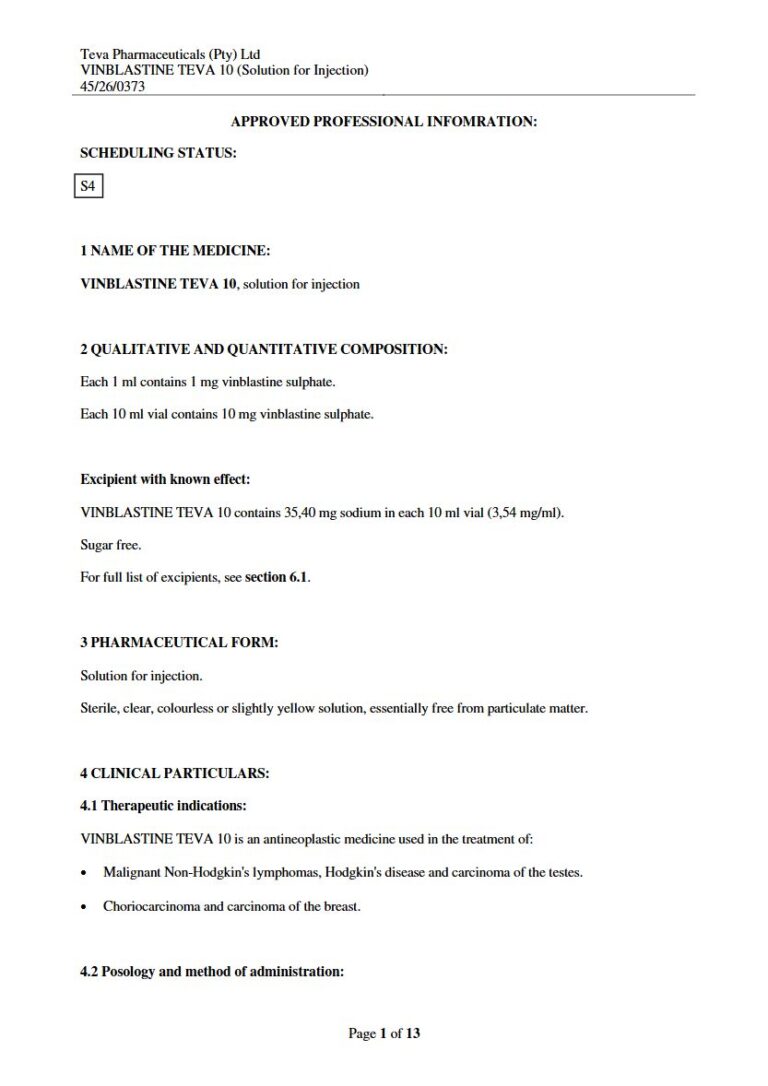
Clinical Particulars
Section 4 of the official insert — extracted exactly as issued, no alterations
4.1 Therapeutic indications
VINBLASTINE TEVA 10 is an antineoplastic medicine used in the treatment of:
- Malignant Non-Hodgkin's lymphomas, Hodgkin's disease and carcinoma of the testes.
- Choriocarcinoma and carcinoma of the breast.
4.2 Posology and method of administration
Posology: The dose of VINBLASTINE TEVA 10 to be given depends on the nature of the tumour, the schedule applied and the concurrent application of radiotherapy. The VINBLASTINE TEVA 10 dose is assessed on the basis of the gravity of leucopoenia following therapy. For this reason, it is recommended that VINBLASTINE TEVA 10 be given not more frequently than once every seven days. It is recommended to initiate therapy by administering a single intravenous dose of 3,7 mg/m2 for adults and 2,5 mg/m2 for children. Thereafter the dose may be increased at weekly intervals with increments of 1,8 mg/m2 for adults and 1,25 mg/m2 for children respectively, until a desired oncolytic effect is achieved or until the total number of leucocytes has decreased to 3 000/mm3. The patient should receive the maximum dose that does not cause leucopoenia. After seven days, the next dose should not be given until the white-cell count has returned to at least 4 000/mm3. The mean weekly dose is 4 to 6 mg/m2 for adults. The maximum weekly dose is 18,5 mg/m2 for adults and 12,5 mg/m2 for children, respectively.
Special populations: Hepatic impairment: In patients with a bilirubin > 51,3 u03bcmol/l, a 50 to 75 % reduction of the VINBLASTINE TEVA 10 dose is advisable.
Method of administration: VINBLASTINE TEVA 10 is for intravenous use only. Intrathecal administration of VINBLASTINE TEVA 10 results in fatal neurotoxicity. VINBLASTINE TEVA 10 should not be injected in an extremity with impaired circulation due to an increased risk of thrombosis. NOTE: VINBLASTINE TEVA 10 is a single dose injection. Any residual solution must be discarded.
4.3 Contraindications
Hypersensitivity to vinblastine sulphate or any of the other vinca alkaloids, or to any of the excipients listed in section 6.1. Patients with a depressed bone marrow function caused by tumours, cytostatics or irradiation. Patients with bacterial infections. Patients with porphyria. Patients in a bad nutritional state. Intrathecal use.
4.4 Special warnings and precautions for use
Due to the severe toxicity profile and possible carcinogenicity of VINBLASTINE TEVA 10, its use should be confined to experienced staff in the use of cancer therapy in specialised centres (see section 6.6). Vaccinations with live or killed vaccines should be postponed for an estimated period of 3 to 12 months after treatment with VINBLASTINE TEVA 10. Bone marrow depression especially leucopoenia tends to be dose-limiting. Maximum depression occurs 5 to 10 days after a dose with recovery in a further 7 to 14 days. Leucopoenia may be more severe in patients with cachexia or extensive skin ulcerations. VINBLASTINE TEVA 10 should not be used in elderly patients with these conditions. Handling of VINBLASTINE TEVA 10 should preferentially occur in a safety hood. Extravasation of VINBLASTINE TEVA 10 should be avoided since severe pain and tissue damage may ensue. It must be handled with great care and contact with skin and eyes avoided; it should not be inhaled. Strict adherence to the recommended dosage schedule is very important. The use of small amounts of VINBLASTINE TEVA 10 daily for long periods is not advised because this may lead to death. Patients may experience an increased risk of infections caused by pathogenic bacteria, fungi, viruses and protozoa and a reduced capacity to cope with them. Special care is necessary in debilitated patients. Prolonged immunosuppression may stimulate the development of neoplasms. It should be given with caution and reduced dosage to patients with hepatic impairment (see section 4.2).
Blood counts and haemoglobin measurements should be performed routinely to help with the prediction of the onset of bone-marrow depression. The following caution should be followed if bone marrow depression occurs:
- Avoiding exposure to persons with infections, especially during periods of low blood counts; patients should contact their doctor immediately if fever or chills, cough or hoarseness, lower back or side pain, or painful or difficult urination occurs.
- Patients should contact their doctor immediately if unusual bleeding or bruising; black, tarry stools; blood in urine or stools; or pinpoint red spots on skin occur.
- Caution should be excised in the use of regular toothbrush, dental floss, or toothpick. Doctor, dentist, or nurse may suggest alternatives means of dental care. Patients should be encouraged to check with their doctor before having dental work done.
- Not touching eyes or inside of nose unless hands washed immediately before.
- Using caution to avoid accidental cuts with use of sharp objects such as safety razor or fingernail or toenail cutters.
- Avoiding contact sports or other situations where bruising or injury could occur.
- Possibility of local tissue injury and scarring if infiltration of intravenous solution occurs; telling medical practitioner or nurse right away about redness, swelling, or pain at site of injection.
VINBLASTINE TEVA 10 contains 35,40 mg sodium in each 10 ml vial (3,54 mg/ml), equivalent to 1,77 % of the WHO maximum recommended maximum daily intake of 2 g sodium for an adult.
4.5 Interaction with other medicines and other forms of interaction
Due to the effects of antineoplastics on the gastrointestinal mucosa, VINBLASTINE TEVA 10 has the potential to interfere with the absorption of medication given orally. VINBLASTINE TEVA 10 may reduce the patients response to vaccines (live and killed vaccines), and there is a possibility of generalised infection with live vaccines. The use of vaccines concomitant with VINBLASTINE TEVA 10 is not recommended (see section 4.4).
Concomitant use of VINBLASTINE TEVA 10 with medication that inhibit cytochromes of the CYP3A subfamily may result in decreased metabolism of VINBLASTINE TEVA 10, increased plasma concentration and increased toxicity, such as with erythromycin. Pharmacodynamic interaction of VINBLASTINE TEVA 10 with other cytostatics may occur with reinforcement of toxic effects. VINBLASTINE TEVA 10 may promote the cellular uptake of methotrexate. Interactions between VINBLASTINE TEVA 10 and alkylating agents and methotrexate during the cell cycle may result in an increase in the total cytotoxic effect. Use with cisplatin may increase the VINBLASTINE TEVA 10 plasma concentration. Interaction with irradiation during radiotherapy is also possible. Severe myelosuppression may occur in patients with high doses of VINBLASTINE TEVA 10 with interferon alfa-n1. Amino acids applied during hyperalimentation can be expected to deactivate VINBLASTINE TEVA 10. Enhanced hepatotoxicity may occur with concurrent use of VINBLASTINE TEVA 10 and paracetamol. Acute dyspnoea, cyanosis and acute respiratory distress have been observed when VINBLASTINE TEVA 10 was administered simultaneously with mitomycin C or bleomycin. Combinations containing allopurinol, colchicine, probenecid or sulfinpyrazone may interact with VINBLASTINE TEVA 10 and raise the concentration of blood uric acid. Antineoplastic medicines such as VINBLASTINE TEVA 10 may decrease the absorption of phenytoin from 80 % to 32 % and resulting in some cases in loss of seizure control.
4.6 Fertility, pregnancy and lactation
Women of childbearing potential / Contraception in males and females: Pregnancy should be avoided in patients receiving VINBLASTINE TEVA 10 treatment. Due to the genotoxic potential of vinblastine (see section 4.4), women of childbearing potential should use effective contraceptive measures while being treated with VINBLASTINE TEVA 10 and for 6 months following completion of treatment. Men are recommended to use effective contraceptive measures and to not father a child while being treated with VINBLASTINE TEVA 10 and for 3 months following completion of treatment.
Pregnancy: VINBLASTINE TEVA 10 should not be administered during pregnancy and lactation. VINBLASTINE TEVA 10 is teratogenic.
Breastfeeding: Mothers receiving VINBLASTINE TEVA 10 should not breastfeed.
4.7 Effects on the ability to drive and use machinery
VINBLASTINE TEVA 10 may cause dizziness, double vision, numbness or tingling in fingers and weakness. Patients should be advised not to drive or operate machinery if these symptoms occur.
4.8 Undesirable effects
Tabulated list of adverse reactions:
System organ class (MedDRA) Frequent Less frequent Frequency unknown
- Blood and lymphatic system disorders Bone marrow depression, especially leucopoenia; haemototoxicity Thrombocytopenia (transient)
- Immune system disorders Anaphylaxis and anaphylactoid-type of reactions
- Psychiatric disorders Psychosis
- Nervous system disorders Neurotoxicity (difficulty walking, dizziness, double vision, drooping eyelids, headache, jaw pain, mental depression, numbness or tingling in fingers and toes, pain in fingers and toes, pain in testicles, weakness), pain in bone or tumour- contained tissue, peripheral neuropathy and neuritis, decreased reflexes (loss of deep tendon reflexes), seizures
- Cardiac disorders Ischaemic cardiac toxicity and sinus tachycardia
- Vascular disorders Orthostatic hypotension and hypertension
- Respiratory, thoracic and mediastinal disorders Pulmonary toxicity dyspnoea and bronchospasm
- Gastrointestinal disorders Nausea and vomiting Stomatitis, haemorrhagic enterocolitis, rectal bleeding and bleeding from existing peptic ulcers, anorexia, diarrhoea, constipation, vesiculation of the mouth, paralytic ileus, pharyngitis, epigastric and abdominal pain
- Hepato-biliary disorders Hepatic fibrosis, jaundice, abnormal liver function tests
- Skin and subcutaneous tissue disorders Alopecia Dermatological toxicity, pigmentation of the skin and nails, dermatitis, vesiculation of the skin, phototoxicity
- Renal and urinary disorders Nephrotoxicity (acute renal failure, urine retention, hyperphosphataemia, and other electrolyte disturbances), hyperuricaemia or uric acid nephropathy
- Reproductive system and breast disorders Decreased fertility, gynaecomastia, amenorrhoea and aspermia
- Congenital, familial and genetic disorders Secondary malignancies
- General disorders and administration site Vocal cord paralysis, phlebitis, fever, malaise, tender parotic glands, a syndrome of inappropriate anti-diuretic hormone secretion, extravasation
Description of selected adverse reactions:
Blood and lymphatic system disorders: In patients with pre-existing bone marrow depression due to previous irradiation or cytostatics, thrombocytopenia may be more pronounced.
Nervous system disorders: Damage to the eighth cranial nerve may result in vestibulary and auditory toxicity leading to nystagmus, vertigo and partial or total deafness.
Gastrointestinal disorders: The abdominal pain and constipation may be related to neurotoxicity of VINBLASTINE TEVA 10. A routine prophylactic regimen against constipation is recommended.
Reproductive system and breast disorders: Decreased fertility, gynaecomastia, amenorrhoea and aspermia may be irreversible.
Congenital, familial and genetic disorders: VINBLASTINE TEVA 10 is mutagenic and secondary malignancies may develop in patients who have previously undergone successful cancer chemotherapy.
General disorders and administration site conditions: A syndrome of inappropriate anti-diuretic hormone secretion may occur and may be relieved by fluid restriction. Extravasation may cause necrosis, cellulitis and sloughing.
Reporting of suspected adverse reactions: Reporting suspected adverse reactions after authorisation of the medicine is important. It allows continued monitoring of the benefit/risk balance of the medicine. Healthcare providers are asked to report any suspected adverse reactions to SAHPRA via the u201c6.04 Adverse Drug Reactions Reporting Formu201d, found online under SAHPRAu2019s publications: https://www.sahpra.org.za/Publications/Index/8
4.9 Overdose
Acute overdosage of VINBLASTINE TEVA 10 results in one or more of the aforementioned side effects. During long-term VINBLASTINE TEVA 10 therapy side effects may be more pronounced. Overdosage has caused permanent central nervous system (CNS) damage. Discontinuation of VINBLASTINE TEVA 10 administration and symptomatic treatment are advised. If necessary, general supportive measures should be taken and blood transfusion should be given. Folinic acid has been suggested for use in overdosage.
