
Vcide 200 Iv 200mg POWDER FOR SOLUTION FOR INFUSION
PDF Leaflet Revision Date: 21 January 2021
Clinical Summary
Quick overview from the medicine insert
Indication
Treatment of invasive aspergillosis and serious fungal infections.
Dosage (summary)
Loading: 6 mg/kg IV every 12 hours for 24 hours; Maintenance: 3-4 mg/kg IV every 12 hours.
Special Populations
- Elderly
- Renal impairment
- Hepatic impairment
Pregnancy & Breastfeeding
Contraindicated in pregnancy; breastfeeding not recommended during treatment.
Key Drug Interactions
- CYP3A4 substrates
- Rifampicin
- Carbamazepine
- Phenobarbital
- Efavirenz
Contraindications
- Hypersensitivity to voriconazole
- Severe hepatic impairment
- Prolonged QT syndrome
Common side effects
- Visual impairment
- Nausea
- Vomiting
- Rash
- Liver function test abnormal
Counselling Points
- Avoid sun exposure
- Monitor for visual disturbances
- Use effective contraception in women of childbearing potential
Serious warnings
- QTc prolongation
- Hepatic toxicity
- Severe cutaneous adverse reactions
Important Disclaimer
The Vcide 200 Iv 200mg POWDER FOR SOLUTION FOR INFUSION professional information leaflet below is the property of Abex Pharmaceutica and is provided on Medinsert exactly as issued, with no.. alterations or editorial changes. We make every effort to keep content current by updating documents as soon as new versions become available. Medinsert serves as a trusted access point for healthcare professionals, but does not replace official sources or clinical judgement. For more details, please read our full disclaimer. read more>>
 Healthcare Professionals Only
This content is for registered healthcare professionals
Sign in or create a free account to read the full package insert.
Free for HPCSA-registered professionals. Powered by Medinsert.
Clinical Particulars
Section 4 of the official insert — extracted exactly as issued, no alterations
4.1 Therapeutic indications
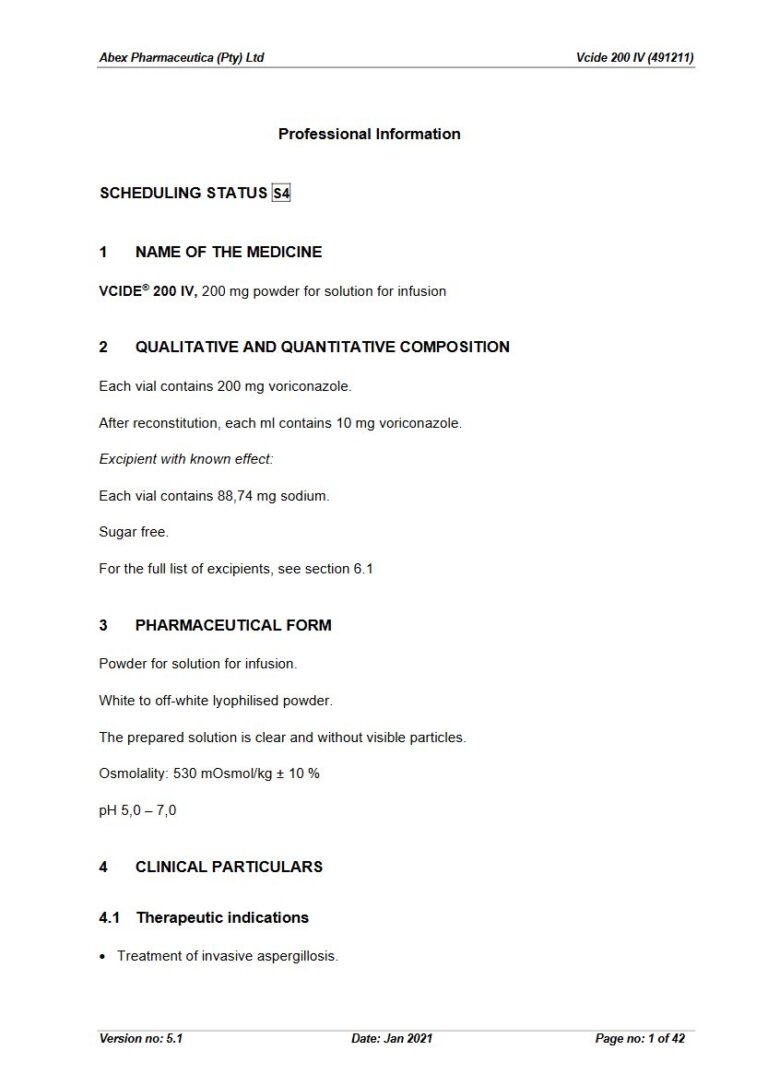
u2022 Treatment of invasive aspergillosis.
u2022 Treatment of serious invasive infections caused by Candida spp (including C. krusei).
u2022 Treatment of serious fungal infections caused by Scedosporium spp and Fusarium spp.
u2022 Prevention of breakthrough of fungal infections in febrile high-risk patients (allogeneic bone marrow transplants, relapsed leukaemia patients) where liposomal amphotericin B cannot be used.
4.2 Posology and method of administration
Posology
Adult dosage
Therapy should be initiated with the specified loading dose regimen of VCIDE to achieve plasma concentrations on day 1 that are close to steady-state. On the basis of the high oral bioavailability (96 %), switching between intravenous and oral administration is appropriate when clinically indicated. Detailed information on dosage recommendations is provided in Table 1 :
| Adult dosage recommendations |
|---|
| Intravenous dose |
| Loading dose regimen for all indications (first 24 hours) 6 mg/kg every 12 hours (for the first 24 hours) |
| Maintenance dose (after first 24 hours) |
| Prevention of breakthrough infections 3 mg/kg every 12 hours |
| Invasive aspergillosis, serious Candida infections, Scedosporium/Fusarium infections 4 mg/kg every 12 hours |
Dosage adjustment
If patient response is inadequate, the maintenance dose may be increased to 4 mg/kg every 12 hours for intravenous administration. If patients are unable to tolerate treatment at these higher doses, reduce the intravenous dose to the original maintenance dose, 3 mg/kg every 12 hours. Phenytoin may be co-administered with VCIDE if the maintenance dose of VCIDE is increased to 5 mg/kg intravenously every 12 hours (see sections 4.4 and 4.5). Efavirenz: When VCIDE is co-administered with adjusted doses of efavirenz, the maintenance dose of VCIDE should be increased to 400 mg every 12 hours (see sections 4.4 and 4.5).
Paediatric dosage
Children aged 2 to < 12 years Limited data are available to determine the optimal posology. However, the regimen detailed in Table 2 has been used in paediatric studies:
| Children dosage |
|---|
| Intravenous dose |
| Loading dose regimen (first 24 hours) 6 mg/kg every 12 hours (for the first 24 hours) |
| Maintenance dose (after first 24 hours) 4 mg/kg every 12 hours |
The pharmacokinetics and tolerability of higher doses have not been characterised in paediatric populations. Adolescents (12 to 16 years of age): See adult dose.
Duration of treatment
Treatment duration depends on the patientu2019s clinical and mycological response. The duration of treatment ranges from 12 weeks to more than 6 months.
Special populations
Use in the elderly
No dose adjustment is necessary for elderly patients.
Use in patients with renal impairment
In patients with moderate to severe renal dysfunction (creatinine clearance < 50 ml/min), accumulation of the intravenous vehicle, hydroxypropyl-beta-cyclodextrin (HP-beta-CD), occurs. Oral voriconazole should be administered to these patients, unless an assessment of the risk-benefit to the patient justifies the use of intravenous voriconazole. Serum creatinine levels should be closely monitored in these patients and, if increases occur, consideration should be given to changing to oral voriconazole therapy (see section 5.2). Voriconazole is haemodialysed with a clearance of 121 ml/min. A four-hour haemodialysis session does not remove a sufficient amount of voriconazole to warrant dose adjustment. The intravenous vehicle, HP-beta-CD, is haemodialysed with a clearance of 55 ml/min.
Use in patients with hepatic impairment
No dose adjustment is necessary in patients with acute hepatic injury, manifested by elevated liver function tests (ALT, AST), but continued monitoring of liver function tests for future elevations is recommended. No data are available on the use of voriconazole as in VCIDE in patients with severe chronic hepatic cirrhosis (Child-Pugh C).
Voriconazole as in VCIDE has been associated with elevations in liver function tests and clinical signs of liver damage, such as jaundice. Patients with hepatic impairment must be carefully monitored for voriconazole toxicity (see section 4.8). VCIDE is contraindicated in severe impairment of hepatic function (see section 4.3).
Paediatric population
Safety and effectiveness in paediatric patients below the age of 2 years have not been established. Therefore, VCIDE is not recommended for children less than 2 years of age.
Method of administration
VCIDE 200 IV requires reconstitution and dilution prior to administration as an intravenous infusion. For instructions on reconstitution and dilution of VCIDE before administration, see section 6.6. VCIDE 200 IV should be administered at a maximum rate of 3 mg/kg per hour over 1 to 2 hours. VCIDE 200 IV is not intended for bolus injection. VCIDE 200 IV is intended for single use only.
4.3 Contraindications
u2022 Hypersensitivity to voriconazole or to any of the excipients of VCIDE listed in section 6.1.
u2022 Patients with prolonged QT- syndrome.
u2022 Severe impairment of hepatic function.
u2022 Co-administration with the following medicines:
- CYP3A4 substrates such as astemizole, cisapride, pimozide or quinidine, since increased plasma concentrations of these medicines can lead to QTc prolongation and occurrences of torsades de pointes (see section 4.5)
- CYP3A4 substrates such as ergot alkaloids, e.g. ergotamine, dihydroergotamine, since increased plasma concentrations of these medicines can lead to ergotism (see section 4.5)
- Rifampicin, carbamazepine and phenobarbital (phenobarbitone), since these medicines are likely to decrease plasma voriconazole concentrations significantly (see section 4.5)
- Rifabutin, since voriconazole is likely to increase plasma concentrations of rifabutin significantly (see section 4.5)
- Ritonavir (high dose u2013 400 mg twice daily), because ritonavir significantly decreased plasma VCIDE concentrations in healthy persons at this dose (see section 4.5)
- Efavirenz (doses u2265 400 mg/day). Co-administration of standard doses of voriconazole as in VCIDE with efavirenz doses of 400 mg once daily or higher is contraindicated, because efavirenz significantly decreases plasma voriconazole concentrations in healthy persons at these doses. Voriconazole as in VCIDE also significantly increases efavirenz plasma concentrations (see section 4.5)
- Sirolimus, since voriconazole is likely to increase plasma concentrations of sirolimus significantly (see section 4.5)
- St. Johnu2019s wort (see section 4.5)
u2022 Pregnancy and lactation.
4.4 Special warnings and precautions for use
Prescribers should adhere to the principles of antibiotic stewardship. Women of childbearing potential Women of childbearing potential must always use effective contraception during treatment.
Hypersensitivity Caution should be used in prescribing VCIDE to patients with hypersensitivity to other azoles (see section 4.8).
Infusion u2013 related reaction: During intravenous infusion of VCIDE anaphylactoid-type reactions, including flushing, fever, sweating, tachycardia, chest tightness, dyspnoea, faintness, nausea, pruritus, and rash have been reported (see section 4.8). Symptoms appeared immediately upon initiating the infusion. Depending on the severity of the symptoms, consideration should be given to stopping treatment.
Duration of IV treatment The duration of treatment with the intravenous formulation should not be longer than 6 months.
Cardiovascular VCIDE has been associated with QTc-interval prolongation. There have been cases of torsades de pointes in patients who had risk factors, such as a history of cardiotoxic chemotherapy, cardiomyopathy, hypokalaemia and who took some other medicines concomitantly (see section 4.5). VCIDE should be administered with caution to patients with potentially pro-dysrhythmic conditions, such as:
u2022 Congenital or acquired QTc prolongation.
u2022 Cardiomyopathy, in particular when heart failure is present.
u2022 Sinus bradycardia.
u2022 Existing symptomatic dysrhythmias.
u2022 Concomitant treatment with medicines known to prolong QTc-interval (see u201cConcomitant administrationu201d below and section 4.5). Electrolyte disturbances such as hypokalaemia, hypomagnesaemia and hypocalcaemia should be monitored and corrected, if necessary, prior to initiation and during VCIDE therapy (see section 4.2).
Hepatic toxicity Serious hepatic reactions may occur, less frequently, during treatment with voriconazole as in VCIDE (see section 4.8). These reactions include clinical hepatitis, cholestasis and fulminant hepatic failure including fatalities which mostly occurred in patients with serious underlying medical conditions (predominantly haematological malignancy). Transient hepatic reactions, including hepatitis and jaundice, have occurred among patients with no other identifiable risk factors. Liver dysfunction has usually been reversible on discontinuation of therapy (see section 4.8).
Monitoring of hepatic function Patients receiving VCIDE must be carefully monitored for more severe hepatic injury. Clinical management should include laboratory evaluation of hepatic function (specifically AST, ALT and bilirubin) at the initiation of treatment with VCIDE and at least weekly for the first month of treatment. Treatment duration should be as short as possible; however, monitoring frequency can be reduced to monthly if there are no changes in the liver function tests. If the liver function tests become markedly elevated, VCIDE should be discontinued. Monitoring of hepatic function should be carried out in both children and adults.
Visual disturbances There have been post-marketing reports of irreversible visual adverse events, including optic neuritis and papilloedema. These events occurred primarily in severely ill patients who had underlying conditions and/or concomitant medicines which may have caused or contributed to these events (see section 4.8). In clinical trials, voriconazole as in VCIDE treatment-related visual disturbances were very common. In these studies, approximately 21 % of patients experienced altered/enhanced visual perception, blurred vision, colour vision change or photophobia. These visual disturbances were transient and fully reversible, with the majority spontaneously resolving within 60 minutes. There was evidence of attenuation with repeated doses of voriconazole as in VCIDE. The visual disturbances were generally mild, rarely resulted in discontinuation and were not associated with long-term sequelae. Visual disturbances may be associated with higher plasma concentrations and/or doses.
There have been post-marketing reports of irreversible visual adverse events. The mechanism of action is unknown, although the site of action is most likely to be within the retina. In a study in healthy volunteers investigating the impact of voriconazole as in VCIDE on retinal function, voriconazole caused a decrease in the electroretinogram (ERG) waveform amplitude. The ERG measures electrical currents in the retina. The ERG changes did not progress over 29 days of treatment and were fully reversible on withdrawal of voriconazole as in VCIDE. The long-term effect of voriconazole as in VCIDE (median 169 days; range 5 to 353 days) on visual function was evaluated in subjects with paracoccidioidomycosis. Voriconazole as in VCIDE had no clinically relevant effect on visual function as assessed by testing of visual acuity, visual fields, colour vision and contrast sensitivity. There were no signs of retinal toxicity. Seventeen of thirty-five patients on voriconazole as in VCIDE experienced visual adverse events. These events did not lead to discontinuation, were generally mild, occurred during the first week of therapy and resolved during continued voriconazole as in VCIDE therapy.
Renal adverse events Acute renal failure has been reported in severely ill patients treated with voriconazole. Patients treated with VCIDE are likely to be treated concomitantly with nephrotoxic medications and have concurrent conditions that may contribute to decreased renal function (see section 4.8).
Monitoring of renal function Patients should be monitored for the development of abnormal renal function. This should include laboratory evaluation, particularly serum creatinine.
Serious dermatological adverse reactions Photosensitivity VCIDE has been associated with phototoxicity including reactions such as ephelides, lentigo, actinic keratosis and pseudoporphyria. It is recommended that all patients, including children, avoid exposure to direct sunlight during VCIDE treatment and use measures such as protective clothing and sunscreen with high sun protection factor (SPF). Photosensitivity reactions have been reported, especially during long-term therapy.
Squamous cell carcinoma of the skin (SCC) Squamous cell carcinoma of the skin has been reported in patients, some of whom have reported prior phototoxic reactions. If VCIDE is continued, however, dermatologic evaluation should be performed on a systematic and regular basis, to allow early detection and management of premalignant lesions. VCIDE should be discontinued if premalignant skin lesions or squamous cell carcinoma are identified (see below the section under u201cLong-term treatmentu201d).
Exfoliative cutaneous reactions Severe cutaneous adverse reactions (SCARs) such as Stevens-Johnson syndrome (SJS), toxic epidermal necrolysis (TEN), erythema multiforme and drug reaction with eosinophilia and systemic symptoms (DRESS), which can be life-threatening or fatal, have been reported with the use of voriconazole. If patients develop a rash, they should be monitored closely and VCIDE discontinued if lesions progress.
Monitoring of pancreatic function Adults and children with risk factors for acute pancreatitis (e.g. recent chemotherapy, haematopoietic stem cell transplantation [HSCT]), should be monitored for the development of pancreatitis during VCIDE treatment. Monitoring of serum amylase or lipase may be considered in this clinical situation.
Long-term treatment Long-term exposure (treatment or prophylaxis), exceeding 6 months, requires careful assessment of the benefit-risk balance. Medical practitioners should therefore consider the need to limit the exposure to VCIDE (see section 4.2). Squamous cell carcinoma of the skin (SCC) has been reported in relation with long-term voriconazole treatment. Non-infectious periostitis, with elevated fluoride and alkaline phosphatase levels, has been reported in transplant patients. If a patient develops skeletal pain and radiologic findings compatible with periostitis, discontinuation of VCIDE should be considered.
Paediatric use Safety and effectiveness in paediatric patients below the age of 2 years has not been established. A higher frequency of liver enzyme elevations was observed in the paediatric population. Hepatic function should be monitored. Intravenous VCIDE administration is recommended in paediatric patients aged 2 to < 12 years with malabsorption and very low body mass for age, as oral bioavailability may be limited in their case. There have been post-marketing reports of pancreatitis in paediatric patients. The frequency of phototoxicity reactions is higher in the paediatric population. As SCC has been reported, stringent measures for the photoprotection are warranted in this population of patients. In children experiencing photoaging injuries such as lentigines or ephelides, sun avoidance and dermatologic follow-up are recommended, even after discontinuation of treatment.
4.5 Interactions with other medicines and other forms of interaction
Voriconazole is metabolised by, and inhibits the activity of, cytochrome P450 isoenzymes, CYP2C19, CYP2C9, and CYP3A4. Inhibitors or inducers of these isoenzymes may increase or decrease voriconazole plasma concentrations, respectively, and there is potential for voriconazole to increase the plasma concentrations of substances metabolised by these CYP450 isoenzymes.
Interaction table
Interactions between voriconazole and other medicines are listed in the table below (u201cNDu201d is the abbreviation for not determined). The direction of the arrow for each pharmacokinetic parameter is based on the 90 % confidence interval of the geometric mean ratio being within ( u2194 ), below (u2193) or above (u2191) the 80 -125 % range. The asterisk (*) indicates a two-way interaction.
| Medicine | [Mechanism of interaction] | Interaction | Geometric mean changes (%) | Recommendations concerning co-administration with VCIDE |
|---|---|---|---|---|
| Astemizole, cisapride, pimozide, quinidine and terfenadine | [CYP3A4 substrates] | Although not studied, increased plasma concentrations of these medicines can lead to QTc prolongation and rare occurrences of torsades de pointes. | Contraindicated (see section 4.3) | |
| Carbamazepine and long-acting barbiturates (e.g. phenobarbital (phenobarbitone), mephobarbital (mephobarbitone)) | [potent CYP450 inducers] | Although not studied, carbamazepine and long-acting barbiturates are likely to significantly decrease plasma voriconazole concentrations. | Contraindicated (see section 4.3) | |
| Efavirenz (a non-nucleoside reverse transcriptase inhibitor) | [CYP450 inducer; CYP3A4 inhibitor and substrate] | Efavirenz 400 mg once daily, co-administered with voriconazole 200 mg twice daily* Efavirenz Cmax u2191 38 % Efavirenz AUC u2191 44 % Voriconazole Cmax u2193 61 % Voriconazole AUC u2193 77 % | Standard doses of voriconazole as in VCIDE and standard doses of efavirenz must not be co-administered | |
| Efavirenz 300 mg once daily, co-administered with voriconazole 400 mg twice daily* | Compared to efavirenz 600 mg once daily, Efavirenz Cmax u2194 Efavirenz AUC u2191 17 % Compared to voriconazole 200 mg twice daily, Voriconazole Cmax u2191 23 % Voriconazole AUC u2193 7 % | The findings of the effect of efavirenz on voriconazole suggest that the metabolism of voriconazole may be induced by an NNRTI (see NNRTIs below). Voriconazole may be co-administered with efavirenz if the voriconazole maintenance dose is increased to 400 mg twice daily and the efavirenz dose is decreased to 300 mg once daily. When voriconazole treatment is stopped, the initial dose of efavirenz should be restored (see section 4.2 and 4.4). | ||
| Ergot alkaloids (e.g. ergotamine and dihydroergotamine) | [CYP3A4 substrates] | Although not studied, voriconazole is likely to increase the plasma concentrations of ergot alkaloids and lead to ergotism. | Contraindicated (see section 4.3) | |
| Rifabutin | [potent CYP450 inducer] | 300 mg once daily Voriconazole Cmax u2193 69 % Voriconazole AUC u2193 78 % | Concomitant use of voriconazole and rifabutin is contraindicated (see section 4.3). | |
| Rifampicin (600 mg once daily) | [potent CYP450 inducer] | Voriconazole Cmax u2193 93 % Voriconazole AUC u2193 96 % | Contraindicated (see section 4.3) | |
| Ritonavir (protease inhibitor) | [potent CYP450 inducer; CYP3A4 inhibitor and substrate] | High dose (400 mg twice daily) Ritonavir Cmax and AUC u2194 Voriconazole Cmax u2193 66 % Voriconazole AUC u2193 82 % | Co-administration of voriconazole and high doses of ritonavir (400 mg and above twice daily) is contraindicated (see section 4.3). | |
| Low dose (100 mg twice daily)* | Ritonavir Cmax u2193 25 % Ritonavir AUC u219313 % Voriconazole Cmax u2193 24 % Voriconazole AUC u2193 39 % | Co-administration of voriconazole and low dose ritonavir (100 mg twice daily) should be avoided unless an assessment of the benefit/risk to the patient justifies the use of voriconazole (see section 4.4). | ||
| St. John's Wort | [CYP450 inducer; P-gp inducer] | 300 mg three times daily (co-administered with voriconazole 400 mg single dose) In an independent published study, Voriconazole AUC0-u221e u2193 59 % | Contraindicated (see section 4.3) | |
| Everolimus | [CYP3A4 substrate, P-gp substrate] | Although not studied, voriconazole is likely to significantly increase the plasma concentrations of everolimus. | Co-administration of voriconazole with everolimus is not recommended because voriconazole is expected to significantly increase everolimus concentrations (see section 4.4). |
4.6 Fertility, pregnancy and lactation
Pregnancy
Adequate information is not available on the use of voriconazole as in VCIDE in pregnant women. Studies in animals have shown reproductive toxicity and teratogenicity. The potential risk to humans is unknown. VCIDE should not be used during pregnancy.
Lactation
The excretion of voriconazole as in VCIDE into breastmilk has not been investigated. Breastfeeding must be stopped on initiation of treatment with VCIDE.
4.7 Effects on ability to drive and use machines
VCIDE may affect vision and dizziness has also been reported (see sections 4.4 and 4.8). Patients should be advised to avoid potentially hazardous tasks, such as driving or operating machinery until they know how VCIDE affects them.
4.8 Undesirable effects
Summary of the safety profile
The most reported adverse reactions with voriconazole as in VCIDE were visual impairment, pyrexia, rash, vomiting, nausea, diarrhoea, headache, peripheral oedema, liver function test abnormal, respiratory distress and abdominal pain.
Tabulated summary of adverse reactions
| System Organ Class | Frequent | Less frequent | Frequency not known (cannot be estimated from available data) |
|---|---|---|---|
| Infections and infestations | Sinusitis | Pseudomembranous colitis | Neoplasms benign, malignant and unspecified (including cysts and polyps) |
| Blood and lymphatic system disorders | Agranulocytosis (includes febrile neutropenia and neutropenia), pancytopenia, thrombocytopenia (includes immune thrombocytopenic purpura), leukopenia, anaemia (including macrocytic, microcytic, normocytic, megaloblastic, aplastic) | Bone marrow failure, lymphadenopathy, eosinophilia, disseminated intravascular coagulation | |
| Immune system disorders | Hypersensitivity, anaphylactoid reaction, angioedema | ||
| Endocrine disorders | Adrenal insufficiency, hypothyroidism, hyperthyroidism | ||
| Metabolism and nutrition disorders | Oedema peripheral hypoglycaemia, hypokalaemia, hyponatraemia | Hypercholesterolaemia | |
| Psychiatric disorders | Depression, hallucination, anxiety, insomnia, agitation, confusional state | ||
| Nervous system disorders | Headache, convulsion, syncope, tremor, hypertonia (includes nuchal rigidity and tetany) paraesthesia, somnolence, dizziness | Brain oedema, encephalopathy (includes hypoxic-ischaemic encephalopathy and metabolic encephalopathy), extrapyramidal disorder (includes akathisia and parkinsonism), peripheral neuropathy, ataxia, hypoaesthesia, dysgeusia, hepatic encephalopathy, Guillain-Barre syndrome, nystagmus, insomnia, hepatic coma | |
| Eye disorders | Visual impairment (including altered/enhanced visual perception, blurred vision, colour vision change, photophobia, chloropsia, colour blindness, cyanopsia, eye disorder, halo vision, night blindness, vitreous floaters, xanthopsia) | Optic nerve disorder (prolonged optic neuritis), papilloedema, oculogyric crisis, diplopia, scleritis, blepharitis, optic atrophy, optic neuritis, corneal opacity | |
| Ear and labyrinth disorders | Hypoacusis, vertigo, tinnitus | ||
| Cardiac disorders | Atrial dysrhythmia, ventricular dysrhythmia, supraventricular tachycardia, bradycardia | Ventricular fibrillation, ventricular extrasystoles, ventricular tachycardia, prolonged QT interval, supraventricular tachycardia, torsades de pointes, complete atrioventricular block, bundle branch block, nodal dysrhythmia | |
| Vascular disorders | Hypotension, phlebitis | Thrombophlebitis, lymphangitis | |
| Respiratory, thoracic and mediastinal disorders | Respiratory distress (includes dyspnoea and exertional dyspnoea), acute respiratory distress syndrome, pulmonary oedema | ||
| Gastrointestinal disorders | Diarrhoea, vomiting, abdominal pain, nausea, cheilitis, dyspepsia, constipation, gingivitis | Peritonitis, pancreatitis, swollen tongue, duodenitis, gastroenteritis, glossitis, pseudomembranous colitis | |
| Hepatobiliary disorders | Liver function test abnormal (including AST, ALT, alkaline phosphatase, GGT, LDH, bilirubin), jaundice, cholestatic jaundice, hepatitis (includes medicine-induced liver injury, hepatitis toxic, hepatocellular injury and hepatotoxicity) | Cholecystitis, cholelithiasis, hepatomegaly, hepatic failure | |
| Skin and subcutaneous tissue disorders | Rash, exfoliative dermatitis, alopecia, maculo-papular rash, pruritus, erythema, facial oedema | Severe cutaneous adverse reactions (SCARS), including Stevens-Johnson syndrome, phototoxicity, purpura, urticaria, allergic dermatitis, papular rash, macular rash, eczema, toxic epidermal necrolysis, drug reaction with eosinophilia and systemic symptoms (DRESS), actinic keratosis*, pseudoporphyria, erythema multiforme, psoriasis, drug eruption | |
| Musculoskeletal and connective tissue disorders | Back pain | Arthritis | Periostitis* |
| Renal and urinary disorders | Renal failure acute, haematuria, increased creatinine | Renal tubular necrosis, proteinuria, nephritis | |
| General disorders and administration site conditions | Pyrexia, chest pain, face oedema (includes periorbital oedema, lip oedema, and oedema mouth), asthenia, chills, peripheral oedema | Infusion site reaction, influenza like illness | |
| Investigations | Increased blood urea, increased blood cholesterol | ||
| Injury, poisoning and procedural complications | Infusion related reactions including flushing, fever, sweating, tachycardia, chest tightness, dyspnoea, faintness, nausea, pruritus and rash |
4.9 Overdose
In overdose, side effects can be precipitated and/or be of increased severity (see section 4.8). There is no known antidote to VCIDE. VCIDE is haemodialysed with a clearance of 121 ml/min and hydroxypropyl-beta-cyclodextrin (HP-beta-CD), is haemodialysed with a clearance of 55 ml/min. In an overdose, haemodialysis may assist in the removal of voriconazole and HP-beta-CD from the body.
