
Abic Vincristine Sulphate Injection
Clinical Summary
Quick overview from the medicine insert
Indication
Vincristine Sulphate is indicated for the treatment of various types of cancer, including acute lymphoblastic leukaemia, lymphoma, and other malignancies.
Dosage (summary)
The typical starting dose for adults is 1.4 mg/m² IV once weekly, not exceeding 2 mg per dose. Dosage may vary based on the specific condition being treated and patient response.
Onset of Action / Duration
Onset of action is typically within 24 hours, with peak effects observed within 1-2 weeks.
Special Populations
- Pediatric patients
- Elderly patients
- Patients with hepatic impairment
- Patients with renal impairment
Pregnancy & Breastfeeding
Vincristine Sulphate is contraindicated during pregnancy and lactation due to potential harm to the fetus and nursing infant.
Key Drug Interactions
- CYP3A4 inhibitors may increase vincristine levels.
- CYP3A4 inducers may decrease vincristine levels.
- Concurrent use with other neurotoxic agents may increase the risk of peripheral neuropathy.
Contraindications
- Hypersensitivity to vincristine or any component of the formulation.
- Patients with demyelinating conditions.
- Patients with severe liver dysfunction.
Common side effects
- Peripheral neuropathy
- Constipation
- Alopecia
- Nausea and vomiting
- Bone marrow suppression
Counselling Points
- Advise patients to report any signs of peripheral neuropathy, such as tingling or numbness.
- Encourage patients to maintain hydration and manage constipation.
- Inform patients about the potential for hair loss and discuss options for coping.
Serious warnings
- Vincristine is a vesicant; extravasation can cause severe tissue damage.
- Monitor for signs of infection due to bone marrow suppression.
- Use caution in patients with a history of seizures or neurotoxicity.
Important Disclaimer
The Abic Vincristine Sulphate Injection professional information leaflet below is the property of Teva Pharmaceuticals and is provided on Medinsert exactly as issued, with no.. alterations or editorial changes. We make every effort to keep content current by updating documents as soon as new versions become available. Medinsert serves as a trusted access point for healthcare professionals, but does not replace official sources or clinical judgement. For more details, please read our full disclaimer. read more>>
 Healthcare Professionals Only
This content is for registered healthcare professionals
Sign in or create a free account to read the full package insert.
Free for HPCSA-registered professionals. Powered by Medinsert.
Clinical Particulars
Section 4 of the official insert — extracted exactly as issued, no alterations
4.1 Therapeutic indications
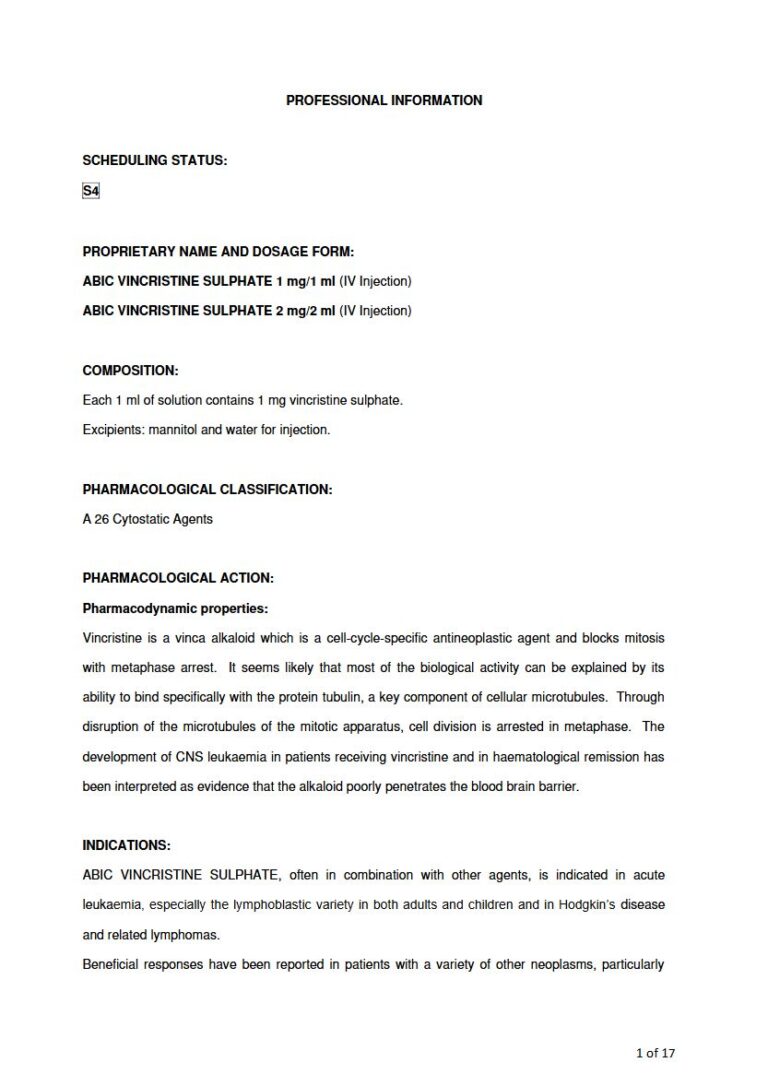
ABIC VINCRISTINE SULPHATE, often in combination with other agents, is indicated in acute leukaemia, especially the lymphoblastic variety in both adults and children and in Hodgkinu2019s disease and related lymphomas. Beneficial responses have been reported in patients with a variety of other neoplasms, particularly Wilmu2019s tumour, neuroblastoma, brain tumours, rhabdomyosarcoma, carcinoma of the breast, bladder, and male and female reproductive systems.
4.2 Posology and method of administration
FOR INTRAVENOUS USE ONLY. FATAL IF GIVEN BY ANY OTHER ROUTE. Extreme care must be taken when calculating and administering the dose of ABIC VINCRISTINE SULPHATE since overdosage may have a very serious or fatal outcome. The dose for children is 2 mg/m2 body-surface or 50 u03bcg/kg body mass increasing by weekly increments of 25 u03bcg/kg to a maximum of 150 u03bcg/kg. Adults may be given about 1.4 mg/m2 or 25 to 75 u03bcg/kg weekly. For other malignancies 25 u03bcg/kg may be given weekly and reduced to 5 to 10 u03bcg/kg for maintenance. White-cell counts should be carried out before and after giving each dose. The solution may be injected either directly into a vein or into the tubing of a running intravenous infusion. Injection of the ABIC VINCRISTINE SULPHATE may be completed in about one minute. Special precautions should be taken for safe handling and disposal. Refer to WARNINGS AND SPECIAL PRECAUTIONS.
4.3 Contraindications
u2022 patients with a known hypersensitivity to vincristine sulphate or one of the excipients of ABIC VINCRISTINE SULPHATE
ABIC VINCRISTINE SULPHATE should not be given to patients with bacterial infection. It is contraindicated:
u2022 in patients with the demyelinating form of Charcot-Marie-Tooth syndrome
u2022 in patients with severe liver function disorder
u2022 in patients with constipation and impending ileus, particularly in children
u2022 in patients who are treated with radiotherapy in which the liver is involved (refer to INTERACTIONS).
4.4 Special warnings and precautions for use
FATAL IF GIVEN INTRATHECALLY. FOR INTRAVENOUS USE ONLY. ABIC VINCRISTINE SULPHATE must be used only under strict supervision by medical practitioners experienced in therapy with cytotoxic agents. Extemporaneously prepared syringes containing this product must be packaged in an overwrap which is labelled u201cDO NOT REMOVE COVERING UNTIL MOMENT OF INJECTION. FOR INTRAVENOUS USE ONLY. FATAL IF GIVEN BY OTHER ROUTESu201d. After inadvertent intrathecal administration, immediate neurosurgical intervention is required in order to prevent ascending paralysis leading to death. In a very small number of patients, life-threatening paralysis and subsequent death was averted but resulted in devastating neurological sequelae, with limited recovery afterwards. Based on the published management of these survival cases, if ABIC VINCRISTINE SULPHATE is mistakenly given by the intrathecal route, the following treatment should be initiated immediately after the injection:
1. Removal of as much CSF as is safely possible through the lumbar access.
2. Insertion of an epidural catheter into the subarachnoid space via the intervertebral space above initial lumbar access and CSF irrigation with lactated Ringeru2019s solution. Fresh frozen plasma should be requested and, when available, 25 ml should be added to every 1 litre of lactated Ringeru2019s solution.
3. Insertion of an intraventricular drain or catheter by a neurosurgeon and continuation of CSF irrigation with fluid removal through the lumbar access connected to a closed drainage system. Lactated Ringeru2019s solution should be given by continuous infusion at 150 ml/h, or at a rate of 75 ml/h when fresh frozen plasma has been added as above. The rate of infusion should be adjusted to maintain a spinal fluid protein level of 150 mg/dl. The following measures have also been used in addition but may not be essential: Folinic acid has been administered intravenously as a 100 mg bolus and then infused at a rate of 25 mg/h for 24 hours, then bolus doses of 25 mg 6-hourly for 1 week. Intravenous administration of glutamic acid 10 g over 24 hours, followed by 500 mg three times daily by mouth for one month. Pyridoxine has been given at a dose of 50 mg 8-hourly by intravenous infusion over 30 minutes. Their roles in the reduction of neurotoxicity are unclear. Care should be taken to avoid extravasation during injection of ABIC VINCRISTINE SULPHATE. Leakage into surrounding tissue during intravenous administration of ABIC VINCRISTINE SULPHATE may cause severe local reaction or extravasation. After administration the vein must be flushed through thoroughly. If leakage into surrounding tissue should occur during intravenous administration of ABIC VINCRISTINE SULPHATE, it may cause considerable irritation. The injection should be stopped immediately, and any remaining portion of the dose should be injected into another vein. Local injection of hyaluronidase and the application of moderate heat to the area of leakage help to disperse the medicine and are thought to minimise discomfort and the possibility of cellulitis. Because severe constipation and impaction of faeces often occur with ABIC VINCRISTINE SULPHATE, enemas or purgatives may be necessary. As ABIC VINCRISTINE SULPHATE penetrates the blood-brain barrier poorly, additional agents and routes of administration may be required for central nervous system leukaemias. Patients who received ABIC VINCRISTINE SULPHATE chemotherapy in combination with anticancer medicines known to be carcinogenic have developed second malignancies. The contributing role of vincristine in this development has not been determined. ABIC VINCRISTINE SULPHATE should be given with caution to patients with pre-existing neuromuscular disease. The neurotoxic effect of ABIC VINCRISTINE SULPHATE may be additive with other neurotoxic agents or increased by spinal cord irradiation and neurological disease. Care should also be taken in elderly patients, who may be more susceptible to neurotoxicity. Doses may need to be adjusted in patients with impaired liver function. Care should be exercised to avoid accidental contamination of the eyes as ABIC VINCRISTINE SULPHATE is highly irritant and can cause corneal ulceration. The eye should be washed immediately and thoroughly. ABIC VINCRISTINE SULPHATE should be administered with caution in patients with ischaemic heart disorders. Leucopenia is less likely following therapy with ABIC VINCRISTINE SULPHATE than is the case with other oncolytic agents. It is usually neuromuscular rather than bone marrow toxicity that limits dosage. Since leucopenia may occur, both the medical practitioner and patient should be on the alert for any complicating infection. Should leucopenia occurs, appropriate measures should be taken including careful consideration of timing the next ABIC VINCRISTINE SULPHATE dose. On occasions, these infections may prove fatal. Acute elevation of serum uric acid may occur during induction of remission in acute leukaemia; therefore, serum uric acid levels should be determined frequently during the first 3 to 4 weeks of treatment or appropriate measures taken to prevent uric acid neuropathy.
4.6 Fertility, pregnancy and lactation
ABIC VINCRISTINE SULPHATE can cause foetal harm when administered to a pregnant woman (refer to HUMAN REPRODUCTION). Both men and women should take contraceptive measures during, and for 3 months after discontinuation of the treatment. Women of childbearing potential should be advised to avoid becoming pregnant while receiving ABIC VINCRISTINE SULPHATE (refer to HUMAN REPRODUCTION).
Pregnancy: Caution is necessary with the use of all oncolytic medicines during pregnancy. Both men and women receiving ABIC VINCRISTINE SULPHATE should be informed of the potential risk of adverse effects. Reliable methods of contraception or abstinence are recommended. Studies in animals have shown teratogenicity and if the patient becomes pregnant while receiving ABIC VINCRISTINE SULPHATE she should be informed of the potential hazard to the foetus.
Lactation: It is unknown whether ABIC VINCRISTINE SULPHATE is excreted in human breast milk. You should not breastfeed your infant during treatment with ABIC VINCRISTINE SULPHATE.
4.7 Effects on ability to drive and use machines
No studies on the effects on the ability to drive and use machines have been performed. ABIC VINCRISTINE SULPHATE has neurological side effects and therefore you should not drive a vehicle or use machines until you know how you are affected. Contains mannitol and may have a laxative effect.
4.8 Undesirable effects
In general, the side effects are reversible and dose dependent. The most frequent occurring side effect is alopecia; the most troublesome side effects are neuromuscular in origin. Side effects may be divided into acute effects occurring shortly after administration, delayed effects occurring days or weeks after administration, and long-term effects which may not become evident for years. Acute effects include anorexia, nausea and vomiting, allergic reactions, and local irritant effects. Nausea and vomiting are common and may occur, with varying severity, minutes or hours after an injection. Allergic reactions include skin rashes, pruritus, and erythema, often of areas previously irradiated, as well as symptoms such as fever, headache, hypotension, malaise, muscle wasting and weakness; anaphylaxis has been reported. Many antineoplastic agents have vesicant or irritant effects on the skin and mucous membranes and may cause thrombophlebitis when injected intravenously. Delayed or long-term adverse effects may result from the action of anti-neoplastic agents on rapidly dividing normal cells in the bone marrow, lymphoreticular tissue, gastrointestinal mucosa, skin, gonads, and foetus. Infections and infestations: Frequency unknown: Infection, sepsis, neutropenic sepsis. Neoplasms benign and malignant and unspecified: Less frequent: Secondary malignancies in patients treated with ABIC VINCRISTINE SULPHATE in association with other anticancer medicines known to be carcinogenic. Blood and the lymphatic system disorders: Frequent: Bone marrow depression, leucopenia, anaemia, haemolytic anaemia, thrombocytopenia, bleeding, immunosuppressant effect involving both antibody and cell-mediated immunity. The attendant increased risks of infection and haemorrhage can be life-threatening although the severity of myelosuppression varies for individual agents and may occur days or weeks after administration. Wound healing may be delayed. Immune system disorders: Less frequent: Allergic reactions, such as anaphylaxis, rash and oedema, temporally related to ABIC VINCRISTINE SULPHATE therapy have been reported in patients who were treated with ABIC VINCRISTINE SULPHATE as part of multi-medicine chemotherapy regimens. Endocrine disorders: Less frequent: Syndrome of inappropriate antidiuretic hormone secretion (SIADH). The syndrome may be associated with the neurotoxicity of the medicine, possibly resulting from a direct effect on the hypothalamus. In these patients, hyponatraemia associated with increased urinary sodium excretion occurs without evidence of renal or adrenal disease, hypotension, dehydration, azotemia, or clinical oedema. With fluid restriction, improvement in the hyponatraemia and in the renal loss of sodium occurs. Metabolism and nutrition disorders: Less frequent: Anorexia. Eye disorders: Less frequent: Nystagmus. Frequency unknown: Double vision, optic, extra-ocular neuropathy, transient cortical blindness, optic atrophy with blindness. Ear and labyrinth disorders: Less frequent: Partial or total deafness (temporary or permanent), difficulties with balance including dizziness and vertigo. Particular caution is warranted when ABIC VINCRISTINE SULPHATE is used in combination with other agents known to be ototoxic, such as the platinum-containing oncolytics. Cardiac disorders: Less frequent: Chemotherapy combinations which have included ABIC VINCRISTINE SULPHATE, when given to patients previously treated with mediastinal radiation have been associated with coronary artery disease and myocardial infarction. Vascular disorders: Less frequent: Hypertension and hypotension. Gastrointestinal disorders: Frequent: Constipation, parotid gland pain, nausea, vomiting. Because of severe constipation and impaction of faeces (colic-like abdominal pains can occur), laxatives or enemas as a routine prophylactic treatment against constipation is recommended for all patients receiving ABIC VINCRISTINE SULPHATE (refer to WARNINGS AND SPECIAL PRECAUTIONS). Less frequent: Stomatitis, mouth ulcers, oesophagitis, abdominal pain, haemorrhage, diarrhoea, and intestinal ulceration, perforation and necrosis. Paralytic ileus, particularly in young children. The ileus will reverse itself upon temporary discontinuance of ABIC VINCRISTINE SULPHATE and with symptomatic care. Reproductive system and breast disorders: Less frequent: Antineoplastic chemotherapy may lead to suppression of ovarian and testicular function resulting in amenorrhoea and the inhibition of spermatogenesis. Gynaecomastia has been reported. Congenital and familial/genetic disorders: ABIC VINCRISTINE SULPHATE is potentially mutagenic and teratogenic. Administration in the first trimester of pregnancy in particular may result in foetal abortion, stunting, or malformation. Secondary malignancies may develop in patients who have previously undergone successful cancer chemotherapy, particularly where the alkylating agents were used. This carcinogenic effect has been linked with the ability of antineoplastic agents to induce mutations and with the effects of prolonged immunosuppression, but it is not possible entirely to separate the effects of chemotherapy from those of radiation, and the underlying defects associated with the disease state. Renal and urinary disorders: Frequent: Polyuria, dysuria, and urinary retention due to bladder atony have occurred. Other medicines known to cause urinary retention should, if possible, be discontinued for the first few days following administration of ABIC VINCRISTINE SULPHATE. Other adverse effects include hyperuricaemia and acute renal failure due to uric acid nephropathy which may result from the lysis of large numbers of cells and the breakdown of nucleoproteins; nephrotoxicity may also occur. Hyperphosphataemia and other disturbances of electrolyte balance have also been reported. Hepato-biliary disorders: Less frequent: Hepatic veno-occlusive disease, particularly in children. Pigmentation of the skin and nails occurs with several antineoplastic agents and may be part of an Addisonian syndrome. Jaundice and abnormal liver function tests may sometimes be a manifestation of the disease rather than its treatment. Respiratory, thoracic and mediastinal disorders: Frequent: Pharyngeal pain, acute shortness of breath, severe bronchospasm (particularly when used together with mitomycin C. Less frequent: Effects on the lung, culminating in pulmonary fibrosis and neurotoxicity, both central and peripheral, occur variably. Nervous system disorders: Frequent: Neurological toxicity is dose- and age-related. The most frequent neurotoxic manifestation is peripheral (mixed sensorimotor) neuropathy which occurs in nearly every patient. Frequently, there is a sequence to the development of neuromuscular side effects. Initially, only sensory impairment and paraesthesia may be encountered. With continued treatment, neuritic pain and later, motor difficulties may occur. Loss of deep-tendon reflexes, ataxia, difficulty in walking, foot drop, and paralysis have been reported with continued administration. Cranial nerve manifestations, including isolated paresis and/or paralysis of muscles controlled by cranial motor nerves, may occur in the absence of motor impairment elsewhere. Cranial nerve palsies and muscular weakness of the larynx may produce hoarseness and vocal cord paresis, including life-threatening bilateral vocal cord paralysis. Convulsions, often with hypertension, have occurred. Several instances of convulsions followed by coma have been reported in children. Less frequent: ABIC VINCRISTINE SULPHATE also produce autonomic and CNS toxicity, although less frequently than peripheral neuropathy. CNS effects including episodes of altered consciousness and mental changes such as depression, agitation, insomnia, confusion, psychoses, and hallucinations have been reported. Skin and subcutaneous tissue disorders: Frequent: Alopecia (reversible when the administration of ABIC VINCRISTINE SULPHATE is discontinued). Frequency unknown: Rash. Musculoskeletal, connective tissue and bone disorders: Frequent: Jaw pain, bone pain, back pain, limb pain and myalgias. Frequency unknown: Muscle wasting. General disorders and administrative site conditions: Less frequent: Fever, headache, phlebitis, pain, cellulitis and necrosis; these symptoms can occur after irritation of the vessel wall or after extravasation during the administration. Investigations: Less frequent: Weight loss.
4.9 Overdose
Refer to SIDE EFFECTS. An overdose with ABIC VINCRISTINE SULPHATE leads to the occurrence of the above-mentioned side effects, in an intensified manner. In children younger than 13 years of age, overdose of 10 times the recommended dose has had fatal results. In this patient group severe symptoms can occur with doses of 3 to 4 mg/m2. Adults can expect severe symptoms after the administration of single doses of 3 mg/m2 or more. There is no known antidote to ABIC VINCRISTINE SULPHATE. Treatment is symptomatic and supportive. Supportive care should include the following: - prevention of side-effects resulting from the syndrome of inappropriate antidiuretic hormone secretion (this would include restriction of fluid intake and perhaps the administration of a diuretic affecting the function of the loop of Henle and the distal tubule); - administration of an anticonvulsive agent to prevent seizures; - monitoring of the cardiovascular system; - determining daily blood counts for guidance in transfusion requirements; - use of enemas to prevent ileus. Folinic acid has been observed to have a protective effect in normal mice which were administered lethal doses of vincristine. Isolated case reports suggest that folinic acid may be helpful in treating humans who have received an overdose. A suggested schedule is to administer 100 mg of folinic acid intravenously every 3 hours for 24 hours and then every 6 hours for at least 48 hours. Theoretical tissue levels of vincristine derived from pharmacokinetic data are predicted to remain significantly elevated for at least 72 hours. Treatment with folinic acid does not eliminate the need for the above-mentioned supportive measures. Most of an intravenous dose of ABIC VINCRISTINE SULPHATE is excreted into the bile after rapid tissue binding. Because only very small amounts of the medicine appear in dialysate, haemodialysis is not likely to be helpful in cases of overdosage. Should oral ingestion occur, the stomach should be evacuated followed by oral administration of activated charcoal and a cathartic.
