
Adco Retic 5mg/50mg Tablets
PDF Leaflet Revision Date: 13 March 2023
Clinical Summary
Quick overview from the medicine insert
Indication
Treatment of oedema and essential hypertension.
Dosage (summary)
1-2 tablets daily for oedema; 1 tablet daily for hypertension.
Special Populations
- Paediatric population
- Renal impairment
- Hepatic impairment
Pregnancy & Breastfeeding
Contraindicated in pregnancy and lactation.
Key Drug Interactions
- Lithium
- NSAIDs
- ACE inhibitors
Contraindications
- Hypersensitivity
- Severe hepatic failure
- Hyperkalaemia
- Impaired renal function
Common side effects
- Electrolyte imbalance
- Dizziness
- Nausea
- Fatigue
Counselling Points
- Avoid potassium supplements
- Monitor for skin lesions
- Caution with driving if experiencing dizziness
Serious warnings
- Risk of nonmelanoma skin cancer
- Potential for hyperkalaemia
- Monitor renal function
Important Disclaimer
The Adco Retic 5mg/50mg Tablets professional information leaflet below is the property of Adcock Ingram and is provided on Medinsert exactly as issued, with no.. alterations or editorial changes. We make every effort to keep content current by updating documents as soon as new versions become available. Medinsert serves as a trusted access point for healthcare professionals, but does not replace official sources or clinical judgement. For more details, please read our full disclaimer. read more>>
 Healthcare Professionals Only
This content is for registered healthcare professionals
Sign in or create a free account to read the full package insert.
Free for HPCSA-registered professionals. Powered by Medinsert.
Clinical Particulars
Section 4 of the official insert — extracted exactly as issued, no alterations
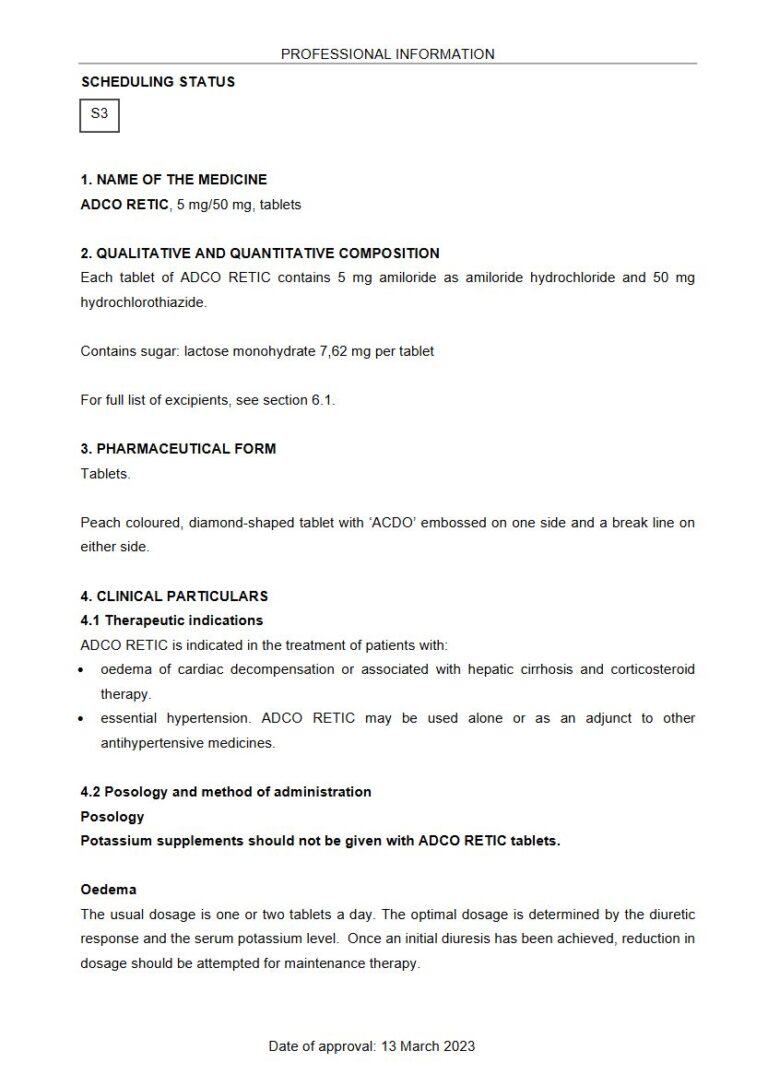
4.1 Therapeutic indications
ADCO RETIC is indicated in the treatment of patients with:
- oedema of cardiac decompensation or associated with hepatic cirrhosis and corticosteroid therapy.
- essential hypertension. ADCO RETIC may be used alone or as an adjunct to other antihypertensive medicines.
4.2 Posology and method of administration
Posology
Potassium supplements should not be given with ADCO RETIC tablets.
Oedema
The usual dosage is one or two tablets a day. The optimal dosage is determined by the diuretic response and the serum potassium level. Once an initial diuresis has been achieved, reduction in dosage should be attempted for maintenance therapy.
Hypertension
The usual dosage is one ADCO RETIC tablet daily. Some patients may require half a tablet daily. ADCO RETIC may be used alone or as an adjunct to other antihypertensive medicines. ADCO RETIC may add to or potentiate the action of other antihypertensive medicines. If ADCO RETIC is added to therapy with other antihypertensive medicines, dosage reduction of such medicines may be necessary in order to reduce the risk of an excessive drop in blood pressure.
Special populations
Paediatric population
The safety of the use of amiloride hydrochloride (as in ADCO RETIC) in children has not been established (see section 4.3).
Method of administration
For oral administration.
4.3 Contraindications
- Hypersensitivity to amiloride hydrochloride and hydrochlorothiazide or to any of the excipients listed in section 6.1.
- Concomitant use with spironolactone or triamterene.
- Severe hepatic failure.
- Addisonu2019s disease.
- Hypercalcaemia.
- Concurrent lithium therapy.
- Hyperkalaemia: ADCO RETIC should not be used in the presence of elevated plasma potassium levels (interpreted as over 5,5 mmol/L).
- Antikaliuretic therapy, potassium supplementation or potassium-rich food (except in severe and/or refractory cases of hypokalaemia under careful monitoring): Other antikaliuretic medicines and potassium supplements are contraindicated in patients receiving ADCO RETIC due to the potassium-sparing effect of amiloride hydrochloride (such combination therapy is commonly associated with rapid increases in plasma potassium levels).
- Impaired renal function: Anuria, acute renal failure, severe progressive renal disease and diabetic nephropathy are contraindications to the use of ADCO RETIC. Patients with increases in blood urea nitrogen (BUN) over 5 mmol/L, in serum creatinine levels over 130 u03bcmol/L, or in whole blood urea values over 10 mmol/L should not receive ADCO RETIC without careful, frequent monitoring of serum electrolytes and BUN levels. Potassium retention in the presence of renal impairment is accentuated by the addition of an antikaliuretic medicine and may result in the rapid development of hyperkalaemia.
- Patients with a history of previous and/or current basal cell carcinomas and/or squamous cell carcinomas of the skin and lip.
- In children: The safety of the use of amiloride hydrochloride in children has not been established; therefore, ADCO RETIC is not recommended in children under 18 years of age.
- Contraindicated in pregnancy and lactation (see section 4.6).
4.4 Special warnings and precautions for use
An increased risk of nonmelanoma skin cancer (NMSC) [basal cell carcinoma (BCC) and squamous cell carcinoma (SCC)] with increasing cumulative dose of hydrochlorothiazide (HCTZ) exposure has been observed in two epidemiological studies. Photosensitizing actions of HCTZ could act as a possible mechanism for NMSC. Patients taking ADCO RETIC should be informed of the risk of NMSC and advised to regularly check their skin for any new lesions and promptly report any suspicious skin lesions. Possible preventive measures such as limited exposure to sunlight and UV rays and, in the case of exposure, adequate protection should be advised to the patients to minimize the risk of skin cancer. Suspicious skin lesions should be promptly examined potentially including histological examinations of biopsies. ADCO RETIC should not be used by patients who have had previous and/or current basal cell carcinomas and/or squamous cell carcinomas of the skin and/or lip (see section 4.3).
Patients with partial heart block may develop complete heart block. Rises in blood urea nitrogen concentrations may occur, as well as abnormalities in liver function tests. Amiloride hydrochloride (as in ADCO RETIC) may cause hepatic encephalopathy manifested by tremors, confusion and coma. Patients with liver disease should be observed for this complication when ADCO RETIC is administered. In cirrhotic patients, jaundice associated with the underlying disease process may deepen. In diabetic patients, hyperkalaemia may occur with amiloride hydrochloride (as in ADCO RETIC) administration, particularly if chronic renal disease or pre-renal azotaemia is present. Before initiating therapy in diabetic or suspected diabetic patients, the renal function status should be known. Therapy with ADCO RETIC should be discontinued at least three days before giving a glucose tolerance test. Amiloride hydrochloride (as in ADCO RETIC) should be given with care to patients likely to develop acidosis, such as severely ill patients with cardiopulmonary disease and with decompensated diabetes. Pathological changes in the parathyroid gland with hypercalcaemia and hypophosphatemia may occur with prolonged treatment with hydrochlorothiazide (as in ADCO RETIC). Hydrochlorothiazide (as in ADCO RETIC) should be used with caution in patients with impaired hepatic or renal function, or with diabetes mellitus or adrenal disease. Insulin requirements in diabetic patients may be increased, decreased, or unchanged due to hydrochlorothiazide. Diabetes mellitus which has been latent may become manifest during thiazide administration. Blood-glucose concentrations should be monitored in patients taking antidiabetic medicines since their requirements of these medicines may change. Increases in cholesterol and triglyceride levels may be associated with thiazide diuretic therapy. Electrolyte imbalance and reversible BUN increases: Hydrochlorothiazide (as in ADCO RETIC) may produce hypomagnesaemia, hyponatraemia, hypochloraemia and hypokalaemia. Hyponatraemia may occur in patients with congestive heart failure who are very oedematous, particularly with large doses in conjunction with restricted salt in the diet. Hypokalaemia intensifies the effect of digoxin on cardiac muscle and administration of digoxin or its glycosides may have to be temporarily suspended. Urinary calcium excretion may be decreased in patients receiving hydrochlorothiazide (as in ADCO RETIC). All patients should be carefully observed for signs of fluid and electrolyte imbalance, especially in the presence of vomiting or during parenteral fluid therapy. If increasing azotaemia and oliguria occur during treatment ADCO RETIC tablets should be discontinued. Hydrochlorothiazide (as in ADCO RETIC) may interfere with a number of diagnostic tests, including tests for parathyroid function; serum concentrations of protein-bound iodine may increase without signs of thyroid disturbance. ADCO RETIC should be discontinued before carrying out tests for parathyroid function.
Effects related to diuresis in cirrhotic patients: Oral diuretic therapy is more frequently accompanied by adverse reactions in patients with hepatic cirrhosis and ascites because these patients are intolerant of acute shifts in electrolyte balance, and because they often have pre-existing hypokalaemia as a result of associated aldosteronism.
Sensitivity reactions to ADCO RETIC tablets may occur in patients with or without a history of allergy or bronchial asthma. The possibility of exacerbation or activation of systemic lupus erythematosus may occur. Patients should be observed regularly for the possible occurrence of liver dysfunction, idiosyncratic reactions, or blood dyscrasias. Less frequent cases of acute respiratory toxicity, including acute respiratory distress syndrome (ARDS) have been reported after taking hydrochlorothiazide. Pulmonary oedema typically develops within minutes to hours after hydrochlorothiazide intake. At the onset, symptoms include dyspnoea, fever, pulmonary deterioration and hypotension. If diagnosis of ARDS is suspected, ADCO RETIC should be withdrawn and appropriate treatment given. Hydrochlorothiazide should not be administered to patients who previously experienced ARDS following hydrochlorothiazide intake. Sulphonamide or sulphonamide derivative medicines can cause an idiosyncratic reaction resulting in choroidal effusion with visual field defect, transient myopia and acute angle-closure glaucoma. Symptoms include acute onset of decreased visual acuity or ocular pain and typically occur within hours to weeks of drug initiation. Untreated acute angle-closure glaucoma can lead to permanent vision loss. The primary treatment is to discontinue the medicine intake as rapidly as possible. Prompt medical or surgical treatments may need to be considered if the intraocular pressure remains uncontrolled. Risk factors for developing acute angle-closure glaucoma may include a history of sulphonamide or penicillin allergy.
Excipients
ADCO RETIC contains lactose monohydrate. This should be taken into account in patients with diabetes mellitus. Patients with rare hereditary problems of galactose intolerance, lactase deficiency or glucose-galactose malabsorption should not take ADCO RETIC. ADCO RETIC contains the colourant Sunset yellow FCF lake which may cause allergic reactions.
4.5 Interaction with other medicines and other forms of interaction
Lithium
Lithium should generally not be given to patients receiving diuretics (such as ADCO RETIC) since the risk of lithium toxicity is very high in such patients due to the decrease in renal clearance of lithium.
Non-steroidal anti-inflammatory medicines including selective cyclooxygenase-2 (COX-2) inhibitors
Non-steroidal anti-inflammatory medicines (NSAIDs) including selective cyclooxygenase-2 inhibitors (COX-2 inhibitors) may reduce the effect of antihypertensive drugs, including the diuretic, natriuretic and antihypertensive effects of diuretics (such as ADCO RETIC). In some patients with compromised renal function (e.g., elderly patients or patients who are volume-depleted, including those on diuretic therapy) who are being treated with non-steroidal anti-inflammatory medicines, including selective cyclooxygenase-2 inhibitors, the co-administration of angiotensin II receptor antagonists or ACE inhibitors may result in a further deterioration of renal function, including possible acute renal failure. These effects are usually reversible. Therefore, the combination should be administered with caution in patients with compromised renal function.
Concomitant administration of NSAIDs and potassium-sparing medicines, including amiloride hydrochloride, may cause hyperkalaemia, particularly in elderly patients. Therefore, when amiloride hydrochloride is used concomitantly with NSAIDs, serum potassium levels should be carefully monitored.
Amiloride hydrochloride
When amiloride hydrochloride is administered concomitantly with an angiotensin-converting enzyme inhibitor, angiotensin II receptor antagonist, trilostane, ciclosporin or tacrolimus, the risk of hyperkalaemia may be increased. Therefore, if concomitant use of these medicines is indicated because of demonstrated hypokalaemia, they should be used with caution and with frequent monitoring of serum potassium.
Hydrochlorothiazide
When given concurrently, the following medicines may interact with thiazide diuretics (as in ADCO RETIC): The potassium depleting effects of hydrochlorothiazide (as in ADCO RETIC) may be enhanced by corticosteroids, corticotrophin and carbenoxalone. Hydrochlorothiazide (as in ADCO RETIC) potentiates the action of other antihypertensive medicines. Therefore, the dosage of these medicines, especially the ganglion blockers, may need to be reduced when ADCO RETIC tablets are added to the regimen. Diuretic therapy should be discontinued for 2-3 days prior to initiation of therapy with an ACE inhibitor to reduce the likelihood of first dose hypotension. Hydrochlorothiazide (as in ADCO RETIC) may increase the neuromuscular blocking action of non-depolarising muscle relaxants like tubocurarine. The antihypertensive effect of ADCO RETIC tablets may be enhanced in the post sympathectomy patient. Hydrochlorothiazide (as in ADCO RETIC) may decrease arterial responsiveness to norepinephrine. This diminution is not sufficient to preclude the effectiveness of the pressor agent for therapeutic use. Orthostatic hypotension due to hydrochlorothiazide (as in ADCO RETIC) may be potentiated by alcohol, barbiturates or narcotics. Oral and parenteral antidiabetic medicines may require adjustment of dosage with concurrent use. ADCO RETIC can act synergistically with chlorpropamide to increase the risk of hyponatraemia. Cholestyramine and colestipol resins absorption of hydrochlorothiazide is impaired in the presence of anionic exchange resins. Single doses of either cholestyramine or colestipol resins bind the hydrochlorothiazide and reduce its absorption from the gastrointestinal tract by up to 85 and 43 %, respectively. When cholestyramine is given 4 hours after the hydrochlorothiazide, the absorption of hydrochlorothiazide is reduced by 30 to 35 %.
4.6 Fertility, pregnancy and lactation
ADCO RETIC is contraindicated in pregnancy and lactation (see section 4.3).
Pregnancy
Diuretics
The routine use of diuretics in otherwise healthy pregnant women with or without mild oedema is not indicated, because they may be associated with hypovolaemia, increased blood viscosity, and decreased placental perfusion. Diuretics do not prevent the development of toxaemia of pregnancy and there is no satisfactory evidence that they are useful for its treatment.
Hydrochlorothiazide
There is limited experience with hydrochlorothiazide during pregnancy, especially during the first trimester. Animal studies are insufficient. Hydrochlorothiazide crosses the placenta. Based on the pharmacological mechanism of action of hydrochlorothiazide its use during the second and third trimester may compromise foeto-placental perfusion and may cause foetal and neonatal effects like icterus, disturbance of electrolyte balance, bone marrow depression and thrombocytopenia. Hydrochlorothiazide should not be used for gestational oedema, gestational hypertension or preeclampsia due to the risk of decreased plasma volume and placental hypoperfusion, without a beneficial effect on the course of the disease. Hydrochlorothiazide should not be used for essential hypertension in pregnant women except in rare situations where no other treatment could be used.
Breastfeeding
Although it is not known whether amiloride hydrochloride is excreted in human milk, it is known that hydrochlorothiazide is excreted in human milk in small amounts. Thiazides in high doses causing intense diuresis can inhibit the milk production. The use of ADCO RETIC during breast feeding is not recommended. If ADCO RETIC is used during breastfeeding, doses should be kept as low as possible.
Fertility
No data available.
4.7 Effects on ability to drive and use machines
Patients may experience weakness, fatigue, dizziness, stupor and vertigo. Should any of these occur, the patient should be cautioned not to drive or operate machinery.
4.8 Undesirable effects
Tabulated list of adverse effects
Adverse effects of ADCO RETIC
| System Organ Class | Frequency | Adverse effects |
|---|---|---|
| Metabolism and nutrition disorders | Frequency unknown | Electrolyte imbalance, hyponatraemia (see section 4.4), dehydration, symptomatic hyponatraemia |
| Psychiatric disorders | Frequency unknown | Insomnia, nervousness, depression, sleepiness |
| Nervous system disorders | Frequency unknown | Stupor |
| Cardiac disorders | Frequency unknown | Dysrhythmia, tachycardia, angina pectoris |
| Respiratory, thoracic and mediastinal disorders | Frequency unknown | Dyspnoea, nasal congestion |
| Gastrointestinal disorders | Frequency unknown | Anorexia, nausea, vomiting, diarrhoea or constipation, appetite changes, abdominal fullness, flatulence, hiccups, bad taste |
| Skin and subcutaneous tissue disorders | Frequency unknown | Flushing, diaphoresis |
| Musculoskeletal, connective tissue and bone disorders | Frequency unknown | Leg ache, joint pain, back pain |
| Renal and urinary disorders | Frequency unknown | Dysuria, nocturia, incontinence, renal dysfunction including renal failure |
| Reproductive system and breast disorders | Frequency unknown | Impotence |
| General disorders and administrative site conditions | Frequency unknown | Malaise, chest pain, syncope |
Adverse effects of amiloride
| System Organ Class | Frequency | Adverse effects |
|---|---|---|
| Blood and lymphatic system disorders | Frequency unknown | Aplastic anaemia, neutropenia |
| Metabolism and nutrition disorders | Frequency unknown | Elevated serum potassium levels (> 5,5 mmol/L) |
| Psychiatric disorders | Frequency unknown | Confusion, minor psychiatric changes, decreased libido, somnolence |
| Nervous system disorders | Frequency unknown | Dizziness, weakness, vertigo, paraesthesia, tremors, encephalopathy |
| Eye disorders | Frequency unknown | Visual disturbances, increased intra-ocular pressure |
| Ear and labyrinth disorders | Frequency unknown | Tinnitus |
| Cardiac disorders | Frequency unknown | Orthostatic hypotension, heart block, palpitation |
| Respiratory, thoracic and mediastinal disorders | Frequency unknown | Cough |
| Gastrointestinal disorders | Frequency unknown | Activation of peptic ulcer, nausea, vomiting, diarrhoea, constipation, abdominal pain, thirst, gastrointestinal bleeding, dry mouth, dyspepsia |
| Hepato-biliary disorders | Frequency unknown | Abnormal liver function, jaundice |
| Skin and subcutaneous tissue disorders | Frequency unknown | Skin rash, pruritus, alopecia |
| Musculoskeletal, connective tissue and bone disorders | Frequency unknown | Muscle cramps, neck/shoulder ache, pain in extremities |
| Renal and urinary disorders | Frequency unknown | Polyuria, urinary frequency, bladder spasm |
Adverse effects of hydrochlorothiazide
| System Organ Class | Frequency | Adverse effects |
|---|---|---|
| Infections and Infestations | Frequency unknown | Sialadenitis |
| Neoplasms benign, malignant and unspecified (including cysts and polyps) | Frequency unknown | Nonmelanoma skin cancer (Basal cell carcinoma and squamous cell carcinoma) |
| Blood and lymphatic system disorders | Frequency unknown | Agranulocytosis, aplastic anaemia, haemolytic anaemia, leukopenia, purpura, thrombocytopenia |
| Endocrine disorders | Frequency unknown | Hyperparathyroidism |
| Metabolism and nutrition disorders | Frequency unknown | Glycosuria, hyperglycaemia, hyperuricaemia, gout, hypokalaemia |
| Psychiatric disorders | Frequency unknown | Headache, restlessness, mental confusion |
| Nervous system disorders | Frequency unknown | Dizziness, vertigo, paraesthesia |
| Eye disorders | Frequency unknown | Transient blurred vision, xanthopsia, choroidal effusion |
| Cardiac disorders | Frequency unknown | Orthostatic hypotension, digoxin toxicity |
| Vascular disorders | Frequency unknown | Necrotizing angiitis (vasculitis, cutaneous vasculitis) |
| Less frequent | Frequency unknown | Acute respiratory distress syndrome (ARDS) (see section 4.4) |
| Respiratory, thoracic and mediastinal disorders | Frequency unknown | Respiratory distress including pneumonitis, pulmonary oedema |
| Gastrointestinal disorders | Frequency unknown | Pancreatitis, thirst, cramping, gastric irritation |
| Hepato-biliary disorders | Frequency unknown | Jaundice (intrahepatic cholestatic jaundice) |
| Skin and subcutaneous tissue disorders | Frequency unknown | Anaphylactic-type reactions, Stevens-Johnson syndrome (erythema multiforme), urticaria, rash, pruritus, photosensitivity toxic epidermal necrolysis |
| Musculoskeletal, connective tissue and bone disorders | Frequency unknown | Muscle cramps |
| Renal and urinary disorders | Frequency unknown | Interstitial nephritis |
| General disorders and administrative site conditions | Frequency unknown | Fever, weakness, fatigue |
| Investigations | Frequency unknown | Changes in serum lipids |
Reporting of suspected adverse reactions
Reporting suspected adverse reactions after authorisation of the medicine is important. It allows continued monitoring of the benefit/risk balance of the medicine. Health care providers are asked to report any suspected adverse reactions to SAHPRA via the u201c6.04 Adverse Drug Reactions Reporting Formu201d, found online under SAHPRAu2019s publications: https://www.sahpra.org.za/Publications/Index/8
4.9 Overdose
Symptoms
See section 4.8 and section 4.4.
Treatment
Treatment is symptomatic and supportive. Empty the stomach by emesis and give symptomatic treatment. Restore fluid and acid-base balance as indicated.
