
Adco Zildem SR Capsule
PDF Leaflet Revision Date: 05 July 2024
Clinical Summary
Quick overview from the medicine insert
Indication
Prophylaxis of angina pectoris and treatment of mild to moderate hypertension.
Dosage (summary)
180 mg once or twice daily or 240 mg once daily; start with reduced doses in elderly or impaired function.
Onset of Action / Duration
Onset: 30-60 mins, Duration: 6-8 hours
Special Populations
- Elderly
- Hepatic impairment
- Renal impairment
Pregnancy & Breastfeeding
Contraindicated in pregnancy and lactation due to potential teratogenic effects and excretion in milk.
Key Drug Interactions
- Beta-blockers
- Digitalis glycosides
- CYP3A4 inhibitors
- Nitrate derivatives
Contraindications
- Hypersensitivity to diltiazem
- Decompensated cardiac insufficiency
- Severe bradycardia
- AV block
- Pregnancy
- Lactation
Common side effects
- Headache
- Dizziness
- Constipation
- Flushing
- Palpitations
Counselling Points
- Swallow capsules intact
- Avoid grapefruit juice
- Monitor for dizziness
- Report any signs of hypersensitivity
Serious warnings
- Risk of bradycardia
- Monitor renal function
- Caution in hypotension
Important Disclaimer
The Adco Zildem SR Capsule professional information leaflet below is the property of Adcock Ingram and is provided on Medinsert exactly as issued, with no.. alterations or editorial changes. We make every effort to keep content current by updating documents as soon as new versions become available. Medinsert serves as a trusted access point for healthcare professionals, but does not replace official sources or clinical judgement. For more details, please read our full disclaimer. read more>>
 Healthcare Professionals Only
This content is for registered healthcare professionals
Sign in or create a free account to read the full package insert.
Free for HPCSA-registered professionals. Powered by Medinsert.
Clinical Particulars
Section 4 of the official insert — extracted exactly as issued, no alterations
4.1 Therapeutic indications
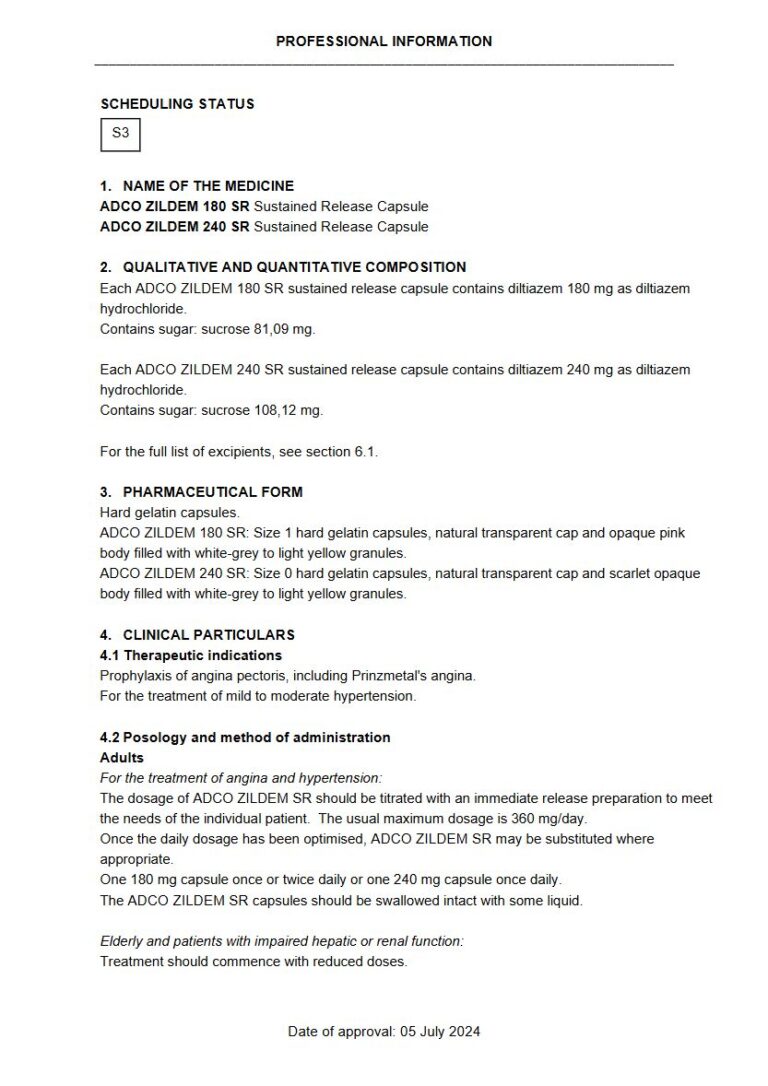
Prophylaxis of angina pectoris, including Prinzmetal's angina. For the treatment of mild to moderate hypertension.
4.2 Posology and method of administration
Adults
For the treatment of angina and hypertension: The dosage of ADCO ZILDEM SR should be titrated with an immediate release preparation to meet the needs of the individual patient. The usual maximum dosage is 360 mg/day. Once the daily dosage has been optimised, ADCO ZILDEM SR may be substituted where appropriate. One 180 mg capsule once or twice daily or one 240 mg capsule once daily. The ADCO ZILDEM SR capsules should be swallowed intact with some liquid.
Elderly and patients with impaired hepatic or renal function: Treatment should commence with reduced doses.
Method of administration
For oral use.
4.3 Contraindications
- Hypersensitivity to diltiazem or any of the excipients of ADCO ZILDEM SR (see section 2 and 6.1).
- Since teratogenic effects were noted in animals, ADCO ZILDEM SR should not be administered to pregnant women or to women of child bearing age.
- ADCO ZILDEM SR is excreted in human milk, and therefore should not be administered to lactating women.
- ADCO ZILDEM SR should not be administered to patients with decompensated cardiac insufficiency, sick sinus syndrome, conduction disturbances (sino-atrial or atrio-ventricular block) and severe bradycardia (pulse rate less than 40 beats / min).
- Second- or third-degree AV block except in the presence of a functioning ventricular pacemaker.
- Left ventricular failure with pulmonary congestion.
- Concomitant use of dantrolene infusion (see section 4.5).
- Additionally, for the intravenous forms, patients known to have an accessory bypass (Wolf-Parkinson-White syndrome or short PR syndrome), and who develop atrial fibrillation or flutter, should not be administered intravenous diltiazem.
- Combination with ivabradine (see section 4.5).
- Concurrent use with lomitapide (see section 4.5).
- Concurrent use with asunaprevir (see section 4.5).
- ADCO ZILDEM SR should not be administered to patients with severe impairment of liver and kidney function.
- It is not safe to administer ADCO ZILDEM SR to patients suffering from porphyria.
- Safety in children has not been established.
4.4 Special warnings and precautions for use
ADCO ZILDEM SR should be administered with caution to elderly patients and patients with impairment of liver and kidney function. In these patients, treatment should commence with reduced doses and close monitoring, particularly of heart rate, should be carried out at the beginning of treatment. If bradycardia is noted, dosage should be decreased, and then discontinued if bradycardia persists. Administer with caution to patients with pre-existing hypotension and also to those with impaired left ventricular function due to potential negative inotropic properties of diltiazem. Diltiazem (as in ADCO ZILDEM SR) has been associated with the development of congestive heart failure. Close observation and caution is necessary in patients with reduced left ventricular function, bradycardia (risk of exacerbation) or with first degree AV block or prolonged PR interval detected on the electrocardiogram (risk of exacerbation and rarely, of completed block). Cases of acute renal failure secondary to decreased renal perfusion have been reported in patients with existing cardiac disease especially reduced left ventricular function, severe bradycardia (since the use of Adco Zildem in these patients is contraindicated) or severe hypotension. Careful monitoring of renal function is advised.
Prior to general anaesthesia, the anaesthetist must be informed of ongoing diltiazem treatment. Depression of cardiac contractility, conductivity and automaticity, as well as the vascular dilatation associated with anaesthetics may be potentiated by calcium channel blockers (see section 4.5). Calcium channel blocking agents, such as diltiazem, may be associated with mood changes, including depression. Early recognition of relevant symptoms is important, especially in predisposed patients. In such cases, drug discontinuation should be considered. Like other calcium channel antagonists, diltiazem has an inhibitory effect on intestinal motility. Therefore it should be used with caution in patients at risk to develop an intestinal obstruction. Tablet residues from slow release formulations of the product may pass into the patientu2019s stools; however, this finding has no clinical relevance. Careful monitoring is necessary in patients with latent or manifest diabetes mellitus due to a possible increase in blood glucose. The use of diltiazem may induce bronchospasm, including asthma aggravation, especially in patients with pre-existing bronchial hyper-reactivity. Cases have also been reported after dose increase. Patients should be monitored for signs and symptoms of respiratory impairment during diltiazem therapy. Contains sugar. Contains sucrose which may have an effect on the glycaemic control of patients with diabetes mellitus. Patients with rare hereditary problems such as fructose intolerance, glucose-galactose malabsorption or sucrase-isomaltase insufficiency should not take this medicine. ADCO ZILDEM SR administration should be stopped if signs of hypersensitivity are observed (see section 4.3).
4.5 Interaction with other medicines and other forms of interaction
Patients receiving ADCO ZILDEM SR in combination with diuretics, ACE-inhibitors and other antihypertensive agents should be regularly monitored. Concomitant use with alpha-blockers such as prazosin should be strictly monitored because of the possible marked synergistic hypotensive effect of this combination. ADCO ZILDEM SR should be administered with caution to patients taking beta-blocker agents or digitalis glycosides as these may have an additive effect on depression of AV conduction. The combination of ADCO ZILDEM SR with the beta-blocker propranolol may enhance the bioavailability of the propranolol significantly, and thus produce elevated levels of propranolol in the serum. Adjustment in the propranolol dosage may be warranted. The combination of ADCO ZILDEM SR with digitalis glycosides can inhibit digitalis glycoside metabolism and elevate serum levels, which may cause digitalis glycoside toxicity. Concomitant use with amiodarone and digoxin may cause an increased risk of bradycardia, small increases in plasma levels of digoxin. Caution is required when these are combined with diltiazem, particularly in elderly subjects and when high doses are used. Case reports have suggested that blood levels of carbamazepine, cyclosporin, and theophylline may be increased when given concurrently with diltiazem (as in ADCO ZILDEM SR). Care should be exercised in patients taking these medicines. Cimetidine's inhibition of the hepatic cytochrome P450 system causes an increase in plasma diltiazem concentrations. An adjustment in the diltiazem dose may be warranted. Lethal ventricular fibrillation is regularly observed in animals when intravenous verapamil and dantrolene are administered concomitantly. The combination of a calcium antagonist and dantrolene is therefore potentially dangerous (see section 4.3). Concomitant use with ivabradine is contraindicated due to additional heart rate lowering effect of diltiazem to ivabradine (see section 4.3). Diltiazem (a moderate CYP3A4 inhibitor) may increase lomitapide plasma concentrations through CYP3A4 inhibition leading to increased risk of elevations in liver enzymes (see section 4.3). Diltiazem (a moderate CYP3A4 inhibitor) may increase asunaprevir plasma concentrations through CYP3A4 inhibition (see section 4.3). Concomitant use with lithium requires caution as there is risk of increase in lithium-induced neurotoxicity. Concomitant use with nitrate derivatives may cause increased hypotensive effects and faintness (additive vasodilating effects). In all the patients treated with calcium antagonists, the prescription of nitrate derivatives should only be carried out at gradually increasing doses. Since diltiazem has antidysrhythmic properties, its concomitant prescription with other antidysrhythmic agents is not recommended (additive risk of increased cardiac adverse effects). This combination should only be used under close clinical and ECG monitoring. There is risk of decrease of diltiazem plasma levels after initiating therapy with rifampicin. The patient should be carefully monitored when initiating or discontinuing rifampicin treatment. Diltiazem increases plasma concentration of imipramine. Diltiazem possibly increases plasma concentration of tricyclic antidepressants. When co-administered with phenytoin, diltiazem may increase phenytoin plasma concentration. It is recommended that the phenytoin plasma concentrations be monitored. Cardiovascular effects of an intravenous bolus of an ionic X-ray contrast media, such as hypotension, may be increased in patients treated with diltiazem. Special caution is required in patients who concomitantly receive diltiazem and X-ray contrast media.
Patients who are taking ADCO ZILDEM SR should inform the anaesthetist accordingly before receiving anaesthesia (see section 4.4). In a pharmacodynamic study, diltiazem was shown to inhibit platelet aggregation. Although the clinical significance of this finding is unknown, potential additive effects when used with antiplatelet drugs should be considered. Diltiazem is extensively metabolized through the CYP450 system and requires careful medication profile review. Diltiazem is metabolised by CYP3A4. Diltiazem is also a CYP3A4 isoform inhibitor. Concomitant use alongside potent CYP450 inhibitors may increase diltiazem concentrations leading to adverse effects even at clinically recommended doses. Co-administration with other CYP3A4 substrates may result in an increase/decrease in plasma concentration of either co-administered drug or diltiazem. Diltiazem significantly increases plasma concentrations of midazolam and triazolam and prolongs their half-life. Special care should be taken when prescribing short-acting benzodiazepines metabolized by the CYP3A4 pathway in patients using diltiazem. Inhibition of methylprednisolone metabolism (CYP3A4) and inhibition of P-glycoprotein. The patient should be monitored when initiating methylprednisolone treatment. An adjustment in the dose of methylprednisolone may be necessary. Diltiazem is an inhibitor of CYP3A4 and has been shown to significantly increase AUC of some statins. The risk of myopathy and rhabdomyolysis due to statins metabolised by CYP3A4 (e.g., atorvastatin, fluvastatin and simvastatin) may be increased with concomitant use of diltiazem. When possible, a non CYP3A4-metabolised statin (e.g pravastatin) should be used together with diltiazem, otherwise close monitoring for signs and symptoms of a potential statin toxicity is required. Oral administration of diltiazem can raise blood levels of drugs exclusively metabolised by the iso-enzyme CYP3A4 u2013 this can lead to increased plasma levels for carbamazepine, tacrolimus, sirolimus, and erythromycin. Grapefruit juice may increase diltiazem exposure (1.2 fold). Patients who consume grapefruit should be monitored for increased adverse effects of diltiazem. Grapefruit juice should be avoided if an interaction is suspected. Inhibition of cilostazol metabolism (CYP3A4). Diltiazem has been shown to increase cilostazol exposure and to enhance its pharmacological activity.
4.6 Fertility, pregnancy and lactation
Pregnancy and lactation
Since teratogenic effects were noted in animals, ADCO ZILDEM SR should not be administered to pregnant women or to women of childbearing age (see section 4.3). ADCO ZILDEM SR is excreted in human milk, and therefore should not be administered to lactating women. If use of diltiazem is considered medically essential, an alternative method of infant feeding should be instituted (see section 4.3).
Fertility
No information available.
4.7 Effects on ability to drive and use machines
Patients taking ADCO ZILDEM SR should exercise caution when driving or using machines as it might cause dizziness and malaise.
4.8 Undesirable effects
a) Summary of the safety profile
The most frequent adverse reactions include headache, dizziness, first-degree, second-degree or third-degree atrio ventricular block, bundle branch block, palpitations, flushing, constipation, indigestion, nausea, gastric discomfort, erythema, peripheral oedema and malaise.
b) Tabulated list of adverse reactions
SYSTEM ORGAN CLASS FREQUENCY ADVERSE REACTIONS
Blood and lymphatic system disorders Frequency unknown Thrombocytopenia
Metabolism and nutrition disorders Frequency unknown Hyperglycemia
Psychiatric disorders Less frequent Nervousness, insomnia Frequency unknown Mood changes (including depression). There have been reports of hyperactivity, sometimes with associated psychiatric symptoms
Nervous system disorders Frequent Dizziness, headache Frequency unknown Extrapyramidal syndrome. Drug-induced Parkinsonism. Confusion
Cardiac disorders Frequent First-degree, second-degree or third-degree atrio ventricular block; bundle branch block may occur, palpitations Less frequent Bradycardia Frequency unknown Sinoatrial block, sinus arrest, congestive heart failure, cardiac arrest
Vascular disorders Frequent Flushing Less frequent Orthostatic hypotension Frequency unknown Ankle oedema, the effects of vasodilation, particularly ankle oedema, are dose dependent and are more frequent in the elderly. Vasculitis (including leukocytoclastic vasculitis)
Respiratory, thoracic and mediastinal disorders Less frequent Bronchospasm (including asthma aggravation)
Gastrointestinal disorders Frequent Constipation, dyspepsia, nausea, gastric discomfort Less frequent Dry mouth, vomiting, diarrhea Frequency unknown Gingival hyperplasia, heartburn
Hepato-biliary disorders Less frequent Hepatic enzymes increase (AST, ALT, LDH, ALP) Frequency unknown Isolated cases of clinical hepatitis have been reported which resolved on cessation of therapy
Skin and subcutaneous tissue disorders Frequent Erythema Frequency unknown Rash has been reported in association with diltiazem (as in ADCO ZILDEM SR). These reactions are generally mild and resolve on cessation of therapy. Photosensitivity (including lichenoid keratosis at sun exposed skin areas), angioneurotic oedema, erythema multiforme (including Steven-Johnsonu2019s syndrome and toxic epidermal necrolysis), sweating, exfoliative dermatitis, acute generalized exanthematous pustulosis and hyperpigmentation in sun-exposed areas have also been reported. Occasionally desquamative erythema with or without fever. Lupus-like syndrome
Reproductive system and breast disorders Frequency unknown Gynaecomastia
General disorders and administration site conditions Frequent Peripheral oedema, malaise
Investigations Frequency unknown Transient increases in alkaline phosphatase, lactic dehydrogenase (LDH), SGOT and SGPT have been observed.
Reporting of suspected adverse reactions
Reporting suspected adverse reactions after authorisation of the medicine is important. It allows continued monitoring of the benefit/risk balance of the medicine. Health care providers are asked to report any suspected adverse reactions to SAHPRA via the u201c6.04 Adverse Drug Reactions Reporting Formu201d, found online under SAHPRAu2019s publications: https://www.sahpra.org.za/Publications/Index/8
4.9 Overdose
(see section 4.8). Signs and symptoms: The clinical effects of acute overdose can involve pronounced hypotension leading to collapse and acute kidney injury, sinus bradycardia with or without isorhythmic dissociation, sinus arrest, atrioventricular conduction disturbances and cardiac arrest. Hyperglycaemia may require treatment. Onset of symptoms may be delayed for several hours after ingestion and have been described after as little as 900 mg diltiazem. Treatment: Treatment is symptomatic and supportive. Observation in a coronary or intensive care unit is advisable if a substantial overdose has been ingested. Profound hypotension requires plasma expanders, IV calcium gluconate and inotropic agents (e.g. dopamine, dobutamine or isoprenaline). Symptomatic bradycardia and heart block may respond to atropine, vasopressors, inotropic agents, isoprenaline, glucagon, calcium gluconate infusion or, if necessary, cardiac pacing. ADCO ZILDEM SR is an extended-release capsule and effects may be slow in onset and prolonged.
