
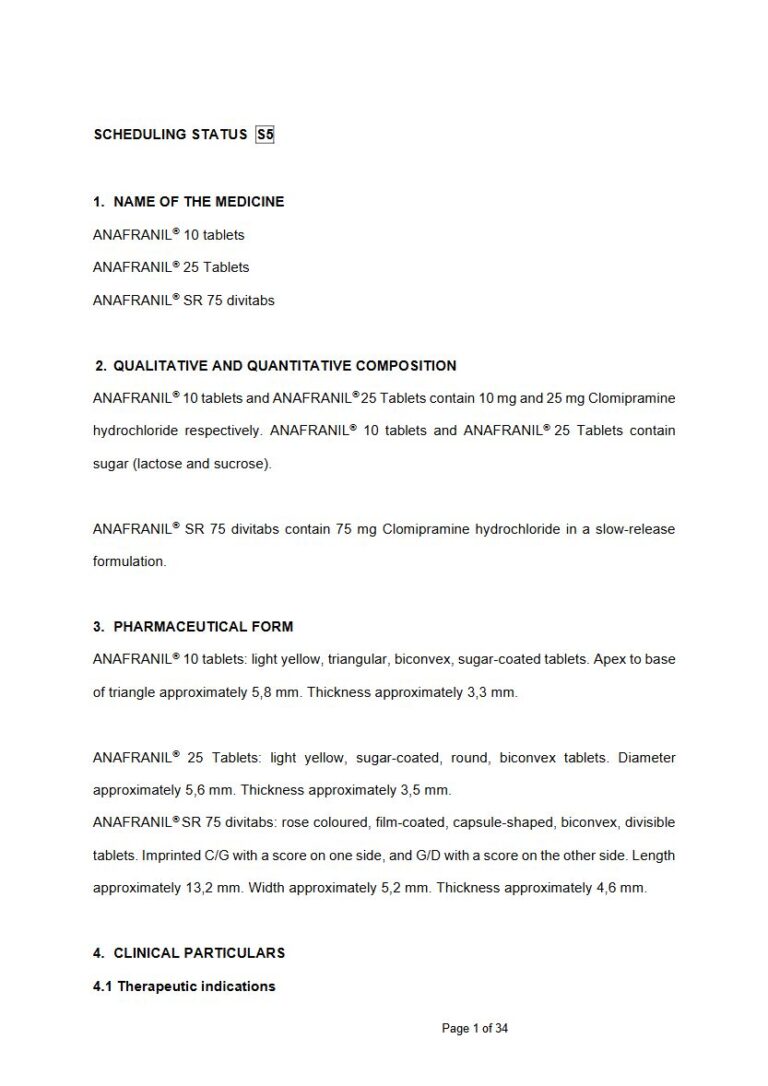
Anafranil 10 mg, 25mg Tablet or SR 75mg Divitabs
PDF Leaflet Revision Date: 24 May 2022
Clinical Summary
Quick overview from the medicine insert
Indication
Treatment of depressive episodes, OCD, and cataplexy.
Dosage (summary)
Adults: Start with 25 mg 2-3 times daily; max 250 mg. Elderly: Start with 10 mg daily, increase to 30-50 mg.
Special Populations
- Elderly
- Children and adolescents
Pregnancy & Breastfeeding
Not recommended during pregnancy; may harm fetus. Clomipramine passes into breast milk.
Key Drug Interactions
- MAO-inhibitors
- SSRIs
- CYP2D6 inhibitors
Contraindications
- Hypersensitivity to clomipramine
- Recent myocardial infarction
- Severe liver disease
- Hypokalaemia
Common side effects
- Dry mouth
- Constipation
- Dizziness
- Fatigue
Counselling Points
- Avoid abrupt discontinuation
- Monitor for worsening depression
- Caution with alcohol and CNS depressants
Serious warnings
- Risk of suicide
- QTc prolongation
- Serotonin syndrome
Important Disclaimer
The Anafranil 10 mg, 25mg Tablet or SR 75mg Divitabs professional information leaflet below is the property of Equity Pharmaceuticals and is provided on Medinsert exactly as issued, with no.. alterations or editorial changes. We make every effort to keep content current by updating documents as soon as new versions become available. Medinsert serves as a trusted access point for healthcare professionals, but does not replace official sources or clinical judgement. For more details, please read our full disclaimer. read more>>
 Healthcare Professionals Only
This content is for registered healthcare professionals
Sign in or create a free account to read the full package insert.
Free for HPCSA-registered professionals. Powered by Medinsert.
Clinical Particulars
Section 4 of the official insert — extracted exactly as issued, no alterations
4.1 Therapeutic indications
Adults: Treatment of depressive episodes, recurrent depressive disorders or major depression. Cataplexy accompanying narcolepsy. Obsessive-compulsive syndromes. Children and adolescents: Obsessiveu2013compulsive syndromes in children 5 years of age and older.
4.2 Posology and method of administration
Posology Medical supervision is essential. Before initiating treatment with ANAFRANIL, hypokalaemia should be treated (see section 4.4). The dosage and mode of administration should be determined individually and adapted to the patient's condition. The ANAFRANIL u00ae SR 75 divitabs can be halved, but must not be chewed. They are fractionable into two equal halves allowing flexible dosages. The lowest dose possible, in order to achieve an optimal therapeutic effect should be used and the dosage should be built up gradually to ensure maximum tolerability. Caution should be exercised in elderly and adolescent patients. As a precaution against possible QTc prolongation and serotonergic toxicity, adherence to the recommended doses of ANAFRANIL is advised and any increase in dose should be made with caution if medicines that prolong QTc interval or other serotonergic agents are co-administered (see sections 4.4 and 4.5).
Adults Depression and obsessive-compulsive disorders Oral: Treatment should be initiated with 1 tablet of 25 mg 2 to 3 times daily or 1 ANAFRANIL u00ae SR 75 divitab of 75 mg once a day (preferably in the evening). The daily dosage should be raised stepwise, e.g. 25 mg every few days, (depending on how the medication is tolerated) to 2 to 4 tablets of 25 mg or 1 ANAFRANIL u00ae SR 75 divitab during the first week of treatment. Higher doses may be needed in some patients, particularly those suffering from obsessional disorders. A maximum dose of 250 mg should not be exceeded. Once a distinct improvement has occurred, adjust the daily dosage to a maintenance level averaging two to four 25 mg tablets or one ANAFRANIL u00ae SR 75 divitab. ANAFRANIL may be given traditionally in divided doses throughout the day or may be administered in a single dose at bedtime by administration of the doses of 10 mg or 25 mg tablets or sustained release ANAFRANIL u00ae SR 75 divitabs of 75 mg. The dosage should be built up gradually for the single bedtime dose, in order to ensure maximum tolerability.
Cataplexy accompanying narcolepsy ANAFRANIL should be given orally in a daily dose of 25 to 75 mg.
Geriatrics Initiate treatment with 1 tablet of 10 mg daily. Gradually raise the dosage to an optimum level of 30 to 50 mg daily, which should be reached after about 10 days and then adhered to until the end of treatment.
Children and adolescents Obsessive-compulsive syndromes The starting dose is 25 mg daily and should be gradually increased (also given in divided doses) during the first two weeks, as tolerated, up to a daily maximum of 3 mg/kg or 100 mg, whichever is smaller. Thereafter, the dosage may be increased gradually over the next several weeks up to a daily maximum of 3 mg/kg or 200 mg, whichever is smaller.
Method of administration ANAFRANIL u00ae 10 tablets, ANAFRANIL u00ae 25 Tablets and ANAFRANIL u00ae SR 75 divitabs: For oral use.
4.3 Contraindications
- Known hypersensitivity to clomipramine or any of the excipients of ANAFRANIL (see section 6.1) or cross sensitivity to tricyclic antidepressants belonging to the dibenzazepine group.
- Combination therapy with other antidepressants.
- Recent myocardial infarction, any degree of heart block or other cardiac dysrhythmias.
- Congenital long QT syndrome.
- Severe liver disease.
- Hypokalaemia.
- Concomitant treatment with ANAFRANIL and MAO-inhibitors including selective, reversible MAO-inhibitors such as moclobemide is contraindicated. In patients who have been receiving a MAO-inhibitor, ANAFRANIL should be given only after an adequate interval (14 days) has elapsed following withdrawal of the MAO-inhibitor (see section 4.5) as severe interactions may occur (e.g. hyperactivity, hypertensive crisis, hyperpyrexia, spasticity, convulsions, coma). The same caution should be observed when administering a MAO-inhibitor after treatment with ANAFRANIL.
- Narrow-angle glaucoma.
- Retention of urine.
- Mania.
4.4 Special warnings and precautions for use
This medicine should at all times be kept out of the reach of children, as relatively small overdoses may be fatal to them. Abrupt discontinuation of therapy with ANAFRANIL should be avoided because of possible withdrawal symptoms. Therefore, dosage should be stopped gradually after regular use for long duration and the patient should be monitored carefully when clomipramine therapy is discontinued.
Anaphylactic shock: Isolated cases of anaphylactic shock have been reported.
Risk of suicide: Risk of suicide is inherent to severe depression and may persist until significant remission occurs. Patients with depressive disorders, both adult and paediatric, may experience worsening of depression and/or suicidality or other psychiatric symptoms, whether or not they are taking antidepressant medication. Antidepressants increased the risk of suicidal thinking and behaviour (suicidality) in short-term studies in children and adolescents with depressive disorders and other psychiatric disorders.
All patients being treated with ANAFRANIL for any indication should be observed closely for clinical worsening, suicidality and other psychiatric symptoms (see section 4.8), especially during the initial phase of therapy or at times of dose changes.
Modifying the therapeutic regimen, including possibly discontinuing the medication, should be considered in these patients, especially if these changes are severe, abrupt in onset, or were not part of the patientu2019s presenting symptoms (see also Treatment Discontinuation ).
Families and caregivers of both paediatric and adult patients being treated with antidepressants for both psychiatric and non-psychiatric indications, should be alerted about the need to monitor patients for the emergence of other psychiatric symptoms (see section 4.8), as well as the emergence of suicidality, and to report such symptoms immediately to health care providers.
Prescriptions for ANAFRANIL should be written for the smallest quantity of tablets or ANAFRANIL u00ae SR 75 divitabs consistent with good patient management, in order to reduce the risk of overdose.
In children and adolescents, there is not sufficient evidence of safety and efficacy of ANAFRANIL in the treatment of depressive states of varying aetiology and symptomatology and cataplexy accompanying narcolepsy. The use of ANAFRANIL in children and adolescents (0 u2013 17 years of age) in these indications is therefore not recommended.
Other psychiatric effects: Many patients with panic disorders experience intensified anxiety symptoms at the start of the treatment with ANAFRANIL. This paradoxical initial increase in anxiety is most pronounced during the first few days of treatment and generally subsides within two weeks.
Activation of psychosis has occasionally been observed in patients with schizophrenia receiving ANAFRANIL.
Caution should be observed with patients suffering from a bipolar disorder, as] [hypomania or mania can be precipitated in such patients. Hypomanic or manic episodes have also been reported during a depressive phase in patients with cyclic affective disorders receiving treatment with a tricyclic antidepressant. In such cases it may be necessary to reduce the dosage of ANAFRANIL or to withdraw it and administer an antipsychotic agent. After such episodes have subsided, low dose therapy with clomipramine may be resumed if required.
In predisposed patients, ANAFRANIL may provoke pharmacogenic (delirious) psychoses, particularly at night. These disappear within a few days of withdrawing the medicine.
As improvement in depression may not occur for the first two to four weeks of treatment, patients should be closely monitored during this period.
Elderly patients are particularly liable to experience adverse effects, especially agitation, confusion, and postural hypotension. Before initiating treatment, it is advisable to check the patientu2019s blood pressure because hypotensives and individuals with a labile circulation may react to the medicine with a fall in blood pressure. This can be controlled by reducing the dosage.
Serotonin syndrome: Due to the risk of serotonergic toxicity, it is advisable to adhere to recommended doses. Serotonin Syndrome, with symptoms such as hyperpyrexia, myoclonus, agitation, seizures, delirium and coma, can possibly occur when ANAFRANIL is administered with serotonergic co-medications such as SSRIs, SNRIs, tricyclic antidepressants or lithium (see section 4.2 and 4.5).
For fluoxetine a washout period of two to three weeks is advised before and after treatment with fluoxetine.
Convulsions: Tricyclic antidepressants are known to lower the convulsion threshold and ANAFRANIL should therefore, be used with extreme caution in patients with epilepsy or in patients prone to convulsions or seizures; and other predisposing factors such as brain damage of various aetiology, concomitant use of neuroleptics, withdrawal from alcohol or medicines with anticonvulsive properties (e.g. benzodiazepines). It appears that the occurrence of seizures is dose dependent. Therefore, the recommended total daily dose of ANAFRANIL should not be exceeded.
Concomitant treatment with ANAFRANIL and electroconvulsive therapy should only be resorted to under careful supervision.
Anticholinergic effects: Because of its anticholinergic properties, ANAFRANIL should be used with caution in patients with a history of increased intra-ocular pressure, narrow-angle glaucoma, urinary retention or with symptoms of bladder neck obstruction, e.g. diseases of the prostate, such as prostatic hypertrophy. Decreased lacrimation and accumulation of mucoid secretions due to the anticholinergic properties of tricyclic antidepressants may cause damage to the corneal epithelium in patients with contact lenses. The use of artificial tears is recommended in these patients.
The simultaneous administration of anticholinergic agents may be dangerous (see section 4.5).
Specific treatment populations: Caution is called for when giving ANAFRANIL to patients with severe hepatic disease and tumours of the adrenal medulla (e.g. phaeochromocytoma, neuroblastoma), in whom the medicine may provoke hypertensive crises. Caution is advised in patients with hyperthyroidism or during concomitant treatment with thyroid preparations, since aggravation of unwanted cardiac effects may occur owing to the anticholinergic action.
It is advisable to monitor cardiac and hepatic function during long-term therapy with ANAFRANIL. In patients with hepatic and renal disease, periodic monitoring of hepatic enzyme levels and renal function is recommended.
An increase in dental caries has been reported during long-term treatment with ANAFRANIL. Regular dental check-ups are therefore advisable during long-term treatment.
Caution is called for in patients with chronic constipation. ANAFRANIL may cause paralytic ileus particularly in the elderly and in bedridden patients.
In elderly patients, tricyclic antidepressants may provoke pharmacogenic (delirious) psychoses, particularly at night. These disappear within a few days of withdrawing the medicine.
Monitoring of cardiac function and the ECG is indicated in elderly patients.
Long-term safety data in children and adolescents concerning growth, maturation and cognitive and behavioural development are not available.
White blood cell count: Occurrences of agranulocytosis have been connected with the use of ANAFRANIL. It is therefore also advisable to perform blood counts during treatment with ANAFRANIL, especially if the patient develops fever, an influenzal infection or sore throat.
Anticoagulants / Non-steroidal anti-inflammatory medicines: Skin and mucous membrane bleeding has been reported with clomipramine. ANAFRANIL should be used with caution among patients that simultaneously use medicines that increase the risk of bleeding, for example anticoagulants, salicylic acid derivatives and non-steroidal anti-inflammatory medicines (NSAIDs). Care should be taken in patients with an increased tendency to bleed.
Anaesthesia: Anaesthetics given during tri/tetracyclic antidepressant therapy may increase the risk of dysrhythmias and hypotension. Before general or local anaesthesia, the anaesthetist should be told that the patient has been receiving ANAFRANIL (see section 4.5).
Treatment discontinuation: Abrupt withdrawal should be avoided because of possible adverse reactions. If the decision has been made to discontinue treatment, medication should be tapered, as rapidly as is feasible, but with recognition that abrupt discontinuation can be associated with certain symptoms (see section 4.8, for a description of the risks of discontinuation of ANAFRANIL).
Central nervous system depression: The risks of central nervous system depression are greater when administered together with other central nervous system depressants (e.g. alcohol and barbiturates) and should therefore not usually be administered simultaneously. Since ANAFRANIL may diminish alcohol tolerance, patients should be advised to abstain from alcohol while under treatment.
Increased prolactin secretion: Owing to its antagonistic effect on dopamine, ANAFRANIL may increase prolactin secretion.
Lactose and sucrose: ANAFRANIL coated tablets contain lactose. Patients with the rare hereditary conditions of galactose intolerance, e.g. galactosaemia, Lapp lactase deficiency, glucose-galactose malabsorption or fructose intolerance should not take ANAFRANIL coated tablets. ANAFRANIL coated tablets contain sucrose. Patients with rare hereditary conditions such as fructose intolerance, glucose-galactose malabsorption or sucrase-isomaltase insufficiency should not take ANAFRANIL coated tablets. Blood sugar concentrations may be altered in diabetic patients.
4.5 Interactions with other medicines
Interactions resulting in a contraindication MAO-Inhibitors: Do not give ANAFRANIL for at least 2 weeks after discontinuation of treatment with MAO- inhibitors (there is a risk of severe symptoms such as hypertensive crisis, hyperpyrexia and those consistent with Serotonin Syndrome e.g. myoclonus, agitation, seizures, delirium and coma). The same applies when giving a MAO-inhibitor after previous treatment with ANAFRANIL. In both instances ANAFRANIL or the MAO-inhibitor should initially be given in small, gradually increasing doses and its effects monitored (see section 4.3).
MAO inhibitors, which are also potent CYP2D6 inhibitors in vivo , such as moclobemide, are contraindicated for coadministration with clomipramine (see section 4.3).
Interactions resulting in a concomitant use not recommended Diuretics: Diuretics may lead to hypokalaemia, which increases the risk of QTc prolongation and torsades de pointes. Hypokalaemia should therefore be treated prior to administration of ANAFRANIL (see sections 4.2 and 4.4).
Antiarrhythmics: Antiarrhythmics (such as quinidine and propafenone), which are potent inhibitors of CYP2D6, should not be used in combination with tricyclic antidepressants.
Selective serotonin re-uptake inhibitors (SSRIs): SSRIs which are inhibitors of CYP2D6, such as fluoxetine, paroxetine, or sertraline, and of others including CYP1A2 and CYP2C19 (e.g. fluvoxamine), may also increase plasma concentrations of clomipramine, with corresponding adverse effects. Steady-state serum levels of clomipramine increased u223c 4-fold by co-administration of fluvoxamine ( N- desmethylclomipramine decreased u223c 2-fold). In addition, co-medication with SSRIs may lead to additive effects on the serotonergic system (see Serotonergic Agents) (see sections 4.2 and 4.4).
Serotonergic agents: Serotonin Syndrome can possibly occur when clomipramine is administered with serotonergic co-medications such as selective serotonin reuptake inhibitors (SSRIs), serotonin and noradrenergic reuptake inhibitors (SNRIs), tricyclic antidepressants or lithium (see sections 4.2 and 4.4). For fluoxetine, a washout period of two to three weeks is advised before and after treatment with fluoxetine.
Interactions to be considered Interactions resulting in increased effect of clomipramine ANAFRANIL (clomipramine) is predominantly eliminated through metabolism. The primary route of metabolism is demethylation to form the active metabolite, N -desmethylclomipramine, followed by hydroxylation and further conjugation of both N -desmethylclomipramine and the parent medicine. Several cytochrome P450s are involved in the demethylation, mainly CYP3A4, CYP2C19 and CYP1A2. Elimination of both active components is by hydroxylation and this is catalysed by CYP2D6.
Concomitant administration of CYP2D6 inhibitors may lead to an increase in concentration of both active components, up to u223c 3-fold in patients with a debrisoquine/sparteine extensive metaboliser phenotype, converting them to a poor-metaboliser phenotype. Concomitant administration of CYP1A2, CYP2C19 and CYP3A4 inhibitors are expected to increase clomipramine concentrations and decrease N -desmethylclomipramine, thus not necessarily affecting the overall pharmacology.
Oral antifungal, terbinafine: Co-administration of clomipramine with terbinafine, a strong inhibitor of CYP2D6, may result in increased exposure and accumulation of clomipramine and its N-demethylated metabolite. Therefore, dose adjustments of ANAFRANIL may be necessary when co-administered with terbinafine.
Cimetidine: Co-administration with histamine 2 (H 2 )-receptor antagonist, cimetidine (an inhibitor of several P450 enzymes, including CYP2D6 and CYP3A4), may increase plasma concentrations of tricyclic antidepressants, whose dosage should therefore be reduced.
Oral contraceptives: No interaction between chronic oral contraceptive use (15 or 30 micrograms ethinyl oestradiol daily) and ANAFRANIL (25 mg daily) has been documented. Oestrogens are not known to be inhibitors of CYP2D6, the major enzyme involved in clomipramine clearance and, therefore, no interaction is expected. Although, in a few cases with high dose oestrogen (50 micrograms daily) and the tricyclic antidepressant imipramine, increased side effects and therapeutic response were noted, it is unclear as to the relevance of these cases to clomipramine and lower dose oestrogen regimens. Monitoring therapeutic response of tricyclic antidepressants at high dose oestrogen regimens (50 micrograms daily) is recommended and dose adjustments may be necessary.
Antipsychotics: Co-medication of antipsychotics (e.g. phenothiazines) may result in increased plasma levels of tricyclic antidepressants, a lowered convulsion threshold, and seizures. Combination with thioridazine or pimozide may produce severe cardiac dysrhythmias.
Methylphenidate: Methylphenidate (e.g. Ritalin) may also increase plasma concentrations of tricyclic antidepressants by potentially inhibiting their metabolism, and a dose reduction of ANAFRANIL may be necessary.
Valproate: Concomitant administration of valproate with ANAFRANIL may cause inhibition of CYP2C and/or UGT enzymes, resulting in increased serum levels of clomipramine and desmethylclomipramine.
Grapefruit, grapefruit juice, or cranberry juice: Concomitant administration of ANAFRANIL with grapefruit, grapefruit juice, or cranberry juice may increase the plasma concentrations of clomipramine.
Interactions resulting in decreased effect of clomipramine Rifampicin: Rifampicin (CYP3A and CYP2C inducer), may decrease clomipramine concentrations as concomitant administration of medicines known to induce cytochrome P450 enzymes, particularly CYP3A4, CYP2C19 and/or CYP1A2 may accelerate the metabolism and decrease the efficacy of ANAFRANIL.
Anticonvulsants: Anticonvulsants (CYP3A and CYP2C inducer) e.g. barbiturates, carbamazepine, phenobarbital and phenytoin, may decrease clomipramine concentrations as concomitant administration of medicines known to induce cytochrome P450 enzymes, particularly CYP3A4, CYP2C19 may accelerate the metabolism and decrease the efficacy of clomipramine.
Cigarette smoking: Known inducers of CYP1A2 (e.g. nicotine/components in cigarette smoke), decrease plasma concentrations of tricyclic medicines. In cigarette smokers, clomipramine steady-state plasma concentrations were decreased 2-fold compared to non-smokers (no change in N - desmethylclomipramine).
Colestipol and cholestyramine: Concomitant administration of ion exchange resins such as cholestyramine or colestipol may reduce the plasma levels of clomipramine. Staggering the dosage of ANAFRANIL and resins, such that the medicine is administered at least 2 h before or 4 u2013 6 h after the administration of resins, is recommended.
St. John's wort: Concomitant administration of ANAFRANIL with St. John's wort during the treatment may decrease the plasma concentrations of clomipramine.
4.6 Fertility, pregnancy and lactation
Women of child-bearing potential: There are no data supporting any special recommendations in women of child-bearing potential.
Pregnancy: Safety in pregnancy has not been established. There is a limited amount of data from the use of clomipramine in pregnant women that indicates a potential to harm the foetus or cause congenital malformation. Neonates whose mothers had taken ANAFRANIL up until delivery have developed dyspnoea, lethargy, colic, irritability, hypotension or hypertension, tremor or spasms, during the first few hours or days. Studies in animals have shown reproductive toxicity (see section 5.3).
ANAFRANIL is not recommended during pregnancy and in women of child-bearing potential not using contraception.
Lactation: Clomipramine passes into the breast milk. Therefore, nursing mothers receiving ANAFRANIL should be advised to withdraw the medication or cease breastfeeding.
Fertility: Clomipramine hydrochloride did not appear to have any significant effects on fertility and general reproductive performance.
4.7 Effects on ability to drive and use machines
At the time of initiation of therapy, patients should be advised not to drive a motor vehicle, climb heights or operate machinery for at least several days. In these situations, impaired decision-making could lead to accidents and caution is always necessary while on ANAFRANIL therapy. Patients receiving ANAFRANIL should be warned that blurred vision, drowsiness and other nervous system and psychiatric related disorders such as somnolence, disturbance in attention, confusion, disorientation, aggravation of depression, delirium etc (see section 4.8) have been observed. In the presence of such effects, patients should not drive, operate machinery or do anything else which may require alertness or quick actions. Patients should also be warned that alcohol or other medicines may potentiate these effects (see section 4.5).
4.8 Undesirable effects
Undesirable effects are usually mild and transient, disappearing under continued treatment or with a reduction in the dosage. They do not always correlate with plasma medicine levels or dose. It is often difficult to distinguish certain undesirable effects from symptoms of depression such as fatigue, sleep disturbances, agitation, anxiety, constipation, and dry mouth. If severe neurological or psychiatric reactions occur, ANAFRANIL should be withdrawn.
Peripheral anticholinergic side effects, notably dry mouth, constipation, urinary retention and pupillary dilatation with blurred vision and changes in visual accommodation can occur. When anticholinergic effects are severe the medicine should be discontinued or reduced.
Adverse reactions are ranked under heading of frequency, the most frequent first, using the following convention: very common (u2265 1/10); common (u2265 1/100, < 1/10); uncommon (u22651/1 000, < 1/100); rare (u2265 1/ 10 000, < 1/1 000); very rare (< 1/ 10 000), including isolated reports, not known (cannot be estimated from the available data).
Blood and lymphatic system disorders : Very rare: Leucopenia, agranulocytosis, thrombocytopenia, eosinophilia.
Immune system disorders : Very rare: Anaphylactic and anaphylactoid reactions including hypotension.
Endocrine disorders: Very rare: SIADH (inappropriate antidiuretic hormone secretion syndrome).
Metabolism and nutrition disorders: Very common: Increased appetite. Common: Decreased appetite.
Psychiatric disorders: Very common: Restlessness. Common: Confusional state, disorientation, hallucinations (particularly in elderly patients and patients suffering from Parkinson's disease), anxiety, agitation, sleep disorder, mania, hypomania, aggression, depersonalisation, aggravation of depression, insomnia, nightmares, delirium. Uncommon: Activation of psychotic symptoms. Not known: Suicidal ideation, suicidal behaviours.
Nervous system disorders: Very common: Dizziness, tremor, headache, myoclonus, somnolence. Common: Speech disorder, paraesthesia, hypertonia, dysgeusia, memory impairment, disturbance in attention. Uncommon: Convulsions, ataxia. Very rare: Neuroleptic malignant syndrome. Not known: Serotonin syndrome, extrapyramidal disorder (including akathisia and tardive dyskinesia).
Eye disorders: Very common : Accommodation disorder, vision blurred. Common : Mydriasis. Very rare : Glaucoma.
Ear and labyrinth disorders: Common: Tinnitus.
Cardiac disorders : Common: Sinus tachycardia, palpitations, orthostatic hypotension, clinically irrelevant ECG changes (e.g. ST and T changes), in patients of normal cardiac status. Uncommon: Dysrhythmias, blood pressure increased. Very rare: Conduction disorders (e.g. widening of QRS complex, prolonged QT interval, PQ changes, bundle-branch block, torsades de pointes, particularly in patients with hypokalaemia).
Vascular disorders: Common: Hot flush.
Respiratory, thoracic, and mediastinal disorders: Common: Yawning. Very rare: Alveolitis allergic (pneumonitis) with or without eosinophilia.
Gastrointestinal disorders: Very common: Nausea, dry mouth, constipation. Common: Vomiting, gastrointestinal disorders, diarrhoea.
Hepatobiliary disorders: Very rare: Hepatitis with or without jaundice.
Skin and subcutaneous tissue disorders: Very common: Hyperhidrosis. Common: Dermatitis allergic (skin rash, urticaria), photosensitivity reaction, pruritus. Very rare: Ecchymosis, purpura, alopecia.
Musculoskeletal and connective tissue disorders: Common: Muscular weakness. Not known: Rhabdomyolysis (as a complication of neuroleptic malignant syndrome).
Renal and urinary disorders: Very common: Micturition disorder. Common: Urinary retention.
Reproductive system and breast disorders: Very common: Libido disorder erectile dysfunction. Common: Galactorrhoea, breast enlargement, women occasionally experience orgasmic impotence. Rare : Vaginal bleeding. Not known: Ejaculation failure, ejaculation delayed.
General disorders and administration site conditions: Very common: Fatigue. Investigations: Very common: Weight increased, blood sugar changes. Common: Elevated transaminases. Very rare: Electroencephalogram abnormal. Not known: Blood prolactin increased.
Withdrawal symptoms: The following symptoms commonly occur after abrupt withdrawal or reduction of the dose: Nausea, vomiting, abdominal pain, diarrhoea, insomnia, headache, nervousness and anxiety (see section 4.4).
Class effects: Epidemiological studies, mainly conducted in patients 50 years of age and older, show an increased risk of bone fractures in patients receiving SSRIs and tricyclic antidepressants. The mechanism leading to this risk is unknown.
Elderly population: Elderly patients are particularly sensitive to anticholinergic, neurological, psychiatric, or cardiovascular effects. Their ability to metabolise and eliminate medicines may be reduced, leading to a risk of elevated plasma concentrations at therapeutic doses. Therapy should be initiated at lower than standard doses in the elderly.
Reporting of suspected adverse reactions Reporting suspected adverse reactions after authorisation of the medicine is important. It allows continued monitoring of the benefit/risk balance of the medicine. Health care providers are asked to report any suspected adverse reactions to SAHPRA via the u201c6.04 Adverse Drug Reactions Reporting Formu201d, found online under SAHPRAu2019s publications: https://www.sahpra.org.za/Publications/Index/8
4.9 Overdose
Signs and symptoms: Overdosage and poisoning may be characterised by central nervous system depression or excitation, severe anticholinergic effects (which set in about a half to two hours after ingestion) and cardiotoxicity. The following symptoms and signs are characteristic of acute overdosage:
Central nervous system: Drowsiness, stupor, coma, ataxia, restlessness, agitation, enhanced reflexes, muscular rigidity, athetoid and choreoathetoid movements, convulsions. In addition, symptoms consistent with Serotonin Syndrome (e.g. hyperpyrexia, myoclonus, delirium and coma) may be observed.
Cardiovascular system: Hypotension, tachycardia, QTc prolongation and arrhythmia, including torsades de pointes, conduction disorders, shock, heart failure, in very rare cases cardiac arrest. Respiratory depression, cyanosis, vomiting, fever, mydriasis, sweating and oliguria or anuria may also occur.
Treatment: There is no specific antidote. Treatment is symptomatic and supportive. Since physostigmine increases the risk of seizures occurring, it should not be used. Anyone suspected of receiving an overdose of ANAFRANIL, particularly children, should be hospitalised and kept under close surveillance for at least 72 hours. Perform gastric lavage or induce vomiting as soon as possible if the patient is alert. If the patient has impaired consciousness, secure the airway with a cuffed endotracheal tube before beginning lavage, and do not induce vomiting. These measures are recommended for up to 12 hours or even longer after the overdose, since the anticholinergic effect of the medicine may delay gastric emptying. Administration of activated charcoal may help to reduce medicine absorption.
Treatment of symptoms is based on modern methods of intensive care, with continuous monitoring of cardiac function, blood gases, and electrolytes, and if necessary, emergency measures such as: For respiratory failure: - intubation and artificial respiration. For cardiovascular symptoms: - in severe hypotension the patient should be placed in an appropriate position and be given a plasma expander, dopamine, or dobutamine by intravenous drip. - cardiac dysrhythmias must be treated according to the requirements of the case. - implantation of a cardiac pacemaker should be considered. - low potassium values and acidosis should be corrected. In all patients with ECG abnormalities, cardiac function should - even after the ECG tracings have reverted to normal - be kept under close observation for at least another 48 hours because relapses may occur.
Treatment of torsades de pointes: If torsades de pointes should occur during treatment with ANAFRANIL, the medicine should be discontinued and hypoxia, electrolyte abnormalities and acid base disturbances should be corrected. Persistent torsades de pointes may be treated with magnesium sulphate 2 g (20 ml of 10 % solution) intravenously over 30 u2013 120 seconds, repeated twice at intervals of 5 u2013 15 minutes if necessary. Alternatively, if these measures fail, the arrhythmia may be abolished by increasing the underlying heart rate. This can be achieved by atrial and ventricular pacing or by isoprenaline (isproterenol) infusion to achieve a heart rate of 90 u2013 110 beats per minute. Torsades de pointes is usually not helped by antiarrhythmic medicines and those which prolong the QTc interval (e.g. amiodarone, quinidine) may make it worse.
Since it has been reported that physostigmine may cause severe bradycardia, asystole and seizures, its use is not recommended in cases of overdosage with ANAFRANIL. Haemodialysis or peritoneal dialysis are ineffective because of the low plasma concentrations of clomipramine.
For convulsions: Diazepam should be given intravenously or other anticonvulsants such as phenobarbitone or paraldehyde (these substances may exacerbate existing respiratory failure, hypotension, or coma).
