
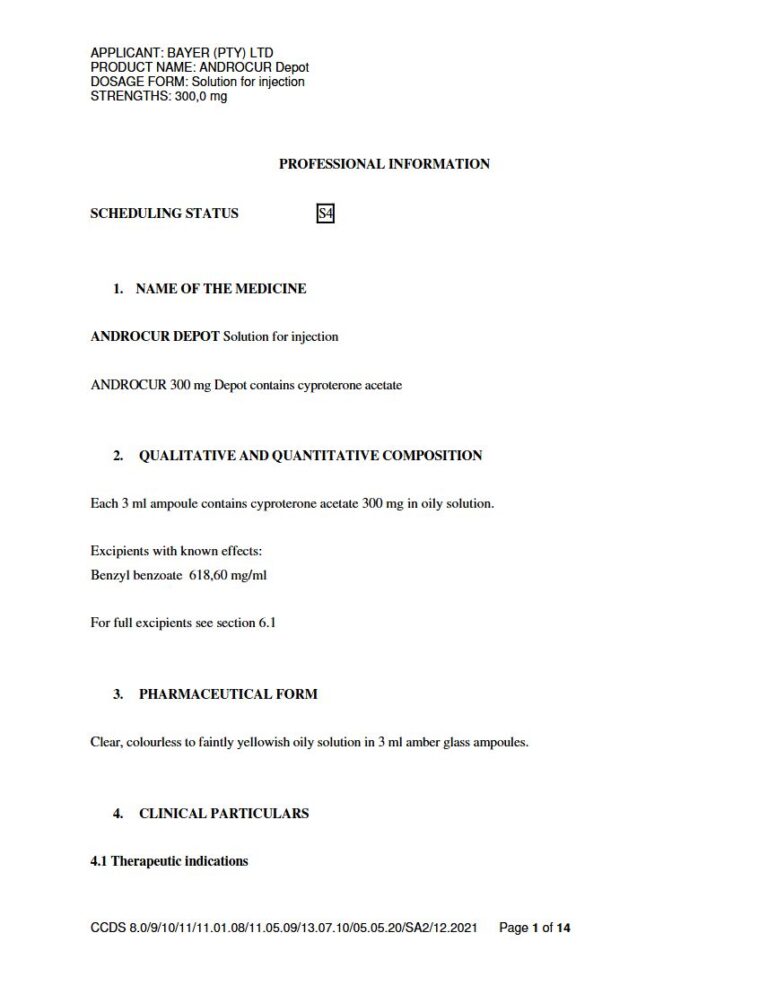
Androcur Depot 300 mg Injection
PDF Leaflet Revision Date: 14/12/2021
Clinical Summary
Quick overview from the medicine insert
Indication
Reduction of drive in sexual deviations in males; Antiandrogen treatment in inoperable carcinoma of the prostate.
Dosage (summary)
1 ampoule (300 mg) IM every 10-21 days; 300 mg weekly without orchidectomy.
Special Populations
- Paediatric population
- Hepatic impairment
- Geriatric patients
- Renal impairment
Pregnancy & Breastfeeding
Not indicated for women; safety in pregnancy not established.
Key Drug Interactions
- CYP3A4 inhibitors (e.g., ketoconazole)
- CYP3A4 inducers (e.g., rifampicin)
Contraindications
- Liver diseases
- Meningioma
- Thromboembolic processes
- Severe diabetes with vascular changes
Common side effects
- Decreased libido
- Erectile dysfunction
- Hepatic toxicity
- Thromboembolic events
Counselling Points
- Monitor liver function regularly
- Avoid alcohol during treatment
- May impair ability to concentrate
Serious warnings
- Hepatic toxicity
- Risk of meningioma
- Thromboembolic events
Important Disclaimer
The Androcur Depot 300 mg Injection professional information leaflet below is the property of Bayer and is provided on Medinsert exactly as issued, with no.. alterations or editorial changes. We make every effort to keep content current by updating documents as soon as new versions become available. Medinsert serves as a trusted access point for healthcare professionals, but does not replace official sources or clinical judgement. For more details, please read our full disclaimer. read more>>
 Healthcare Professionals Only
This content is for registered healthcare professionals
Sign in or create a free account to read the full package insert.
Free for HPCSA-registered professionals. Powered by Medinsert.
Clinical Particulars
Section 4 of the official insert — extracted exactly as issued, no alterations
4.1 Therapeutic indications
Reduction of drive in sexual deviations in males; Antiandrogen treatment in inoperable carcinoma of the prostate.
4.2 Posology and method of administration
Posology
The injections must be administered very slowly.
ANDROCUR Depot is strictly for intramuscular injection. Special care must be given to avoid intravasal injection.
Reduction of drive in sexual deviations in males
In general, 1 ampoule of ANDROCUR Depot is given as a deep intramuscular injection every 10 to 21 days.
If, in exceptional cases, the effect is inadequate, 2 ampoules can be given every 10 to 21 days, preferably as 1 ampoule each in the right and left gluteal muscles. Efficacy can be maintained by injection intervals ranging from 10 to 21 days.
The duration of cyproterone acetate treatment should be defined on an individual basis. When the therapeutic result is considered to be satisfactory, an attempt should be made to reduce the dosage by gradually increasing the intervals between injections.
To stabilise the therapeutic effect it is necessary to administer ANDROCUR Depot over a protracted period of time, if possible with the simultaneous use of psychotherapeutic measures.
Antiandrogen treatment in inoperable carcinoma of the prostate
After orchidectomy: 300 mg (1 ampoule) every 2 weeks as a deep IM injection.
Without orchidectomy: 300 mg (1 ampoule) weekly as a deep IM injection.
Treatment should not be interrupted, nor the dosage reduced after improvement or remissions have occurred.
4.3 Contraindications
- Liver diseases.
- Dubin-Johnson syndrome, Rotor syndrome.
- Previous or existing liver tumours (only if these are not due to metastases from carcinoma of the prostate).
- Presence or history of meningioma
- Wasting diseases (with the exception of inoperable carcinoma of the prostate).
- Depression.
- Previous or existing thromboembolic processes.
- Severe diabetes with vascular changes.
- Sickle-cell anaemia.
- Hypersensitivity to any of the components of ANDROCUR Depot.
4.4 Special warnings and precautions for use
Liver
Direct hepatic toxicity, including jaundice, hepatitis and hepatic failure, has been observed in patients treated with ANDROCUR. At dosages of 100 mg and above also cases with fatal outcome have been reported.
Most reported fatal cases were in males with advanced carcinoma of the prostate.
Toxicity is dose-related and develops, usually, several months after treatment has begun. Liver function tests should be performed pre-treatment, at regular intervals during treatment and whenever any symptoms or signs suggestive of hepatotoxicity occur.
If hepatotoxicity is confirmed, ANDROCUR should be withdrawn, unless the hepatotoxicity can be explained by another cause, e.g. metastatic disease, in which case ANDROCUR should be continued only if the perceived benefit outweighs the risk.
Meningioma
The occurrence of meningiomas (single and multiple) has been reported in association with long-term use (years) of cyproterone acetate at doses of 25 mg/day and above. The risk of meningioma increases with increasing cumulative doses of cyproterone acetate. If a patient treated with ANDROCUR is diagnosed with meningioma, treatment with cyproterone containing product, including ANDROCUR must be permanently stopped (see section u20184.3u2019).
In very rare cases benign and malignant liver tumours, which may lead to life-threatening intra-abdominal haemorrhage, have been observed after the use of ANDROCUR. If severe upper abdominal complaints, liver enlargement or signs of intra-abdominal haemorrhage occur, a liver tumour should be included in the differential-diagnostic considerations.
Thromboembolic events
The occurrence of thromboembolic events has been reported in patients using ANDROCUR Depot, although a causal relationship has not been established. Patients with previous arterial or venous thrombotic/thromboembolic events (e.g. deep venous thrombosis, pulmonary embolism, and myocardial infarction) or with a history of cerebrovascular accidents or with advanced malignancies are at increased risk of further thromboembolic events.
In patients with inoperable carcinoma of the prostate, presenting with a history of thromboembolic processes or suffering from sickle-cell anaemia or from severe diabetes with vascular changes, a careful risk: benefit evaluation must be carried out in each individual case before ANDROCUR is prescribed.
Prolactin levels may increase with higher doses of ANDROCUR.
Anaemia
Anaemia has been reported during treatment with ANDROCUR. Therefore, the red-blood cell count should be checked regularly during treatment.
Shortness of breath
A sensation of shortness of breath may occur under high-dosed treatment with ANDROCUR. The differential diagnosis in such cases must include the stimulating effect on breathing known for progesterone and synthetic progestogens which is accompanied by hypocapnia and compensated respiratory alkalosis and which is not considered to require treatment.
ANDROCUR should not be given before the conclusion of puberty since an unfavourable influence on longitudinal growth and the still unstabilised axes of endocrine function cannot be ruled out.
ANDROCUR should be used with caution in cardiovascular disease, ischaemic heart disease, cerebrovascular disease and hypertension.
During treatment, liver function, adrenocortical function and the red blood-cell count should be checked regularly.
Diabetes mellitus
Strict medical supervision is necessary if the patient suffers from diabetes.
Adrenocortical function
During treatment, adrenocortical function should be checked regularly, as preclinical data suggest a possible suppression due to the corticoid-like effect of ANDROCUR with high doses (see section u20185.3u2019).
Other conditions
As with all oily solutions, ANDROCUR Depot must be injected strictly intramuscularly and very slowly. Pulmonary microembolism of oily solutions can in some cases lead to signs and symptoms such as cough, dyspnoea and chest pain. There may be other signs and symptoms including vasovagal reactions such as malaise, hyperhydrosis, dizziness, paraesthesia, or syncope. These reactions may occur during or immediately after the injection and are reversible. Treatment is usually supportive, e.g. by administration of oxygen.
In the indication u201creduction of drive in sexual deviationsu201d, the drive -reducing effect of ANDROCUR Depot can be diminished under the disinhibitory influence of alcohol.
4.5 Interaction with other medicines and other forms of interaction
Although clinical interaction studies have not been performed it is expected that ketoconazole, itraconazole, clotrimazole, ritonavir and other strong inhibitors of CYP3A4 will inhibit the metabolism of ANDROCUR as it is metabolised by CYP3A4. On the other hand, inducers of CYP3A4 such as e.g. rifampicin, phenytoin and products containing St Johnu2019s Wort may reduce the levels of ANDROCUR.
Based on in vitro inhibition studies, an inhibition of the cytochrome P450 enzymes CYP2C8, 2C9, 2C19, 3A4 and 2D6 is possible at high therapeutic ANDROCUR doses of 3 times 100 mg per day.
The risk of statin-associated myopathy or rhabdomyolysis may be increased when those HMGCoA inhibitors (statins), which are primarily metabolised by CYP3A4, are administered with high therapeutic ANDROCUR doses since they share the same metabolic pathway.
4.6 Fertility, pregnancy and lactation
Treatment with ANDROCUR depot (for use in men) is not indicated for women.
4.7 Effects on ability to drive and use machines
It should be pointed out to patients whose occupation demands great concentration (e.g. road users, machine operators) that ANDROCUR Depot can lead to tiredness and diminished vitality and can impair the ability to concentrate.
4.8 Undesirable effects
The most frequently observed adverse drug reactions (ADRs) in patients receiving ANDROCUR are decreased libido (u2265 1/10), erectile dysfunction (u2265 1/10) and reversible inhibition of spermatogenesis (u2265 1/10).
The most serious adverse drug reactions (ADRs) in patients receiving ANDROCUR are hepatic toxicity (u2265 1/100 and < 1/10), benign and malignant liver tumours (< 1/10 000) which may lead to intra-abdominal haemorrhage (frequency unknown), and thromboembolic events (u2265 1/10 000 and < 1/1000).
The frequencies of ADRs reported with ANDROCUR are summarized in the table below. Frequencies are defined as very common (u2265 1/10), common (u2265 1/100 and < 1/10), uncommon (u2265 1/1,000 and < 1/100), rare (u2265 1/10,000 and < 1/1,000) and very rare (< 1/10,000). The ADRs identified only during post marketing surveillance, and for which a frequency could not be estimated are listed under u201cnot knownu201d.
Under treatment with ANDROCUR Depot, sexual drive and potency are reduced and gonadal function is inhibited. These changes are reversible after discontinuation of therapy.
Over the course of several weeks, ANDROCUR Depot inhibits spermatogenesis as a result of the antiandrogenic and antigonadotropic actions. Spermatogenesis recovers gradually within a few months of discontinuing the therapy.
ANDROCUR Depot may lead to gynaecomastia (sometimes combined with tenderness to touch of the mamillae) which usually regresses after withdrawal of the preparation. Permanent enlargement of the mammary glands may occur. Galactorrhoea and benign nodules have been reported. Long-term androgen deprivation with ANDROCUR may lead to osteoporosis.
Meningiomas have been reported in association with long-term use (several years) of ANDROCUR doses of 25 mg and above. (see section u201c4.3u201d and section u201c4.4u201d)
4.9 Overdose
See u201cSection 4.8u201d. Treatment is supportive and symptomatic.
