
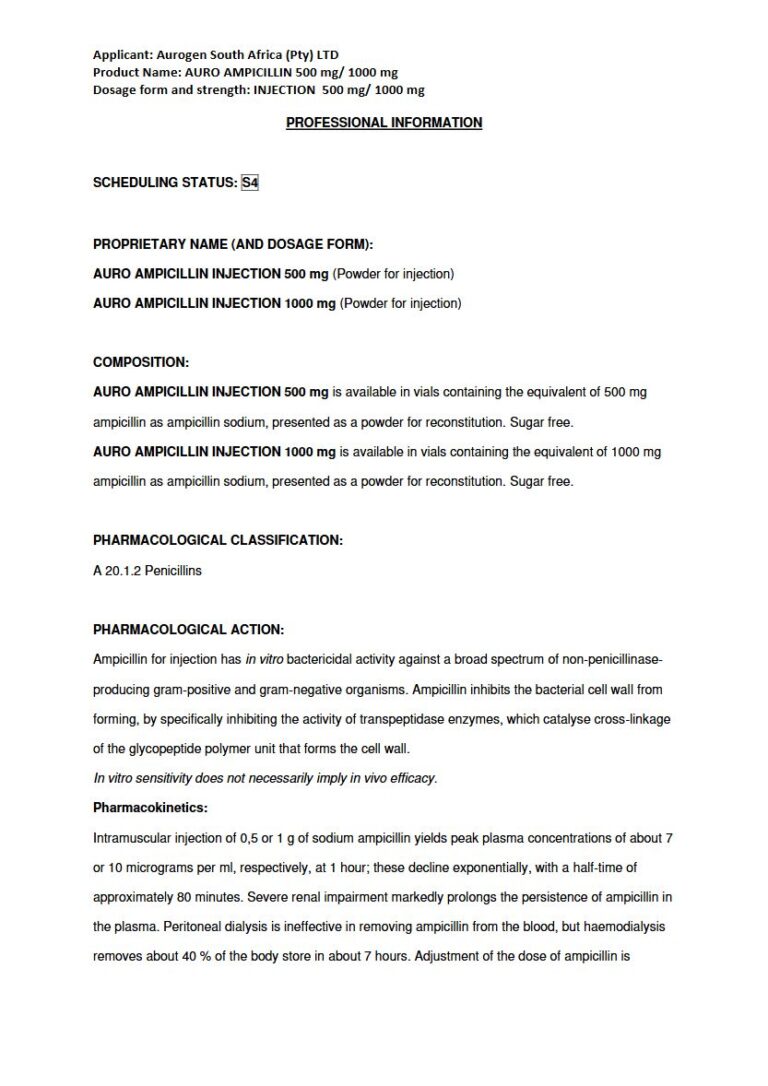
Auro Ampicillin Injection
PDF Leaflet Revision Date: 02 February 2022
Clinical Summary
Quick overview from the medicine insert
Indication
Treatment of bacterial infections caused by non-penicillinase-producing ampicillin-sensitive organisms.
Dosage (summary)
500 - 1000 mg IV 4-6 times daily; Meningitis: 2 g every 6 hours.
Onset of Action / Duration
Onset: 1 hour, Duration: 1-1.5 hours
Special Populations
- Elderly
- Renal impairment
Pregnancy & Breastfeeding
Safety in pregnancy and lactation not established; may cause sensitization in infants.
Key Drug Interactions
- Increased INR with anticoagulants
- Decreased efficacy of oral contraceptives
- Increased risk of rashes with allopurinol
Contraindications
- Hypersensitivity to penicillins or cephalosporins
- Neonates born to hypersensitive mothers
Common side effects
- Hypersensitivity reactions
- Nausea
- Vomiting
- Diarrhea
Counselling Points
- Observe for allergic reactions
- Maintain adequate hydration
- Avoid alcohol during treatment
Serious warnings
- Serious hypersensitivity reactions
- Monitor for Jarisch-Herxheimer reaction in syphilis patients
Important Disclaimer
The Auro Ampicillin Injection professional information leaflet below is the property of Aurogen South Africa and is provided on Medinsert exactly as issued, with no.. alterations or editorial changes. We make every effort to keep content current by updating documents as soon as new versions become available. Medinsert serves as a trusted access point for healthcare professionals, but does not replace official sources or clinical judgement. For more details, please read our full disclaimer. read more>>
 Healthcare Professionals Only
This content is for registered healthcare professionals
Sign in or create a free account to read the full package insert.
Free for HPCSA-registered professionals. Powered by Medinsert.
Clinical Particulars
Section 4 of the official insert — extracted exactly as issued, no alterations
4.1 Therapeutic indications
AURO AMPICILLIN INJECTION is indicated for the treatment of bacterial infections caused by non-penicillinase-producing ampicillin-sensitive organisms. AURO AMPICILLIN INJECTION is effective in conditions caused by:
- Gram-positive non-penicillinase producing staphylococci, haemolytic and non-haemolytic streptococci, Diplococcus pneumoniae, Clostridium species and Streptococcus faecalis.
- Gram-negative cocci Neisseria species, H.influenzae, E.coli, Proteus mirabilis and many strains of brucellae, Salmonellae and Shigellae.
Parenteral usage is indicated where oral dosage is inappropriate.
4.2 Posology and method of administration
Recommended Adult Dosage: Adults (including elderly patients): 500 - 1000 mg 4 - 6 times a day intravenously for as long as IV therapy is required. Meningitis: 2 g six-hourly intravenously. (Children's dosage: 150 mg/kg daily intravenously in 4 divided doses). In the treatment of beta-haemolytic streptococcal infections, a therapeutic dose must be administered for at least 10 days. The above dosages may be increased in particularly severe infections. Children < 20 kg: 10 - 25 mg/kg 6 hourly. Children u2265 20 kg: Adult dose. Meningitis or severe infections: 50 mg/kg 6 hourly. Neonates: 5 mg/kg/dose (meningitis: 100 mg/kg/dose) 12 hourly in the first week of life, and then 8 hourly. Then 1 - 3 mg/kg/dose 6 hourly.
Administration: Intramuscular: 500 mg, 1 g - add 1,5 to 2,0 ml Water for Injections. Intravenous: Dissolve the contents of a vial in the specified volume of Water for Injections: 500 mg - 10,0 ml; 1 g - 20,0 to 30,0 ml. The intravenous dose is given by slow injection (3 - 4 minutes) but may also be added to infusion fluids or be injected, suitably diluted, into the drip tube over 3 - 4 minutes.
4.3 Contraindications
AURO AMPICILLIN INJECTION should not be given to:
- Patients known to be hypersensitive or allergic to penicillins or cephalosporins (see u201cWARNINGS AND SPECIAL PRECAUTIONSu201d).
- Babies in the neonatal period, born to mothers hypersensitive to ampicillin.
- Safety in pregnancy and lactation has not been established (see u201cPREGNANCY AND LACTATIONu201d).
4.4 Special warnings and precautions for use
Serious and occasionally fatal hypersensitivity (severe anaphylactic) reactions have been reported in patients on ampicillin/penicillin therapy. Before initiating therapy with AURO AMPICILLIN INJECTION, careful enquiry should be made concerning previous hypersensitivity or allergic reactions to penicillins, cephalosporins or other allergies. These reactions are more likely to occur in individuals with a history of penicillin hypersensitivity and/or a history of sensitivity to multiple allergens. There have been reports of individuals with a history of penicillin hypersensitivity that have experienced severe reactions when treated with cephalosporins. Resuscitative equipment should be available when AURO AMPICILLIN INJECTION is to be administered, and patients should be observed for at least one hour after administration of AURO AMPICILLIN INJECTION. If an allergic reaction occurs, AURO AMPICILLIN INJECTION should be discontinued and the appropriate therapy instituted. Serious anaphylactic reactions may require immediate emergency treatment with adrenaline (epinephrine), oxygen, intravenous steroids, anti-histamines and airway management, including intubation.
Use with caution in patients with known history of allergy. Caution is needed when administering AURO AMPICILLIN INJECTION to patients with syphilis as the Jarisch-Herxheimer reaction may occur shortly after commencing treatment in these patients. This reaction, which manifests in fever, chills, headache and reactions at the site of the lesion, may be dangerous in cardiovascular syphilis or where there is a serious risk of increased local damage such as with optic atrophy. AURO AMPICILLIN INJECTION should be discontinued if a skin rash occurs. It should preferably be avoided if infectious mononucleosis, lymphatic leukemia or possibly HIV infection is suspected and also in patients receiving allopurinol treatment, because of an increased risk of rashes associated with these conditions, following the administration of AURO AMPICILLIN INJECTION.
When high doses are administered, adequate fluid intake and urinary output must be maintained. Prolonged use may result in overgrowth of non-susceptible organisms. Pseudomembranous enterocolitis has been reported. Increases in the INR have been reported in patients receiving AURO AMPICILLIN INJECTION. Appropriate monitoring should be undertaken when anticoagulants are prescribed concurrently. Periodic assessment of organ function, including renal, hepatic and haematopoietic functions, is advisable during prolonged therapy.
4.5 Interactions with other medicines
AURO AMPICILLIN INJECTION should not be mixed in the same syringe or administration set with aminoglycosides such as gentamycin, as substantial inactivation of the aminoglycosides may result, or with other beta-lactam antibacterials such as cephalosporins, as substantial mutual inactivation may result. If these groups of antibacterials are to be administered concurrently, they should be administered in separate sites, at least 1 hour apart. The meningococcal carrier state is not eliminated by AURO AMPICILLIN INJECTION therapy. Sodium content must be taken into account in patients on a sodium-restricted diet if the administration of high doses is necessary. Do not add to containers of infusions containing dextrose. It may be piggybacked via the same administration set.
AURO AMPICILLIN INJECTION markedly decreases the clearance of methotrexate given intravenously for the treatment of neoplasms, which may result in toxicity. Patients should be closely monitored; and leucovorin doses may need to be increased and administered for longer periods of time. Concurrent use of AURO AMPICILLIN INJECTION with ACE inhibitors, potassium-sparing diuretics, potassium-containing medications or potassium supplements may promote serum potassium accumulation with possible resultant hyperkalaemia, especially in patients with renal insufficiency; concurrent administration with ACE inhibitors may result in hyperkalaemia since reduction of aldosterone production induced by ACE inhibitors may lead to elevation of serum potassium. Concurrent use of medication with an antiplatelet function with AURO AMPICILLIN INJECTION may increase the risk of haemorrhage due to additive inhibition of platelet aggregation. In addition, hypoprothrombinaemia induced by large doses of salicylates, and the gastrointestinal ulcerative or haemorrhagic potential of NSAIDs or salicylates may also increase the risk of haemorrhage when these medications are used concurrently with AURO AMPICILLIN INJECTION. Patients receiving anticoagulants, heparin or thrombolytic agents may experience a prolonged INR and bleeding following treatment with AURO AMPICILLIN INJECTION. AURO AMPICILLIN INJECTION may reduce the efficacy of oral contraceptives and patients should be warned accordingly to use alternative or additional measures of contraception. The concomitant administration of allopurinol and AURO AMPICILLIN INJECTION substantially increases the incidence of skin rashes in patients receiving both agents as compared to patients receiving ampicillin alone. This is especially so for hyperuricemic patients. It is not known whether this potentiation of rashes is due to allopurinol or the hyperuricaemia present in these patients. No information is available about the concurrent use of AURO AMPICILLIN INJECTION and alcohol. However, the ingestion of alcohol whilst being treated with some other beta-lactam antibiotics has precipitated a disulfiram-like reaction in some patients. Therefore, the ingestion of alcohol should be avoided during and for several days after treatment with AURO AMPICILLIN INJECTION. It is recommended that when testing for the presence of glucose in urine during treatment with AURO AMPICILLIN INJECTION, enzymatic glucose oxidase methods should be used. Due to the high urinary concentrations of penicillins such as AURO AMPICILLIN INJECTION, false positive or falsely elevated readings are common with chemical methods such as copper sulphate. An increase in INR has been associated with intravenous administration of some penicillins such as AURO AMPICILLIN INJECTION.
4.6 Fertility, pregnancy and lactation
Safety in pregnancy and lactation has not been established. Animal studies with AURO AMPICILLIN INJECTION have shown no teratogenic effects. Use in lactation: Small amounts of AURO AMPICILLIN INJECTION is distributed into breast milk. The use of AURO AMPICILLIN INJECTION by breast-feeding mothers may lead to sensitization, diarrhoea, candidiasis and skin rash in the infant.
4.7 Effects on ability to drive and use machines
AURO AMPICILLIN INJECTION may cause drowsiness and dizziness. Patients should be advised to exercise caution until you know how the medicine affects them.
4.8 Undesirable effects
Hypersensitivity reactions: If any hypersensitivity reaction occurs, treatment should be discontinued immediately. Less frequent: Severe allergic reactions including angioneurotic oedema, anaphylaxis, serum sickness and vasculitis have been reported. Skin rashes such as erythema multiforme and Stevens-Johnson syndrome, toxic epidermal necrolysis and bullous and exfoliative dermatitis and other skin rashes have been reported. A generalised sensitivity reaction with urticaria, fever, joint pains and eosinophilia can develop within a few hours to several weeks after starting treatment. Interstitial nephritis can occur.
Infections and infestations: The following side-effects have been reported and frequencies are unknown: Caution is needed when administering AURO AMPICILLIN INJECTION to patients with syphilis as the Jarisch-Herxheimer reaction may occur shortly after commencing treatment in these patients. This reaction, which manifests in fever, chills, headache and reactions at the site of the lesion, may be dangerous in cardiovascular syphilis or where there is a serious risk of increased local damage such as with optic atrophy. Superinfection by resistant species such as pseudomonas or candida, which do not respond to therapy with AURO AMPICILLIN INJECTION may occur.
Blood and the lymphatic system disorders: Less frequent: Leucopenia, thrombocytopenia, and coagulation disorders such as prolongation of bleeding time and defective platelet function have been reported in patients receiving prolonged high dosage of parenteral benzylpenicillin sodium such as AURO AMPICILLIN INJECTION, e.g. in subacute bacterial endocarditis. The following side-effects have been reported and frequencies are unknown: Haemolytic anaemia, granulocytopenia and agranulocytosis have been reported in patients receiving prolonged high dosage of parenteral benzylpenicillin sodium such as AURO AMPICILLIN INJECTION, e.g. in subacute bacterial endocarditis. Disturbances of blood electrolytes may follow administration of large doses of AURO AMPICILLIN INJECTION. Haematological parameters should be monitored during prolonged and high dose therapy. Sodium content must be taken into account in patients on a sodium-restricted diet if the administration of high doses is necessary.
Investigations: The following side-effects have been reported and frequencies are unknown: Disturbances of blood electrolytes may follow administration of large doses of AURO AMPICILLIN INJECTION and may interfere with some diagnostic tests, such as those for urinary glucose using copper sulphate, direct anti-globulin (Coombs.) tests, and some tests for urinary or serum proteins. AURO AMPICILLIN INJECTION may interfere with tests that use bacteria, for example the Guthrie test for phenylketonuria using Bacillus subtilis organisms.
Nervous system disorders: Less frequent: Convulsions. Intrathecal administration of AURO AMPICILLIN INJECTION is not used, since it may precipitate convulsions when given by this route. Convulsions and other signs of toxicity to the central nervous system may occur particularly with intravenous administration, in those receiving high doses or in patients with impaired renal function or renal failure. There have been rare reports of paraesthesia following long-term administration. The following side-effects have been reported and frequencies are unknown: Hyperkinesia and dizziness may occur.
Gastrointestinal disorders: Frequent: Nausea, vomiting and diarrhoea. Less frequent: Antibiotic-associated colitis (pseudomembranous colitis) has been reported. The following side-effects have been reported and frequencies are unknown: Stomatitis, glossitis, black hairy tongue and heartburn have been reported. Mucocutaneous candidiasis and antibiotic-associated colitis (haemorrhagic colitis) has been reported.
Hepato-billiary disorders: The following side-effects have been reported and frequencies are unknown: A moderate rise in liver enzyme (aspartate transaminase (AST) and/or alanine transaminase (ALT) values has been noted, but the significance of this is unclear. Hepatitis and cholestatic jaundice have been reported.
Skin and subcutaneous tissue disorders: The following side-effects have been reported and frequencies are unknown: Contact with AURO AMPICILLIN INJECTION should be avoided since skin sensitisation may occur.
Renal and urinary disorders: The following side-effects have been reported and frequencies are unknown: Crystalluria has been reported. When high doses are administered, adequate fluid intake and urinary output must be maintained. Dosage should be adjusted in patients with renal impairment. Massive doses of sodium penicillins such as AURO AMPICILLIN INJECTION may cause hypokalaemia and sometimes hypernatraemia. Use of a potassium sparing diuretic may be helpful. Care should be taken when high doses of AURO AMPICILLIN INJECTION are given to patients with renal impairment (due to the risk of neurotoxicity) or congestive heart failure. In the presence of impaired renal function large doses of AURO AMPICILLIN INJECTION (e.g. more than 8 g per day in an adult) may cause cerebral irritation, convulsions and coma. Renal systems should be monitored during prolonged and high dose therapy.
4.9 Overdose
Overdosage with ampicillins such as AURO AMPICILLIN INJECTION is usually asymptomatic. Gastrointestinal effects such as nausea, vomiting and diarrhoea may be evident and symptoms of water and electrolyte imbalance should be treated symptomatically. Adequate fluid intake and urinary output must be maintained to minimise the crystalluria. AURO AMPICILLIN INJECTION may be removed from the circulation by haemodialysis. Peritoneal dialysis is not effective in the removal thereof. Treatment is symptomatic and supportive (see u201cSIDE EFFECTSu201d).
