
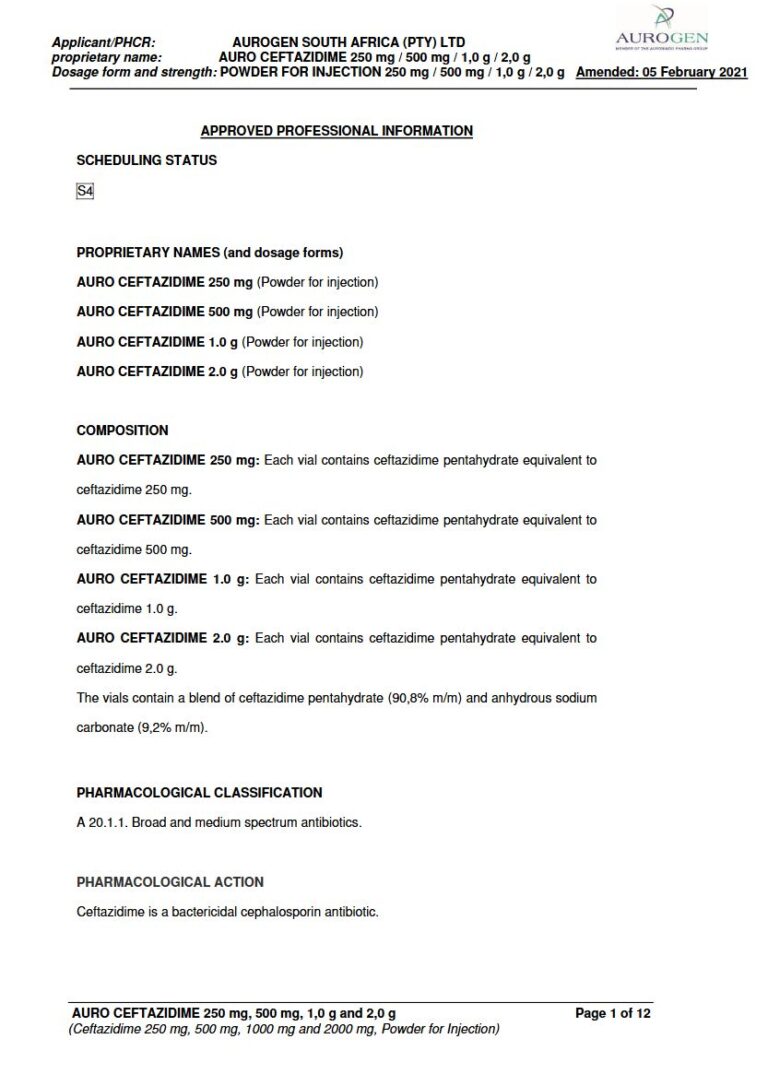
Auro Ceftazidime Injection
PDF Leaflet Revision Date: 05 February 2021
Clinical Summary
Quick overview from the medicine insert
Indication
Treatment of severe infections caused by susceptible organisms.
Dosage (summary)
Adults: 1-6 g daily in divided doses; max 3 g for elderly.
Special Populations
- Renal impairment
- Elderly
Pregnancy & Breastfeeding
Safety in pregnancy and lactation not established.
Key Drug Interactions
- Nephrotoxic agents (e.g., aminoglycosides)
- Probenecid
- Bacteriostatic antibacterials
Contraindications
- Hypersensitivity to cephalosporins
Common side effects
- Nausea
- Vomiting
- Diarrhoea
- Hypersensitivity reactions
Counselling Points
- Report any allergic reactions
- Stay hydrated during treatment
Serious warnings
- Caution in penicillin-sensitive patients
- Monitor renal function
Important Disclaimer
The Auro Ceftazidime Injection professional information leaflet below is the property of Aurogen South Africa and is provided on Medinsert exactly as issued, with no.. alterations or editorial changes. We make every effort to keep content current by updating documents as soon as new versions become available. Medinsert serves as a trusted access point for healthcare professionals, but does not replace official sources or clinical judgement. For more details, please read our full disclaimer. read more>>
 Healthcare Professionals Only
This content is for registered healthcare professionals
Sign in or create a free account to read the full package insert.
Free for HPCSA-registered professionals. Powered by Medinsert.
Clinical Particulars
Section 4 of the official insert — extracted exactly as issued, no alterations
4.1 Therapeutic indications
AURO CEFTAZIDIME is indicated for the treatment of the following infections when caused by susceptible organisms:
- Severe infections including: septicaemia, bacteraemia, peritonitis, and in immunocompromised patients, caused by Streptococcus pyogenes, Streptococcus Group B, Streptococcus pneumoniae, Streptococcus mitis, Streptococcus spp., Escherichia coli, Haemophilus influenzae, Klebsiella pneumoniae, Salmonella spp., Acinetobacter spp., Yersinia enterocolitica, or Pasteurella multocida.
- Respiratory tract infections such as pneumonia, bronchopneumonia, and bronchitis including lung infections in patients with cystic fibrosis, caused by Streptococcus pneumoniae, Haemophilus influenzae, Klebsiella pneumoniae, Haemophilus parainfluenzae, Escherichia coli, Streptococcus pyogenes, Proteus mirabilis, Serratia spp., or Enterobacter spp.
- Ear, nose and throat infections, caused by Streptococcus pneumoniae, Haemophilus influenzae, Klebsiella pneumoniae, Haemophilus parainfluenzae, Escherichia coli, Streptococcus pyogenes, Proteus mirabilis, Serratia spp., or Enterobacter spp.
- Urinary tract infections, caused by Neisseria gonorrhoeae, Escherichia coli, Proteus mirabilis, Klebsiella pneumoniae, Proteus vulgaris, Morganella morganii, Enterobacter spp., or Citrobacter spp.
- Skin and soft tissue infections, caused by Streptococcus pyogenes, Streptococcus spp., Escherichia coli, Enterobacter spp., Klebsiella pneumoniae, Proteus mirabilis, or Morganella morganii.
- Gastrointestinal, biliary and abdominal infections, caused by Escherichia coli, Klebsiella pneumoniae, Streptococcus spp., Salmonella spp., Shigella spp., or Yersinia enterocolitica.
4.2 Posology and method of administration
AURO CEFTAZIDIME is given by deep intramuscular injection, slow intravenous injection over 3 to 5 minutes, or intravenous infusion over up to 30 minutes.
Adults: The usual dose for adults ranges from 1 g to 6 g daily in divided doses every 8 or 12 hours. The higher doses are used in severe infections especially in immunocompromised patients. In adults with cystic fibrosis who have pseudomonal lung infection, high doses of 90 to 150 mg per kg body-weight daily in 3 divided doses are used; up to 9 g daily has been given to adults with normal renal function. Single doses of more than 1 g should be given intravenously.
Children: Children are usually given 30 to 100 mg per kg daily in 2 or 3 divided doses, but in severely ill children up to 150 mg per kg daily to a maximum of 6 g daily may be given in 3 divided doses.
Neonates and infants up to 2 months old: A dose of 25 to 60 mg per kg daily in 2 divided doses is effective.
Elderly: In the elderly, the dose should generally not exceed 3 g daily.
Renal impairment: In patients with renal impairment the dosage of AURO CEFTAZIDIME may need to be reduced. Following a loading dose of 1 g, maintenance doses are based on the creatinine clearance. Maintenance doses are:
Creatinine Clearance (ml/min) Recommended dosage
- 31 u2014 50: 1 g every 12 hours
- 16 u2014 30: 1 g every 24 hours
- 6 u2014 15: 0.5 g every 24 hours
- < 5: 0.5 g every 48 hours
In severe infections these doses may need to be increased by 50%. In these patients ceftazidime trough serum concentrations should not exceed 40 u03bcg/ml. In patients undergoing peritoneal dialysis a loading dose of 1 g may be given followed by 500 mg every 24 hours; ceftazidime sodium may also be added to the dialysis fluid, usually 125 mg to 250 mg of ceftazidime for 2 litres of dialysis fluid. In patients undergoing haemodialysis a loading dose of 1 g is given and should be repeated after each dialysis period.
4.3 Contraindications
Hypersensitivity to cephalosporin antibiotics.
4.4 Special warnings and precautions for use
Great care should be taken if AURO CEFTAZIDIME is to be given to patients who are penicillin-sensitive. Care is also necessary in patients with known histories of allergy.
4.5 Interactions with other medicines
The concomitant use of a nephrotoxic medicine such as the aminoglycoside gentamicin may increase the risk of kidney damage with AURO CEFTAZIDIME. There is also some evidence for enhanced nephrotoxicity with a loop diuretic like furosemide. The renal excretion of AURO CEFTAZIDIME is inhibited by probenecid. There may be antagonism between AURO CEFTAZIDIME and bacteriostatic antibacterials.
4.6 Fertility, pregnancy and lactation
The safety in pregnancy and lactation has not been established.
4.7 Effects on ability to drive and use machines
Not provided in the text.
4.8 Undesirable effects
Side-effects: Haematological disorders: Less frequent: Neutropaenia, thrombocytopaenia, bleeding complications related to hypothrombinaemia and/or platelet dysfunction, haemolytic anaemia. Gastrointestinal disorders: Frequent: Nausea, vomiting, diarrhoea, oral candidiasis. Less frequent: Pseudomembranous colitis. The following side-effects have been reported and frequencies are unknown: Prolonged use may result in overgrowth of non-susceptible organisms. Hepato-biliary disorders: The following side-effects have been reported and frequencies are unknown: Hepatitis and cholestatic jaundice have occurred. Immune system disorders (including skin reactions): Frequent: Hypersensitivity reactions, including eosinophilia. Less frequent: Hypersensitivity reactions, including skin reactions, urticaria, fever, reactions resembling serum sickness, and anaphylaxis. Nervous system disorders: Less frequent: Convulsions and other signs of CNS toxicity have been associated with high doses, especially in patients with severe renal impairment. Renal and urinary disorders: The following side-effects have been reported and frequencies are unknown: Nephrotoxicity has been reported. Acute renal tubular necrosis has followed excessive dosage and has also been associated with its use in older patients or those with pre-existing renal impairment or those with the concomitant administration of nephrotoxic medicines such as aminoglycosides. Acute interstitial nephritis is also a possibility as a manifestation of hypersensitivity. Reproductive system and breast disorders: Frequent: Vaginal candidiasis. General disorders and administration site conditions: Less frequent: Thrombophlebitis has occurred following intravenous infusion. The following side effects have been reported and frequencies are unknown: Positive response to the Coombs' test, pain at the injection site following intra-muscular administration. Investigations: The following side-effects have been reported and frequencies are unknown: Transient increases in liver enzyme values have been reported.
4.9 Overdose
See side-effects and special precautions. Serum levels of AURO CEFTAZIDIME are reduced by dialysis. Treatment is supportive and symptomatic.
