
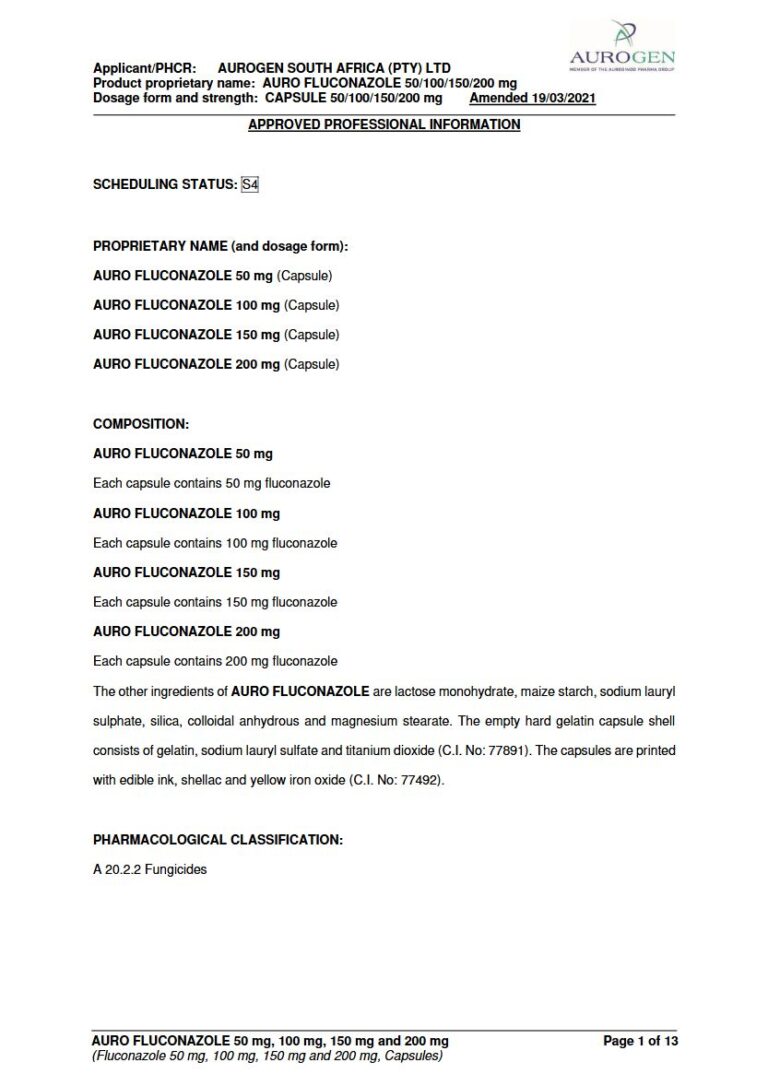
Auro Fluconazole Capsules
PDF Leaflet Revision Date: 19 March 2021
Clinical Summary
Quick overview from the medicine insert
Indication
Treatment of fungal infections including cryptococcal meningitis and candidiasis.
Dosage (summary)
400 mg on day 1, then 200 mg daily for cryptococcal meningitis; 50-400 mg daily for candidiasis.
Special Populations
- Renal impairment
- Elderly
Pregnancy & Breastfeeding
Use in pregnancy may cause congenital abnormalities; present in breast milk.
Key Drug Interactions
- Warfarin
- Benzodiazepines
- Cisapride
- Tacrolimus
Contraindications
- Hypersensitivity to fluconazole
- Renal impairment
- Pregnancy and lactation
Common side effects
- Abdominal pain
- Nausea
- Vomiting
- Hepatotoxicity
- Abnormal vision
Counselling Points
- Monitor for liver function
- Avoid in pregnancy
- May cause dizziness
Serious warnings
- Serious hepatic toxicity
- Risk of severe cutaneous reactions in AIDS patients
Important Disclaimer
The Auro Fluconazole Capsules professional information leaflet below is the property of Aurogen South Africa and is provided on Medinsert exactly as issued, with no.. alterations or editorial changes. We make every effort to keep content current by updating documents as soon as new versions become available. Medinsert serves as a trusted access point for healthcare professionals, but does not replace official sources or clinical judgement. For more details, please read our full disclaimer. read more>>
 Healthcare Professionals Only
This content is for registered healthcare professionals
Sign in or create a free account to read the full package insert.
Free for HPCSA-registered professionals. Powered by Medinsert.
Clinical Particulars
Section 4 of the official insert — extracted exactly as issued, no alterations
4.1 Therapeutic indications
AURO FLUCONAZOLE is indicated for the treatment of the following conditions in adults:
- Cryptococcal meningitis and maintenance therapy to prevent relapse of cryptococcal disease in patients with a
- Systemic candidasis.
- Oropharyngeal and oesophageal candidiasis.
- Prevention of fungal infections in patients with malignancy who are predisposed to such infections as a result of cytotoxic chemotherapy and radiotherapy.
4.2 Posology and method of administration
Therapy for those types of infections requiring multiple dose treatment should be continued until clinical parameters or laboratory tests indicate that active fungal infection has subsided. An inadequate period of treatment may lead to recurrence of active infection. Patients with AIDS and cryptococcal meningitis or recurrent oropharyngeal candidiasis usually require maintenance therapy to prevent relapse.
Use in Adults:
- For cryptococcal meningitis the usual dose is 400 mg on the first day followed by 200 mg once daily. Depending on the clinical response of the patient this dose may be increased to 400 mg daily. Usually, duration of treatment for cryptococcal meningitis is 6-8 weeks. For the prevention of relapse of cryptococcal meningitis in patients with AIDS, after the patient received a full course of primary therapy, AURO FLUCONAZOLE may be administered at a daily dose of 100 to 200 mg.
- For systemic candidiasis the usual dose is 400 mg on the first day followed by 200 mg daily. Depending on the clinical response, the dose may be increased to 400 mg daily. Duration of treatment is based upon the clinical response.
- For oropharyngeal candidiasis, the usual dose is 50 to 100 mg once daily for 7-14 days. If necessary, treatment can be continued for longer periods in patients with severely compromised immune function. For the prevention of relapse of oropharyngeal candidiasis in patients with AIDS, after the patient receives a full course of primary therapy, AURO FLUCONAZOLE may be administered at a 150 mg once weekly dose. For oesophageal candidiasis, the recommended dose is 200 mg on the first day, followed by 100 mg to 200 mg once daily. Doses up to 400 mg/day may be used, based on medical judgment of the patientu2019s response to therapy. Patients with oesophageal candidiasis should be treated for a minimum of three weeks and for at least two weeks following resolution of symptoms.
- The recommended AURO FLUCONAZOLE dosage for the prevention of candidiasis is 50 mg to 400 mg once daily, based on the patientu2019s risk for developing fungal infections. For patients at high risk of systemic infection e.g. patients who are anticipated to have profound or prolonged neutropenia, a dose of 400 mg once daily has been used. AURO FLUCONAZOLE administration should start several days before the anticipated onset of neutropenia and continue for 7 days after the neutrophil count rises above 1000 cells per mm3.
Use in the Elderly: Where there is no evidence of renal impairment, normal dosage recommendations should be adopted.
Use in Children: This formulation is not suitable for dosages < 50 mg/kg.
4.3 Contraindications
- AURO FLUCONAZOLE should not be used in patients with known hypersensitivity to fluconazole or to any of the ingredients or to related azole compounds.
- Pregnancy and lactation (see PREGNANCY AND LACTATION).
- Multiple dose therapy is contraindicated in patients with renal impairment.
- Co-administration of AURO FLUCONAZOLE with medicines metabolised by CYP 3A4 and are known to prolong QT interval, such as cisapride, astemizole, pimozide and quinidine (see INTERACTIONS).
4.4 Special warnings and precautions for use
Warnings
Hepatic Function: Fluconazole such as in AURO FLUCONAZOLE has been associated with cases of serious hepatic toxicity including fatalities, primarily in patients with serious underlying medical conditions. In cases of fluconazole-associated hepatotoxicity, no obvious relationship to total daily dose, duration of therapy, sex or age of patient has been observed. Hepatotoxicity may be reversible on discontinuation of AURO FLUCONAZOLE therapy. Patients who develop abnormal liver function tests during AURO FLUCONAZOLE therapy should be monitored for the development of more serious hepatic injury. AURO FLUCONAZOLE should be discontinued if clinical signs or symptoms consistent with liver disease develop that may be attributable to fluconazole.
AIDS patients are more prone to the development of severe cutaneous reactions to many medicines. If patients with invasive/systemic fungal infections develop rashes, they should be monitored closely and AURO FLUCONAZOLE discontinued if bullous lesions or erythema multiforme develop.
Special Precautions: AURO FLUCONAZOLE contains lactose and should not be given to patients with rare hereditary problems or a history of galactose intolerance, Lapp lactase deficiency or glucose-galactose malabsorption.
4.5 Interactions with other medicines
Fluconazole has been shown to prolong prothrombin times/INR in subjects receiving warfarin. Bleeding events (bruising, epistaxis, gastrointestinal bleeding, haematuria, and melena) have been reported, in association with increases in prothrombin time/INR in patients receiving fluconazoles such as in AURO FLUCONAZOLE concurrently with warfarin. In concomitant treatment of AURO FLUCONAZOLE and warfarin the dose of anticoagulant should be carefully titrated and the prothrombin time/INR should be carefully monitored. Particular attention should be paid to such patients requiring minor oral surgery and dental procedures.
Benzodiazepines (Short Acting): Concurrent oral administration of midazolam and fluconazole resulted in substantial increases in midazolam concentrations and its psychomotor effects. This effect on midazolam appears to be more pronounced following oral administration of fluconazole than with fluconazole administered intravenously. If concomitant benzodiazepine therapy (e.g. midazolam, triazolam) is necessary in patients on treatment with AURO-FLUCONAZOLE, a reduction of the benzodiazepine dosage should be considered and patients should be appropriately monitored. Fluconazole such as in AURO FLUCONAZOLE has been shown to prolong the serum half-life of concomitantly administered oral sulphonylureas.
No clinically significant interactions have been seen with co-administration of oral contraceptives, or cimetidine. No adverse effect has been seen on endogenous steroid levels or on ACTH stimulated cortisol response.
A kinetic study in renal transplant patients found fluconazole 200 mg daily to slowly increase ciclosporin concentrations. However, in another multiple dose study with 100 mg daily, fluconazole did not affect ciclosporin levels in patients with bone marrow transplants. Ciclosporin plasma concentration monitoring in patients receiving AURO FLUCONAZOLE is recommended.
Co-administration of multiple doses of hydrochlorothiazide may increase the plasma concentrations of fluconazole such as in AURO FLUCONAZOLE. Concomitant administration of AURO FLUCONAZOLE and phenytoin may increase the levels of phenytoin to a clinical significant degree.
Concomitant administration of AURO FLUCONAZOLE and theophylline may increase the risk of theophylline toxicity due to a fluconazole induced decrease in plasma theophylline clearance.
Concomitant administration of AURO FLUCONAZOLE and rifampicin may result in a 25 % decrease in the AUC and 20 % shorter half-life of fluconazole.
Zidovudine: Two kinetic studies resulted in increased levels of zidovudine most likely caused by the decreased conversion of zidovudine to its major metabolite. One study determined zidovudine levels in AIDS or ARC patients before and following fluconazole 200 mg daily for 15 days. There was a significant increase in zidovudine AUC (20 %). A second randomised, two-period, two-treatment, cross-over study examined zidovudine levels in HIV patients. On two occasions, 21 days apart, patients received zidovudine 200 mg every eight hours either with or without fluconazole 400 mg daily for seven days. The AUC of zidovudine significantly increased (74 %) during co-administration with fluconazole. Patients receiving AURO FLUCONAZOLE in combination with zidovudine should be monitored for the development of zidovudine-related adverse reactions.
Nevirapine: Co-administration of fluconazole and nevirapine may result in approximately 100 % increase in nevirapine exposure as compared with historical data where nevirapine is administered alone. Because of the risk of increased exposure to nevirapine, caution should be exercised if nevirapine and AURO FLUCONAZOLE are given concomitantly and patients should be monitored closely.
Cisapride: There have been reports of cardiac events including torsade de pointes in patients to whom fluconazole and cisapride were co-administered. Co-administration of cisapride is contraindicated in patients receiving AURO-FLUCONAZOLE.
Rifabutin: There have been reports that an interaction exists when fluconazole is administered concomitantly with rifabutin, leading to increased serum levels of rifabutin. There have been reports of uveitis in patients to whom fluconazole and rifabutin were co-administered. Patients receiving rifabutin and AURO FLUCONAZOLE concomitantly should be carefully monitored.
Tacrolimus: There have been reports that an interaction exists when fluconazole is administered concomitantly with tacrolimus, leading to increased serum levels of tacrolimus. There have been reports of nephrotoxicity in patients to whom AURO FLUCONAZOLE and tacrolimus were co-administered. Patients receiving tacrolimus and fluconazole concomitantly should be carefully monitored for changes in plasma concentrations of tacrolimus and/or nephro- and neurotoxicity.
The use of AURO FLUCONAZOLE in patients concurrently taking astemizole or other medicines metabolised by the cytochrome P-450 system may be associated with elevations in serum levels of these medicines. In the absence of definitive information, caution should be used when co-administering AURO FLUCONAZOLE. Patients should be carefully monitored (see WARNINGS AND SPECIAL PRECAUTIONS).
4.6 Fertility, pregnancy and lactation
Use during pregnancy and lactation: There are no adequate and well controlled studies which assessed the safety of fluconazole treatment in pregnant women. There have been reports of congenital abnormalities in infants whose mothers were treated with fluconazole. The relationship between fluconazole use and these events is unclear. Lactation, as fluconazole is found in breast milk at concentrations similar to plasma.
4.7 Effects on ability to drive and use machines
AURO FLUCONAZOLE may cause abnormal vision which may affect ability to drive and use machinery.
4.8 Undesirable effects
Blood and the lymphatic system disorders: Less frequent: Thrombocytopenia. The following side effects have been reported but the frequencies are unknown: Neutropenia, leucopenia.
Immune system disorders: The following side effects have been reported but the frequencies are unknown: Anaphylaxis, angioedema.
Metabolism and nutritional disorders: The following side effects have been reported but the frequencies are unknown: Hypertriglyceridemia.
Nervous system disorders: The following side effects have been reported but the frequencies are unknown: Seizures.
Gastrointestinal disorders: Less frequent: Abdominal pain, vomiting, nausea, diarrhoea and flatulence. The following side effects have been reported but the frequencies are unknown: Taste perversion, constipation, dyspepsia.
Hepato-biliary disorders: The following side effects have been reported but the frequencies are unknown: Hepatitis, liver failure.
Skin and subcutaneous tissue disorders: Less frequent: Stevens-Johnson syndrome. The following side effects have been reported but the frequencies are unknown: Alopecia, toxic epidermal necrolysis, pruritus, urticaria.
Reproductive system and breast disorders: The following side effects have been reported but the frequencies are unknown: Menstrual disorders.
Eye disorders: The following side effects have been reported but the frequencies are unknown: Abnormal vision.
4.9 Overdose
The following events may occur with an overdosage of AURO FLUCONAZOLE: insomnia, irritability, vomiting, diarrhoea, abdominal pain/cramps, anorexia, bulging fontanel, elevation of alkaline phosphatase and gamma glutamyl transpeptidase, increase in serum calcium, renal failure, fatigue, facial rash, skin erythema, generalised urticaria, arthralgia, itching, numbness of the tongue and distressed mood. In the advent of overdosage, symptomatic treatment (with supportive measures and gastric lavage if necessary) may be adequate. Fluconazole is largely excreted in the urine; forced diuresis would probably increase the elimination rate. A three hour haemodialysis session decreases plasma levels by approximately 50 %.
