
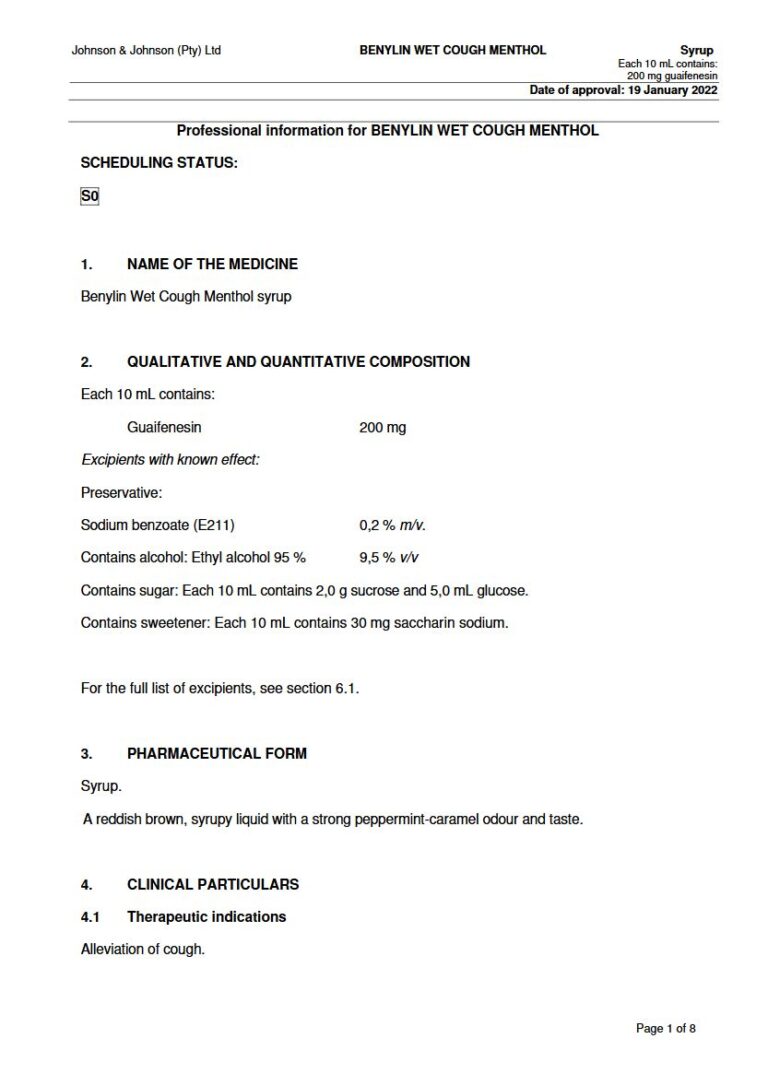
Benylin Wet Cough Menthol Syrup
PDF Leaflet Revision Date: 19 January 2022
Clinical Summary
Quick overview from the medicine insert
Indication
Alleviation of cough.
Dosage (summary)
Adults: 10 mL u2013 20 mL every 4 hours.
Special Populations
- Patients with acute porphyria
- Patients with hereditary fructose intolerance
Pregnancy & Breastfeeding
Not to be used during pregnancy and lactation.
Key Drug Interactions
- May interfere with urinary diagnostic measurements
Contraindications
- Hypersensitivity to guaifenesin
- Pregnancy and lactation
- Acute porphyria
Common side effects
- Drowsiness
- Diarrhoea
- Nausea
- Vomiting
- Rash
Counselling Points
- Shake before use
- Consult a doctor if symptoms persist
- Contains sugar and sodium
Serious warnings
- Do not use for persistent cough
- Caution advised when driving or operating machinery
Important Disclaimer
The Benylin Wet Cough Menthol Syrup professional information leaflet below is the property of Johnson and is provided on Medinsert exactly as issued, with no.. alterations or editorial changes. We make every effort to keep content current by updating documents as soon as new versions become available. Medinsert serves as a trusted access point for healthcare professionals, but does not replace official sources or clinical judgement. For more details, please read our full disclaimer. read more>>
 Healthcare Professionals Only
This content is for registered healthcare professionals
Sign in or create a free account to read the full package insert.
Free for HPCSA-registered professionals. Powered by Medinsert.
Clinical Particulars
Section 4 of the official insert — extracted exactly as issued, no alterations
4.1 Therapeutic indications
Alleviation of cough.
4.2 Posology and method of administration
Shake the bottle before use. Adults: 10 mL u2013 20 mL (two u2013 four medicine measures) every 4 hours. If symptoms persist a doctor should be consulted. For oral use only.
4.3 Contraindications
- Hypersensitivity to guaifenesin or to any of the other ingredients in Benylin Wet Cough Menthol (see section 6.1).
- Pregnancy and lactation (see section 4.6).
- Patients with acute porphyria.
4.4 Special warnings and precautions for use
Benylin Wet Cough Menthol should not be taken for persistent or chronic cough, such as occurs with asthma, or where cough is accompanied by excessive secretions, unless directed by a physician. A persistent cough may be a sign of a serious condition. If cough persists for more than 7 days, tends to recur, or is accompanied by a fever, rash, or persistent headache, a doctor should be consulted.
Benylin Wet Cough Menthol contains sugar: sucrose and glucose. Patients with rare hereditary problems of fructose intolerance, glucose-galactose malabsorption or sucrase-isomaltase insufficiency should not take Benylin Wet Cough Menthol.
Benylin Wet Cough Menthol contains sodium benzoate. An increase in bilirubinaemia following its displacement from albumin may increase neonatal jaundice which may develop into kernicterus (non-conjugated bilirubin deposits in the brain tissue).
Benylin Wet Cough Menthol contains sodium. Benylin Wet Cough Menthol contains 114 mg sodium per 10 mL, equivalent to 5,7 % of the WHO recommended maximum daily intake of 2 g sodium for an adult.
4.5 Interaction with other medicines and other forms of interaction
Guaifenesin may interfere with diagnostic measurements of urinary 5-hydroxy-indoleacetic acid or vanillylmandelic acid.
4.6 Fertility, pregnancy and lactation
Benylin Wet Cough Menthol should not be used during pregnancy and lactation (see section 4.3).
4.7 Effects on ability to drive and use machines
Benylin Wet Cough Menthol can cause side effects, such as drowsiness and may affect the ability to drive and use machinery. Caution is advised before driving a vehicle or operating machinery until the effects of Benylin Wet Cough Menthol are known.
4.8 Undesirable effects
The safety of guaifenesin is based on available data from clinical trials and adverse drug reactions (ADRs) identified during post-marketing experience. The frequencies are provided according to the following convention:
Very common u22651/10
Common u22651/100 and < 1/10
Uncommon u22651/1,000 and <1/100
Rare u22651/10,000 and <1/1,000
Very rare < 1/10,000
Not known (cannot be estimated from the available data)
System organ class and frequency
Adverse reactions
Immune system disorders
Very rare Hypersensitivity
Nervous system disorders
Not known Drowsiness
Gastrointestinal disorders
Very rare Diarrhoea, nausea, vomiting, upper abdominal pain
Not known Gastrointestinal discomfort
Skin and subcutaneous tissue disorders
Very rare Rash
Reporting of suspected adverse reactions: Reporting suspected adverse reactions after authorisation of Benylin Wet Cough Menthol is important. It allows continued monitoring of the benefit/risk balance of Benylin Wet Cough Menthol. Health care providers are asked to report any suspected adverse reactions to SAHPRA via the u201c6.04 Adverse Drug Reactions Reporting Formu201d, found online under SAHPRAu2019s publications: https://www.sahpra.org.za/Publications/Index/8. For further information, please contact the Johnson & Johnson call centre on 0860 410032 (landline).
4.9 Overdose
In large doses, guaifenesin will cause drowsiness, nausea and vomiting. It may also cause renal calculi. Treatment is symptomatic and supportive.
