
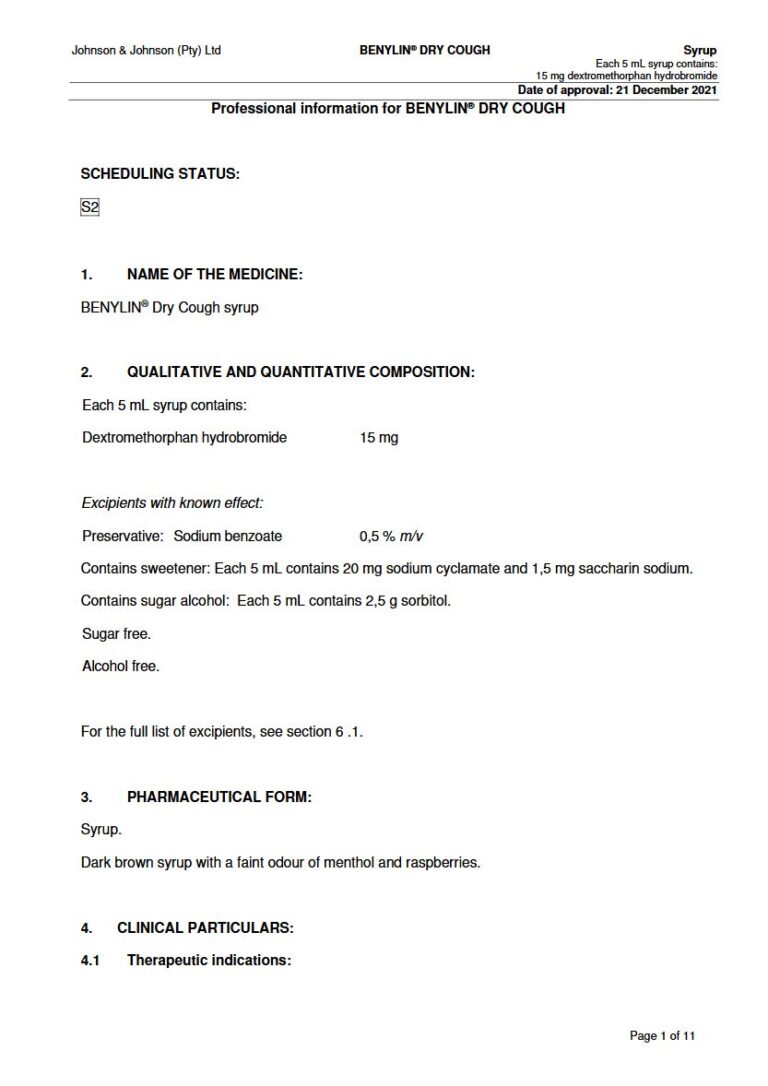
Benylina Dry Cough Syrup
PDF Leaflet Revision Date: 21 December 2021
Clinical Summary
Quick overview from the medicine insert
Indication
Symptomatic relief of non-productive cough.
Dosage (summary)
Adults: 5 mL every 4 hours or 10 mL every 6-8 hours.
Onset of Action / Duration
Onset: 30 mins, Duration: 5-6 hours
Special Populations
- Hepatic impairment
- Children under 5 years
Pregnancy & Breastfeeding
Not recommended in pregnancy; avoid in lactation due to unknown secretion in breast milk.
Key Drug Interactions
- MAOIs
- CNS depressants
- CYP2D6 inhibitors
- SSRIs
Contraindications
- Hypersensitivity to dextromethorphan
- Asthma
- Hepatic dysfunction
- Children under 5 years
Common side effects
- Dizziness
- Somnolence
- Nausea
- Vomiting
Counselling Points
- Do not exceed recommended dose
- Consult doctor if cough persists for more than one week
- Caution advised before driving or operating machinery
Serious warnings
- Risk of serotonin syndrome with MAOIs and SSRIs
- Caution in patients with a history of drug abuse
Important Disclaimer
The Benylina Dry Cough Syrup professional information leaflet below is the property of Johnson and is provided on Medinsert exactly as issued, with no.. alterations or editorial changes. We make every effort to keep content current by updating documents as soon as new versions become available. Medinsert serves as a trusted access point for healthcare professionals, but does not replace official sources or clinical judgement. For more details, please read our full disclaimer. read more>>
 Healthcare Professionals Only
This content is for registered healthcare professionals
Sign in or create a free account to read the full package insert.
Free for HPCSA-registered professionals. Powered by Medinsert.
Clinical Particulars
Section 4 of the official insert — extracted exactly as issued, no alterations
4.1 Therapeutic indications
BENYLIN u00ae Dry Cough is indicated for the symptomatic relief of non-productive cough.
4.2 Posology and method of administration
Do not exceed the recommended dose. For oral use only. Shake the bottle before use.
Adults: One medicine measure (5 mL) every four hours, or two medicine measures (10 mL) every six to eight hours.
Children 5 to 12 years: Half to one medicine measure (2,5 mL u2013 5 mL) every six to eight hours.
Children below 5 years of age: Not recommended (see section 4.3).
4.3 Contraindications
- Hypersensitivity to dextromethorphan or to any of the other ingredients in BENYLIN u00ae Dry Cough (see section 6.1).
- Patients taking monoamine oxidase inhibitors (MAOIs), or for 2 weeks after stopping the MAOI medicine. There is risk of serotonin syndrome with the concomitant use of BENYLIN u00ae Dry Cough and MAOIs and the concomitant use of these medicines may cause a rise in blood pressure and/or hypertensive crisis (see section 4.5).
- Patients with asthma and hepatic dysfunction.
- Children under 5 years of age.
4.4 Special warnings and precautions for use
BENYLIN u00ae Dry Cough should not be taken for a persistent respiratory condition, which occurs with smoking, bronchial asthma, emphysema, chronic bronchitis or where cough is accompanied by excessive secretions, except under the advice and supervision of a doctor. A persistent cough may be a sign of a serious condition. If cough persists for more than one week, tends to recur or is accompanied by high fever, rash or persistent headache, consult a doctor. Persistent coughs should be investigated by a doctor for the possible underlying cause.
Cases of dextromethorphan abuse and associated dependence have been reported. Caution with BENYLIN u00ae Dry Cough is particularly recommended for adolescents and young adults, as well as in patients with a history of drug abuse or use of psychoactive substances.
Dextromethorphan is metabolised by hepatic cytochrome P450 2D6. The activity of this enzyme is genetically determined. About 10 % of the general population are poor metabolisers of CYP2D6. Poor metabolisers and patients with concomitant use of CYP2D6 inhibitors may experience exaggerated and/or prolonged effects of dextromethorphan. Caution with BENYLIN u00ae Dry Cough should therefore be exercised in patients who are slow metabolisers of CYP2D6 or use CYP2D6 inhibitors (see section 4.5). If a patient is a known slow metaboliser of CYP2D6, or is using any other medicines (such as serotonergic medicines, including selective serotonin re-uptake inhibitors (SSRIs), medicines which impair the metabolism of serotonin (including MAOIs - see section 4.3) or CYP2D6 inhibitors), a doctor or pharmacist should be consulted prior to taking BENYLIN u00ae Dry Cough. Serotonergic effects, including the development of a potentially life-threatening serotonin syndrome, have been reported for dextromethorphan with concomitant administration of serotonergic medicines.
Sodium benzoate: BENYLIN u00ae Dry Cough contains sodium benzoate. An increase in bilirubinaemia following its displacement from albumin may increase neonatal jaundice which may develop into kernicterus (non-conjugated bilirubin deposits in the brain tissue).
4.5 Interaction with other medicines and other forms of interaction
Monoamine oxidase inhibitors (MAOIs): BENYLIN u00ae Dry Cough should not be used concurrently in patients taking MAOIs, or within 14 days of stopping treatment with MAOIs, as there is a risk of serotonin syndrome. Concurrent use with monoamine oxidase inhibitors may cause excitation, hypertension and hyperpyrexia.
Central nervous system (CNS) depressants: Concomitant administration with central nervous system depressants may potentiate central nervous system depressant effects.
CYP450 interactions: CYP2D6 inhibitors: BENYLIN u00ae Dry Cough is metabolised by CYP2D6 and has an extensive first-pass metabolism. Concomitant use of potent CYP2D6 enzyme inhibitors can increase the dextromethorphan concentrations in the body. This increases the risk of the patient for toxic effects of dextromethorphan (agitation, confusion, tremor, insomnia, diarrhoea and respiratory depression) and development of serotonin syndrome. Potent CYP2D6 enzyme inhibitors include fluoxetine, paroxetine, quinidine and terbinafine. In concomitant use with quinidine, plasma concentrations of dextromethorphan have increased up to 20-fold, which increases the CNS adverse effects of the medicine. Amiodarone, flecainide and propafenone, sertraline, bupropion, methadone, cinacalcet, haloperidol, perphenazine and thioridazine also have similar effects on the metabolism of dextromethorphan. If concomitant use of CYP2D6 inhibitors and BENYLIN u00ae Dry Cough is necessary, the patient should be monitored and the BENYLIN u00ae Dry Cough dose may need to be reduced.
Isavuconazole: Isavuconazole is a moderate inhibitor of CYP3A4 and a mild inducer of CYP2B6. When administered concomitantly with dextromethorphan, the area under the curve (AUC) and C max of dextromethorphan has been observed to increase by 18 % and 17 %, respectively.
Selective serotonin reuptake inhibitors (SSRIs): Concomitant use of BENYLIN u00ae Dry Cough with SSRI medicines may lead to serotonin syndrome.
4.6 Fertility, pregnancy and lactation
Safety in pregnancy and lactation has not been established.
Pregnancy: BENYLIN u00ae Dry Cough is not recommended in pregnancy.
Lactation: BENYLIN u00ae Dry Cough should not be used by nursing mothers, as there is no information to support the secretion of dextromethorphan into breast milk.
4.7 Effects on ability to drive and use machines
BENYLIN u00ae Dry Cough can cause side effects, such as somnolence and dizziness. Caution is advised before driving a vehicle or operating machinery until the effects of BENYLIN u00ae Dry Cough are known.
4.8 Undesirable effects
Immune system disorders: Less frequent: angioedema
Psychiatric disorders: Less frequent: insomnia
Nervous system disorders: Less frequent: dizziness, psychomotor hyperactivity, somnolence
Gastrointestinal disorders: Less frequent: gastrointestinal disturbances, abdominal pain, diarrhoea, nausea, vomiting
Skin and subcutaneous tissue disorders: Less frequent: pruritus, rash, urticaria
Reporting of suspected adverse reactions: Reporting suspected adverse reactions after authorisation of BENYLIN u00ae Dry Cough is important. It allows continued monitoring of the benefit/risk balance of BENYLIN u00ae Dry Cough. Healthcare providers are asked to report any suspected adverse reactions to SAHPRA via the u201c6.04 Adverse Drug Reactions Reporting Formu201d, found online under SAHPRAu2019s publications: https://www.sahpra.org.za/Publications/Index/8. For further information, please contact the Johnson & Johnson call centre on 0860 410032 (landline).
4.9 Overdose
Symptoms of overdose may include: excitation, agitation, confusional state, conversion disorder, mixed hallucinations, ataxia, clumsiness, coma, depressed levels of consciousness, dysarthria, dystonia, lethargy, nystagmus, seizure, serotonin syndrome, tremor, miosis, mydriasis, respiratory depression, urinary retention, tachycardia, ischaemic colitis, and hypertension. Bromide intoxication has been observed during concomitant use with bromide-containing over-the-counter medicines or with overdose of dextromethorphan hydrobromide.
Treatment: Symptomatic and supportive.
