
Bicalutamide 150 Accord Tablets
PDF Leaflet Revision Date: 22 February 2022
Clinical Summary
Quick overview from the medicine insert
Indication
Treatment of locally advanced prostate cancer.
Dosage (summary)
1 tablet (150 mg) once daily for 2 years or until progression.
Special Populations
- Renal impairment
- Hepatic impairment
Pregnancy & Breastfeeding
Contraindicated in pregnancy and breastfeeding.
Key Drug Interactions
- CYP3A4 inhibitors
- Coumarin anticoagulants
Contraindications
- Females
- Children
- Hypersensitivity to bicalutamide
Common side effects
- Anaemia
- Dizziness
- Decreased libido
- Hot flush
- Hepatotoxicity
Counselling Points
- Avoid sun exposure
- Monitor liver function
- Use contraception during treatment
Serious warnings
- Severe hepatic changes
- QT prolongation risk
Important Disclaimer
The Bicalutamide 150 Accord Tablets professional information leaflet below is the property of Accord Healthcare and is provided on Medinsert exactly as issued, with no.. alterations or editorial changes. We make every effort to keep content current by updating documents as soon as new versions become available. Medinsert serves as a trusted access point for healthcare professionals, but does not replace official sources or clinical judgement. For more details, please read our full disclaimer. read more>>
 Healthcare Professionals Only
This content is for registered healthcare professionals
Sign in or create a free account to read the full package insert.
Free for HPCSA-registered professionals. Powered by Medinsert.
Clinical Particulars
Section 4 of the official insert — extracted exactly as issued, no alterations
4.1 Therapeutic indications
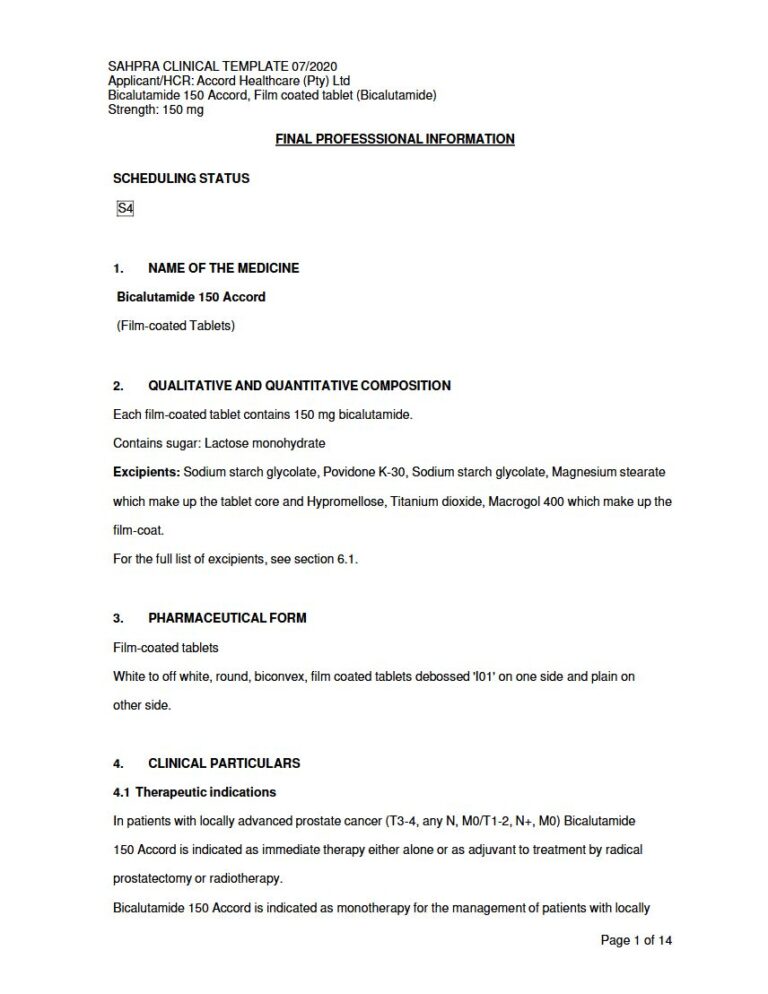
In patients with locally advanced prostate cancer (T3-4, any N, M0/T1-2, N+, M0) Bicalutamide 150 Accord is indicated as immediate therapy either alone or as adjuvant to treatment by radical prostatectomy or radiotherapy. Bicalutamide 150 Accord is indicated as monotherapy for the management of patients with locally advanced, non-metastatic prostate cancer for whom surgical or medical castration is not appropriate.
4.2 Posology and method of administration
Posology
Adult males including the elderly: 1 tablet (150 mg) once a day. For 2 years or until progression. Renal impairment: no dosage adjustment is necessary for patients with renal impairment. Hepatic impairment: no dosage adjustment is necessary for patients with mild hepatic impairment. Increased accumulation may occur in patients with moderate to severe hepatic impairment (see section 4.4).
4.3 Contraindications
Bicalutamide 150 Accord is contraindicated in females and children. Bicalutamide 150 Accord must not be given to any patient who has shown a hypersensitivity reaction to the bicalutamide or to any of the excipients of Bicalutamide 150 Accord. Co-administration of terfenadine, astemizole or cisapride.
4.4 Special warnings and precautions for use
Initiation of treatment should be under the direct supervision of a specialist. Bicalutamide is extensively metabolised in the liver. Data suggest that its elimination may be slower in subjects with severe hepatic impairment and this could lead to increased accumulation of bicalutamide. Therefore, Bicalutamide 150 Accord should be used with caution in patients with moderate to severe hepatic impairment. Periodic liver function testing should be considered due to the possibility of hepatic changes. The majority of changes are expected to occur within the first 6 months of Bicalutamide 150 Accord therapy. Severe hepatic changes and hepatic failure have been observed with Bicalutamide 150 Accord, and fatal outcomes have been reported (see section 4.8). Bicalutamide 150 Accord therapy should be discontinued if changes are severe. For patients who have an objective progression of disease together with elevated PSA, cessation of Bicalutamide 150 Accord therapy should be considered. Clinically discontinuation of Bicalutamide 150 Accord can result in anti-androgen withdrawal syndrome in a subset of patients. This is characterised by a decline in PSA (prostate specific antigen) or clinical response following withdrawal of the anti-androgen component of Maximal Androgen Blockade (MAB). This syndrome has been well described in scientific literature although the pathophysiology is unknown and may reflect multiple mechanisms, but it is believed to represent the development of agonistic activity by the medicine at the receptor level due to receptor mutations with advancing disease. Although this effect has only been reported with the 50 mg dose (approved for use in combination therapy), given the likely mode of action the phenomenon could theoretically occur with the 150 mg dose used as single agent therapy. Bicalutamide has been shown to inhibit cytochrome P450 (CYP3A4), as such, caution should be exercised when co-administered with medicines metabolised predominantly by CYP 3A4 (see sections 4.3 and 4.5). Less frequently, photosensitivity reactions have been reported for patients taking Bicalutamide 150 Accord. Patients should be advised to avoid direct exposure to excessive sunlight or UV-light while on Bicalutamide 150 Accord and the use of sunscreens may be considered. In cases where the photosensitivity reaction is more persistent and/or severe, an appropriate symptomatic treatment should be initiated. The product contains lactose. Patients with rare hereditary problems of galactose intolerance, total lactase deficiency or glucose-galactose malabsorption should not take this medicine. Androgen deprivation therapy may prolong the QT interval. In patients with a history of or risk factors for QT prolongation and in patients receiving concomitant medicinal products that might prolong the QT interval (see section 4.5) physicians should assess the benefit risk ratio including the potential for Torsade de pointes prior to initiating Bicalutamide 150 Accord. Antiandrogen therapy may cause morphological changes in spermatozoa. Although the effect of bicalutamide on sperm morphology has not been evaluated and no such changes have been reported for patients who received Bicalutamide 150 Accord, patients and/or their partners should follow adequate contraception during and for 130 days after Bicalutamide 150 Accord therapy. Potentiation of coumarin anticoagulant effects have been reported in patients receiving concomitant Bicalutamide 150 Accord therapy, which may result in increased Prothrombin Time (PT) and International Normalised Ratio (INR). Some cases have been associated with risk of bleeding. Close monitoring of PT/INR is advised and anticoagulant dose adjustment should be considered (see sections 4.5 and 4.8).
4.5 Interaction with other medicinal products and other forms of interaction
In vitro studies have shown that R-bicalutamide is an inhibitor of CYP 3A4, with lesser inhibitory effects on CYP 2C9, 2C19 and 2D6 activity. Although clinical studies using antipyrine as a marker of cytochrome P450 (CYP) activity showed no evidence of a drug interaction potential with Bicalutamide 150 Accord, mean midazolam exposure (AUC) was increased by up to 80% after co-administration of Bicalutamide 150 Accord for 28 days. For drugs with a narrow therapeutic index such an increase could be of relevance. As such, concomitant use of terfenadine, astemizole and cisapride is contraindicated (see section 4.3) and caution should be exercised with the co-administration of Bicalutamide 150 Accord with compounds such as ciclosporin and calcium channel blockers. Dosage reduction may be required for these drugs particularly if there is evidence of enhanced or adverse drug effect. For ciclosporin, it is recommended that plasma concentrations and clinical condition are closely monitored following initiation or cessation of Bicalutamide 150 Accord therapy. Caution should be exercised when prescribing Bicalutamide 150 Accord with other drugs which may inhibit drug oxidation e.g. cimetidine and ketoconazole. In theory, this could result in increased plasma concentrations of bicalutamide which theoretically could lead to an increase in side effects. In vitro studies have shown that bicalutamide can displace the coumarin anticoagulant, warfarin, from its protein binding sites. There have been reports of increased effect of warfarin and other coumarin anticoagulants when co-administered with Bicalutamide 150 Accord. It is therefore recommended that if Bicalutamide 150 Accord is administered in patients who are concomitantly receiving coumarin anticoagulants, PT/INR should be closely monitored and adjustments of anticoagulant dose considered (see sections 4.4 and 4.8). Since androgen deprivation treatment may prolong the QT interval, the concomitant use of Bicalutamide 150 Accord with medicinal products known to prolong the QT interval or medicinal products able to induce Torsade de pointes such as class IA (e.g. quinidine, disopyramide) or class III (e.g. amiodarone, sotalol, dofetilide, ibutilide) antidysrhythmic medicinal products, methadone, moxifloxacin, antipsychotics, etc. should be carefully evaluated (see section 4.4).
4.6 Fertility, pregnancy and lactation
Pregnancy
Bicalutamide is contraindicated in females and must not be given to pregnant women.
Breast-feeding
Bicalutamide is contraindicated during breast-feeding.
Fertility
Reversible impairment of male fertility has been observed in animal studies (see section 5.3). A period of subfertility or infertility should be assumed in man.
4.7 Effects on ability to drive and use machines
During treatment with Bicalutamide 150 Accord, somnolence has been reported in patients who experience this symptom should not drive or use machine.
4.8 Undesirable effects
In this section, undesirable effects are defined as follows: frequency unknown (cannot be estimated from the available data).
Table 1: Frequency of Adverse Reactions
SYSTEM ORGAN CLASS
Frequency
Event
Blood and the lymphatic system disorders
Frequent
Anaemia
Immune system disorders
Less frequent
Hypersensitivity, angioedema and urticaria
Metabolism and nutrition disorders
Frequent
Decreased appetite
Psychiatric disorders
Frequent
Decreased libido, Depression
Nervous system disorders
Frequent
Dizziness, Somnolence
Cardiac disorders
Frequency unknown
QT prolongation (see sections 4.4 and 4.5)
Vascular disorders
Frequent
Hot flush
Respiratory, thoracic and mediastinal disorders
Less frequent
Interstitial lung disease e (fatal outcomes have been reported).
Gastrointestinal disorders
Frequent
Abdominal, pain, Constipation, Dyspepsia, Flatulence, Nausea
Hepato-biliary disorders
Frequent
Hepatotoxicity, jaundice, hypertransaminasaemia a
Less Frequent
Hepatic failure d (fatal outcomes have been reported).
Skin and subcutaneous tissue disorders
Frequent
Rash, Alopecia, Hirsutism/hair re-growth, Dry skin c Pruritus
Less frequent
Photosensitivity reaction
Reproductive system and breast disorders
frequent
Erectile dysfunction, Gynaecomastia and breast tenderness b
General disorders and administration site conditions
Frequent
Chest pain, Oedema, Asthenia
Investigations
Frequent
Weight increased
a. Hepatic changes are rarely severe and were frequently transient, resolving or improving with continued therapy or following cessation of therapy.
b. The majority of patients receiving Bicalutamide 150 Accord as monotherapy experience gynaecomastia and/or breast pain. In studies these symptoms were considered to be severe in up to 5% of the patients. Gynaecomastia may not resolve spontaneously following cessation of therapy, particularly after prolonged treatment.
c. Due to the coding conventions used in the EPC studies, adverse events of 'dry skin' were coded under the COSTART term of 'rash'. No separate frequency descriptor can therefore be determined for the 150 mg Bicalutamide 150 Accord dose however the same frequency as the 50 mg dose is assumed.
d. Listed as an adverse drug reaction following review of post-marketed data. Frequency has been determined from the incidence of reported adverse events of hepatic failure in patients receiving treatment in the open-label Bicalutamide 150 Accord arm of the 150 mg EPC studies.
e. Listed as an adverse drug reaction following review of post-marketed data. Frequency has been determined from the incidence of reported adverse events of interstitial pneumonia in the randomised treatment period of the 150 mg EPC studies.
Increased PT/INR: Accounts of coumarin anticoagulants interacting with Bicalutamide 150 Accord have been reported in post-marketing surveillance (see sections 4.4 and 4.5).
Reporting of suspected adverse reactions
Reporting suspected adverse reactions after authorisation of the medicine is important. It allows continued monitoring of the benefit/risk balance of the medicine. Healthcare professionals are asked to report any suspected adverse reactions to SAHPRA via the u201c6.04 Adverse Drug Reactions Reporting Formu201d, found online under SAHPRAu2019s publications: https://www.sahpra.org.za/Publications/Index/8
4.9 Overdose
There is no human experience of overdosage. There is no specific antidote; treatment should be symptomatic. Dialysis may not be helpful, since bicalutamide is highly protein bound and is not recovered unchanged in the urine. General supportive care, including frequent monitoring of vital signs, is indicated.
