
Breztri Aerosphere
PDF Leaflet Revision Date: 21 October 2025
Clinical Summary
Quick overview from the medicine insert
Indication
Maintenance treatment for COPD.
Dosage (summary)
2 inhalations twice daily.
Onset of Action / Duration
Onset: hours, Duration: 12 hours
Special Populations
- Renal impairment
- Hepatic impairment
- Elderly
Pregnancy & Breastfeeding
Use only if benefits outweigh risks; minimal transfer to breast milk.
Key Drug Interactions
- CYP3A4 inhibitors
- Beta-adrenergic blockers
Contraindications
- Hypersensitivity to components
Common side effects
- Oral candidiasis
- Pneumonia
- Hyperglycaemia
- Anxiety
- Palpitations
Counselling Points
- Instruct on proper inhalation technique
- Do not double dose if missed
- Monitor for worsening symptoms
Serious warnings
- Paradoxical bronchospasm
- Not for acute use
- Potential for pneumonia
Important Disclaimer
The Breztri Aerosphere professional information leaflet below is the property of Astrazeneca Pharmaceuticals and is provided on Medinsert exactly as issued, with no.. alterations or editorial changes. We make every effort to keep content current by updating documents as soon as new versions become available. Medinsert serves as a trusted access point for healthcare professionals, but does not replace official sources or clinical judgement. For more details, please read our full disclaimer. read more>>
 Healthcare Professionals Only
This content is for registered healthcare professionals
Sign in or create a free account to read the full package insert.
Free for HPCSA-registered professionals. Powered by Medinsert.
Clinical Particulars
Section 4 of the official insert — extracted exactly as issued, no alterations
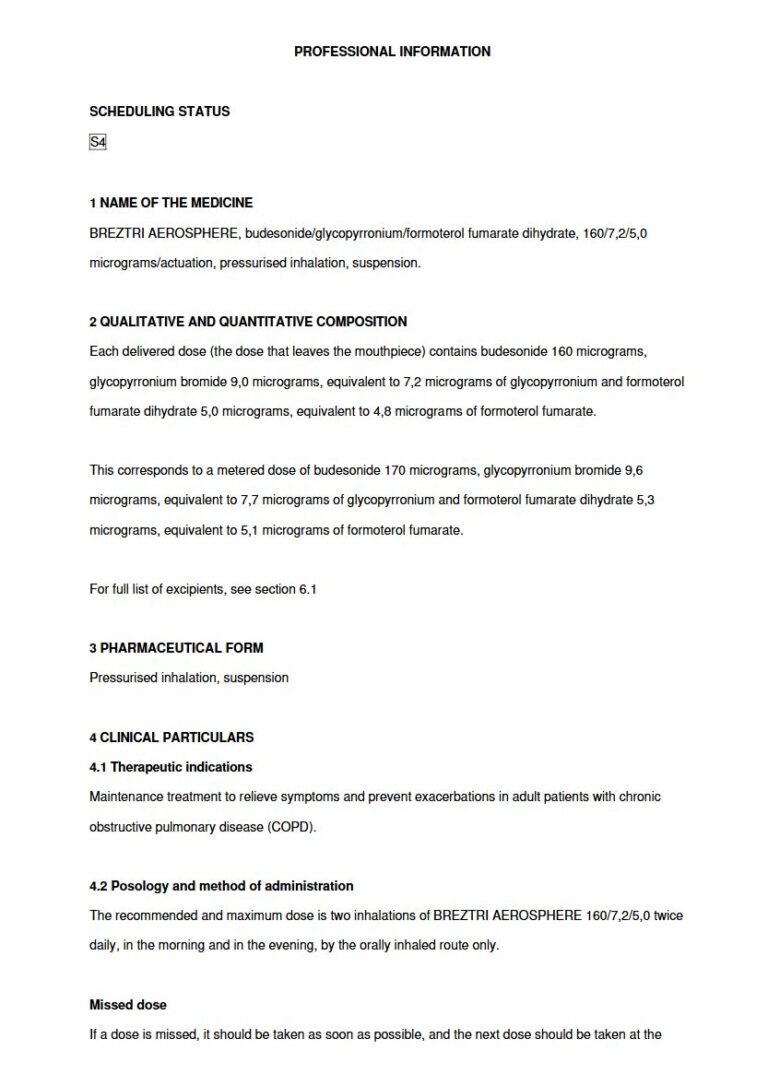
4.1 Therapeutic indications
Maintenance treatment to relieve symptoms and prevent exacerbations in adult patients with chronic obstructive pulmonary disease (COPD).
4.2 Posology and method of administration
The recommended and maximum dose is two inhalations of BREZTRI AEROSPHERE 160/7,2/5,0 twice daily, in the morning and in the evening, by the orally inhaled route only.
Missed dose
If a dose is missed, it should be taken as soon as possible, and the next dose should be taken at the usual time. A double dose should not be taken to make up for a forgotten dose.
Children:
BREZTRI AEROSPHERE should not be used in children and adolescents (under 18 years of age).
Dosage in patients with renal impairment:
It can also be used at the recommended dose in patients with severe renal impairment or end-stage renal disease requiring dialysis, only if the expected benefit outweighs the potential risk.
Dosage in patients with hepatic impairment:
No dosage adjustment is necessary for patients with hepatic impairment (see section 4.4 and section 5.2)
Elderly:
No dosage adjustment is necessary for elderly patients (see section 5.2)
Method of Administration:
For oral inhalation use. For detailed instructions, refer to the patient leaflet. Patients should be instructed how to administer the product correctly and advised to read the instructions for use carefully. Patients who find it difficult to co-ordinate actuation with inhalation may use BREZTRI AEROSPHERE with a spacer to ensure proper administration of the product. BREZTRI AEROSPHERE can be used with spacer devices including the Aerochamber Plusu00ae Flow-Vuu00ae.
4.3 Contraindications
Hypersensitivity to the active substances or any of the excipients.
4.4 Special warnings and precautions for use
Deterioration of disease
If patients find the treatment ineffective, despite taking the highest recommended dose of BREZTRI AEROSPHERE, medical attention must be sought. Sudden and progressive deterioration in control of COPD is potentially life threatening and the patient should undergo urgent medical assessment. In this situation, consideration should be given to the need for increased therapy such as a course of oral corticosteroids or antibiotic treatment if an infection is present.
Transfer from oral therapy
Particular care is needed in patients transferring from oral steroids, since they may remain at risk of impaired adrenal function for a considerable time. Patients who have required high dose corticosteroid therapy or prolonged treatment at the highest recommended dose of inhaled corticosteroids may also be at risk. These patients may exhibit signs and symptoms of adrenal insufficiency when exposed to severe stress. Additional systemic corticosteroid cover should be considered during periods of stress or elective surgery.
Paradoxical bronchospasm
Administration of BREZTRI AEROSPHERE may cause paradoxical bronchospasm. If this occurs, treatment with BREZTRI AEROSPHERE should be stopped and other treatments considered.
Not for acute use
BREZTRI AEROSPHERE is not indicated for the treatment of acute episodes of bronchospasm, or to treat an acute COPD exacerbation (i.e. as a rescue therapy).
Cardiovascular effects
Caution should be observed in patients with thyrotoxicosis and in patients with a severe cardiovascular disorder, such as ischaemic heart disease, tachydysrhythmias or severe heart failure. Caution should be observed when treating patients with a prolonged QTc-interval.
Systemic effects
Systemic effects may occur with any inhaled corticosteroid, particularly at high doses prescribed for long periods. These effects are much less likely to occur with inhaled corticosteroid treatments than with oral corticosteroids. Possible systemic effects include Cushing's syndrome, Cushingoid features, adrenal suppression, decrease in bone mineral density, cataract and glaucoma. Potential effects on bone density should be considered particularly in patients on high doses for prolonged periods that have co existing risk factors for osteoporosis. Long-term studies with inhaled budesonide in adults at daily doses of 800 micrograms (metered dose) have not shown any significant effects on bone mineral density (see section 5.1).
Hypokalaemia and hyperglycaemia
In one clinical trial of 24 weeks that included a 28-week safety extension study, and in one 52-week study evaluating BREZTRI AEROSPHERE in subjects with COPD, there was no evidence of a treatment effect on potassium. Metabolic effects of hyperglycaemia and hypokalaemia may be observed with high doses of u03b22 adrenergic agonists. The decrease in serum potassium is usually transient, not requiring supplementation (see section 4.5).
Anticholinergic activity
Due to its anticholinergic activity, BREZTRI AEROSPHERE should be used with caution in patients with symptomatic prostatic hyperplasia, urinary retention or narrow-angle glaucoma.
Renal impairment
Formal pharmacokinetic studies using BREZTRI AEROSPHERE have not been conducted in patients with renal impairment. As glycopyrronium is predominantly renally excreted, patients with severe renal impairment (creatinine clearance of <30 mL/min) should be treated with BREZTRI AEROSPHERE only if the expected benefit outweighs the potential risk.
Hepatic impairment
As budesonide and formoterol are primarily eliminated via hepatic metabolism an increased exposure can be expected in patients with severe hepatic impairment. In patients with severe hepatic impairment, BREZTRI AEROSPHERE should be used only if the expected benefit outweighs the potential risk (see section 5.2).
Pneumonia
Medical practitioners should remain vigilant for the possible development of pneumonia in patients with COPD as the clinical features of such infections can overlap with the symptoms of COPD exacerbations.
4.5 Interaction with other medicines and other forms of interaction
No formal drug interaction studies have been performed with BREZTRI AEROSPHERE.
COPD medicines
Co-administration of BREZTRI AEROSPHERE with other anticholinergic and/or long-acting u03b22-adrenergic agonist containing medicines has not been studied and is not recommended.
Metabolic interactions
The metabolism of budesonide is primarily mediated by CYP3A4. Co-treatment with strong CYP3A inhibitors, e.g. itraconazole, ketoconazole, HIV protease inhibitors and cobicistat-containing products, are expected to increase the risk of systemic side effects (see section 4.4 and section 5.2). This is of limited clinical importance for short-term (1-2 weeks) treatment, but should be taken into consideration during long-term treatment with a strong CYP3A4 inhibitor.
Since glycopyrronium is eliminated mainly by the renal route, drug interaction could potentially occur with medicines affecting renal excretion mechanisms. In-vitro glycopyrronium is a substrate for the renal transporters OCT2 and MATE1/2K. The effect of cimetidine, a probe inhibitor of OCT2 and MATE1, on inhaled glycopyrronium disposition showed a limited increase in its total systemic exposure (AUC 0-t) by 22 % and a slight decrease in renal clearance by 23 % due to co-administration of cimetidine.
Formoterol does not inhibit the CYP450 enzymes at therapeutically relevant concentrations (see section 5.2). Budesonide and glycopyrronium do not inhibit or induce CYP450 enzymes at therapeutically relevant concentrations (see section 5.2).
Drug-induced hypokalaemia
Possible initial hypokalaemia may be potentiated by concomitant medications, including non-potassium sparing diuretics.
u03b2-adrenergic blockers
Beta-adrenergic blockers (including eye drops) can weaken or inhibit the effect of formoterol.
Other pharmacodynamic interactions
BREZTRI AEROSPHERE should be administered with caution to patients being treated with medicinal products known to prolong the QTc-interval (see section 4.4).
4.6 Fertility, pregnancy and lactation
Pregnancy
There are no adequate data on the use of BREZTRI AEROSPHERE in pregnant women. Data on the use of inhaled budesonide in more than 2 500 exposed pregnancies indicate no increased teratogenic risk associated with budesonide. Single-dose studies in humans found that very small amounts of glycopyrronium passed the placental barrier. There are no adequate data from use of formoterol or glycopyrronium in pregnant women. No animal reproductive toxicology studies have been conducted with BREZTRI AEROSPHERE. Budesonide has been shown to induce embryofoetal toxicity in rats and rabbits, a class effect of glucocorticoids. At very high doses/systemic exposure levels, formoterol caused implantation losses as well as decreases in birth weight and early postnatal survival, whereas glycopyrrolate had no significant effects on reproduction (see section 5.3). BREZTRI AEROSPHERE should only be used during pregnancy if the expected benefits outweigh the potential risks.
Breastfeeding
A clinical pharmacology study has shown that inhaled budesonide is excreted in breast milk. However, budesonide was not detected in nursing infant blood samples. Based on pharmacokinetic parameters, the plasma concentration in the child is estimated to be less than 0,17 % of the motheru2019s plasma concentration. Consequently, no effects due to budesonide are anticipated in breast-fed children whose mothers are receiving therapeutic doses of BREZTRI AEROSPHERE. It is not known whether glycopyrronium or formoterol are excreted in human milk. Evidence of transfer of glycopyrronium and formoterol into maternal milk in rats has been reported.
Fertility
Studies in rats have shown slight reductions in fertility only at dose levels higher than the maximum human exposure to formoterol (see section 5.3). Budesonide and glycopyrronium individually, did not cause any adverse effects on fertility in rats. It is unlikely that BREZTRI AEROSPHERE administered at the recommended dose will affect fertility in humans.
4.7 Effects on ability to drive and use machines
No studies on the effects on the ability to drive and use machines have been performed. Based on the pharmacological profile, BREZTRI AEROSPHERE is expected to have no or negligible influence on the ability to drive and use machines.
4.8 Undesirable effects
Summary of the safety profile
As BREZTRI AEROSPHERE contains budesonide, glycopyrronium and formoterol, the type and severity of adverse reactions associated with each of the components may be expected with BREZTRI AEROSPHERE. The safety evaluation of the pivotal program for BREZTRI AEROSPHERE 160/7,2/5,0 included 639 subjects with COPD in one 24-week lung function trial, and a long-term safety extension study of 28 weeks, and 2 144 subjects in one 52-week exacerbation trial. In addition, 2 137 subjects in the 52-week exacerbation trial received BGF MDI 80/7,2/5,0.
Tabulated summary of adverse reactions
The frequency of adverse reactions is defined using the following convention: very common (u22651/10); common (u22651/100 to <1/10); uncommon (u22651/1 000 to <1/100); rare (u22651/10 000 to <1/1,000); very rare (<1/10 000) and not known (cannot be estimated from available data).
Table 1: Adverse drug reactions by frequency and system order class (SOC)
System Organ Class Frequency Preferred term
- Infections and infestations Common Oral candidiasis
- Pneumonia
- Immune system disorders Uncommon Hypersensitivity
- Endocrine disorders Very rare Signs or symptoms of systemic glucocorticosteroid effects, e.g. hypofunctions of the adrenal gland
- Metabolism and nutrition disorders Common Hyperglycaemia
- Psychiatric disorders Common Anxiety, insomnia
- Uncommon Depression, agitation, restlessness, nervousness
- Very rare Abnormal behaviour
- Nervous system disorders Common Headache
- Uncommon Tremor, dizziness
- Cardiac disorders Common Palpitations
- Uncommon Angina pectoris, Tachycardia, Cardiac arrhythmias (atrial fibrillation, supraventricular tachycardia and extrasystoles)
- Respiratory, thoracic and mediastinal disorders Common Dysphonia, cough
- Uncommon Throat irritation, bronchospasm
- Gastrointestinal disorders Common Nausea
- Uncommon Dry mouth
- Renal and urinary disorders Common Urinary tract infection
- Uncommon Urinary retention
- Musculoskeletal and connective tissue disorders Common Muscle spasms
- General disorders and administration site conditions Uncommon Chest pain
Description of selected adverse reactions
Pneumonia
In KRONOS (see section 5.1), the incidence of confirmed pneumonia was 1,9 % with BREZTRI AEROSPHERE 160/7,2/5,0, 1,9 % with budesonide and formoterol fumarate dihydrate [BFF MDI 160/5,0 mcg], and 1,6 % with glycopyrronium and formoterol fumarate dihydrate [GFF MDI 7,2/,5.0 mcg]. In ETHOS (see section 5.1), the incidence of confirmed pneumonia was 4,2 % with BREZTRI AEROSPHERE 160/7,2/5,0, 3,5 % with BGF MDI 80/7,2/5, 4,5 % with BFF MDI 160/5,0 mcg and 2,3 % with GFF MDI 7,2/5,0 mcg.
Reporting of suspected adverse reactions
Reporting suspected adverse reactions after authorisation of the medicine is important. It allows continued monitoring of the benefit/risk balance of the medicine. Health care providers are requested to report any suspected adverse drug reactions to SAHPRA via the Med Safety APP (Medsafety X SAHPRA) and eReporting platform (who-umc.org) found on SAHPRA website.
4.9 Overdose
There is limited evidence on the management of overdose with BREZTRI AEROSPHERE. An overdose of BREZTRI AEROSPHERE may lead to exaggerated anticholinergic and/or u03b22-adrenergic signs and symptoms; the most frequent of which include blurred vision, dry mouth, nausea, muscle spasm, tremor, headache, palpitations and systolic hypertension. Acute overdosage with budesonide, even in excessive doses, is not expected to be a clinical problem. When used chronically in excessive doses, systemic glucocorticosteroid effects may appear.
