
Brilintaa 90mg Tablets
PDF Leaflet Revision Date: 12 May 2022
Clinical Summary
Quick overview from the medicine insert
Indication
Prevention of thrombotic events in Acute Coronary Syndromes.
Dosage (summary)
180 mg loading dose, then 90 mg twice daily.
Onset of Action / Duration
Onset: 30 mins, Duration: 6-8 hours
Special Populations
- Elderly
- Renal impairment
- Hepatic impairment
Pregnancy & Breastfeeding
Safety in pregnancy not established; not recommended during breastfeeding.
Key Drug Interactions
- Strong CYP3A4 inhibitors
- CYP3A4 inducers
- Digoxin
Contraindications
- Hypersensitivity to ticagrelor
- Active bleeding
- Severe hepatic impairment
Common side effects
- Bleeding
- Dyspnoea
- Dizziness
Counselling Points
- Take with aspirin unless contraindicated
- Avoid missed doses
- Monitor for bleeding
Serious warnings
- Increased bleeding risk
- Bradyarrhythmia
- Thrombotic Thrombocytopenic Purpura
Important Disclaimer
The Brilintaa 90mg Tablets professional information leaflet below is the property of Astrazeneca Pharmaceuticals and is provided on Medinsert exactly as issued, with no.. alterations or editorial changes. We make every effort to keep content current by updating documents as soon as new versions become available. Medinsert serves as a trusted access point for healthcare professionals, but does not replace official sources or clinical judgement. For more details, please read our full disclaimer. read more>>
 Healthcare Professionals Only
This content is for registered healthcare professionals
Sign in or create a free account to read the full package insert.
Free for HPCSA-registered professionals. Powered by Medinsert.
Clinical Particulars
Section 4 of the official insert — extracted exactly as issued, no alterations
4.1 Therapeutic indications
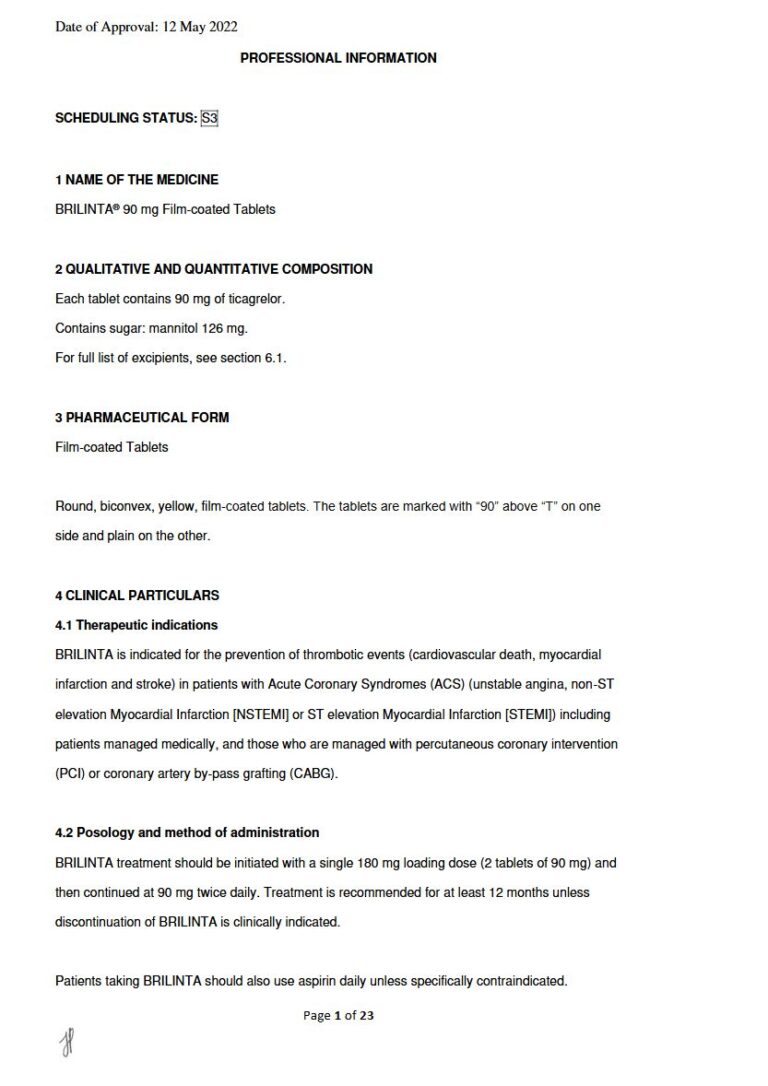
BRILINTA is indicated for the prevention of thrombotic events (cardiovascular death, myocardial infarction and stroke) in patients with Acute Coronary Syndromes (ACS) (unstable angina, non-ST elevation Myocardial Infarction [NSTEMI] or ST elevation Myocardial Infarction [STEMI]) including patients managed medically, and those who are managed with percutaneous coronary intervention (PCI) or coronary artery by-pass grafting (CABG).
4.2 Posology and method of administration
BRILINTA treatment should be initiated with a single 180 mg loading dose (2 tablets of 90 mg) and then continued at 90 mg twice daily. Treatment is recommended for at least 12 months unless discontinuation of BRILINTA is clinically indicated. Patients taking BRILINTA should also use aspirin daily unless specifically contraindicated.
Following an initial dose of aspirin, BRILINTA should be used with a maintenance dose of aspirin of 75-150 mg daily (see section 4.4 and 5.1).
Missed dose
Lapses in therapy should be avoided. A patient who misses a dose of BRILINTA should take one 90 mg tablet (their next dose) at its scheduled time.
Premature discontinuation
Premature discontinuation with any antiplatelet therapy, including BRILINTA, could result in an increased risk of cardiovascular (CV) death, MI or stroke due to the patientu2019s underlying disease (see section 4.4).
Switching
In patients having an ACS event, the loading dose of 180 mg should be given as soon as possible regardless of any previous antiplatelet treatment. Medical practitioners who desire to switch patients with a prior ACS event from clopidogrel to BRILINTA should administer the first 90 mg dose of BRILINTA 24 hours following the last dose of clopidogrel. There is no data on switching patients from other ADP receptor inhibitors to BRILINTA.
Special populations
Paediatric patients: Safety and efficacy in children below the age of 18 have not been established.
Elderly patients: No dose adjustment is required.
Patients with renal impairment: No dose adjustment is necessary for patients with renal impairment (see section 5.2).
Patients with hepatic impairment: Although the delay in elimination of BRILINTA was statistically significant in patients with mild hepatic impairment (Child Pugh A), no dose adjustment is necessary in these patients. BRILINTA has not been studied in patients with severe hepatic impairment (see section 4.3, 4.4 and 5.2).
Administration
For oral use. BRILINTA can be taken with or without food. For patients who are unable to swallow the tablet(s) whole, BRILINTA tablets (90 mg and 2 x 90 mg) can be crushed to a fine powder and mixed in half a glass of water and drunk immediately. The glass should be rinsed with a further half glass of water and the contents drunk. The mixture can also be administered via a nasogastric tube (CH8 or greater). It is important to flush the nasogastric tube through with water after administration of the mixture.
4.3 Contraindications
- Hypersensitivity to ticagrelor (BRILINTA) or any of its excipients listed in section 6.1.
- Active bleeding.
- Inherited bleeding disorders.
- Severe hepatic impairment.
- History of intracranial haemorrhage.
- Strong CYP3A4 inhibitors (such as ketoconazole, clarithromycin, itraconazole, ritonavir and atazanavir).
- CYP3A4 inducers (such as rifampicin, phenytoin, carbamazepine and phenobarbitone).
4.4 Special warnings and precautions for use
Bleeding risk: The use of BRILINTA in patients at known increased risk for bleeding should be balanced against the benefit in terms of prevention of thrombotic events. Consideration should be given to the following:
- Patients with a propensity to bleed (e.g., due to recent trauma, recent surgery, active or recent gastrointestinal bleeding or moderate hepatic impairment) or who are at increased risk of trauma. The use of BRILINTA is contraindicated in patients with active pathologic bleeding, inherited bleeding disorders and in those with a history of intracranial haemorrhage and severe hepatic impairment (see section 4.3).
- Concomitant administration of medicinal products that may increase the risk of bleeding including non-steroidal anti-inflammatory drugs (NSAIDs), oral anticoagulants and/or fibrinolytics within 24 hours of BRILINTA dosing.
- The safe co-administration of BRILINTA with warfarin has not been established.
- Platelet transfusion did not reverse the antiplatelet effect of BRILINTA in healthy volunteers and is unlikely to be of clinical benefit in patients with bleeding. Since co-administration of BRILINTA with desmopressin did not decrease template bleeding time; desmopressin is unlikely to be effective in managing clinical bleeding events.
CABG-related bleeding: In the phase 3 study, 12 % underwent coronary artery bypass graft (CABG) surgery. u2018Major Fatal/Life - threateningu2019 bleeding occurred in approximately 42 % of patients and fatal CABG bleeding occurred in 6 patients.
Surgery:
- If a patient requires surgery, medical practitioners should consider each patientu2019s clinical profile as well as the benefits and risks of continued antiplatelet therapy when determining when discontinuation of BRILINTA treatment should occur.
- In a clinical study, mean Inhibition of Platelet Aggregation (IPA) for BRILINTA at 24, 48, 72 and 120 hours post-dose was 58,4 %, 32,8 %, 19,5 % and 9,7 % respectively.
- If a patient is to undergo elective surgery and antiplatelet effect is not desired, BRILINTA should be discontinued 5 days prior to surgery.
- There are no data available in regard to major regional block techniques and neuraxial blocks. Caution is advised in patients with increased risk of bleeding such as those undergoing spinal anaesthesia, epidural anaesthesia and lumbar puncture.
- Neurological monitoring for neuroaxial haematoma is recommended consistent with standard of care, during peri-operative and post-operative care.
- BRILINTA should be discontinued 5 days prior to surgery or for any procedure in which antiplatelet effect is not desired.
Patients at risk for bradyarrhythmia: Holter ECG monitoring has shown an increased frequency of ventricular pauses during treatment with ticagrelor compared with clopidogrel. In phase 3 studies evaluating the safety and efficacy of BRILINTA, bradyarrhythmic events were reported in a similar frequency for ticagrelor and comparators (placebo, clopidogrel and ASA). Patients with an increased risk of bradycardic events (e.g., patients without a pacemaker who have sick sinus syndrome, 2nd or 3rd degree atrioventricular (AV) block or bradycardic-related syncope) have been excluded from BRILINTA outcome studies. Therefore, due to the limited clinical experience in these patients, caution is advised (see also section 5.1). Bradyarrhythmic events and AV blocks have been reported in the post-marketing setting in patients taking BRILINTA (see section 4.8), primarily in patients with ACS, where cardiac ischemia and concomitant drugs reducing the heart rate or affecting cardiac conduction are potential confounders. The patientu2019s clinical condition and concomitant medication should be assessed as potential causes prior to adjusting treatment. In a Holter sub-study, 6 % of patients on BRILINTA developed ventricular pauses of > 3 seconds.
Dyspnoea: Dyspnoea commonly occurs in patients treated with BRILINTA and may resolve during continued BRILINTA treatment. The mechanism has not yet been elucidated but may be related to potentiation of adenosine. If a patient develops new, prolonged or worsened dyspnoea during treatment with BRILINTA this should be investigated fully and if not tolerated, treatment with BRILINTA should be stopped (see section 4.8).
Central Sleep Apnoea: Central sleep apnoea including Cheyne-Stokes respiration has been reported in the post marketing setting in patients taking BRILINTA. If central sleep apnoea is suspected, further clinical assessment may be considered.
Thrombotic Thrombocytopenic Purpura (TTP): Thrombotic Thrombocytopenic Purpura has been reported very rarely with the use of BRILINTA. TTP is a serious condition and requires prompt treatment.
Interference with laboratory tests: Platelet function tests to diagnose Heparin-induced thrombocytopenia (HIT): False negative results in platelet function test for heparin-induced thrombocytopenia (HIT) have been reported in patients administered ticagrelor. This is related to inhibition of the P2Y 12 -receptor on the healthy donor platelets in the test by ticagrelor in the patientu2019s sera/plasma. Information on concomitant treatment with ticagrelor is required for interpretation of HIT platelet function tests. Before considering discontinuation of ticagrelor, the benefit and risk of continued treatment should be assessed, taking both the prothrombotic state of HIT and the increased risk of bleeding with concomitant anticoagulant and ticagrelor treatment into consideration.
Other: Based on a relationship observed in the PLATO Study between maintenance aspirin dose, co-administration of BRILINTA and high maintenance dose of aspirin (300 mg) is not recommended (see section 4.2 and 5.1). Co-administration of BRILINTA with strong CYP3A4 inhibitors (e.g., ketoconazole, clarithromycin, ritonavir and atazanavir) should be avoided as co-administration may lead to a substantial increase in exposure to BRILINTA (see section 4.3 and 4.5). Co-administration of BRILINTA and simvastatin increased mean simvastatin C max by 81 % and AUC by 56 % and increased simvastatin acid C max by 64 % and AUC by 52 %, which may be associated with increased adverse events related to increased simvastatin exposure. The concomitant use of BRILINTA with doses of simvastatin or lovastatin > 40 mg is not recommended.
4.5 Interaction with other medicines and other forms of interaction
Effects of other medicines on BRILINTA: Medicinal products metabolised by CYP3A4:
Ketoconazole (strong CYP3A4 inhibitors): Co-administration of ketoconazole with BRILINTA increased ticagrelor C max and AUC equal to 2,4-fold and 7,3-fold, respectively. The C max and AUC of the active metabolite were reduced by 89 % and 56 % respectively. Other strong inhibitors of CYP3A4 (clarithromycin, itraconazole, ritonavir and atazanavir) would be expected to have similar effects and should not be given concomitantly with BRILINTA (see section 4.3).
Diltiazem (moderate CYP3A4 inhibitors): Co-administration of BRILINTA and diltiazem increased the C max of ticagrelor by 69 % and AUC by 174 % and decreased the active metabolite C max by 38 % and AUC was unchanged. There was no effect of BRILINTA on diltiazem plasma levels. Other moderate CYP3A4 inhibitors (e.g., amprenavir, erythromycin, fluconazole and verapamil) may probably be co-administered with BRILINTA.
Rifampicin and other CYP3A4 inducers: Co-administration of rifampicin with BRILINTA decreased ticagrelor C max and AUC by 73 % and 86 %, respectively. The C max of the active metabolite was unchanged and the AUC was decreased by 46 % respectively. Other CYP3A4 inducers (e.g., phenytoin, carbamazepine and phenobarbitone) would be expected to decrease the exposure to BRILINTA as well and may result in reduced efficacy of BRILINTA (see section 4.3).
Ciclosporin (P-gp and CYP3A inhibitor): Co-administration of ciclosporin (600 mg) with ticagrelor increased ticagrelor C max and AUC equal to 2,3-fold and 2,8-fold, respectively. The AUC of the active metabolite was increased by 32 % and C max was decreased by 15 % in the presence of ciclosporin. There was no effect of ticagrelor on ciclosporin blood levels.
Others: Clinical pharmacology interaction studies showed that co-administration of BRILINTA with heparin, enoxaparin and aspirin did not have any effect on ticagrelor or the active metabolite plasma levels. Delayed and decreased exposure to oral P2Y 12 inhibitors, including ticagrelor and its active metabolite, has been reported in patients treated with morphine (approximately 35 % reduction in ticagrelor). This interaction may be related to reduced gastrointestinal motility and therefore apply to other opioids. The clinical relevance is unknown.
Effects of BRILINTA on other medicines: Medicinal products metabolised by CYP3A4:
Simvastatin: Co-administration of BRILINTA with simvastatin increased simvastatin C max by 81 % and AUC by 56 % and increased simvastatin acid C max by 64 % and AUC by 52 % with some individual increases equal to 2-3 fold. The concomitant use of BRILINTA with a dose of simvastatin or lovastatin > 40 mg is not recommended.
Atorvastatin: Co-administration of atorvastatin and BRILINTA increased atorvastatin acid C max by 23 % and AUC by 36 %. Similar increases in AUC and C max were observed for all atorvastatin acid metabolites. These increases are not considered clinically significant.
Medicinal products metabolised by CYP2C9:
Tolbutamide: Co-administration of BRILINTA with tolbutamide resulted in no change in the plasma levels of either medicine, which suggest that ticagrelor is not a CYP2C9 inhibitor and unlikely to alter the CYP2C9 mediated metabolism of tolbutamide.
Oral Contraceptives: Co-administration of BRILINTA and levonorgestrel and ethinyl estradiol increased ethinyl estradiol exposure by approximately 20 % but did not alter the pharmacokinetics of levonorgestrel. No clinically relevant effect on oral contraceptive efficacy is expected when levonorgestrel and ethinyl estradiol are co-administered with BRILINTA.
Digoxin (Pg-p substrate): Concomitant administration of BRILINTA increased the digoxin C max by 75 % and AUC by 28 %. Therefore, appropriate clinical and/or laboratory monitoring is recommended when giving narrow therapeutic index P-gp dependent medicines like digoxin concomitantly with BRILINTA.
4.6 Fertility, pregnancy and lactation
Pregnancy: Safety in pregnancy has not been established.
Breastfeeding: The use of BRILINTA during breastfeeding is not recommended.
4.7 Effects on ability to drive and use machines
No studies on the effects of BRILINTA on the ability to drive and use machines have been performed. During treatment for Acute Coronary Syndromes, dizziness and confusion have been reported. Therefore, patients who experience these symptoms should be cautious while driving or using machines.
4.8 Undesirable effects
a. Summary of the safety profile
The safety profile of BRILINTA has been evaluated in two large phase 3 outcome trials (PLATO and PEGASUS) including more than 39,000 patients. The safety of BRILINTA in patients with acute coronary syndromes (unstable angina, NSTEMI and STEMI) was evaluated in the PLATO Study. Median treatment duration for BRILINTA was 277 days. BRILINTA had a 7,4 % incidence of discontinuation due to adverse events. The most commonly reported adverse reactions in patients treated with BRILINTA were bleeding and dyspnoea.
b. Tabulated summary of adverse reactions
Adverse reactions are classified according to frequency and System Organ Class. Frequency categories are defined according to the following conventions: Very common (u2265 1/10), Common (u2265 1/100, < 1/10), Uncommon (u2265 1/1 000, < 1/100), Rare (u2265 1/10 000, < 1/1 000). The following adverse reactions have been identified following studies with BRILINTA:
Table 1 u2013 Adverse Reactions by System Organ Class (SOC) and by Adverse Event Frequency
System Organ Classification Very Common Common Uncommon Neoplasms benign, malignant and unspecified (including cysts and polyps) Tumour bleeding b Blood and lymphatic system disorders Blood disorder bleeding c Metabolism and nutrition disorders Hyperuricaemia a Gout Psychiatric disorders Confusion Nervous system disorders Dizziness Syncope Intracranial haemorrhage l Eye disorders Eye haemorrhage d Ear and labyrinth disorders Vertigo Ear haemorrhage Vascular disorders Hypotension Respiratory, thoracic and mediastinal disorders Dyspnoea Respiratory system bleeding e Gastrointestinal disorders Gastrointestinal haemorrhage f Diarrhoea, Nausea Retroperitoneal haemorrhage Skin and subcutaneous tissue disorders Subcutaneous or dermal bleeding g , pruritus Musculoskeletal connective tissue and bone disorders Muscular bleeding h Renal and urinary disorders Urinary tract bleeding i Reproductive system and breast disorders Reproductive system bleeding j Investigations Increased blood creatinine a Injury, poisoning and procedural complications Post procedural haemorrhage, Traumatic bleeding k
a Frequencies derived from laboratory observations (uric acid increases to > ULN from baseline below or within reference range. Creatinine increases of > 50 % from baseline) and not crude adverse event report frequency.
b e.g., bleeding from bladder cancer, gastric cancer, colon cancer.
c e.g., increased tendency to bruise, spontaneous haematoma, haemorrhagic diathesis.
d e.g., conjunctival, retinal, intraocular bleeding.
e e.g., epistaxis, haemoptysis.
f e.g., gingival bleeding, rectal haemorrhage, gastric ulcer haemorrhage.
g e.g., ecchymosis, skin haemorrhage, petechiae.
h e.g., haemarthrosis, muscle haemorrhage.
i e.g., haematuria, cystitis haemorrhagic.
j e.g., vaginal haemorrhage, haematospermia, postmenopausal haemorrhage.
k e.g., contusion, traumatic haematoma, traumatic haemorrhage.
l i.e., spontaneous, procedure related or traumatic intracranial haemorrhage.
Post-marketing experience
The following adverse reactions have been identified during post-approval use of BRILINTA. Because these reactions are reported voluntarily from a population of an unknown size, it is not always possible to reliably estimate their frequency.
Blood disorders: Thrombotic Thrombocytopenic Purpura (see section 4.4).
Immune system disorders: Hypersensitivity reactions including angioedema (see section 4.3).
Nervous system disorders: Central sleep apnoea including Cheyne-Stokes respiration (see section 4.4)
Skin and subcutaneous tissue disorders: Rash.
Cardiac disorders: Bradyarrhythmia, AV block (see section 4.4)
c. Description of selected adverse reactions
Bleeding: The following bleeding definitions were used in the PLATO Study: u2018Major Fatal/Life - threateningu2019 : fatal, or intracranial, or intrapericardial bleed with cardiac tamponade, or hypovolaemic shock or severe hypotension due to bleeding and requiring pressors or surgery, or clinically overt or apparent bleeding associated with a decrease in haemoglobin of more than 5 g/dL, or transfusion of 4 or more units (whole blood or packed red blood cells [PRBCs]) for bleeding. u2018Major Otheru2019 : Significantly disabling (e.g., intraocular with permanent vision loss) or clinically overt or apparent bleeding associated with a decrease in haemoglobin of 3-5 g/dL or transfusion of 2-3 units (whole blood or PRBCs) for bleeding. u2018Minoru2019 : Requires medical intervention to stop or treat bleeding (e.g., epistaxis requiring visit to medical facility for packing). Minimal bleeds included all other bleeds; these were collected but not adjudicated. Bleeding events in PLATO were also mapped to the TIMI (Thrombolysis in Myocardial Infarction) scale. TIMI Major is defined as clinically overt bleeding associated with a fall in haemoglobin > 5 g/dL, or intracranial haemorrhage and TIMI Minor is defined as overt bleeding associated with a fall in haemoglobin of 2 g/dL but u2264 5 g/dL.
Table 2 u2013 Analysis of overall bleeding events
BRILINTA 90 mg twice daily (%) N = 9 235 Primary Safety Endpoint Total Major 11,6 Secondary Endpoints Fatal/Life-Threatening 5,8 Combined Total Major + Minor bleeding 16,1 Non-CABG Major 4,5 Non-Procedural Major 3,1 Non-Procedural Major + Minor 5,9 TIMI-defined bleeding categories TIMI-defined Major 7,9 TIMI-defined Major + Minor 11,4
There were few fatal bleeding events in the PLATO Study, 20 (0,2 %) for BRILINTA 90 mg twice daily. CABG-related bleeding: In the PLATO study, 12 % underwent coronary artery bypass graft (CABG) surgery. u2018Major Fatal/Life - threateningu2019 bleeding occurred in approximately 42 % of patients and fatal CABG bleeding occurred in 6 patients. Non-CABG related bleeding: When CABG bleeding is removed from the analysis (see Table 3 below), the absolute bleeding rates for all categories are lower.
Table 3 u2013 Non-CABG Related PLATO-defined Major Bleeding Events and TIMI-defined Bleeding Events
BRILINTA (%) N = 9 235 PLATO-defined bleeding categories Total Major Bleeding 4,5 Major Fatal/Life-Threatening 2,1
Bleeding unrelated to any procedure: As shown in Table 2 study-defined u2018Majoru2019 and u2018Major + Minoru2019 non-procedural bleeding was common with BRILINTA. Discontinuation of treatment due to non-procedural bleeding was 2,9 %. u2018Major Fatal/Life - threateningu2019 intracranial non-procedural bleeding events with BRILINTA occurred in 26 patients, of which 11 bleeding events were fatal. Baseline characteristics including age, gender, weight, race, geographic region, medical history, concurrent conditions and concomitant therapy were assessed to explore any increase in risk of bleeding with BRILINTA. No particular risk group was identified for any subset of bleeding.
Dyspnoea: Dyspnoea commonly occurs during treatment with BRILINTA although its mechanism has not been elucidated. In PLATO dyspnoea adverse events were in 13,8 % of the patients taking BRILINTA 90 mg twice daily. Most reported dyspnoea adverse events were mild to moderate in intensity. Dyspnoea usually occurred in the initial phase of treatment and 87 % of patients who reported dyspnoea experienced a single episode without the need to discontinue treatment. Dyspnoea serious adverse events occurred in 0,7 % taking BRILINTA. Patients who had dyspnoea tended to be older and more frequently had dyspnoea, CHF, COPD or asthma at baseline. Clinical data do not suggest that the occurrence of dyspnoea with BRILINTA is due to new or worsening heart or lung disease (see section 4.4). There was no indication of an adverse effect of BRILINTA on pulmonary function.
Laboratory abnormalities: In the PLATO study, serum uric acid concentration increased to more than upper limit of normal in 22 % of patients receiving BRILINTA. Mean serum uric acid concentration increased approximately 15 % with BRILINTA and reduced after treatment was stopped. In the PLATO study, serum creatinine concentration increased by > 50 % in 8 % of patients receiving BRILINTA. The increases typically did not progress with ongoing treatment and often decreased with continued therapy. Signs of reversibility on discontinuation were observed even in those with the greatest on treatment increases.
Reporting of suspected adverse reactions
Reporting suspected adverse reactions after authorisation of the medicine is important. It allows continued monitoring of the benefit/risk balance of the medicine. Health care providers are asked to report any suspected adverse reactions to SAHPRA via the u201c6.04 Adverse Drug Reaction Reporting Formu201d, found online under SAHPRAu2019s publications: https://www.sahpra.org.za/Publications/Index/8
4.9 Overdose
There is no known antidote to reverse the effects of BRILINTA and BRILINTA is not dialysable (see section 5.2). Treatment of overdose should follow local standard medical practice. The expected effect of excessive BRILINTA dosing is increased bleeding risk associated with platelet inhibition. If bleeding occurs, appropriate supportive measures should be taken. BRILINTA is well tolerated in single doses up to 900 mg. Gastrointestinal toxicity was dose limiting in a single ascending dose study. Other clinically meaningful adverse effects which may occur with overdose include dyspnoea and ventricular pauses. In the event of overdose, observe for these potential adverse effects and consider ECG monitoring.
