
Cabometyx Tbalets
PDF Leaflet Revision Date: 12 December 2023
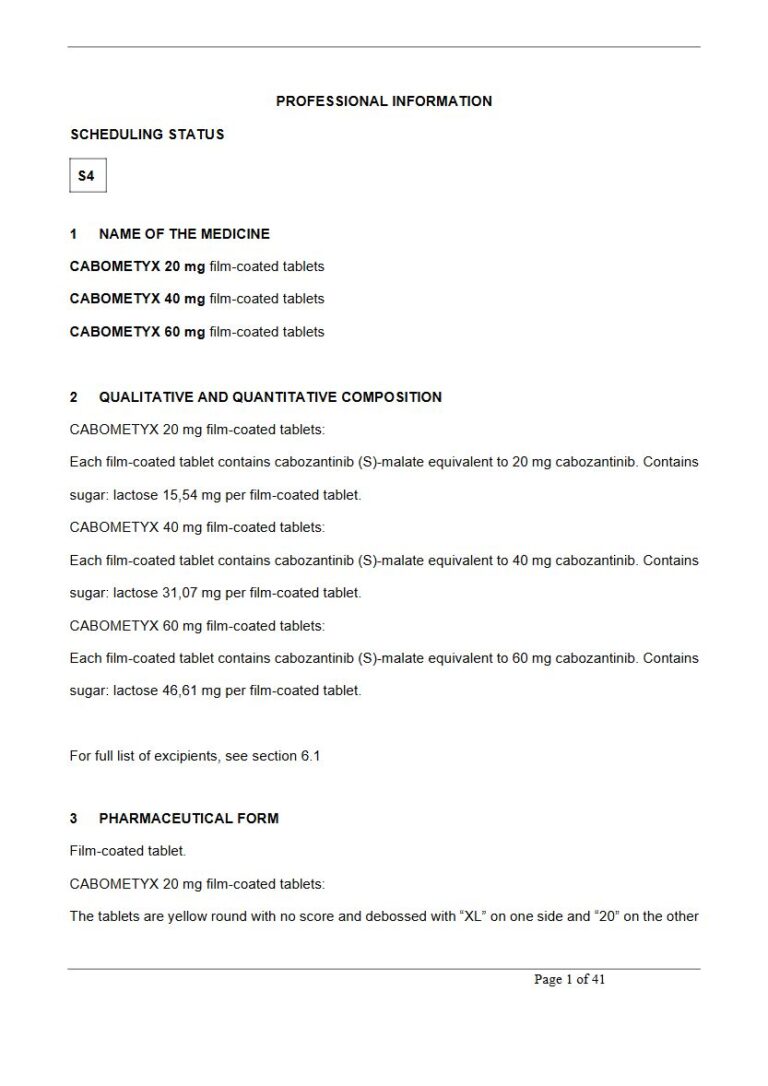
Clinical Summary
Quick overview from the medicine insert
Indication
Treatment of advanced renal cell carcinoma and hepatocellular carcinoma.
Dosage (summary)
60 mg once daily; reduce to 40 mg or 20 mg if needed.
Special Populations
- Elderly
- Renal impairment
- Hepatic impairment
Pregnancy & Breastfeeding
Avoid during pregnancy; discontinue breastfeeding during treatment and for 4 months after.
Key Drug Interactions
- CYP3A4 inhibitors
- CYP3A4 inducers
- P-glycoprotein substrates
Contraindications
- Hypersensitivity to cabozantinib
Common side effects
- Diarrhoea
- Fatigue
- Nausea
- Hypertension
- Palmar-plantar erythrodysaesthesia syndrome
Counselling Points
- Take on an empty stomach
- Monitor for signs of liver dysfunction
- Report severe side effects immediately
Serious warnings
- Severe haemorrhage
- GI perforations
- Hepatic encephalopathy
- Thromboembolic events
Important Disclaimer
The Cabometyx Tbalets professional information leaflet below is the property of Acino Pharma and is provided on Medinsert exactly as issued, with no.. alterations or editorial changes. We make every effort to keep content current by updating documents as soon as new versions become available. Medinsert serves as a trusted access point for healthcare professionals, but does not replace official sources or clinical judgement. For more details, please read our full disclaimer. read more>>
 Healthcare Professionals Only
This content is for registered healthcare professionals
Sign in or create a free account to read the full package insert.
Free for HPCSA-registered professionals. Powered by Medinsert.
Clinical Particulars
Section 4 of the official insert — extracted exactly as issued, no alterations
4.1 Therapeutic indications
Renal Cell Carcinoma (RCC)
CABOMETYX is indicated for the treatment of advanced renal cell carcinoma (RCC):
- in treatment-nau00efve adults with intermediate or poor risk (see section 5.1)
- in adults following prior vascular endothelial growth factor (VEGF)-targeted therapy. (1)
(1) Hepatocellular Carcinoma (HCC)
CABOMETYX is indicated as monotherapy for the treatment of hepatocellular carcinoma (HCC) in adults who have previously been treated with sorafenib. (1)
4.2 Posology and method of administration
Therapy with CABOMETYX should be initiated by a medical practitioner experienced in the administration of anticancer medicines. (1)
Posology
For RCC and HCC, the recommended dose of CABOMETYX is 60 mg once daily. Treatment should continue until the patient is no longer clinically benefiting from therapy or until unacceptable toxicity occurs. (1)
Management of suspected adverse drug reactions may require temporary treatment interruption and/or dose reduction of CABOMETYX therapy (see Table 1). When dose reduction is necessary, it is recommended to reduce to 40 mg daily, and then to 20 mg daily. Dose interruptions are recommended for management of CTCAE grade 3 or greater toxicities or intolerable grade 2 toxicities. Dose reductions are recommended for events that, if persistent, could become serious or intolerable. (1)
If a patient misses a dose, the missed dose should not be taken if it is less than 12 hours before the next dose. (1)
4.3 Contraindications
u2022 Hypersensitivity to cabozantinib or to any of the excipients (see section 6.1). (1)
4.4 Special warnings and precautions for use
As most events occur early in the course of treatment, the clinical practitioner should evaluate the patient closely during the first eight weeks of treatment to determine if dose modifications are warranted. Events that generally have early onset include hypocalcaemia, hypokalaemia, thrombocytopenia, hypertension, palmar-plantar erythrodysaesthesia syndrome (PPES), proteinuria, and gastrointestinal (GI) events (abdominal pain, mucosal inflammation, constipation, diarrhoea, vomiting). (1)
In renal cell carcinoma following prior vascular endothelial growth factor (VEGF)-targeted therapy, dose reductions and dose interruptions due to an AE occurred in 59.8% and 70%, respectively, of cabozantinib-treated patients in the pivotal clinical trial (METEOR). Two dose reductions were required in 19.3% of patients. The median time to first dose reduction was 55 days, and to first dose interruption was 38 days. (1)
In treatment-nau00efve renal cell carcinoma, dose reductions and dose interruptions occurred in 46% and 73%, respectively, of cabozantinib-treated patients in the clinical trial (CABOSUN). (1)
In hepatocellular carcinoma following prior systemic therapy, dose reductions and dose interruptions occurred in 62% and 84%, respectively, of cabozantinib-treated patients in the clinical trial (CELESTIAL). Two dose reductions were required in 33% of patients. The median time to first dose reduction was 38 days, and to first dose interruption was 28 days. Closer monitoring is advised in patients with mild or moderate hepatic impairment. (1)
4.5 Interactions with other medicines
Concomitant medicines that are strong inhibitors of CYP3A4 should be used with caution, and chronic use of concomitant medicines that are strong inducers of CYP3A4 should be avoided (see sections 4.4 and 4.5). (1)
Selection of an alternative concomitant medicines with no or minimal potential to induce or inhibit CYP3A4 should be considered. (1)
4.6 Fertility, pregnancy and lactation
Women of childbearing potential must be advised to avoid pregnancy while on cabozantinib. Female partners of male patients taking cabozantinib must also avoid pregnancy. Effective methods of contraception should be used by male and female patients and their partners during therapy, and for at least 4 months after completing therapy. Because oral contraceptives might possibly not be considered as u201ceffective methods of contraceptionu201d, they should be used together with another method, such as a barrier method (see section 4.5). (1)
Pregnancy
There are no studies in pregnant women using cabozantinib. Studies in animals have shown embryo foetal and teratogenic effects (see section 5.3). The potential risk for humans is unknown. Cabozantinib should not be used during pregnancy unless the clinical condition of the woman requires treatment with cabozantinib. (1)
Breast-feeding
It is not known whether cabozantinib and/or its metabolites are excreted in human milk. Because of the potential harm to the infant, mothers should discontinue breast-feeding during treatment with cabozantinib, and for at least 4 months after completing therapy. (1)
Fertility
There are no data on human fertility. Based on non-clinical safety findings, male and female fertility may be compromised by treatment with cabozantinib (see section 5.3). Both men and women should be advised to seek advice and consider fertility preservation before treatment. (1)
4.7 Effects on ability to drive and use machines
Cabozantinib has minor influence on the ability to drive and use machines. Adverse reactions such as fatigue and weakness have been associated with cabozantinib. Therefore, caution should be recommended when driving or operating machines. (1)
4.8 Undesirable effects
a. Summary of the safety profile
The most common serious adverse drug reactions in the RCC population (u22651% incidence) are abdominal pain, diarrhoea, nausea, hypertension, embolism, hyponatraemia, pulmonary embolism, vomiting, dehydration, fatigue, asthenia, decreased appetite, deep vein thrombosis, dizziness, hypomagnesaemia and palmar-plantar erythrodysaesthesia syndrome (PPES). (1)
The most frequent adverse reactions of any grade (experienced by at least 25% of patients) in the RCC population included diarrhoea, fatigue, nausea, decreased appetite, PPES, hypertension, weight decreased, vomiting, dysgeusia, constipation, and AST increased. Hypertension was observed more frequently in the treatment nau00efve RCC population (67%) compared to RCC patients following prior VEGF-targeted therapy (37%). (1)
The most common serious adverse drug reactions in the HCC population (u22651% incidence) are hepatic encephalopathy, asthenia, fatigue, PPES, diarrhoea, hyponatraemia, vomiting, abdominal pain and thrombocytopenia. (1)
The most frequent adverse reactions of any grade (experienced by at least 25% of patients) in the HCC population included diarrhoea, decreased appetite, PPES, fatigue, nausea, hypertension and vomiting. (1)
4.9 Overdose
There is no specific treatment for cabozantinib overdose and possible symptoms of overdose have not been established. (1)
In the event of suspected overdose, cabozantinib should be withheld and supportive care instituted. Metabolic clinical laboratory parameters should be monitored at least weekly or as deemed clinically appropriate to assess any possible changing trends. Adverse reactions associated with overdose are to be treated symptomatically. (1)
