
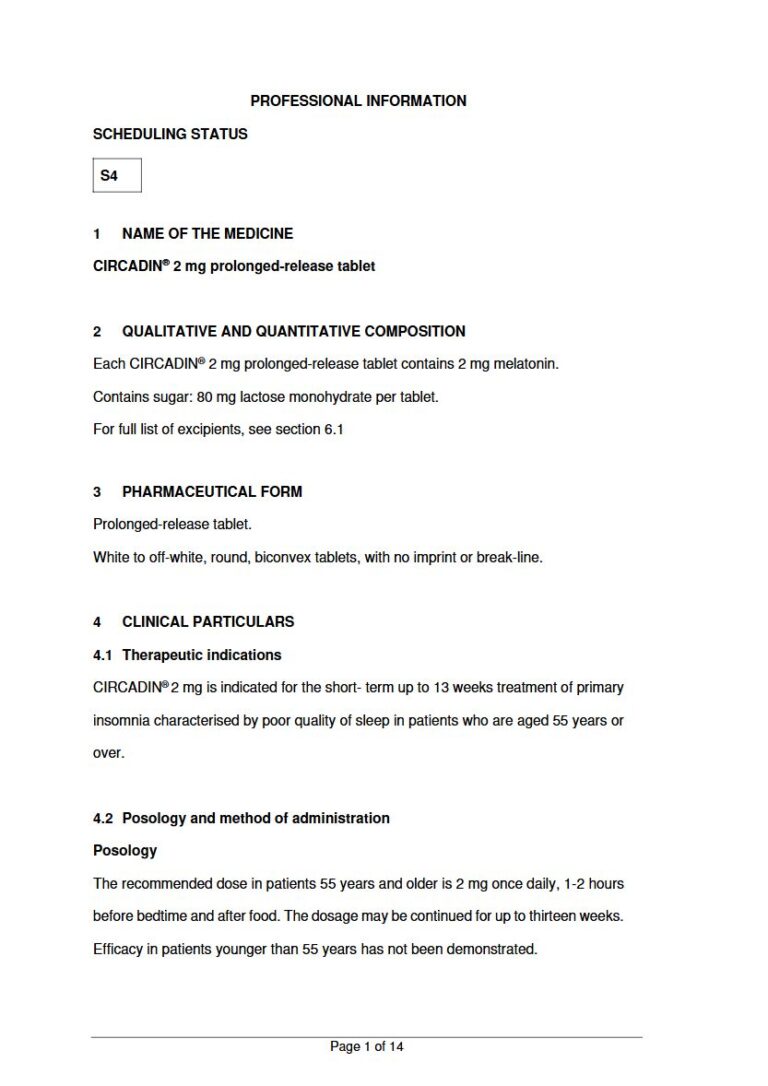
Circadin 2mg Prolonged-release tablet.
PDF Leaflet Revision Date: 15 June 2022
Clinical Summary
Quick overview from the medicine insert
Indication
Short-term treatment of primary insomnia in patients aged 55 and over.
Dosage (summary)
2 mg once daily, 1-2 hours before bedtime after food.
Special Populations
- Renal impairment
- Hepatic impairment
- Elderly
Pregnancy & Breastfeeding
Not recommended during pregnancy or lactation; safety not established.
Key Drug Interactions
- Fluvoxamine increases melatonin levels
- Cimetidine increases melatonin levels
- Alcohol reduces effectiveness
Contraindications
- Hypersensitivity to melatonin or excipients
- Pregnancy and lactation
Common side effects
- Headache
- Nasopharyngitis
- Back pain
- Arthralgia
Counselling Points
- Take 1-2 hours before bedtime.
- Do not crush or chew tablets.
- Avoid alcohol while taking this medication.
Serious warnings
- May cause drowsiness; caution with hazardous activities.
- Not recommended for autoimmune diseases.
Important Disclaimer
The Circadin 2mg Prolonged-release tablet. professional information leaflet below is the property of Acino Pharma and is provided on Medinsert exactly as issued, with no.. alterations or editorial changes. We make every effort to keep content current by updating documents as soon as new versions become available. Medinsert serves as a trusted access point for healthcare professionals, but does not replace official sources or clinical judgement. For more details, please read our full disclaimer. read more>>
 Healthcare Professionals Only
This content is for registered healthcare professionals
Sign in or create a free account to read the full package insert.
Free for HPCSA-registered professionals. Powered by Medinsert.
Clinical Particulars
Section 4 of the official insert — extracted exactly as issued, no alterations
4.1 Therapeutic indications
CIRCADIN u00ae 2 mg is indicated for the short-term up to 13 weeks treatment of primary insomnia characterised by poor quality of sleep in patients who are aged 55 years or over.
4.2 Posology and method of administration
Posology
The recommended dose in patients 55 years and older is 2 mg once daily, 1-2 hours before bedtime and after food. The dosage may be continued for up to thirteen weeks.
Efficacy in patients younger than 55 years has not been demonstrated.
Special populations
Renal impairment
The effect of any stage of renal impairment on melatonin pharmacokinetics has not been studied. Caution should be used when melatonin is administered to such patients.
Hepatic impairment
There is no experience of the use of CIRCADIN u00ae 2 mg in patients with liver impairment. Data demonstrates markedly elevated endogenous melatonin levels during daytime hours due to decreased clearance in patients with hepatic impairment. Therefore, CIRCADIN u00ae 2 mg is not recommended for use in patients with hepatic impairment.
Paediatric population
CIRCADIN u00ae 2 mg is not recommended for use in children and adolescents below age 18 due to insufficient data on safety and efficacy.
Method of administration
Oral use. Tablets should be swallowed whole to maintain prolonged release properties. Crushing or chewing should not be used to facilitate swallowing.
4.3 Contraindications
- Hypersensitivity to melatonin or to any of the excipients (see section 6.1) of CIRCADIN u00ae 2 mg
- Safety in pregnancy and lactation has not been established (see section 4.6).
4.4 Special warnings and precautions for use
CIRCADIN u00ae 2 mg may cause drowsiness. Therefore, the product should be used with caution if the effects of drowsiness are likely to be associated with a risk to safety.
No clinical data exist concerning the use of CIRCADIN u00ae 2 mg in individuals with autoimmune diseases. Therefore, CIRCADIN u00ae 2 mg is not recommended for use in patients with autoimmune diseases.
CIRCADIN u00ae 2 mg contains lactose which may have an effect on the glycaemic control of patients with diabetes mellitus. Patients with rare hereditary problems of galactose intolerance, e.g. galactosaemia the LAPP lactase deficiency or glucose-galactose malabsorption should not take this medicine.
Pediatric population
The safety and efficacy of CIRCADIN u00ae 2 mg in children aged 0 to 18 years has not yet been established.
4.5 Interaction with other medicines and other forms of interaction
Pharmacokinetic interactions
u2022 Melatonin has been observed to induce CYP3A in vitro at supra-therapeutic concentrations. The clinical relevance of the finding is unknown. If induction occurs, this can give rise to reduced plasma concentrations of concomitantly administered medicinal products.
u2022 Melatonin does not induce CYP1A enzymes in vitro at supra-therapeutic concentrations. Therefore, interactions between melatonin and other active substances as a consequence of melatoninu2019s effect on CYP1A enzymes are not likely to be significant (see section 5.2).
u2022 Melatoninu2019s metabolism is mainly mediated by CYP1A enzymes. Therefore, interactions between melatonin and other active substances as a consequence of their effect on CYP1A enzymes are possible.
u2022 Caution should be exercised in patients on fluvoxamine, which increases melatonin levels (17-fold higher AUC and a 12-fold higher serum C max) by inhibiting its metabolism by hepatic cytochrome P450 (CYP) isoenzymes CYP1A2 and CYP2C19. The combination should be avoided (see section 5.2).
u2022 Caution should be exercised in patients on 5 or 8-methoxypsoralen (5 and 8-MOP), which increases melatonin levels, by inhibiting its metabolism.
u2022 Caution should be exercised in patients on cimetidine, a CYP2D inhibitor, which increases plasma melatonin levels, by around 68 % by inhibiting its metabolism.
u2022 Cigarette smoking may decrease melatonin levels due to induction of CYP1A2.
u2022 Caution should be exercised in patients on oestrogens (e.g. contraceptive or hormone replacement therapy), which increase melatonin levels by inhibiting its metabolism by CYP1A1 and CYP1A2 (see section 5.2).
u2022 CYP1A2 inhibitors such as quinolones may give rise to increased melatonin exposure.
u2022 CYP1A2 inducers such as carbamazepine and rifampicin may give rise to reduced plasma concentrations of melatonin.
u2022 There is a large amount of data in the literature regarding the effect of adrenergic agonists/antagonists, opiate agonists/antagonists, antidepressants, prostaglandin inhibitors, benzodiazepines, tryptophan, and alcohol, on endogenous melatonin secretion. Whether or not these active substances interfere with the dynamic or kinetic effects of CIRCADIN u00ae 2 mg or vice versa has not been studied.
u2022 All sedatives can be expected to have an additive effect.
Pharmacodynamic interactions
u2022 Alcohol should not be taken with CIRCADIN u00ae 2 mg, because it reduces the effectiveness of CIRCADIN u00ae 2 mg on sleep.
u2022 CIRCADIN u00ae 2 mg may enhance the sedative properties of benzodiazepines and non-benzodiazepine hypnotics, such as zaleplon, zolpidem and zopiclone.
u2022 CIRCADIN u00ae 2 mg has been co-administered in studies with thioridazine and imipramine. No clinically significant pharmacokinetic interactions were found.
4.6 Fertility, pregnancy, and lactation
Pregnancy
CIRCADIN u00ae 2 mg should not be used during pregnancy and lactation. Safety in pregnancy and lactation has not been established. (see section 4.3).
Breastfeeding
Endogenous melatonin was measured in breast milk thus exogenous melatonin is probably secreted into human milk. Mothers on CIRCADIN u00ae 2 mg should not breastfeed their infants.
4.7 Effects on ability to drive and use machines
CIRCADIN u00ae 2 mg may cause somnolence or dizziness. Patients should not engage in hazardous activities (such as driving or operating machinery) after taking CIRCADIN u00ae 2 mg.
4.8 Undesirable effects
a. Summary of the safety profile
The most common adverse reactions were headache, nasopharyngitis, back pain, and arthralgia.
b. Tabulated summary of adverse reactions
The following adverse effects were reported in clinical trials and were defined as possibly, probably, or definitely related to treatment. Frequencies are defined as: Very common (u22651/10); Common (u22651/100 to <1/10); Uncommon (u22651/1 000 to <1/100); Rare (u22651/10 000 to <1/1 000); Very rare (<1/10 000); Not known (cannot be established from the available data).
4.9 Overdose
Several cases of overdose have been reported post-marketing. Somnolence was the most reported adverse event. Most were mild to moderate in severity. CIRCADIN u00ae 2 mg has been administered at 5 mg daily doses in clinical trials over 12 months without significantly changing the nature of the adverse reactions reported. Administration of daily doses of up to 300 mg of melatonin without causing clinically significant adverse reactions have been reported in the literature. If overdose occurs, drowsiness is to be expected. Clearance of the active substance is expected within 12 hours after ingestion. No special treatment is required.
