
Cloxacillin Fresenius 250 mg/500 mg Solution
PDF Leaflet Revision Date: 16 September 2024
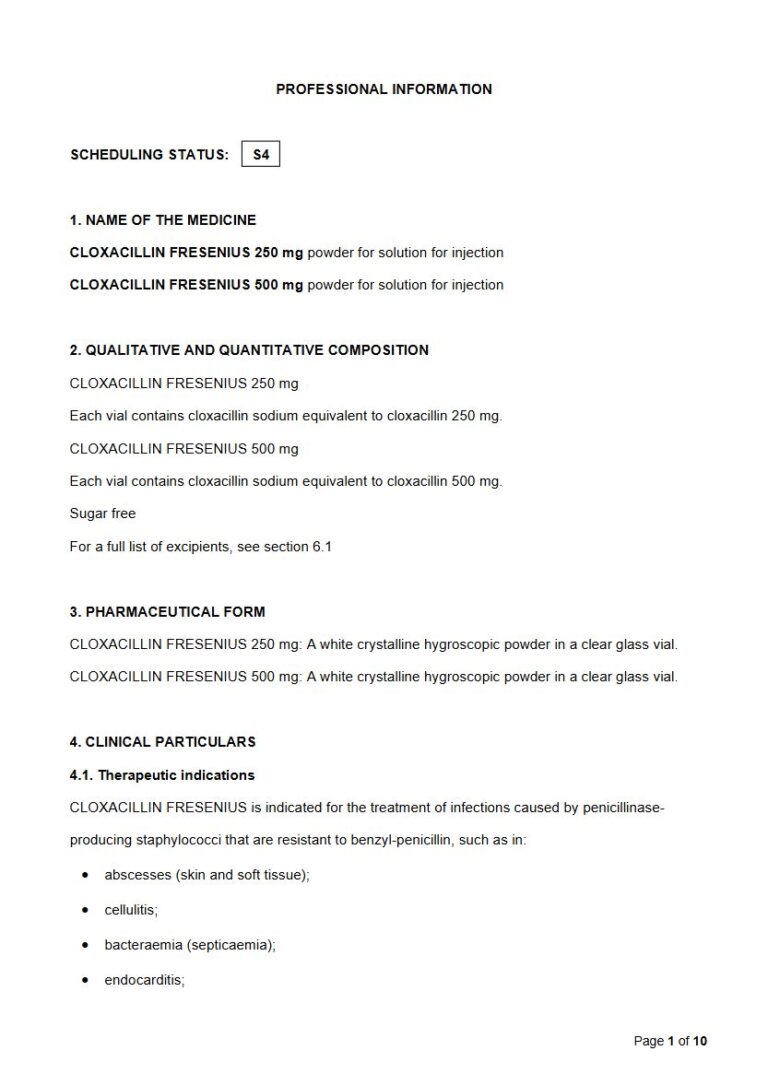
Clinical Summary
Quick overview from the medicine insert
Indication
Infections caused by penicillinase-producing staphylococci.
Dosage (summary)
250 mg IM every 4-6 hours; 500 mg IV every 4-6 hours.
Special Populations
- Jaundiced neonates
- Renal impairment
Pregnancy & Breastfeeding
Safety in pregnancy not established; passes into breast milk.
Key Drug Interactions
- Aminoglycosides
- Chloramphenicol
- Tetracyclines
- Oral contraceptives
- Probenecid
Contraindications
- Hypersensitivity to cloxacillin
- History of penicillin allergy
- Neonates from penicillin-sensitive mothers
Common side effects
- Allergic reactions
- Nausea
- Vomiting
- Diarrhoea
- Convulsions
Counselling Points
- Report any allergic reactions
- Take on an empty stomach for better absorption
- Monitor for signs of superinfection
Serious warnings
- Risk of neurotoxicity in renal impairment
- Potential for severe allergic reactions
Important Disclaimer
The Cloxacillin Fresenius 250 mg/500 mg Solution professional information leaflet below is the property of Fresenius Kabi South Africa and is provided on Medinsert exactly as issued, with no.. alterations or editorial changes. We make every effort to keep content current by updating documents as soon as new versions become available. Medinsert serves as a trusted access point for healthcare professionals, but does not replace official sources or clinical judgement. For more details, please read our full disclaimer. read more>>
 Healthcare Professionals Only
This content is for registered healthcare professionals
Sign in or create a free account to read the full package insert.
Free for HPCSA-registered professionals. Powered by Medinsert.
Clinical Particulars
Section 4 of the official insert — extracted exactly as issued, no alterations
4.1. Therapeutic indications
CLOXACILLIN FRESENIUS is indicated for the treatment of infections caused by penicillinase- producing staphylococci that are resistant to benzyl-penicillin, such as in:
- abscesses (skin and soft tissue);
- cellulitis;
- bacteraemia (septicaemia);
- endocarditis;
- pneumonia (respiratory tract);
- osteomyelitis (bone and joints).
4.2. Posology and method of administration
Please note: The reconstituted solution must be shaken well before use. It is recommended that a needle not larger than 21 gauge is used to reduce fragmentation of the rubber stopper.
Route Dosage (for Adults) Method of Administration
IM Injection 250 mg 4 - 6 hourly The contents of each vial should be dissolved in 1,5 mL of water for injection
Slow IV Injection 500 mg every 4 - 6 hours 500 mg of CLOXACILLIN FRESENIUS to be given over 3 to 4 minutes dissolved in 10 - 20 mL water for injection
IV Infusion 500 mg every 4 - 6 hours CLOXACILLIN FRESENIUS is compatible with (the commonly used IV fluids) sodium chloride 0,9 % and dextrose 5 % in water and may be added to the drip container, or preferably, injected directly into the drip tube over a period of 2 - 3 minutes. All systemic dosages may be doubled in severe infections.
Route Dosage (for Adults) Method of Administration
Intrapleural Injection 500 mg daily 250 mg to 500 mg CLOXACILLIN FRESENIUS to be dissolved in 2 u2013 5 mL of water for injections.
Intra- articular injection 500 mg daily 250 mg to 500 mg CLOXACILLIN FRESENIUS to be dissolved in 2 - 5 mL of water for injection. 0,5 % Lignocaine hydrochloride may be used as a local anaesthetic, if desired.
Paediatric population
Dosage for children: 12,5 to 25 mg/kg every 6 hours. Under 2 years: u00bc of adult dose 2 to 10 years: u00bd of adult dose
4.3. Contraindications
- Patients with hypersensitivity to cloxacillin.
- Patients with a history of penicillin allergy.
- Neonates born of mothers sensitive to penicillins.
- Patients allergic to cephalosporins may also be allergic to penicillins.
- CLOXACILLIN FRESENIUS should not be administered by sub-conjunctival injection or used as an eye drop.
- Intrathecal administration of CLOXACILLIN FRESENIUS should be avoided, since CLOXACILLIN FRESENIUS is a potent convulsant when given via this route.
4.4. Special warnings and precautions for use
Use with care in jaundiced neonates. Incompatible with aminoglycosides, tetracyclines, erythromycin and polymyxin B (see section 4.5). CLOXACILLIN FRESENIUS crosses the placenta and is distributed into breast milk (see section 4.6). CLOXACILLIN FRESENIUS has been associated with acute attacks of porphyria and is considered unsafe in porphyric patients. Renal, hepatic and haematological systems should be monitored during prolonged and high dose therapy. Care should be taken when administering high doses of CLOXACILLIN FRESENIUS especially to patients with impaired renal function as there is a risk of neurotoxicity. Plasma concentrations are enhanced if probenecid is given concomitantly (see section 4.5). CLOXACILLIN FRESENIUS may also interact with bacteriostatic antibacterials such as chloramphenicol and tetracyclines that interfere with active bacterial growth necessary for cloxacillin to achieve its effect. Reduced concentrations in patients with cystic fibrosis have been attributed to enhanced non-renal clearance of CLOXACILLIN FRESENIUS. CLOXACILLIN FRESENIUS is not removed by haemodialysis. Sensitivity reactions may include skin rashes, angioedema, bronchospasm, serum sickness and anaphylaxis, and sometimes death within minutes. Treatment with epinephrine (adrenaline), corticosteroids, aminophyllin or antihistamine may be necessary. A generalised sensitivity reaction can develop within a few hours or weeks of commencing treatment, including urticaria, fever, joint pains and eosinophilia. Other allergic reactions include exfoliative dermatitis and other skin reactions, interstitial nephritis and vasculitis. Haemolytic anaemia, leucopoenia, prolonged bleeding time and defective platelet function. Superinfection with C. albicans , other fungi or organisms resistant to CLOXACILLIN FRESENIUS may occur. Patients with syphilis may exhibit the Jarishu2013Herxheimer reaction and should also therefore be monitored. A skin test for sensitivity may be used to determine those patients most likely to develop allergic reactions to penicillins.
4.5. Interaction with other medicines and other forms of interaction
Aminoglycosides and CLOXACILLIN FRESENIUS are physically and/or chemically incompatible and can mutually inactivate each other in vitro . In vitro mixing of CLOXACILLIN FRESENIUS and aminoglycosides should be avoided during concomitant therapy, and the medicines should be administered separately (see section 4.4). CLOXACILLIN FRESENIUS may also interact with bacteriostatic antibacterials such as chloramphenicol and tetracyclines that interfere with active bacterial growth necessary for cloxacillin to achieve its effect.
The possibility of a prolonged bleeding time should be borne in mind in patients receiving anticoagulants. CLOXACILLIN FRESENIUS may decrease the efficacy of oral contraceptives. CLOXACILLIN FRESENIUS may enhance the effects of methotrexate, by decreasing its renal excretion. As with other penicillins, concurrent administration of probenecid enhances the serum concentration of cloxacillin.
4.6. Fertility, pregnancy and lactation
Pregnancy The safety of this preparation in pregnancy has not been established. Breastfeeding Penicillins including CLOXACILLIN FRESENIUS pass into the breastmilk. Even though only small amounts may pass into breastmilk, allergic reactions associated with penicillin side effects may occur.
4.7. Effects on ability to drive and use machines
The effect on the ability to drive and operate machinery is unknown however care should be taken due to the risk of convulsions.
4.8. Undesirable effects
Tabulated list of adverse reactions
System Organ Class Frequency Side effects
Blood and lymphatic system disorders Less frequent Leucopoenia, defective platelet function, neutropenia
Immune system disorders Less frequent Allergic reactions such as skin rashes, angioedema, bronchospasm, serum sickness, anaphylaxis, and sometimes death within minutes, exfoliative dermatitis, interstitial nephritis
Nervous system disorders Less frequent Convulsions and signs of toxicity to the CNS may occur with intravenous administration or in patients with renal failure.
Vascular disorders Frequency unknown Phlebitis, thrombophlebitis
Gastrointestinal disorders Frequent sore mouth or tongue; transient diarrhoea; nausea, vomiting
Frequency unknown black hairy tongue, heartburn, pruritus ani, pseudomembranous colitis, epigastric discomfort, flatulence, loose stools
Hepato-biliary disorders Frequency unknown Increases in liver enzyme values, hepatitis, cholestatic jaundice
Skin and subcutaneous tissue disorders Less frequent Pain and sterile inflammatory reaction at the site of intra-muscular injection, Description of selected adverse reactions
The following side effects have been reported and the frequencies are unknown: Infections and Infestations: Symptoms due to overgrowth of non-susceptible organisms (Aerobacter aerogenes, Pseudomonas, Candida, etc.) may appear and then CLOXACILLIN FRESENIUS should be discontinued and specific or supportive therapy instituted. Blood and lymphatic system disorders: Haemolytic anaemia and prolongation of bleeding time, usually following high intravenous doses. Eosinophilia, thrombocytopenia, thrombocytopenic, purpura, and agranulocytosis have been reported during therapy with penicillins.
Immune system disorders: Treatment with epinephrine (adrenaline), corticosteroids, aminophylline or antihistamine may be necessary. When CLOXACILLIN FRESENIUS is administered to a hypersensitive patient, allergic reactions may occur including urticaria and skin rashes, exfoliative dermatitis, interstitial nephritis, vasculitis, eosinophilia, angioneurotic oedema, fever and swollen joints. These reactions are more common after parenteral use but may occur after oral administration of any penicillin derivative in persons who have become hypersensitised after a previous course of treatment. The onset of symptoms varies; it may occur within a few hours or days of the beginning of treatment or not until therapy with a penicillin derivative is resumed on a subsequent occasion.
Nervous system disorders: The administration of high doses to children may cause cerebral irritation and convulsions.
Skin and subcutaneous tissue disorders: Erythema multiforme type of rash for up to 15 days after stopping administration.
General disorders and administrative site conditions: Care should be taken when treating patients with syphilis, as the Jarisch-Herxheimer reaction may occur shortly after starting treatment. This reaction, manifesting as fever, chills, headache and reactions at the site of the lesion, can be dangerous in cardiovascular syphilis or where there is a serious risk of increased local damage such as optic atrophy.
Reporting of suspected adverse reactions
Reporting suspected adverse reactions after authorisation of the medicine is important. It allows continued monitoring of the benefit/risk balance of the medicine. Healthcare providers are requested to report any suspected adverse drug reactions to SAHPRA via the Med Safety APP (Medsafety X SAHPRA) and eReporting platform (who-umc.org) found on SAHPRA website.
Healthcare providers are asked to report any suspected adverse drug reactions to the Holder of the Certificate of Registration at the following email address: [email protected] and to the relevant medicineu2019s regulatory authority in the country where the product is marketed.
4.9. Overdose
Disturbance of electrolyte balance may occur following administration of large doses. Convulsions and other signs of toxicity to the central nervous system may occur with very high doses, particularly when administered intravenously to patients with renal failure, since patients with normal kidneys excrete penicillins at a fast rate. Nephrotoxicity may occur in patients with diminished renal function. Treatment of overdosage is symptomatic and supportive. No specific treatment can be recommended. In patients with severe allergic reactions, general supportive measures (if the patient is in shock) or symptomatic therapy similar to that applied in all cases of hypersensitivity are recommended.
