
Co-Irbecard 12,5 mg/25 mg Tablets
PDF Leaflet Revision Date: 22 February 2022
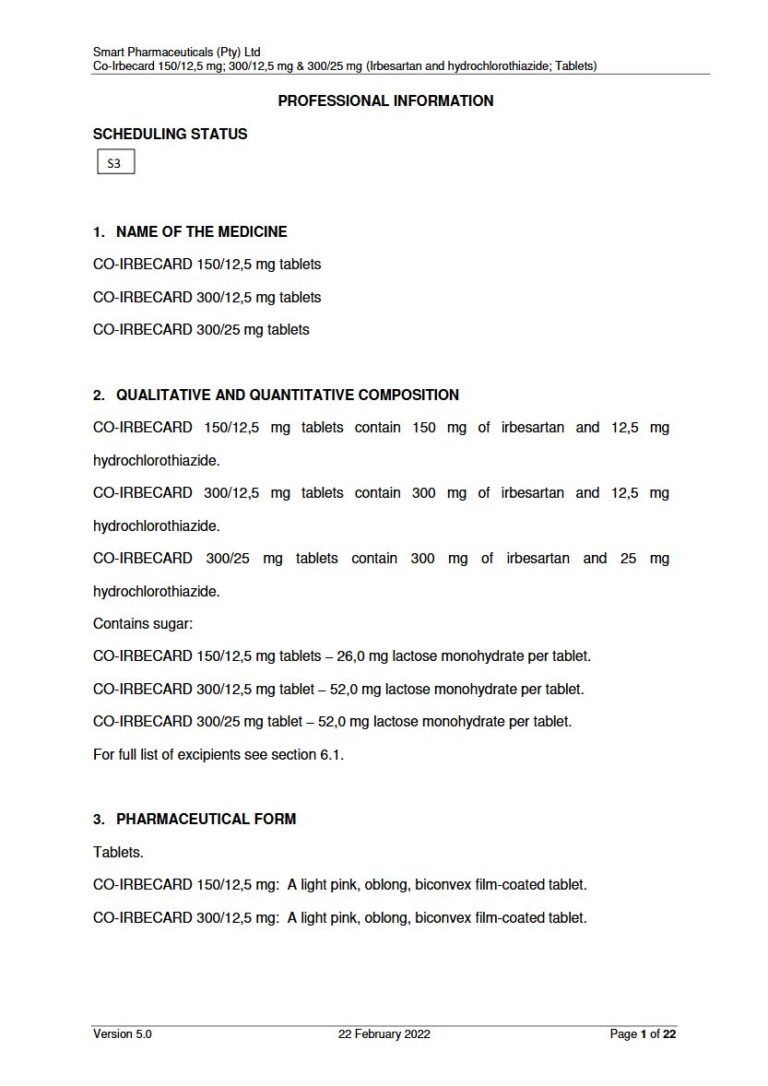
Clinical Summary
Quick overview from the medicine insert
Indication
Treatment of essential hypertension.
Dosage (summary)
One tablet daily; starting dose 150/12.5 mg, may increase to 300/12.5 mg as needed.
Special Populations
- Elderly
- Renal impairment
- Hepatic impairment
Pregnancy & Breastfeeding
Contraindicated in pregnancy and lactation.
Key Drug Interactions
- Potassium-sparing diuretics
- Lithium
- NSAIDs
Contraindications
- Hypersensitivity to components
- Severe renal impairment
- Pregnancy
- Lactation
Common side effects
- Dizziness
- Headache
- Nausea
- Fatigue
Counselling Points
- Monitor blood pressure regularly
- Avoid potassium supplements
- Report any signs of allergic reactions
Serious warnings
- Hypotension in volume-depleted patients
- Risk of renal impairment
Important Disclaimer
The Co-Irbecard 12,5 mg/25 mg Tablets professional information leaflet below is the property of Smart Pharmaceuticals and is provided on Medinsert exactly as issued, with no.. alterations or editorial changes. We make every effort to keep content current by updating documents as soon as new versions become available. Medinsert serves as a trusted access point for healthcare professionals, but does not replace official sources or clinical judgement. For more details, please read our full disclaimer. read more>>
 Healthcare Professionals Only
This content is for registered healthcare professionals
Sign in or create a free account to read the full package insert.
Free for HPCSA-registered professionals. Powered by Medinsert.
Clinical Particulars
Section 4 of the official insert — extracted exactly as issued, no alterations
4.1 Therapeutic indications
CO-IRBECARD is indicated for the treatment of essential hypertension in patients stabilised on the individual components at the same dosages. CO-IRBECARD may also be used as initial therapy in previously untreated patients with sitting diastolic blood pressure of 100 mm Hg or higher, or in patients previously treated with one of the components of CO-IRBECARD whose diastolic blood pressure is 100 mm Hg or higher. The choice of CO-IRBECARD as initial therapy for hypertension should be based on an assessment of potential benefits and risks.
4.2 Posology and method of administration
Posology
Essential hypertension in patients stabilised on the individual components at the same dosages
One tablet daily with or without food. CO-IRBECARD is indicated for use in patients who are adequately controlled on the individual components at the same dosages. If blood pressure is not adequately controlled with CO-IRBECARD alone, another antihypertensive medicine (e.g. beta-adrenergic blocking medicine, long-acting calcium channel blocking medicine) may be added.
Initial therapy
The usual starting dose is CO-IRBECARD 150/12,5 mg once daily. The dosage can be increased after 1 to 2 weeks of therapy to 300/12,5 mg once daily as needed to control blood pressure. CO-IRBECARD 300 mg/25 mg may be administered in patients insufficiently controlled by CO-IRBECARD 300 mg/12,5 mg. Doses higher than 300 mg irbesartan/25 mg hydrochlorothiazide once daily are not recommended.
Special populations
Elderly patients and patients with renal or hepatic impairment
No dosage reduction is generally necessary in the elderly or in patients with mild to moderate renal impairment (creatinine clearance > 30 ml/min). However, due to the hydrochlorothiazide component, CO-IRBECARD is not recommended for patients with severe renal dysfunction (creatinine clearance < 30 ml/min (see section 4.4).
No dosage reduction is generally necessary in patients with mild to moderate hepatic impairment. Due to the hydrochlorothiazide component, CO-IRBECARD should be used with caution in patients with severe hepatic impairment (see section 4.4).
Patients with intravascular volume depletion
Volume and/or sodium depletion should be corrected prior to administration of CO-IRBECARD (see section 4.4)
Paediatric population:
CO-IRBECARD is not recommended for use in children and adolescents because the safety and efficacy have not been established.
Method of administration
CO-IRBECARD is for oral administration with a glass of water.
4.3 Contraindications
CO-IRBECARD is contraindicated in patients with:
- hypersensitivity to irbesartan, sulphonamide derived medicines (e.g. thiazides) or to any other component of the CO-IRBECARD formulation (see section 6.1). In general, hypersensitivity reactions are more likely to occur in patients with a history of allergy or bronchial asthma
- a history of angioedema related to previous therapy with ACE inhibitors or ARBs. These patients must never again be given these medicines
- hereditary or idiopathic angioedema
- hypertrophic obstructive cardiomyopathy (HOCM)
- severe renal function impairment (creatinine clearance less than 30 ml/min)
- moderate to severe renal impairment, and concomitantly using fluoroquinolones
- bilateral renal artery stenosis
- renal artery stenosis in patients with single kidney, or a transplanted kidney
- aortic stenosis
- concomitant therapy with potassium-sparing diuretics such as spironolactone, triamterene, amiloride (see section 4.5)
- porphyria - hydrochlorothiazide has been associated with acute attacks of porphyria
- thiazide diuretics in (fixed dose) combination with irbesartan [i.e. CO-IRBECARD) should not be given to patients with Addison's disease. This therapy is also contraindicated in patients with severe renal impairment or anuria
- lithium therapy: Concomitant administration with CO-IRBECARD may lead to toxic blood concentrations of lithium (see sections 4.4 and 4.5)
- pregnancy and lactation (see sections 4.4 and 4.6)
- concomitant use of CO-IRBECARD with direct renin inhibitors such as aliskiren-containing medicines (see sections 4.4. and 4.5)
Paediatric use: Safety and efficacy in paediatric patients have not been established.
4.4 Special warnings and precautions for use
Pregnancy and lactation: Thiazides cross the placental barrier and appear in cord blood. The routine use of diuretics in otherwise healthy pregnant women is not recommended and exposes mother and foetus to unnecessary hazard, including foetal or neonatal jaundice thrombocytopenia and possibly other adverse reactions, which have occurred in the adult.
Hypotension u2013 Volume-depleted patients: CO-IRBECARD has been associated with hypotension in hypertensive patients without other risk factors for hypotension. Symptomatic hypotension may be expected to occur in sodium/volume-depleted patients such as those treated vigorously with diuretics and/or salt restriction, or on haemodialysis. Volume and/or sodium-depletion should be corrected before initiating therapy with CO-IRBECARD. Thiazides may potentiate the action of other antihypertension medicines (see section 4.5).
Renal artery stenosis - Renovascular hypertension: there is an increased risk of severe hypotension and renal insufficiency when patients with bilateral renal artery stenosis or stenosis of the artery to a single functioning kidney are treated with angiotensin converting enzyme inhibitors or angiotensin-II receptor antagonists. While this is not documented with CO-IRBECARD, a similar effect should be anticipated.
Renal impairment and kidney transplantation: when CO-IRBECARD is used in patients with impaired renal function, a periodic monitoring of potassium, creatinine and uric acid serum levels is recommended. There is no experience regarding the administration of CO-IRBECARD in patients with a recent kidney transplantation. CO-IRBECARD should not be used in patients with severe renal impairment (creatinine clearance < 30 ml/min) (see section 4.3).
Thiazide diuretic-associated azotaemia may occur in patients with impaired renal function. No dosage adjustment is necessary in patients with renal impairment whose creatinine clearance is u2265 30 ml/min. However, in patients with mild to moderate renal impairment (creatinine clearance u2265 30 ml/min but < 60 ml/min) this fixed dose combination should be administered with caution.
Dual blockade of the renin-angiotensin-aldosterone system (RAAS): There is evidence that the concomitant use of ACE-inhibitors, angiotensin II receptor blockers (ARBs) or aliskiren may increase the risk of hypotension, hyperkalaemia and decreases renal function (including acute renal failure). Dual blockade of RAAS through the combined use of CO-IRBECARD and aliskiren is therefore contraindicated (see section 4.3).
Hepatic impairment: thiazides should be used with caution in patients with impaired hepatic function or progressive liver disease, since minor alterations of fluid and electrolyte balance may precipitate hepatic coma. There is no clinical experience with CO-IRBECARD in patients with hepatic impairment.
Aortic and mitral valve stenosis, obstructive hypertrophic cardiomyopathy: as with other vasodilators, special caution is indicated in patients suffering from aortic or mitral stenosis, or obstructive hypertrophic cardiomyopathy.
Primary aldosteronism: patients with primary aldosteronism generally will not respond to antihypertensive medicinal products acting through inhibition of the renin-angiotensin system. Therefore, the use of CO-IRBECARD is not recommended.
Metabolic and endocrine effects: thiazide therapy may impair glucose tolerance. In diabetic patients dosage adjustments of insulin or oral hypoglycaemic medicines may be required. Latent diabetes mellitus may become manifest during thiazide therapy. Increases in cholesterol and triglyceride levels have been associated with thiazide diuretic therapy; however at the 12,5 mg dose contained in CO-IRBECARD, minimal or no effects were reported. Hyperuricaemia may occur or frank gout may be precipitated in certain patients receiving thiazide therapy.
Electrolyte imbalance: as for any patient receiving diuretic therapy, periodic determination of serum electrolytes should be performed at appropriate intervals. Thiazides, including hydrochlorothiazide, can cause fluid or electrolyte imbalance (hypokalaemia, hyponatraemia, and hypochloremic alkalosis). Although hypokalaemia may develop with the use of thiazide diuretics, concurrent therapy with irbesartan may reduce diuretic-induced hypokalaemia. The risk of hypokalaemia is greatest in patients with cirrhosis of the liver, in patients experiencing brisk diuresis, in patients who are receiving inadequate oral intake of electrolytes and in patients receiving concomitant therapy with corticosteroids or ACTH. Conversely, due to the irbesartan component of CO-IRBECARD hyperkalaemia might occur, especially in the presence of renal impairment and/or heart failure, and diabetes mellitus. Adequate monitoring of serum potassium in patients at risk is recommended. Potassium-sparing diuretics, potassium supplements or potassium-containing salts substitutes should be co-administered cautiously with CO-IRBECARD (see section 4.5).
There is no evidence that irbesartan would reduce or prevent diuretic-induced hyponatraemia. Chloride deficit is generally mild and usually does not require treatment. Thiazides may decrease urinary calcium excretion and cause an intermittent and slight elevation of serum calcium in the absence of known disorders of calcium metabolism. Marked hypercalcaemia suggests the possibility of hyperparathyroidism. Thiazides should be discontinued before carrying out tests for parathyroid function. Thiazides have been shown to increase the urinary excretion of magnesium, which may result in hypomagnaesemia.
Fluoroquinolones and ARBs: Concomitant use of fluoroquinolones and ARBs may precipitate acute kidney injury in patients, especially those with moderate to severe renal impairment and elderly patients (see section 4.3). Renal function should be assessed before initiating treatment and monitored during treatment with fluoroquinolones or ARBs whether used separately and/or concomitantly.
Lithium: The combination of lithium and CO-IRBECARD is contraindicated (refer to sections 4.3 and 4.5).
General: In patients whose vascular tone and renal function depend predominantly on the activity of the renin-angiotensin-aldosterone system (e.g. patients with severe congestive heart failure or underlying renal disease, including renal artery stenosis), treatment with angiotensin converting enzyme inhibitors or angiotensin-II receptor antagonists that affect this system has been associated with acute hypotension, azotaemia, oliguria, or acute renal failure (see section 4.5). As with any antihypertensive medicine, excessive blood pressure decrease in patients with ischemic cardiopathy or ischemic cardiovascular disease could result in a myocardial infarction or stroke. Hypersensitivity reactions to hydrochlorothiazide may occur in patients with or without a history of allergy or bronchial asthma, but are more likely in patients with such a history.
Exacerbation or activation of systemic lupus erythematosus has been reported with the use of thiazide diuretics. Cases of photosensitivity reactions have been reported with thiazides diuretics (see section 4.8). If photosensitivity reaction occurs during treatment, it is recommended to stop the treatment. If a re-administration of the diuretic is deemed necessary, it is recommended to protect exposed areas to the sun or to artificial UVA.
Acute myopia and secondary acute angle-closure glaucoma: sulfonamide medicines or sulfonamide derivative medicines can cause an idiosyncratic reaction, resulting in transient myopia and acute angle-closure glaucoma. While hydrochlorothiazide is a sulfonamide, only isolated cases of acute angle-closure glaucoma have been reported so far with hydrochlorothiazide. Symptoms include acute onset of decreased visual acuity or ocular pain and typically occur within hours to weeks of medicine initiation. Untreated acute angle-closure glaucoma can lead to permanent vision loss. The primary treatment is to discontinue medicine intake as rapidly as possible. Prompt medical or surgical treatments may need to be considered if the intraocular pressure remains uncontrolled. Risk factors for developing acute angle-closure glaucoma may include a history of sulfonamide or penicillin allergy (see section 4.8).
Non-melanoma skin cancer: An increased risk of non-melanoma skin cancer (NMSC) [basal cell carcinoma (BCC) and squamous cell carcinoma (SCC)] with increasing cumulative dose of hydrochlorothiazide (HCTZ) exposure has been observed. Photosensitizing actions of HCTZ could act as a possible mechanism for NMSC. Patients taking HCTZ should be informed of the risk of NMSC and advised to regularly check their skin for any new lesions and promptly report any suspicious skin lesions. Possible preventive measures such as limited exposure to sunlight and UV rays and, in case of exposure, adequate protection should be advised to the patients in order to minimize the risk of skin cancer. Suspicious skin lesions should be promptly examined potentially including histological examinations of biopsies. The use of HCTZ may also need to be reconsidered in patients who have experienced previous NMSC (see also section 4.8).
4.5 Interactions with other medicines and other forms of interactions
Based on in vitro data, no interactions would be expected to occur with medicines whose metabolism is dependent on cytochrome P450 isoenzymes CYP1A1, CYP1A2, CYP2A6, CYP2B6, CYP2D6, CYP2E1 or CYP3A4. Irbesartan is primarily metabolised by CYP2C9, however, during clinical interaction studies, no significantly pharmacodynamics interactions were observed when irbesartan was co-administered with warfarin (a medicine metabolised by CYP2C9). Irbesartan does not affect the pharmacokinetics of digoxin or simvastatin. The pharmacokinetics of irbesartan is not affected by co-administration with nifedipine or hydrochlorothiazide. Based on experience with the use of other medicines that affect the renin-angiotensin system, concomitant use of potassium-sparing diuretics, potassium supplements, or salt substitutes containing potassium may lead to increases in serum potassium. Concurrent therapy with hydrochlorothiazide may reduce the frequency of this effect. Alcohol, barbiturates or narcotics - Potentiation of thiazide diuretic-induced orthostatic hypotension may occur. Antidiabetic medicines oral medicines and insulin - Thiazides may elevate blood glucose levels thus, dosage adjustments of antidiabetic medicines may be necessary. Antigout medication - Dosage adjustments of antigout medication may be needed since hydrochlorothiazide may raise the blood level of uric acid. Cardiac glycosides (e.g. digoxin) and other anti-dysrhythmic medicines (e.g. sotalol) - Diuretic induced hypokalaemia may accentuate cardiac dysrhythmias.
Calcium salts - Thiazide diuretics may increase serum calcium levels due to decreased excretion. If calcium or a calcium sparing medicine (e.g. Vitamin D therapy is prescribed, serum calcium levels should be monitored and calcium dosage adjusted accordingly. Cholestyramine resin and colestipol hydrochloride - May delay or decrease absorption of hydrochlorothiazide. CO-IRBECARD should be taken at least one hour before or four hours after these medications. Non-steroidal anti-inflammatory drugs - when angiotensin II antagonists are administered simultaneously with non-steroidal anti-inflammatory drugs (i.e. selective COX-2 inhibitors, acetylsalicylic acid (> 3 g/day) and non-selective NSAIDs), attenuation of the antihypertensive effect may occur. As with ACE inhibitors, concomitant use of angiotensin II antagonists and NSAIDs may lead to an increased risk of worsening of renal function, including possible acute renal failure, and an increase in serum potassium, especially in patients with poor pre-existing renal function. The combination should be administered with caution, especially in the elderly. Patients should be adequately hydrated and consideration should be given to monitoring renal function after initiation of concomitant therapy, and periodically thereafter. Inhibitors of endogenous prostaglandin synthesis (i.e. non-steroidal anti-inflammatory medicines) - In some patients these medicines can reduce the effects of thiazide diuretics. Lithium - Reversible increases in serum lithium concentrations and toxicity have been reported during concomitant administration of lithium with angiotensin converting enzyme inhibitors. Similar effects have been reported with irbesartan. Furthermore, renal clearance of lithium is reduced by thiazides so the risk of lithium toxicity could be increased with CO-IRBECARD. Therefore, the combination is contraindicated (see section 4.3). Other diuretics and antihypertensive medications - The thiazide component or CO-IRBECARD may potentiate the actions of other antihypertensive medicines, especially ganglionic or peripheral adrenergic-blocking medicines. Hydrochlorothiazide may interact with diazoxide; blood glucose, serum uric acid levels and blood pressure should be monitored.
Medicines used during surgery - The effects of non-depolarising muscle relaxants, pre-anaesthetics and anaesthetics used in surgery (e.g. tubocurarine) may be potentiated by hydrochlorothiazide: dosage adjustments may be required. Pre-anaesthetic and anaesthetic medicines should be given in reduced dosage, and if possible, hydrochlorothiazide therapy discontinued one week prior to surgery. Concomitant use of ARBs and fluoroquinolones may precipitate acute kidney injury. The mechanism of the possible interaction between the different classes of medicines, over and above different mechanisms of kidney damage, is unknown (see section 4.3). Dual blockade of the RAAS with ARBs, ACE inhibitors, or aliskiren - Clinical trial data has shown that dual blockade of the renin-angiotensin-aldosterone-system (RAAS) through the combined use of ACE inhibitors, angiotensin II receptor blockers or aliskiren is associated with a higher frequency of adverse events such as hypotension, hyperkalaemia and decreased renal function (see sections 4.3 and 4.4).
4.6 Fertility, pregnancy and lactation
Pregnancy
CO-IRBECARD is contraindicated in pregnancy (see sections 4.3 and 4.4) CO-IRBECARD can cause foetal morbidity and death. CO-IRBECARD passes through the placenta and can be presumed to cause disturbances in foetal blood pressure regulatory mechanisms. Oligohydramnios, as well as hypotension, oliguria and anuria in newborns have been reported after administration of ARBs such as CO-IRBECARD in the second and third trimesters of pregnancy. Cases of defective skull ossification have been observed. Prematurity and low birth mass can occur.
Women of Childbearing Potential
Women of childbearing age should ensure effective contraception.
Breastfeeding
CO-IRBECARD is contraindicated in lactation (see section 4.3).
Fertility
Irbesartan had no effect upon fertility of treated rats and their offspring up to the dose levels inducing the first signs of parental toxicity.
4.7 Effects on ability to drive and use machines
Based on its pharmacodynamic properties, CO-IRBECARD is unlikely to affect the ability to drive and use machines. When driving vehicles or operating machines, it should be taken into account that occasionally dizziness or weariness may occur during treatment of hypertension.
4.8 Undesirable effects
Adverse reactions have been ranked under the heading of system-organ class and frequency indicated as frequent, less frequent and isolated cases. lrbesartan/hydrochlorothiazide combination:
Immune system disorders
Less frequent: rash
Nervous system disorders
Frequent: dizziness, headache
Less frequent: orthostatic hypotension
Cardiac disorders
Less frequent: hypotension, oedema, syncope, tachycardia
Vascular disorders
Less frequent: flushing
Gastrointestinal disorders
Frequent: nausea/vomiting
Less frequent: diarrhoea, dry mouth
Musculoskeletal, connective tissue and bone disorders
Less frequent: swelling of the extremities, muscle/skeletal pain
Renal and urinary disorders
Frequent: abnormal urination
Reproductive system and breast disorders
Less frequent: libido changes, sexual dysfunction
General disorders and administration site conditions
Frequent: fatigue
Less frequent: weakness
Adverse reactions reported from post-marketing experience:
Immune system disorders: cases of hypersensitivity reactions (angioedema, urticaria) have been reported.
Metabolism and nutrition disorders: hyperkalaemia
Respiratory, thoracic and mediastinal disorders: cough
Gastrointestinal disorders: dyspepsia
Hepatobiliary disorders: elevated liver function tests, jaundice, hepatitis
Musculoskeletal, connective tissue and bone disorders: myalgia
Renal and urinary disorders: impaired renal function including isolated cases of renal failure in patients at risk.
General disorders and administration site conditions: asthenia
Additional information on individual components: in addition to the adverse reactions listed above for the combination product, other undesirable effects previously reported with one of the individual components may be potential undesirable effects with CO-IRBECARD.
lrbesartan:
Cardiac disorders
Less frequent: ECG abnormalities
Musculoskeletal, connective tissue and bone disorders
Less frequent: extremity weakness
General disorders and administration site conditions
Less frequent: pruritus, abdominal (chest) pain
Hydrochlorothiazide:
Adverse events (regardless of relationship to medicine) reported with the use of hydrochlorothiazide alone include:
Blood and lymphatic system disorders: Frequency unknown: aplastic anaemia, haemolytic anaemia, leucopenia, neutropenia/agranulocytosis, thrombocytopenia
Nervous system disorders: Frequency unknown: paraesthesia, restlessness, vertigo
Eye disorders: Frequency unknown: transient blurred vision, xanthopsia, acute myopia and secondary acute angle-closure glaucoma
Respiratory, thoracic and mediastinal disorders: Frequency unknown: respiratory distress (including pneumonitis and pulmonary oedema)
Gastrointestinal disorders: Frequency unknown: anorexia, gastric irritation, diarrhoea, constipation, pancreatitis, sialadenitis
Hepato-biliary disorders: Frequency unknown: jaundice (intrahepatic cholestatic jaundice)
Skin and subcutaneous tissue disorders: Frequency unknown: anaphylactic reactions, toxic epidermal necrolysis, necrotizing angitis (vasculitis, cutaneous vasculitis), photosensitivity reactions, urticaria
Musculoskeletal, connective tissue and bone disorder: Frequency unknown: muscle spasm, weakness
Renal and urinary disorders: Frequency unknown: interstitial nephritis, renal dysfunction
General disorders and administration site conditions: Frequency unknown: fever
Investigations: Frequency unknown: electrolyte imbalance (including hyponatraemia and hypokalaemia), glycosuria, hyperglycaemia, hyperuricaemia
Laboratory test abnormalities: No clinically significant changes in laboratory test parameters occurred in controlled clinical studies. No special monitoring of laboratory parameters is necessary.
Reporting of suspected adverse reactions
Reporting of suspected adverse reactions after authorisation of the medicine is important. It allows continued monitoring of the benefit/risk balance of the medicine. Health care providers are asked to report any suspected adverse reactions to SAHPRA via the u201c6.04 Adverse Drug Reactions Reporting Formu201d, found online under SAHPRAu2019s publications: https://www.sahpra.org.za/Publications/Index/8
4.9 Overdose
No specific information is available on the treatment of overdosage with CO-IRBECARD. However, daily doses of irbesartan up to 900 mg/day for 8 weeks have been well tolerated. The patient should be closely monitored and treatment should be symptomatic and supportive. Suggested measures include induction of emesis. CO-IRBECARD is not removed from the body by haemodialysis. The most common signs and symptoms observed in adults exposed to hydrochlorothiazide are those caused by electrolyte depletion (hypokalaemia, hypochloraemia, hyponatraemia) and dehydration resulting from excessive diuresis. If a cardiac glycoside (e.g. digoxin) or other anti-dysrhythmic medicine (e.g. sotalol) has also been administered, hypokalaemia may accentuate cardiac dysrhythmias.
The degree to which hydrochlorothiazide is removed by haemodialysis have not been established.
