
Dalacin C 150 Mg Capsules
PDF Leaflet Revision Date: 17 January 2022
Clinical Summary
Quick overview from the medicine insert
Indication
Serious infections caused by susceptible Gram-positive organisms and anaerobic pathogens.
Dosage (summary)
Adults: 150 mg every 6 hours for mild infections; up to 450 mg every 6 hours for severe infections.
Onset of Action / Duration
Onset: 30 mins, Duration: 6-8 hours
Special Populations
- Elderly
- Renal impairment
- Hepatic impairment
Pregnancy & Breastfeeding
Contraindicated in pregnancy; not recommended during breastfeeding.
Key Drug Interactions
- CYP3A4 inhibitors may reduce clearance
- Neuromuscular blocking agents
Contraindications
- Hypersensitivity to clindamycin
- Diarrhoeal states
- Gastrointestinal disease
Common side effects
- Diarrhoea
- Abdominal pain
- Eosinophilia
- Maculopapular rash
Counselling Points
- Take with a full glass of water
- Do not chew or crush capsules
- Report severe diarrhea immediately
Serious warnings
- Severe hypersensitivity reactions
- Risk of antibiotic-associated colitis
Important Disclaimer
The Dalacin C 150 Mg Capsules professional information leaflet below is the property of Pfizer Laboratories and is provided on Medinsert exactly as issued, with no.. alterations or editorial changes. We make every effort to keep content current by updating documents as soon as new versions become available. Medinsert serves as a trusted access point for healthcare professionals, but does not replace official sources or clinical judgement. For more details, please read our full disclaimer. read more>>
 Healthcare Professionals Only
This content is for registered healthcare professionals
Sign in or create a free account to read the full package insert.
Free for HPCSA-registered professionals. Powered by Medinsert.
Clinical Particulars
Section 4 of the official insert — extracted exactly as issued, no alterations
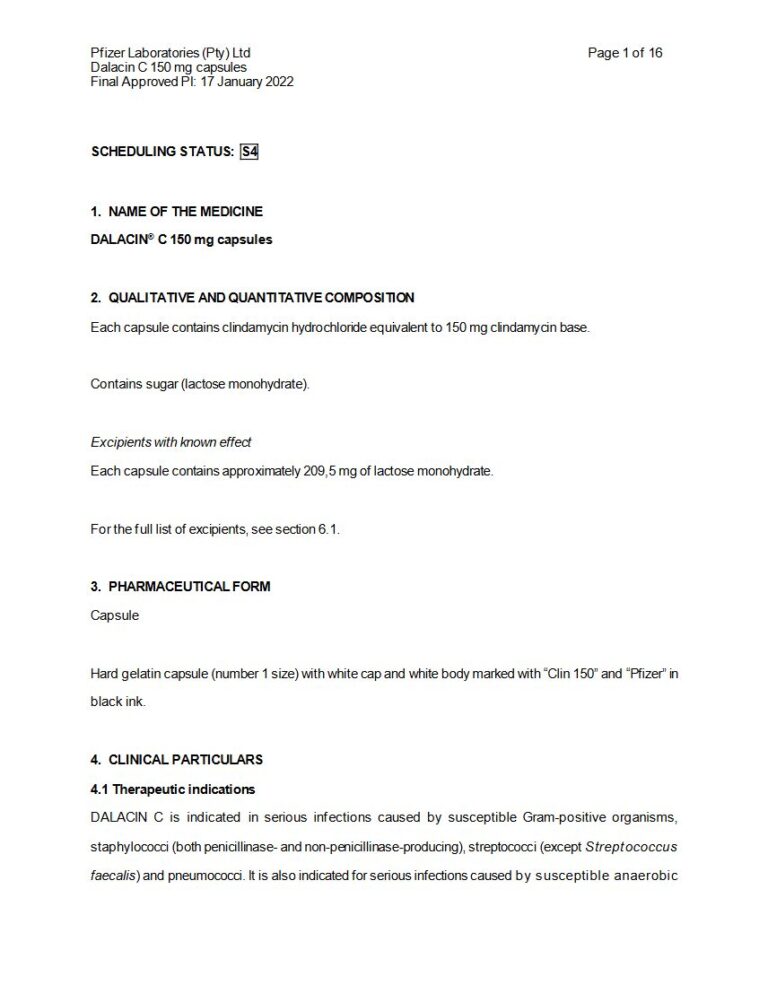
4.1 Therapeutic indications
DALACIN C is indicated in serious infections caused by susceptible Gram-positive organisms, staphylococci (both penicillinase- and non-penicillinase-producing), streptococci (except Streptococcus faecalis) and pneumococci. It is also indicated for serious infections caused by susceptible anaerobic pathogens. In vitro susceptibility studies should be performed. Infections due to sensitive organisms which respond to an effective dose of this oral preparation include infections of the:
- Upper respiratory tract including pharyngitis, tonsillitis, sinusitis, otitis media.
- Lower respiratory tract including bronchitis and pneumonia.
- Skin and soft tissue including abscesses, cellulitis, infected wounds, and dental infections (periapical abscesses and gingivitis).
- Bones and joints including acute and chronic osteomyelitis.
Bacteraemia has responded to the usually recommended dosages.
4.2 Posology and method of administration
Posology
Adults
Mild to moderately severe infections 150 mg approximately every six hours.
Severe infections Up to 450 mg every six hours.
Elderly patients The half-life, volume of distribution, clearance and extent of absorption after administration of DALACIN C are not altered by increased age. Analysis of data from clinical studies has not revealed any age-related increase in toxicity. Dosage requirements in elderly patients, therefore, should not be influenced by age alone.
Paediatric population
Mild infections 8 - 12 mg/kg/day divided into 3 or 4 equal doses.
Moderately severe infections 13 - 16 mg/kg/day divided into 3 or 4 equal doses.
Severe infections 17 - 25 mg/kg/day divided into 3 or 4 equal doses.
DALACIN C capsules should only be used for children who are able to swallow capsules. Do not give DALACIN C capsules to children weighing less than 10 kg. The use of whole capsules may not be suitable to provide the exact mg/kg doses required for the treatment of children.
Patients with renal and hepatic impairment DALACIN C dosage modification is not necessary in patients with renal or hepatic insufficiency (see section 5.2). During prolonged therapy, periodic liver and kidney function tests and blood counts should be performed. Patients with severe renal or severe hepatic disease or with severe metabolic aberrations should be dosed with caution and serum clindamycin levels monitored during high dose therapy.
Note: With u00df-haemolytic streptococcal infections, treatment should continue for at least ten days to diminish the likelihood of subsequent severe complications such as rheumatic fever or glomerulonephritis.
Method of administration For oral use. Capsules should be taken with a full glass of water to avoid the possibility of oesophageal irritation. The capsules must be swallowed whole and not chewed, crushed or opened because of unpleasant taste and possible buccal and oesophageal irritation. Absorption of DALACIN C is not appreciably modified by the presence of food.
4.3 Contraindications
- Patients with known hypersensitivity to clindamycin, lincomycin or doxorubicin or to any of the excipients of DALACIN C (listed in section 6.1).
- Patients with diarrhoeal states or gastrointestinal disease, particularly those with a history of colitis.
- Safety for use in pregnancy has not been established.
- Clindamycin has been reported to appear in breast milk. Do not use in lactation.
4.4 Special warnings and precautions for use
Prescribers should adhere to the principles of antibiotic stewardship. Severe hypersensitivity reactions, including severe skin reactions such as drug reaction with eosinophilia and systemic symptoms (DRESS), Stevens-Johnson syndrome (SJS), toxic epidermal necrolysis (TEN), and acute generalised exanthematous pustulosis (AGEP) have been reported in patients receiving DALACIN C therapy. If a hypersensitivity or severe skin reaction occurs, DALACIN C should be discontinued and appropriate therapy should be initiated (see sections 4.3 and 4.8).
DALACIN C should only be used in the treatment of serious infections. In considering the use of the product, the health care provider should bear in mind the type of infection and the potential hazard of diarrhoea which may develop, since cases of colitis have been reported following the administration of DALACIN C.
DALACIN C-associated colitis may end fatally. Toxins produced by Clostridium difficile are regarded as the principal cause of antibiotic-associated colitis. Colitis has a clinical spectrum from mild, watery diarrhoea to severe, persistent diarrhoea, leucocytosis, fever and severe abdominal cramps which may be associated with the passage of blood and mucus which, if allowed to progress, may produce peritonitis, shock and toxic megacolon. Diagnosis is made on basis of the clinical symptoms and can be substantiated by endoscopic demonstration of pseudomembranous colitis. The presence of the disease may be further confirmed by culture of the stool for Clostridium difficile on selective media and assay of the stool specimen for the toxin(s) of the C. difficile. Antibiotic-associated colitis has occurred during the administration or even two to three weeks following administration of DALACIN C. The disease is likely to take a more severe course in older patients or in patients who are debilitated.
For treatment of antibiotic-associated colitis see section below.
Treatment of antibiotic-associated colitis If persistent diarrhoea occurs during therapy, DALACIN C should be discontinued. Significant diarrhoea occurring up to several weeks post-therapy should be managed as if antibiotic-associated.
- Mild colitis: May respond to discontinuation of DALACIN C alone.
- Moderate colitis: Discontinue DALACIN C and treat with fluid, electrolyte and protein replacement.
- Severe colitis: In cases not responding to the above, discontinue DALACIN C and treat with appropriate fluid, electrolyte and protein supplementation and with one of the following:
- vancomycin 125 to 500 mg orally, every 6 hours for 5 to 10 days
- metronidazole 250 to 500 mg orally, every 8 hours
- cholestyramine 4 grams orally, four times a day
Relapses must be treated with a second course of the above medicines. Cholestyramine and colestipol resins bind to C. difficile toxin in vitro. When administered concurrently with vancomycin, it is advisable to administer the medicines several hours apart since the resins have been shown to bind to oral vancomycin. Anti-peristaltic anti-diarrhoeals are not recommended since they may delay the removal of toxins from the colon, thereby prolonging and/or worsening the condition.
Cross-resistance has been demonstrated between lincomycin hydrochloride and DALACIN C. Since DALACIN C does not diffuse adequately into cerebrospinal fluid, it should not be used in the treatment of meningitis. DALACIN C should be prescribed with caution in atopic individuals or in patients with a history of gastrointestinal disease, particularly colitis. Acute kidney injury, including acute renal failure, has been reported infrequently. In patients suffering from pre-existing renal dysfunction or taking concomitant nephrotoxic medicines, monitoring of renal function should be considered (see section 4.8). The use of antibiotics may result in overgrowth of non-susceptible organisms, particularly yeasts. Should superinfections occur, appropriate measures should be taken as indicated by the clinical situation.
Lactose intolerance DALACIN C contains lactose. Patients with rare hereditary problems of galactose intolerance, total lactase deficiency or glucose-galactose malabsorption should not take this medicine.
4.5 Interaction with other medicines and other forms of interaction
DALACIN C has been shown to have neuromuscular blocking properties that may enhance the action of other neuromuscular blocking medicines. Therefore, it should be used with caution in patients receiving such medicines.
Co-administration of DALACIN C with inhibitors of CYP3A4 and CYP3A5 DALACIN C is metabolised predominantly by CYP3A4, and to a lesser extent by CYP3A5, to the major metabolite clindamycin sulfoxide and minor metabolite N-desmethylclindamycin. Therefore, inhibitors of CYP3A4 and CYP3A5 may reduce DALACIN C clearance and inducers of these isoenzymes may increase DALACIN C clearance. In the presence of strong CYP3A4 inducers such as rifampicin, monitor for loss of effectiveness.
In vitro studies indicate that DALACIN C does not inhibit CYP1A2, CYP2C9, CYP2C19, CYP2E1 or CYP2D6 and only moderately inhibits CYP3A4. Therefore, clinically important interactions between DALACIN C and co-administered medicines metabolised by these CYP enzymes are unlikely.
4.6 Fertility, pregnancy and lactation
Pregnancy DALACIN C is contraindicated in pregnancy as safety has not been demonstrated (see section 4.3). DALACIN C crosses the placenta in humans. After multiple doses, amniotic fluid concentrations were approximately 30 % of maternal blood concentrations.
Breastfeeding DALACIN C has been reported to appear in human breast milk in ranges from < 0,5 to 3,8 u03bcg/mL. Because of the potential for serious adverse reactions in nursing infants, DALACIN C should not be taken by breastfeeding mothers (see section 4.3).
Fertility Fertility studies in rats treated orally with DALACIN C revealed no effects on fertility or mating ability.
4.7 Effects on ability to drive and use machines
The effect of DALACIN C on the ability to drive or operate machinery has not been systematically evaluated.
4.8 Undesirable effects
Tabulated summary of adverse reactions The table below lists the adverse reactions by system organ class and frequency using the following convention: Very common (u2265 1/10); common (u2265 1/100 to < 1/10); uncommon (u2265 1/1 000 to < 1/100); rare (u2265 1/10 000 to < 1/1 000); very rare (< 1/10 000) and not known (cannot be estimated from the available data).
| System organ class | Frequency | Side effect |
|---|---|---|
| Blood and lymphatic system disorders | Common | Eosinophilia |
| Nervous system disorders | Uncommon | Dysgeusia |
| Gastrointestinal disorders | Common | Diarrhoea, abdominal pain |
| Uncommon | Vomiting, nausea | |
| Skin and subcutaneous tissue disorders | Common | Maculopapular rash |
| Uncommon | Urticaria | |
| Rare | Erythema multiforme, pruritus | |
| Investigations | Common | Abnormalities in liver function test (elevations of alkaline phosphatases and serum transaminases) |
Post-marketing experience Adverse reactions identified from post-marketing experience include the following:
| System organ class | Side effect |
|---|---|
| Infections and infestations | Pseudomembranous colitis, clostridium difficile colitis, vaginal infection |
| Blood and lymphatic system disorders | Agranulocytosis, neutropenia, leukopenia, thrombocytopenia |
| Immune system disorders | Anaphylactic shock, anaphylactoid reaction, anaphylactic reaction, hypersensitivity |
| Gastrointestinal disorders | Oesophageal ulcer, oesophagitis |
| Hepato-biliary disorders | Jaundice |
| Skin and subcutaneous tissue disorders | Toxic epidermal necrolysis (TEN), Stevens-Johnson syndrome (SJS), drug reaction with eosinophilia and systemic symptoms (DRESS), acute generalised exanthematous pustulosis (AGEP), angioedema, exfoliative dermatitis, bullous dermatitis, morbilliform rash |
| Renal and urinary disorders | Acute kidney injury (see section 4.4) |
Paediatric population Adverse reactions in children are not expected to be different than in adults.
Reporting of suspected adverse reactions Reporting suspected adverse reactions after authorisation of the medicine is important. It allows continued monitoring of the benefit/risk balance of the medicine. Health care providers are asked to report any suspected adverse reactions to SAHPRA via the u201c6.04 Adverse Drug Reactions Reporting Formu201d, found online under SAHPRAu2019s publications: https://www.sahpra.org.za/Publications/Index/8
4.9 Overdose
The incidence of gastrointestinal side effects is greater with higher doses. Haemodialysis and peritoneal dialysis are not effective means of removing DALACIN C from the blood. Treatment is symptomatic and supportive.
