
Deferiprone Key 500 mg FC tablets
PDF Leaflet Revision Date: 27 May 2025
Clinical Summary
Quick overview from the medicine insert
Indication
Treatment of iron overload in thalassaemia major.
Dosage (summary)
25 mg/kg three times daily, max 75 mg/kg/day.
Special Populations
- Renal impairment
- Hepatic impairment
- Paediatric population
Pregnancy & Breastfeeding
Contraindicated in pregnancy and breastfeeding.
Key Drug Interactions
- Aluminium-based antacids
- Vitamin C
Contraindications
- Hypersensitivity
- Neutropenia
- Agranulocytosis
- Pregnancy
- Breastfeeding
Common side effects
- Nausea
- Vomiting
- Abdominal pain
- Chromaturia
Counselling Points
- Monitor for signs of infection
- Avoid pregnancy
- Urine may discolor
Serious warnings
- Neutropenia
- Agranulocytosis
- Carcinogenic potential
Important Disclaimer
The Deferiprone Key 500 mg FC tablets professional information leaflet below is the property of Key Oncologics and is provided on Medinsert exactly as issued, with no.. alterations or editorial changes. We make every effort to keep content current by updating documents as soon as new versions become available. Medinsert serves as a trusted access point for healthcare professionals, but does not replace official sources or clinical judgement. For more details, please read our full disclaimer. read more>>
 Healthcare Professionals Only
This content is for registered healthcare professionals
Sign in or create a free account to read the full package insert.
Free for HPCSA-registered professionals. Powered by Medinsert.
Clinical Particulars
Section 4 of the official insert — extracted exactly as issued, no alterations
4.1 Therapeutic indications
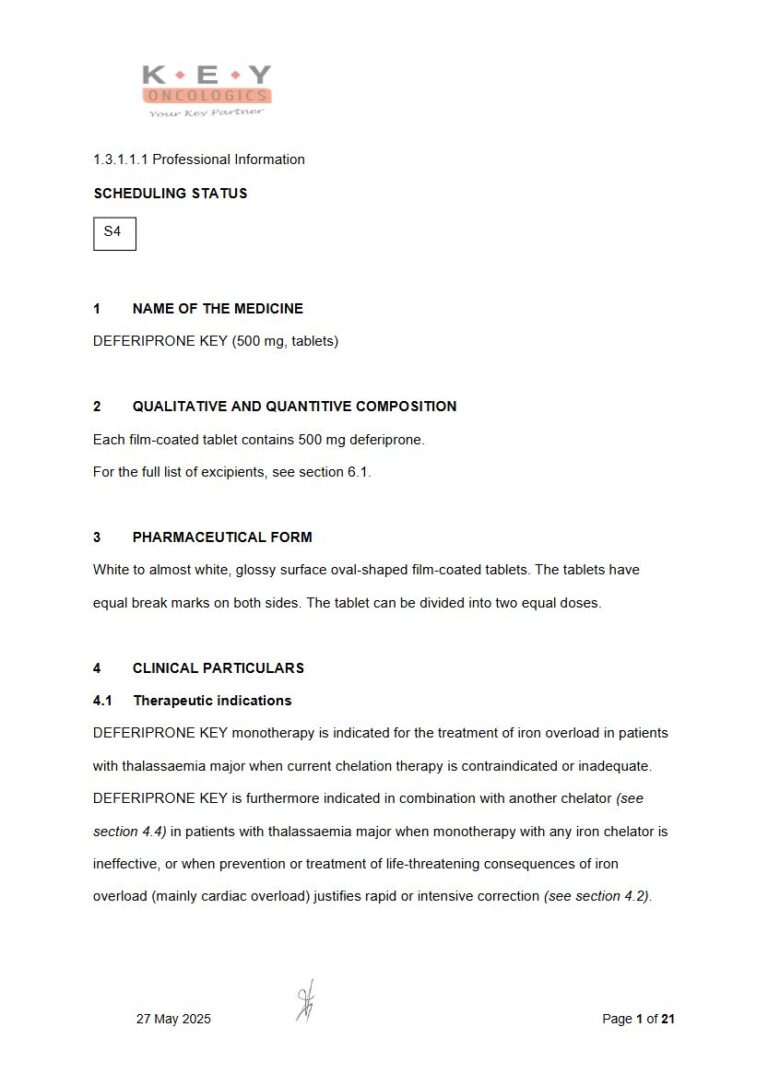
DEFERIPRONE KEY monotherapy is indicated for the treatment of iron overload in patients with thalassaemia major when current chelation therapy is contraindicated or inadequate. DEFERIPRONE KEY is furthermore indicated in combination with another chelator (see section 4.4) in patients with thalassaemia major when monotherapy with any iron chelator is ineffective, or when prevention or treatment of life-threatening consequences of iron overload (mainly cardiac overload) justifies rapid or intensive correction (see section 4.2).
4.2 Posology and method of administration
Posology
DEFERIPRONE KEY is usually given as 25 mg/kg body weight, orally, three times a day for a total daily dose of 75 mg/kg body weight. Dose per kilogram body weight should be calculated to the nearest half tablet. To obtain a dose of about 75 mg/kg/day, use the number of tablets suggested in the following tables for the body weight of the patient. Sample body weights at 10 kg increments are listed.
Table 1: Dose table for DEFERIPRONE KEY, 500 mg film-coated tablets
- Body weight (kg)
- Total daily dose (mg)
- Dose (mg, three times/day)
- Number of tablets (three times/day)
- 20 - 1 500 - 500 - 1.0
- 30 - 2 250 - 750 - 1.5
- 40 - 3 000 - 1 000 - 2.0
- 50 - 3 750 - 1 250 - 2.5
- 60 - 4 500 - 1 500 - 3.0
- 70 - 5 250 - 1 750 - 3.5
- 80 - 6 000 - 2 000 - 4.0
- 90 - 6 750 - 2 250 - 4.5
A total daily dose above 100 mg/kg body weight is not recommended because of the potentially increased risk of adverse reactions (see sections 4.4, 4.8, and 4.9).
Dose adjustment:
The effect of DEFERIPRONE KEY in decreasing the body iron is directly influenced by the dose and the degree of iron overload. After starting DEFERIPRONE KEY therapy, it is recommended that serum ferritin concentrations, or other indicators of body iron load, be monitored every two to three months to assess the long-term effectiveness of the chelation regimen in controlling the body iron load. Dose adjustments should be tailored to the individual patient's response and therapeutic goals (maintenance or reduction of body iron burden). Interruption of therapy with DEFERIPRONE KEY should be considered if serum ferritin falls below 500 u03bcg/L.
Dose adjustments when used with other iron chelators:
In patients for whom monotherapy is inadequate, DEFERIPRONE KEY may be used with deferoxamine at the standard dose (75 mg/kg/day) but should not exceed 100 mg/kg/day. The product information of deferoxamine should be consulted. Concurrent use of iron chelators is not recommended in patients whose serum ferritin falls below 500 u03bcg/l due to the risk of excessive iron removal.
Special populations
Renal impairment: Dose adjustment is not required in patients with mild, moderate, or severe renal impairment (see section 5.2). The safety and pharmacokinetics of DEFERIPRONE KEY in patients with end stage renal disease are unknown.
Hepatic impairment: Dose adjustment is not required in patients with mildly or moderately impaired hepatic function (see section 5.2). The safety and pharmacokinetics of DEFERIPRONE KEY in patients with severe hepatic impairment are unknown.
Paediatric population: There are limited data available on the use of DEFERIPRONE KEY in children between 6 and 10 years of age, and no data on DEFERIPRONE KEY use in children under 6 years of age.
Method of administration
For oral use.
4.3 Contraindications
- Hypersensitivity to the active substance deferiprone or to any of the excipients listed in section 6.1.
- History of recurrent episodes of neutropenia.
- History of agranulocytosis.
- Pregnancy (see section 4.6).
- Breastfeeding (see section 4.6).
- Due to the unknown mechanism of deferiprone-induced neutropenia, patients must not take medicinal products known to be associated with neutropenia or those that can cause agranulocytosis (see section 4.5).
4.4 Special warnings and precautions for use
- Neutropenia/Agranulocytosis:
- Deferiprone as contained in DEFERIPRONE KEY has been shown to cause neutropenia, including agranulocytosis (see section 4.8 'Description of selected adverse reactions'). The patient's absolute neutrophil count (ANC) should be monitored every week during the first year of therapy. For patients whose DEFERIPRONE KEY has not been interrupted during the first year of therapy due to any decrease in the neutrophil count, the frequency of ANC monitoring may be extended to the patient's blood transfusion interval (every 2-4 weeks) after one year of DEFERIPRONE KEY therapy.
- The change from weekly ANC monitoring to monitoring at the time of transfusion visits after 12 months of DEFERIPRONE KEY therapy, should be considered on an individual patient basis, according to the physician's assessment of the patient's understanding of the risk minimization measures required during therapy (see section 4.4 below).
- In clinical studies, weekly monitoring of the neutrophil count has been effective in identifying cases of neutropenia and agranulocytosis. Agranulocytosis and neutropenia usually resolve upon discontinuation of DEFERIPRONE KEY, but fatal cases of agranulocytosis have been reported. If the patient develops an infection while on DEFERIPRONE KEY, therapy should be immediately interrupted, and an ANC obtained without delay. The neutrophil count should be then monitored more frequently.
- Patients should be aware to contact their healthcare professional if they experience any symptoms indicative of infection (such as fever, sore throat and flu-like symptoms). Immediately interrupt DEFERIPRONE KEY if the patient experiences infection.
- Suggested management of cases of neutropenia is outlined below. It is recommended that such a management protocol be in place prior to initiating any patient on deferiprone treatment.
- Treatment with DEFERIPRONE KEY should not be initiated if the patient is neutropenic. The risk of agranulocytosis and neutropenia is higher if the baseline ANC is less than 1.5x10⁹/l.
- For neutropenia events (ANC [absolute neutrophil count] < 1.5x10⁹/l and > 0.5x10⁹/l):
- Instruct the patient to immediately discontinue DEFERIPRONE KEY and all other medicinal products with a potential to cause neutropenia.
- The patient should be advised to limit contact with other individuals in order to reduce the risk of infection.
- Obtain a complete blood cell (CBC) count, with a white blood cell (WBC) count, corrected for the presence of nucleated red blood cells, a neutrophil count, and a platelet count immediately upon diagnosing the event and then repeat daily.
- It is recommended that following recovery from neutropenia, weekly CBC, WBC, neutrophil and platelet counts continue to be obtained for three consecutive weeks, to ensure that the patient has fully recovered.
- Should any evidence of infection develop concurrently with the neutropenia, the appropriate cultures and diagnostic procedures should be performed, and an appropriate therapeutic regimen instituted.
- For agranulocytosis (ANC [absolute neutrophil count] < 0.5x10⁹/l):
- Follow the guidelines above and administer appropriate therapy such as granulocyte colony stimulating factor, beginning the same day that the event is identified; administer daily until the condition resolves. Provide protective isolation and if clinically indicated, admit patient to the hospital.
- Limited information is available regarding rechallenge. Therefore, in the event of neutropenia, rechallenge is not recommended. In the event of agranulocytosis, rechallenge is contraindicated. - Carcinogenicity/mutagenicity:
- In view of the genotoxicity results, a carcinogenic potential of DEFERIPRONE KEY cannot be excluded (see section 5.3). - Plasma zinc (Zn2+) concentration:
- Monitoring of plasma Zn2+ concentration, and supplementation in case of a deficiency, is recommended. - Human immunodeficiency virus (HIV) positive or other immunocompromised patients:
- No data are available on the use of DEFERIPRONE KEY in HIV positive or in other immunocompromised patients.
- Given that DEFERIPRONE KEY can be associated with neutropenia and agranulocytosis, therapy in immunocompromised patients should be initiated with caution. - Renal or hepatic impairment and liver fibrosis:
- There are no data available on the use of DEFERIPRONE KEY in patients with end stage renal disease or severe hepatic impairment (see section 5.2).
- Caution must be exercised in patients with end stage renal disease or severe hepatic dysfunction. Renal and hepatic function should be monitored in these patient populations during DEFERIPRONE KEY therapy.
- If there is a persistent increase in serum alanine aminotransferase (ALT), interruption of DEFERIPRONE KEY therapy should be considered. - In thalassaemia patients there is an association between liver fibrosis and iron overload and/or hepatitis C. Special care must be taken to ensure that iron chelation in patients with hepatitis C is optimal. In these patients careful monitoring of liver histology is recommended.
- Discolouration of urine:
- Patients should be informed that their urine may show a reddish/brown discolouration due to the excretion of the iron-deferiprone complex. - Neurological disorders:
- Neurological disorders have been observed in children treated with more than 2.5 times the maximum recommended dose for several years but have also been observed with standard doses of DEFERIPRONE KEY.
- Prescribers are reminded that the use of doses above 100 mg/kg/day are not recommended.
- DEFERIPRONE KEY use should be discontinued if neurological disorders are observed (see sections 4.8 and 4.9). - Combined use with other iron chelators:
- The use of combination therapy should be considered on a case-by-case basis. The response to therapy should be assessed periodically, and the occurrence of adverse events closely monitored.
- Fatalities and life-threatening situations (caused by agranulocytosis) have been reported with DEFERIPRONE KEY in combination with deferoxamine. Combination therapy with deferoxamine is not recommended when monotherapy with either chelator is adequate or when serum ferritin falls below 500 u03bcg/l.
- Limited data are available on the combined use of DEFERIPRONE KEY and deferasirox, and caution should be applied when considering the use of such combination.
4.5 Interaction with other medicines and other forms of Interaction
- Due to the unknown mechanism of DEFERIPRONE KEY-induced neutropenia, patients must not take medicinal products known to be associated with neutropenia or those that can cause agranulocytosis (see section 4.3).
- Since DEFERIPRONE KEY binds to metallic cations, the potential exists for interactions between DEFERIPRONE KEY and trivalent cation-dependent medicinal products such as aluminium-based antacids. Therefore, it is not recommended to concomitantly ingest aluminium-based antacids and DEFERIPRONE KEY.
- The safety of concurrent use of DEFERIPRONE KEY and vitamin C has not been formally studied. Based on the reported adverse interaction that can occur between deferoxamine and vitamin C, caution should be used when administering DEFERIPRONE KEY and vitamin C concurrently.
4.6 Fertility, pregnancy and lactation
Women of childbearing potential/ Contraception in males and females
Women of childbearing potential must be advised to avoid pregnancy due to the clastogenic and teratogenic properties of the medicinal product. These women should be advised to take contraceptive measures and must be advised to immediately stop taking DEFERIPRONE KEY if they become pregnant or plan to become pregnant (see section 4.3).
Pregnancy
As there are no adequate data from the use of DEFERIPRONE KEY in pregnant women and studies in animals have shown reproductive toxicity, use during pregnancy is contraindicated.
Breastfeeding
As it is not known whether DEFERIPRONE KEY is excreted in human milk, and no prenatal and postnatal reproductive studies have been conducted in animals, use during breastfeeding is contraindicated.
Fertility
No effects on fertility or early embryonic development were observed in animals.
4.7 Effects on ability to drive and use machines
DEFERIPRONE KEY has no or negligible effect on mental and/or physical abilities to perform or execute tasks or activities requiring mental alertness, judgment and/or sound coordination and vision.
4.8 Undesirable effects
a. Summary of the safety profile
The most common adverse reactions reported during therapy with DEFERIPRONE KEY in clinical studies were nausea, vomiting, abdominal pain, and chromaturia, which were reported in more than 10 % of patients. The most serious adverse reaction reported in clinical studies with DEFERIPRONE KEY was agranulocytosis, defined as an absolute neutrophil count less than 0.5x10⁹/L, which occurred in approximately 1 % of patients. Less severe episodes of neutropenia were reported in approximately 5 % of patients.
b. Table 2: List of adverse reactions
Adverse reaction frequencies: very common (u2265 1/10), common (u2265 1/100 to < 1/10), not known (cannot be estimated from the available data).
- System organ class
- Very common (u2265 1/10)
- Common (u2265 1/100 to < 1/10)
- Frequency not known
- Blood and lymphatic system disorders
- Neutropenia
- Agranulocytosis
- Immune system disorders
- Hypersensitivity reactions
- Metabolism and nutrition disorders
- Increased appetite
- Nervous system disorders
- Headache
- Gastrointestinal disorders
- Nausea
- Abdominal pain
- Vomiting
- Diarrhoea
- Skin and subcutaneous tissue disorders
- Rash
- Urticaria
- Musculoskeletal and connective tissue disorders
- Arthralgia
- Renal and urinary disorders
- Chromaturia
- General disorders and administration site conditions
- Fatigue
- Investigations
- Increased liver enzymes
Description of selected adverse reactions
The most serious adverse reaction reported in clinical studies with deferiprone as contained in DEFERIPRONE KEY is agranulocytosis (neutrophils < 0.5x10⁹/L), with an incidence of 1.1 % (0.6 cases per 100 patient-years of treatment) (see section 4.4). Data from pooled clinical studies in patients with systemic iron overload showed that 63 % of the episodes of agranulocytosis occurred within the first six months of treatment, 74 % within the first year and 26 % after one year of therapy. The median time to onset of the first episode of agranulocytosis was 190 days (ranged 22 days- 17.6 years) and median duration was 10 days in clinical studies. A fatal outcome was observed in 8.3 % of the reported episodes of agranulocytosis from clinical studies and post-marketing experience. The observed incidence of the less severe form of neutropenia (neutrophils < 1.5 x 10⁹/L) is 4.9 % (2.5 cases per 100 patient-years). This rate should be considered in the context of the underlying elevated incidence of neutropenia in thalassaemia patients, particularly in those with hypersplenism. Episodes of diarrhoea, mostly mild and transient, have been reported in patients treated with DEFERIPRONE KEY. Gastrointestinal effects are more frequent at the beginning of therapy and resolve in most patients within a few weeks without the discontinuation of treatment. In some patients it may be beneficial to reduce the dose of DEFERIPRONE KEY and then scale it back up to the former dose. Arthropathy events, which ranged from mild pain in one or more joints to severe arthritis with effusion and significant disability, have also been reported in patients treated with DEFERIPRONE KEY. Mild arthropathies are generally transient. Increased levels of serum liver enzymes have been reported in some patients taking DEFERIPRONE KEY. In the majority of these patients, the increase was asymptomatic and transient, and returned to baseline without discontinuation or decreasing the dose of DEFERIPRONE KEY (see section 4.4). Some patients experienced progression of fibrosis associated with an increase in iron overload or hepatitis C. Low plasma zinc levels have been associated with DEFERIPRONE KEY in a minority of patients. The levels normalised with oral zinc supplementation. Neurological disorders (such as cerebellar symptoms, diplopia, lateral nystagmus, psychomotor slowdown, hand movements and axial hypotonia) have been observed in children who had been voluntarily prescribed more than 2.5 times the maximum recommended dose of 100 mg/kg/day for several years. Episodes of hypotonia, instability, inability to walk, and hypertonia with inability of limb movement, have been reported in children in the post-marketing setting with standard doses of DEFERIPRONE KEY. The neurological disorders progressively regressed after DEFERIPRONE KEY discontinuation (see sections 4.4 and 4.9). The safety profile of combination therapy (DEFERIPRONE KEY and deferoxamine) observed in clinical studies, post-marketing experience or published literature was consistent with that characterised for monotherapy. Data from the pooled safety database from clinical studies (1 343 patient-years exposure to DEFERIPRONE KEY monotherapy and 244 patient-years exposure to DEFERIPRONE KEY and deferoxamine) showed statistically significant (p < 0.05) differences in the incidence of adverse reactions based on System Organ Class for u201cCardiac disorders
4.9 Overdose
In overdose, undesirable effects can be precipitated and/or be of increased severity (see section 4.8). No cases of acute overdose have been reported.
Symptoms:
However, neurological disorders (such as cerebellar symptoms, diplopia, lateral nystagmus, psychomotor slowdown, hand movements and axial hypotonia) have been observed in children who had been voluntarily prescribed more than 2.5 times the maximum recommended dose of 100 mg/kg per day for several years.
Treatment:
The neurological disorders progressively regressed after DEFERIPRONE KEY discontinuation. In case of overdose, close clinical supervision of the patient is required.
