
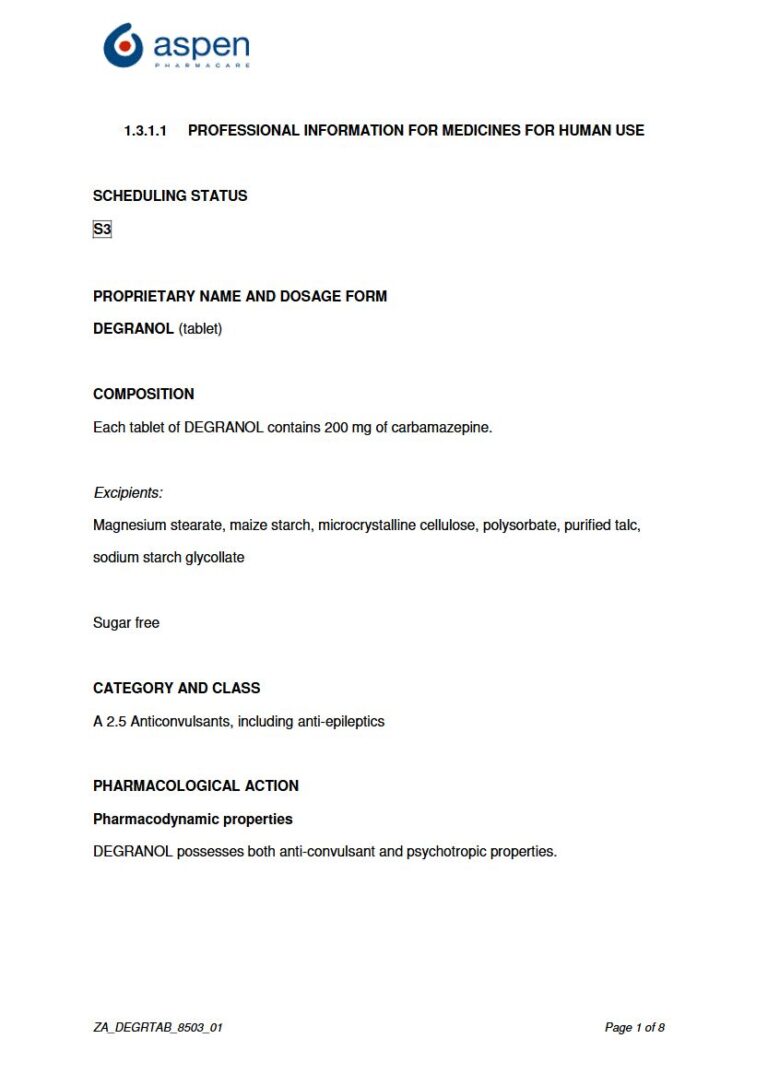
Degranol 700mg Tablet
PDF Leaflet Revision Date: 19 March 1985
Clinical Summary
Quick overview from the medicine insert
Indication
Treatment of epilepsy and trigeminal neuralgia.
Dosage (summary)
Epilepsy: 100-200 mg once/twice daily, increase to 400 mg 2-3 times daily. Trigeminal Neuralgia: 200 mg twice daily, increase as needed.
Special Populations
- Elderly
- Hepatic impairment
- Renal impairment
Pregnancy & Breastfeeding
Safety in pregnancy not established; passes into breast milk.
Key Drug Interactions
- Alcohol
- Phenytoin
- Doxycycline
- Oral anticoagulants
- Oral contraceptives
Contraindications
- Hypersensitivity to carbamazepine
- Liver disease
- Heart block
- Monoamine oxidase inhibitors
- Porphyria
Common side effects
- Drowsiness
- Dizziness
- Nausea
- Headache
- Dry mouth
Counselling Points
- Avoid alcohol
- Monitor liver function
- Gradual dosage increase recommended
Serious warnings
- Increased liver tumor incidence in rats
- Medicinal supervision required
Important Disclaimer
The Degranol 700mg Tablet professional information leaflet below is the property of Pharmacare Limited and is provided on Medinsert exactly as issued, with no.. alterations or editorial changes. We make every effort to keep content current by updating documents as soon as new versions become available. Medinsert serves as a trusted access point for healthcare professionals, but does not replace official sources or clinical judgement. For more details, please read our full disclaimer. read more>>
 Healthcare Professionals Only
This content is for registered healthcare professionals
Sign in or create a free account to read the full package insert.
Free for HPCSA-registered professionals. Powered by Medinsert.
Clinical Particulars
Section 4 of the official insert — extracted exactly as issued, no alterations
4.1 Therapeutic indications
Epilepsy with motor and psychic manifestations:
- psychomotor or temporal-lobe epilepsy
- grand mal
- mixed forms
- focal seizures
DEGRANOL is also used in the treatment of trigeminal neuralgia.
4.2 Posology and method of administration
Trigeminal Neuralgia: An initial dose of 200 mg twice daily gradually increasing until a suitable response is obtained. The usual dosage required is one tablet three or four times daily. In elderly or hypersensitive patients an initial dose of half a tablet twice daily is recommended.
Epilepsy:
Adults: Initially 100 mg to 200 mg once or twice a day, followed by a slow increase until usually, at a level of 400 mg twice or three times a day, the best response is obtained. In some instances 1 600 mg in 3 to 4 divided doses may be necessary.
Children: Administered in several fractional doses - usually 10 to 20 mg/kg per day. Age up to 1 year: 100 mg to 200 mg (u00bd to 1 tablet) per day. 1 to 5 years: 200 mg to 400 mg (1 to 2 tablets) per day. 5 to 10 years: 400 mg to 600 mg (2 to 3 tablets) per day. 10 to 15 years: 600 mg to 1 000 mg (3 to 5 tablets) per day.
4.3 Contraindications
Hypersensitivity to carbamazepine. DEGRANOL is contraindicated for expectant or nursing mothers and patients with liver disease. Not to be used in patients with heartblock. It should not be given to patients taking a mono-amine oxidase inhibitor or within 2 weeks of stopping such treatment. Not to be used in patients with porphyria.
4.4 Special warnings and precautions for use
In rats treated with carbamazepine for two years, the incidence of tumours of the liver was found to be increased. There is, however, no evidence to indicate that this observation has any significance relative to therapeutic use of the medicine. Medicinal supervision during treatment is essential.
The level of serum folic acid should be observed during anticonvulsant therapy since DEGRANOL may enhance the metabolism of folic acid. Abnormalities of liver function and jaundice have been associated with long-term treatment. Blood counts and liver function tests should be performed before commencing treatment. Blood counts should then be repeated at weekly intervals during the first month of treatment and subsequently at monthly intervals; liver function tests should also be undertaken periodically. If allergic skin reactions occur, if the leucocyte and/or platelet should diminish, if tests reveal deterioration in liver function, or if any serious adverse symptoms develop, DEGRANOL should be withdrawn.
4.5 Interactions with other medicines
DEGRANOL may reduce the patientu2019s alcohol tolerance, it is therefore advisable to abstain from alcohol during treatment. Induction of hepatic enzymes in response to DEGRANOL may have the effect of diminishing the activity of certain medicines that are metabolised in the liver. This should be borne in mind when administering DEGRANOL concomitantly with other anti-epileptic medicines, e.g. phenytoin and the tetracycline, doxycycline. Similarly, in patients receiving oral anticoagulant medication, the dosage of the anticoagulant should be readapted to clinical requirements whenever treatment with DEGRANOL is initiated or withdrawn. DEGRANOL may adversely affect the reliability or oral contraceptives.
4.6 Fertility, pregnancy and lactation
Safety of DEGRANOL in pregnancy has not been demonstrated conclusively. If pregnancy occurs in a woman receiving DEGRANOL or if the problem of initiating treatment with DEGRANOL rises during pregnancy, the medicineu2019s potential benefits must be carefully weighed against its possible hazards, particularly in the first three months of pregnancy. The active substance of DEGRANOL passes into the breast milk.
4.7 Effects on ability to drive and use machines
Reaction-time may be increased by DEGRANOL. The patientu2019s safety as a road-user or operator of machines may be impaired in consequence.
4.8 Undesirable effects
Unwanted effects - i.e. loss of appetite, dryness of the mouth, retching, diarrhoea or constipation, headache, drowsiness, dizziness, somnolence, ataxia, disorders of visual accommodation, diplopia, or, in elderly patients, states of confusion and agitation - may occur, particularly at the start of treatment. These effects may require temporary reduction in the dosage. Hyponatraemia due to the anti diuretic effect of DEGRANOL and possibly accompanied by vomiting, headache, and mental confusion has been observed. Allergic skin reactions, as well as occurrences of exfoliative dermatitis, paraesthesia, systemic lupus erythematosus, Stevens-Johnson syndrome, photosensitivity, altered skin pigmentation, leucopenia, thrombocytopenia, agranulocytosis, aplastic anaemia, thrombo-embolism, left ventricular failure, disturbances of cardiac impulse conduction, hepatocellular and cholestatic hepatitis, acute oliguria with hypertension and proteinuria have been reported. A wide variety of other central nervous system, gastrointestinal, cardiovascular and dermatological effects have also been reported. In patients with cardiovascular diseases, or with hepatic or renal disorders, glaucoma and in elderly subjects, DEGRANOL should be administered with caution. Tolerance may develop to some of the untoward effects of DEGRANOL and they can be minimised by gradual increase in dosage and adjustment of maintenance dosage. If treatment with DEGRANOL is withdrawn abruptly, the change-over to another anti-epileptic should be effected under cover of diazepam or a barbiturate.
4.9 Overdose
Symptoms: Agitation, tremor, abnormal reflexes, convulsions, impairment of consciousness, hypertension or hypotension, nausea, vomiting, renal insufficiency, deep sleep, coma, EEG and ECG changes.
Treatment: No specific antidote. The stomach should be emptied by aspiration and lavage. Ensure clear airway and maintain respiration. Treatment is mainly supportive and symptomatic. Measures to monitor and safeguard vital functions. Administration of diazepam where necessary.
