
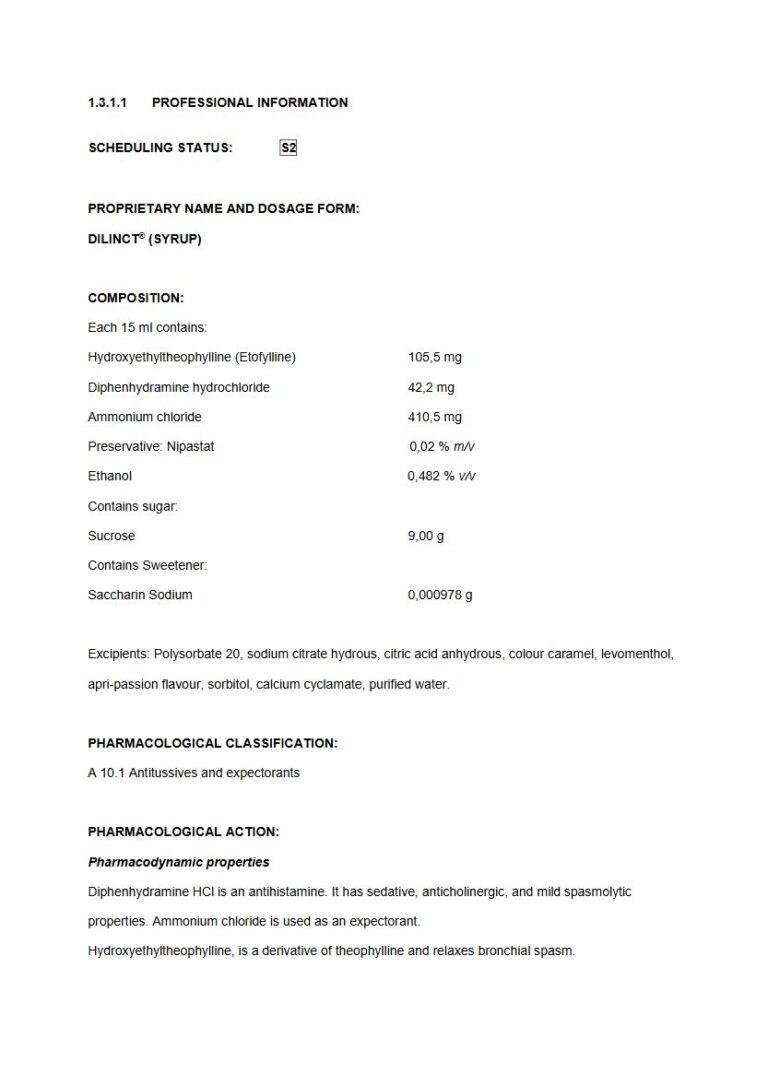
Dilinct (Syrup) 15 ml SYRUP
PDF Leaflet Revision Date: 06 May 1983
Clinical Summary
Quick overview from the medicine insert
Indication
Relief of coughing and facilitation of bronchodilation and expectoration.
Dosage (summary)
Adults: 3 measures (15 ml) 3-4 times daily; Not for children under 2 years.
Special Populations
- Children under 2 years
- Renal impairment
- Hepatic impairment
Pregnancy & Breastfeeding
Safety in pregnancy and lactation not established.
Key Drug Interactions
- CNS depressants
- Beta blockers
- CYP2D6 substrates
Contraindications
- Epilepsy
- Children under 2 years
- Impaired renal or hepatic function
Common side effects
- Drowsiness
- Nausea
- Palpitations
- Irritability
Counselling Points
- Avoid alcohol
- May impair concentration
- Monitor for sedation
Serious warnings
- May cause drowsiness
- Caution in glaucoma
- Contains sucrose
Important Disclaimer
The Dilinct (Syrup) 15 ml SYRUP professional information leaflet below is the property of Adcock Ingram and is provided on Medinsert exactly as issued, with no.. alterations or editorial changes. We make every effort to keep content current by updating documents as soon as new versions become available. Medinsert serves as a trusted access point for healthcare professionals, but does not replace official sources or clinical judgement. For more details, please read our full disclaimer. read more>>
 Healthcare Professionals Only
This content is for registered healthcare professionals
Sign in or create a free account to read the full package insert.
Free for HPCSA-registered professionals. Powered by Medinsert.
Clinical Particulars
Section 4 of the official insert — extracted exactly as issued, no alterations
4.1 Therapeutic indications
For the relief of coughing and to facilitate bronchodilation and expectoration.
4.2 Posology and method of administration
1 medicine measure = 5 ml.
Adults: 3 medicine measures three to four times daily.
Children: 2 to 6 years: u00bd medicine measure, three to four times daily.
6 to 12 years: 1 medicine measure, three to four times daily.
Not recommended for children under 2 years of age.
4.3 Contraindications
The antihistamines are contraindicated in epileptics, since in large doses they may precipitate fits.
Do not use in children under 2 years of age.
Ammonium chloride: Should not be given to patients with impaired renal or hepatic functions, advanced arteriosclerosis or dehydration.
4.4 Special warnings and precautions for use
This medicine may lead to drowsiness and impaired concentration that may be aggravated by the simultaneous intake of alcohol or other central nervous system depressants.
Caution is needed in conditions such as closed-angle glaucoma, urinary retention, prostatic hyperplasia, pyloroduodenal obstruction.
Contains sucrose which may have an effect on the glycaemic control of patients with diabetes mellitus.
Contains sucrose. Patients with rare hereditary conditions such as fructose intolerance, glucose-galactose mal-absorption or sucrase-isomaltase insufficiency should not take DILINCT.
Patients with the rare hereditary condition of sorbitol intolerance should not take DILINCT.
4.5 Interactions with other medicines
Hydroxyethyltheophylline (Etofylline): Theophylline clearance may be reduced by interaction with other medication including allopurinol, antiarrhythmics, cimetidine, disulfiram, fluvoxamine, macrolide antibacterials and quinolones, oral contraceptives, tiabendazole and viloxazine. The dose of the theophylline may need to be reduced. Phenytoin and other antiepileptics, ritonavir, rifampicin and sulfinpyrazone may increase theophylline clearance and the dose may need to be increased. The use of theophylline with beta blockers must be avoided. The toxic effects of theophylline, aminophylline and other xanthines are additive. Use with other xanthine medications should therefore be avoided.
Diphenhydramine inhibits the cytochrome P450 isoenzyme CYP2D6 that is partly responsible for the metabolism of some beta blockers including metoprolol and the antidepressant venlafaxine.
Sedating antihistamines, such as diphenhydramine, may enhance the sedative effects of CNS depressants including alcohol, barbiturates, hypnotics, opioid analgesics, anxiolytic sedatives and anxiolytics.
Sedating antihistamines, such as diphenhydramine, have an additive antimuscarinic action with other antimuscarinic drugs, such as atropine and some antidepressants (both tricyclics and MAOIs).
4.6 Fertility, pregnancy and lactation
Safety in pregnancy and lactation has not been established.
4.7 Effects on ability to drive and use machines
This section is not explicitly mentioned in the provided text.
4.8 Undesirable effects
Hydroxyethyltheophylline (Etofylline): May give rise to the following side effects:
System Organ Class Adverse Effect Frequency
Psychiatric disorders Irritability, anxiety, restlessness and confusion. Unknown
Nervous system disorders CNS stimulation, insomnia, tremors. Overdosage of theophylline may lead to convulsions. Frequent
Cardiac disorders Palpitations. Unknown
Gastrointestinal disorders Nausea, vomiting, diarrhoea, abdominal pain. Unknown
General disorders and administration site conditions Headache. Unknown
Diphenhydramine hydrochloride: May give rise to the following side effects:
System Organ Class Adverse Effect Frequency
Immune system disorders Hypersensitivity reactions (cross-sensitivity to related drugs may occur) Unknown
Psychiatric disorders Sedation, drowsiness, lassitude. Frequent
Nervous system disorders Dizziness, incoordination; CNS stimulation (especially in children) with insomnia, nervousness, euphoria, irritability, tremors, nightmares, hallucinations and convulsions. Unknown
Cardiac disorders Transient bradycardia followed by tachycardia with palpitations and arrhythmias. Unknown
Eye Disorders Blurred vision Unknown
Respiratory, thoracic and mediastinal disorders Thickened respiratory tract secretions, tightness of the chest. Unknown
Gastrointestinal disorders Reduction in tone and motility of the gastrointestinal tract resulting in, constipation and increased gastric reflux. Nausea, vomiting, diarrhoea, gastric pain. Unknown
General disorders and administration site conditions Urinary difficulty and retention. Unknown
Ammonium chloride: Is irritant to the gastric mucosa and may produce nausea and vomiting particularly in large doses. Ammonium chloride can also produce a transient diuresis and mild acidosis.
4.9 Overdose
Overdosing usually causes nausea and vomiting and possibly cardiac arrest and collapse. Respiratory and cardiac depression and collapse must be prevented and treated with artificial respiration, analeptics and oxygen - maintain blood pressure and control convulsions. Treatment is symptomatic and supportive.
