
Doribax 500mg Injection
PDF Leaflet Revision Date: 28 December 2024
Clinical Summary
Quick overview from the medicine insert
Indication
Treatment of infections caused by susceptible bacteria.
Dosage (summary)
500 mg IV every 8 hours; adjust for renal impairment.
Special Populations
- Renal impairment
- Hepatic impairment
- Elderly
Pregnancy & Breastfeeding
Safety not established in pregnancy or lactation.
Key Drug Interactions
- Probenecid
- Valproic acid
Contraindications
- Hypersensitivity to doripenem or beta-lactams
Common side effects
- Nausea
- Diarrhoea
- Headache
- Phlebitis
Counselling Points
- Monitor for allergic reactions
- Report severe diarrhea
- Avoid use in absence of infection
Serious warnings
- Increased mortality in ventilator-associated pneumonia
- Serious hypersensitivity reactions
Important Disclaimer
The Doribax 500mg Injection professional information leaflet below is the property of Acino Pharma and is provided on Medinsert exactly as issued, with no.. alterations or editorial changes. We make every effort to keep content current by updating documents as soon as new versions become available. Medinsert serves as a trusted access point for healthcare professionals, but does not replace official sources or clinical judgement. For more details, please read our full disclaimer. read more>>
 Healthcare Professionals Only
This content is for registered healthcare professionals
Sign in or create a free account to read the full package insert.
Free for HPCSA-registered professionals. Powered by Medinsert.
Clinical Particulars
Section 4 of the official insert — extracted exactly as issued, no alterations
4.1 Therapeutic indications
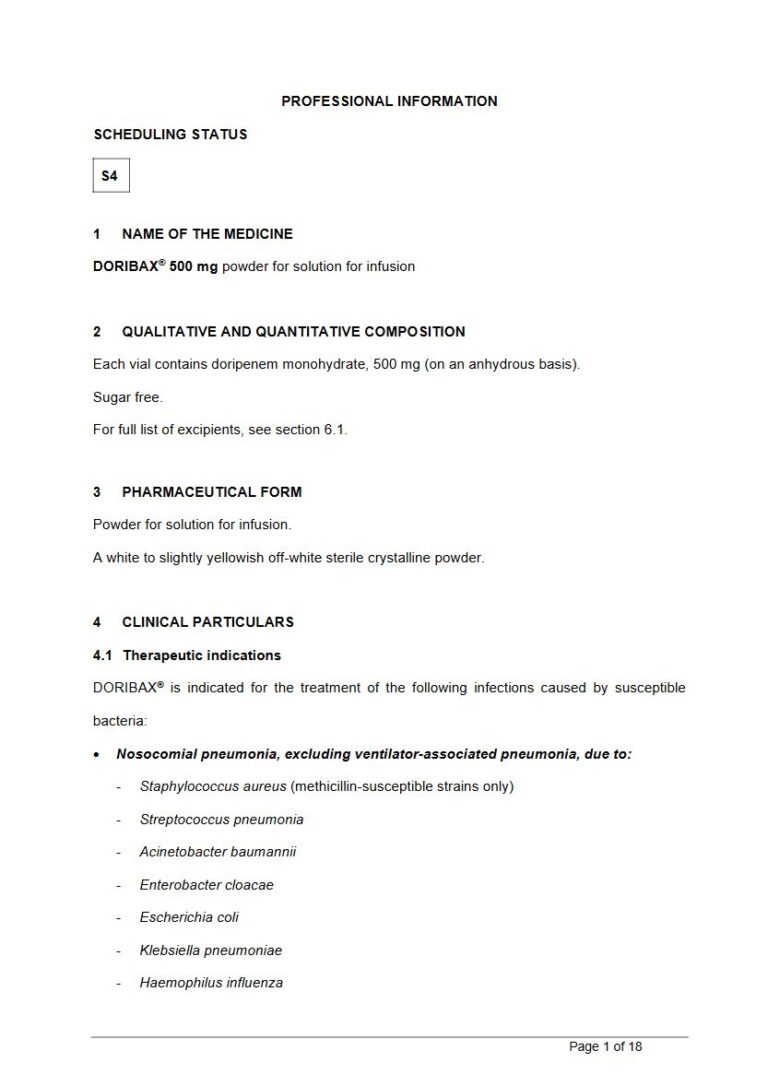
DORIBAX u00c6 is indicated for the treatment of the following infections caused by susceptible bacteria:
- Nosocomial pneumonia, excluding ventilator-associated pneumonia, due to:
- Staphylococcus aureus (methicillin-susceptible strains only)
- Streptococcus pneumonia
- Acinetobacter baumannii
- Enterobacter cloacae
- Escherichia coli
- Klebsiella pneumoniae
- Haemophilus influenza
- Pseudomonas aeruginosa
- Complicated intra-abdominal infections, due to
- Escherichia coli
- Klebsiella pneumonia
- Pseudomonas aeruginosa
- Bacteroides caccae
- Bacteroides fragilis
- Bacteroides thetaiotaomicron
- Bacteroides uniformis
- Bacteroides vulgatis
- Enterococcus faecalis
- Streptococcus intermedius
- Streptococcus constellatus
- Peptostreptococcus micros
- Complicated urinary tract infections, including pyelonephritis, due to
- Escherichia coli (including levofloxin-resistant strains) with or without co-current bacteraemia
- Klebsiella pneumonia
- Proteus mirabilis
- Pseudomonas aeruginosa
- Acinetobacter baumannii
- Enterococcus faecalis
4.2 Posology and method of administration
Posology
The recommended dose of DORIBAX u00c6 is 500 mg administered every 8 hours by intravenous infusion. The recommended dosage and administration by infection is described in Table 1.
Table 1: Dosage of DORIBAX u00c6 by infection
| Infection | Dosage | Frequency | Infusion time (hours) | Duration |
|---|---|---|---|---|
| Nosocomial pneumonia | 500 mg | Every 8 hours | 1 to 4 * | 7 u2013 14 days |
| Complicated intra-abdominal infection | 500 mg | Every 8 hours | 1 | 5 u2013 14 days |
| Complicated UTI, including pyelonephritis | 500 mg | Every 8 hours | 1 | 10 days |
* One-hour infusions are recommended for treatment of patients with nosocomial pneumonia. For patients who are at risk for infection with less susceptible pathogens, four-hour infusions are recommended.
Treatment duration should be guided by the severity of illness, infecting pathogen, and the patientu2019s clinical response. The usual treatment duration is 7 to 14 days for patients with nosocomial pneumonia.
Special populations
Paediatric population
The safety and efficacy of doripenem in children and adolescents aged < 18 years have not yet been established. No data are available.
Patients with impaired renal function
In patients whose creatinine clearance (CrCl) is > 50 mL/min, no dosage adjustment is necessary. In patients with moderate renal impairment (CrCl u2265 30 to u2264 50 mL/min), the dosage of DORIBAX u00c6 should be 250 mg every 8 hours. In patients with severe renal impairment (CrCl > 10 to < 30 mL/min), the dosage of DORIBAX u00c6 should be 250 mg every 12 hours.
In patients prescribed 1 g every 8 hours as a 4-hour infusion, the dose should be similarly adjusted (moderate renal impairment: 500 mg every 8 hours; severe renal impairment: 500 mg every 12 hours).
Due to limited clinical data and an expected increased exposure to doripenem and its metabolite (doripenem-M-1), Doribax should be used with caution in patients with severe renal impairment (see section 5.2).
The following formula may be used to estimate CrCl. The serum creatinine used in the formula should represent a steady state of renal function.
Males: Creatinine clearance (mL/min) = weight (kg) x (140 u2013 age in years) / (0.82 x plasma creatinine (u03bcmol/L))
Females: Creatinine clearance (mL/min) = weight (kg) x (140 u2013 age in years) / (0.85 x plasma creatinine (u03bcmol/L))
In patients with augmented renal clearance, it is recommended that the dose of DORIBAXu00c6 be doubled to 1 g every 8 hours by intravenous infusion over 30 minutes for 10 u2013 14 days. This is also recommended when non-fermenting Gram-negative bacteria are suspected or confirmed as the cause of infection, and concomitant treatment with an aminoglycoside antibacterial medicine should be considered in these cases.
Patients on dialysis
DORIBAX u00c6 dosing and administration recommendations for patients on continuous renal replacement therapies are shown in Table 2.
Table 2: Dosage of DORIBAX u00c6 in patients on continuous renal replacement therapies
| CRRT procedure | Estimated CrCl (mL/min) | Dose | Frequency | Infusion time | Target attainment (MIC) |
|---|---|---|---|---|---|
| CVVH | u2264 30 mL/min | 250 mg | Every 12 hours | 4 hours | u2264 1 u03bcg/mL |
| CVVHDF | < 5 mL/min | 250 mg | Every 12 hours | 4 hours | u2264 1 u03bcg/mL |
| CVVHDF | 5 u2013 30 mL/min | 500 mg | Every 12 hours | 4 hours | u2264 1 u03bcg/mL |
For patients with acute renal insufficiency on CRRT, an infusion time of 4 hours is required, taking into consideration the possible increases in non-renal clearance of carbapenems in patients with acute renal insufficiency. These recommendations are based on limited clinical data and simulation data.
Dosing recommendations for pathogens with MIC >1 u03bcg/mL have not been established for continuous renal replacement therapy due to the potential for accumulation of doripenem and doripenem-M-1 metabolite (see section 4.4 and 5.2). Close safety monitoring is advised for these patients due to limited clinical data and an expected increased exposure to doripenem-M-1 metabolite.
As many patients receiving DORIBAXu00c6 are not candidates for traditional short-term intermittent haemodialysis due to haemodynamic instability or other risks, there is insufficient data to provide dosing recommendations for subjects on intermittent haemodialysis.
Patients with hepatic impairment
No dosage adjustment is necessary.
Method of administration
DORIBAXu00c6 500 mg is a powder for solution for infusion. For instructions on preparation of DORIBAX u00c6 solution for infusion see section 6.6. DORIBAX u00c6 infusions range from clear, colourless solutions to solutions that are clear and slightly yellow. Variations in colour within this range do not affect the potency of the product.
4.3 Contraindications
Known hypersensitivity to doripenem, to other medicines in the same class, or to betalactams.
4.4 Special warnings and precautions for use
Ventilator-associated pneumonia
A study in the use of DORIBAX u00c6 in a fixed 7-day regimen in ventilator-associated pneumonia has shown an increase in mortality.
Hypersensitivity reactions
Serious and fatal hypersensitivity (anaphylactic) reactions have occurred in patients receiving beta-lactam antibiotics, including DORIBAX u00c6 (see section 4.3). These reactions are more likely to occur in individuals with a history of sensitivity to multiple allergens. Before therapy with DORIBAX u00c6 is instituted, careful inquiry should be made to determine whether the patient has had a previous hypersensitivity reaction to other carbapenems, cephalosporins, penicillin or other allergens. If DORIBAX u00c6 is to be given to a penicillin- or other beta-lactam-allergic patient, caution should be exercised because cross-hyperreactivity among beta-lactam antibiotics has been clearly documented. If an allergic reaction to DORIBAX u00c6 occurs, discontinue DORIBAX u00c6. Serious acute hypersensitivity (anaphylactic) reactions require immediate emergency treatment.
Pseudomembranous colitis
Pseudomembranous colitis due to C. difficile has been reported with DORIBAX u00c6 and may range in severity from mild to life-threatening. Therefore, it is important to consider this diagnosis in patients who have received DORIBAX u00c6 and who present with diarrhoea.
Overgrowth of non-susceptible bacteria
Prescribing DORIBAX u00c6 in the absence of a proven or strongly suspected bacterial infection or for prophylactic indication is unlikely to provide benefit to the patient and increases the risk of the development of medicine-resistant bacteria.
Interaction with valproic acid
DORIBAX u00c6 reduced serum valproic acid concentration to sub-therapeutic levels in healthy subjects. Therapeutic monitoring of valproic acid and use of alternative therapies should be considered in patients (see section 4.5 and 5.2).
End stage renal disease (ESRD)
The exposure to metabolite doripenem-M-1 in patients with ESRD may be increased to levels for which no in vivo safety data are presently available. The metabolite lacks microbiological activity, but other possible pharmacological effects are unknown. Therefore, close safety monitoring is advised (see section 4.2 and 5.2).
Pneumonitis with inhalational use
When used investigational via inhalation, pneumonitis has occurred. DORIBAX u00c6 should not be administered by this route.
4.5 Interaction with other medicines and other forms of interaction
Probenecid
Probenecid competes with DORIBAX u00c6 for active tubular secretion and reduces the renal clearance of DORIBAX u00c6. Coadministration of probenecid with DORIBAX u00c6 is not recommended.
Valproic acid
DORIBAX u00c6 reduced serum valproic acid concentration to sub-therapeutic levels in healthy subjects (see section 5.2), Therefore, valproic acid concentrations in the blood should be monitored if DORIBAX u00c6 is administered concomitantly with valproic acid or sodium valproate and alternative therapies should be considered (see section 4.4).
Cytochrome P450 isoenzymes
DORIBAX u00c6 is not expected to inhibit clearance of medicines that are metabolised by CYP 450 isoenzymes in a clinically relevant manner.
4.6 Fertility, pregnancy, and lactation
Pregnancy
Safety in pregnancy has not been demonstrated.
Breastfeeding
Safety in lactation has not been demonstrated. DORIBAX u00c6 was found to be present in the breast milk of rats at a concentration of u2159 (one sixth) of the plasma concentration.
4.7 Effects on ability to drive and use machines
No studies on the effects of DORIBAX u00c6 on the ability to drive and use machines have been performed. It is not anticipated that DORIBAX u00c6 will affect the ability to drive and use machines.
4.8 Undesirable effects
a. Summary of the safety profile
Adverse reactions that led to DORIBAXu00c6 discontinuation were nausea (0,1 %), diarrhoea (0,1 %), pruritis (0,1 %), vulvomycotic infection (0,1 %), hepatic enzyme increased (0,2 %) and rash (0,2 %).
b. Tabulated summary of adverse reactions
Adverse events from clinical trials
In 1 817 adult patients, who received DORIBAX u00c6 in phase 2 and 3 clinical trials (500 mg administered every 8 hours), adverse reactions that were observed are listed in Table 3:
Table 3 : Adverse drug events observed in clinical trials occurring at a rate u2265 1 %
| System organ class | Adverse drug reaction | DORIBAX u00c6 500 mg administered every 8 hours N = 1 817 (%) |
|---|---|---|
| Nervous system disorders | Headache | 10 |
| Vascular disorders | Phlebitis | 6 |
| Gastrointestinal disorders | Nausea | 8 |
| Gastrointestinal disorders | Diarrhoea | 9 |
| Skin and subcutaneous tissue disorders | Pruritus | 2 |
| Skin and subcutaneous tissue disorders | Rash | 4 |
| Investigations | Increased hepatic enzyme | 1 |
| Infection and infestations | Oral candidiasis, vulvomycotic infection | 1 |
Table 4: Adverse drug events observed in < 1 % of DORIBAX u00c6 -treated Patients in Clinical Trials
System organ class
Adverse drug reaction
Gastrointestinal disorders
C. difficile colitis
Immune system disorders
Hypersensitivity
Adverse reaction information from spontaneous reports
The following adverse reactions have been identified during post-approval use of DORIBAX u00c6.
Table 5: Adverse drug events identified during post-marketing experience with DORIBAX u00c6
System organ class
Adverse drug reaction
Blood and the lymphatic system disorders
Thrombocytopenia, neutropenia
Immune system disorders
Anaphylaxis
Skin and subcutaneous tissue disorders
Toxic epidermal necrolysis, Stevens-Johnson syndrome
Because these reactions were reported voluntarily from a population of uncertain size, it is not possible to reliably estimate their frequency.
Reporting of suspected adverse reactions
Reporting suspected adverse reactions after authorisation of the medicine is important. It allows continued monitoring of the benefit/risk balance of the medicine. Health care providers are asked to report any suspected adverse reactions to SAHPRA via the Med Safety App (Medsafety X SAHPRA) and eReporting platform (who-umc.org) found on SAHPRA website. You can also report side effects to Acino Pharma via email on [email protected]
4.9 Overdose
In the event of overdose, DORIBAX u00c6 should be discontinued and general supportive treatment given until renal elimination takes place. DORIBAX u00c6 can be removed by continuous renal replacement therapy or haemodialysis. However, insufficient information is available on the use of either of these therapies to treat overdosage.
