
Droperidol Equity 1,25 mg/mL Solution for injection (IV)
PDF Leaflet Revision Date: 17 June 2025
Clinical Summary
Quick overview from the medicine insert
Indication
Prevention and treatment of post-operative nausea and vomiting.
Dosage (summary)
Adults: 0.625 to 1.25 mg IV; Elderly: 0.625 mg IV.
Onset of Action / Duration
Onset: 2-3 mins, Duration: 2-4 hours.
Special Populations
- Elderly
- Renal impairment
- Hepatic impairment
Pregnancy & Breastfeeding
Use in pregnancy is not recommended; excreted in breast milk.
Key Drug Interactions
- QT prolonging agents
- CNS depressants
- Dopaminergic agents
Contraindications
- Hypersensitivity to droperidol
- QT interval prolongation
- Bradycardia
Common side effects
- Drowsiness
- Hypotension
- Cardiac dysrhythmias
Counselling Points
- Avoid driving for 24 hours
- Monitor for drowsiness
- Report any unusual symptoms
Serious warnings
- Risk of QT prolongation
- CNS depression
- Neuroleptic malignant syndrome
Important Disclaimer
The Droperidol Equity 1,25 mg/mL Solution for injection (IV) professional information leaflet below is the property of Equity Pharmaceuticals and is provided on Medinsert exactly as issued, with no.. alterations or editorial changes. We make every effort to keep content current by updating documents as soon as new versions become available. Medinsert serves as a trusted access point for healthcare professionals, but does not replace official sources or clinical judgement. For more details, please read our full disclaimer. read more>>
 Healthcare Professionals Only
This content is for registered healthcare professionals
Sign in or create a free account to read the full package insert.
Free for HPCSA-registered professionals. Powered by Medinsert.
Clinical Particulars
Section 4 of the official insert — extracted exactly as issued, no alterations
4.1 Therapeutic indications
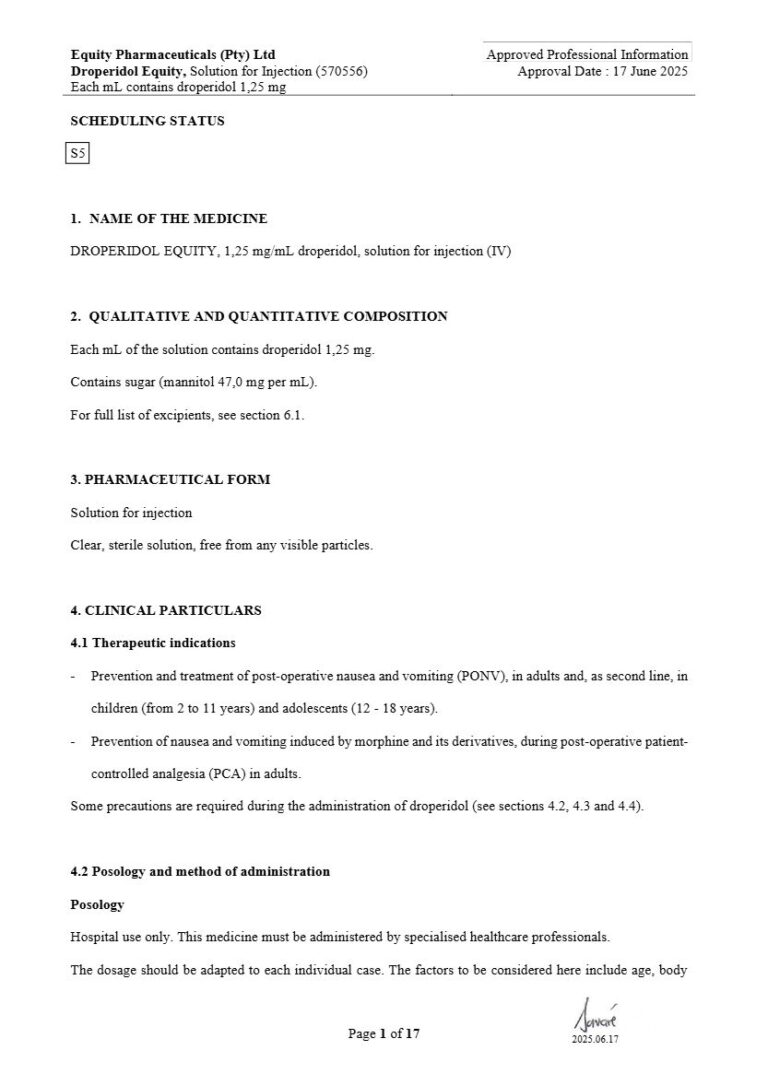
- Prevention and treatment of post-operative nausea and vomiting (PONV), in adults and, as second line, in children (from 2 to 11 years) and adolescents (12 - 18 years).
- Prevention of nausea and vomiting induced by morphine and its derivatives, during post-operative patient-controlled analgesia (PCA) in adults. Some precautions are required during the administration of droperidol (see sections 4.2, 4.3 and 4.4).
4.2 Posology and method of administration
Posology
Hospital use only. This medicine must be administered by specialised healthcare professionals. The dosage should be adapted to each individual case. The factors to be considered here include age, body weight, the use of other medicines, the type of anaesthesia to be used and the surgical or diagnostic procedure involved. Vital signs and ECG should be monitored routinely. To minimise the risk of ventricular dysrhythmia an electrocardiograph (ECG) should be performed and examined for evidence of QT prolongation before any operation commences. ECG monitoring should continue during the surgical or diagnostic procedure and subsequently for a period consistent with best medical judgement, but at least 7 hours after the end of the procedure (see section 4.3 and 4.8).
Prevention and treatment of post-operative nausea and vomiting (PONV):
- Adults 0,625 mg to 1,25 mg (0,5 mL to 1 mL).
- Elderly patients (65 years): 0,625 mg (0,5 mL)
- Renal/hepatic impairment: 0,625 mg (0,5 mL)
- Paediatric population Children (2 to 11 years) and adolescents (12 to 18 years): 10 to 50 microgram/kg (up to a maximum of 1,25 mg).
- Children (below the age of 2 years): not recommended.
Administration of DROPERIDOL EQUITY is recommended 30 minutes before the anticipated end of surgery. Repeat doses may be given every 6 hours as required.
Prevention of nausea and vomiting induced by morphine derivatives during post-operative patient controlled analgesia (PCA):
- Adults: 15 to 50 micrograms droperidol per mg of morphine, up to a maximum daily dose of 5 mg droperidol.
- Elderly (over 65 years), renal and hepatic impairment: no data in patient controlled analgesia (PCA) available.
- Paediatric population Children (2 to 11 years) and adolescents (12 to 18 years): not indicated in patient controlled analgesia (PCA).
Continuous pulse oximetry should be performed in patients with identified or suspected risk of ventricular dysrhythmia and should continue for 30 minutes following single IV administration.
Method of administration
Intravenous route. For instructions on dilution of the medicine before administration, see section 6.6.
4.3 Contraindications
- Hypersensitivity to droperidol, butyrophenones or to any of the excipients of DROPERIDOL EQUITY listed in section 6.1
- Known or suspected QT interval prolongation (QTc > 450 ms in females and > 440 ms in males). This includes patients with congenital long QT syndrome, patients with a family history of congenital QT prolongation and patients treated concomitantly with medicines known for the risk of inducing torsades de pointes through QT prolongation (see section 4.5): Class IA and III anti-dysrhythmic agents (amiodarone, amisulpride, disopyramide, dronedarone, hydroquinidine, quinidine, sotalol), citalopram, escitalopram, cocaine, domperidone, erythromycin administered by intravenous route, hydroxyzine, mequitazine, moxifloxacin, piperaquine, spiramycin, toremifene, vincamine, vandetanib.
- Hypokalaemia or hypomagnesaemia
- Bradycardia (< 55 heartbeats per minute)
- Known concomitant treatment leading to bradycardia
- Phaeochromocytoma
- Comatose states
- Parkinson's Disease
- Severe depression
Combination with dopaminergic agents (amantadine, apomorphine, bromocriptine, cabergoline, entacapone, lisuride, piribedil, pramipexole, quinagolide, rasagiline, ropinirole, rotigotine, selegiline, tolcapone).
4.4 Special warnings and precautions for use
Central Nervous System
DROPERIDOL EQUITY may enhance CNS depression produced by other CNS-depressant medicines. Any patient subjected to anaesthesia and receiving potent CNS depressant medicines or showing symptoms of CNS depression should be monitored closely. Concomitant use of metoclopramide and other neuroleptics may lead to an increase in extrapyramidal symptoms and should be avoided (see section 4.5). Use with caution in patients with epilepsy (or a history of epilepsy) and conditions predisposing to epilepsy or convulsions.
Cardiovascular system
Mild to moderate hypotension and occasionally (reflex) tachycardia have been observed following the administration of droperidol as contained in DROPERIDOL EQUITY. This reaction usually subsides spontaneously. However, should hypotension persist, the possibility of hypovolaemia should be considered, and appropriate fluid replacement administered. Patients with, or suspected of having, the following risk factors for cardiac dysrhythmia should be carefully evaluated prior to administration of DROPERIDOL EQUITY:
- a history of significant cardiac disease including serious ventricular dysrhythmia, second or third degree atrio-ventricular block, sinus node dysfunction, congestive heart failure, ischemic heart disease and left ventricular hypertrophy;
- family history of sudden death;
- renal failure (particularly when on chronic dialysis);
- significant chronic obstructive pulmonary disease and respiratory failure;
- risk factors for electrolyte disturbances, as seen in patients taking laxatives, glucocorticoids, potassium-wasting diuretics, in association with the administration of insulin in acute settings, or in patients with prolonged vomiting and/or diarrhoea.
Patients at risk for cardiac dysrhythmia should have serum electrolytes and creatinine levels assessed and the presence of QT prolongation excluded prior to administration of DROPERIDOL EQUITY. Continuous pulse oximetry should be performed in patients with identified or suspected risk of ventricular dysrhythmia and should continue for 30 minutes following single intravenous administration.
General
To prevent QT prolongation, caution is necessary when patients are taking medicine likely to induce electrolyte imbalance (hypokalaemia and/or hypomagnesaemia) e.g. potassium-wasting diuretics, laxatives and glucocorticoids. Substances inhibiting the activity of cytochrome P450 iso-enzymes (CYP) CYP1A2, CYP3A4 or both could decrease the rate at which droperidol is metabolised and prolong its pharmacological action. Hence, caution is advised if droperidol is given concomitantly with strong CYP 1A2 and CYP3A4 inhibitors (see section 4.5). Patients who have, or are suspected of having, a history of alcohol abuse or recent high intakes, should be thoroughly assessed before droperidol is administered. Taking the following medicines with DROPERIDOL EQUITY, that may induce cardiac rhythm disorders, specifically torsades de pointes, is not recommended (see section 4.5): Arsenic trioxide, antiparasitic medicines likely to induce torsades de pointes (chloroquine, halofantrine, lumefantrine, pentamidine), neuroleptics likely to induce torsades de pointes (chlorpromazine, cyamemazine, flupentixol, fluphenazine, haloperidol, levomepromazine, pimozide, pipamperone, pipotiazine, sulpiride, tiapride, zuclopenthixol), delamanid, crizotinib, hydroxychloroquine, methadone, sulfamethoxazole + trimethoprim. In case of unexplained hyperthermia, it is essential to discontinue treatment, since this sign may be one of the elements of malignant syndrome reported with neuroleptics. Cases of venous thromboembolism (VTE) have been reported with antipsychotic medicines. Since patients treated with antipsychotics often present with acquired risk factors for VTE, all possible risk factors for VTE should be identified before and during treatment with DROPERIDOL EQUITY and preventive measures undertaken. The dose should be reduced in the elderly and those with impaired renal and hepatic function (see section 4.2).
4.5 Interaction with other medicines and other forms of interaction
Contraindicated for concomitant use
Medicines known to cause torsades de pointes through QT prolongation should not be concomitantly administered with DROPERIDOL EQUITY. For example:
- Class IA anti-dysrhythmics e.g., quinidine, hydroquinidine, disopyramide, procainamide
- Class III anti-dysrhythmics e.g., amiodarone, sotalol, dronedarone
- cocaine
- dopaminergic agents (amantadine, apomorphine, bromocriptine, cabergoline, entacapone, lisuride, piribedil, pramipexole, quinagolide, rasagiline, ropinirole, rotigotine, selegiline, tolcapone).
Reciprocal antagonism between the dopaminergic agent and the neuroleptic. Use an anti-emetic devoid of extrapyramidal effects.
- hydroxyzine
- levodopa
- anti-cancer medicine such as toremifene, vandetanib
- vincamine
- macrolide antibiotics e.g., erythromycin, clarithromycin, spiramycin
- fluoroquinolone antibiotics e.g., sparfloxacin, moxifloxacin
- antihistamines e.g., astemizole, terfenadine, mequitazine
- certain antipsychotic medications e.g., chlorpromazine, haloperidol, pimozide, thioridazine, risperidone, sertindole
- anti-malaria medicine e.g., chloroquine, halofantrine, piperaquine
- cisapride, domperidone, methadone, pentamidine, bepridil
- tricyclic antidepressants (such as amitriptyline, citalopram, escitalopram)
- certain tetracyclic antidepressants (such as maprotiline)
Concomitant use of medicines that induce extrapyramidal symptoms, e.g., metoclopramide and other neuroleptics, may lead to an increased incidence of these symptoms and should therefore be avoided. Since droperidol blocks dopamine receptors, it may inhibit the action of dopamine agonists, such as bromocriptine, lisuride, and of L-dopa (see section 4.3).
Concomitant use is not recommended (see section 4.4):
- alcoholic beverages and medicines containing alcohol. Caution is also advised when DROPERIDOL EQUITY is used in patients who have, or are suspected of having, a history of alcohol abuse or recent high intakes, as the risk of dysrhythmia is increased.
- arsenic trioxide
- anti-parasitic medicine e.g., lumefantrine, pentamidine, hydroxychloroquine
- neuroleptic medicine e.g., cyamemazine, flupentixol, fluphenazine, levomepromazine, pipamperone, pipotiazine, sulpiride, tiapride, zuclopenthixol
- crizotinib
- delamanid
- sodium oxybate
- sulfamethoxazole + trimethoprim
Caution is advised for concomitant use
Caution is advised when DROPERIDOL EQUITY is used with any other medication known to prolong the QT interval. This includes:
- anagrelide
- azithromycin, roxithromycin
- beta-blockers in heart failure
- bradycardia-inducing agents
- ciprofloxacin, levofloxacin, norfloxacin
- glasdegib
To reduce the risk of QT prolongation, caution is necessary when patients are taking medicines likely to induce electrolyte imbalance (hypokalaemia and/or hypomagnesaemia) e.g., potassium-wasting diuretics, laxatives and glucocorticoids. Caution is advised for concomitant use of DROPERIDOL EQUITY with lithium and ondansetron. DROPERIDOL EQUITY may potentiate the action of sedatives. This includes barbiturates, benzodiazepines, morphine derivatives (analgesics, antitussives and substitution treatments), neuroleptics, anxiolytics other than benzodiazepines (for example meprobamate), hypnotic agents, sedative antidepressants (amitriptyline, doxepin, mianserine, mirtazapine, trimipramine), sedative H1 antihistamines, central-acting antihypertensive agents, baclofen and thalidomide.
Droperidol as contained in DROPERIDOL EQUITY, may potentiate respiratory depression caused by opioids. Substances inhibiting the activity of cytochrome P450 iso-enzymes (CYP) CYP1A2, CYP3A4 or both could decrease the rate at which droperidol is metabolised and prolong its pharmacological action. Hence, caution is advised if DROPERIDOL EQUITY is given concomitantly with CYP1A2 inhibitors (e.g., ciprofloxacin, ticlopidine), CYP3A4 inhibitors (e.g., diltiazem, erythromycin, fluconazole, indinavir, itraconazole, ketoconazole, nefazodone, nelfinavir, ritonavir, saquinavir, verapamil) or both (e.g., cimetidine, mibefradil).
Concomitant use to be taken into consideration
- aripiprazole
- dapoxetine
- medicines that cause male hypogonadism (abiraterone, apalutamide, bicalutamide, cyproterone, degarelix, dutasteride, enzalutamide, finasteride, flutamide, gosereline, leuprorelin, nilutamide, triptorelin)
- orlistat
Medicines that cause orthostatic hypotension
In addition to antihypertensive agents, many medicines can cause orthostatic hypotension. This is specifically the case of nitrate derivatives, type 5 phosphodiesterase inhibitors, alpha-blockers for urological purposes, imipraminic antidepressants and phenothiazine neuroleptics, dopaminergic agonists and levodopa. Therefore, their joint use with DROPERIDOL EQUITY risks increasing the frequency and intensity of this undesirable effect. Refer to the interactions specific to each group, with the corresponding constraint levels.
Medicines that lower the seizure threshold
Concomitant use of proconvulsant medicines, or that lower the seizure threshold, should be carefully considered, due to the severity of the risk involved. These medicines are represented in particular by the majority of antidepressants (imipraminic, selective serotonin uptake inhibitors), neuroleptics (phenothiazines and butyrophenones), mefloquine, chloroquine, fluoroquinolones, bupropion and tramadol.
4.6 Fertility, pregnancy and lactation
Pregnancy
A limited amount of clinical data has shown no increase of malformative risk. Droperidol has not been shown to be teratogenic in rats. Animal studies are insufficient with respect to the effects on pregnancy and embryonal/foetal, parturition and postnatal development. In newborn babies from mothers under long-term treatment and high doses of neuroleptics, temporary neurological disturbances of extrapyramidal nature have been described. As a precaution, it is best not to administer DROPERIDOL EQUITY during pregnancy. If it is necessary to administer DROPERIDOL EQUITY in late pregnancy, it is recommended to monitor the neurological functions of the newborn.
Breastfeeding
Neuroleptics of the butyrophenone type are known to be excreted in breast milk; treatment with DROPERIDOL EQUITY should be limited to a single administration. Repeated administration is not recommended.
Fertility
The clinical effect of DROPERIDOL EQUITY on fertility has not been established.
4.7 Effects on ability to drive and use machines
DROPERIDOL EQUITY has an important influence on the ability to drive and use machines. Patients should not drive or operate a machine for 24 hours after DROPERIDOL EQUITY administration.
4.8 Undesirable effects
Summary of the safety profile
The most frequently reported events during clinical experience are incidents of drowsiness and sedation. In addition, less frequent reports of hypotension, cardiac dysrhythmias, neuroleptic malignant syndrome (NMS) and symptoms associated with NMS, plus movement disorders, such as dyskinesias, plus incidents of anxiety or agitation have occurred.
Tabulated list of adverse reactions
Blood and lymphatic systems disorders
- Less frequent Blood dyscrasias
Immune system disorders
- Less frequent Anaphylactic reaction, angioneurotic oedema, hypersensitivity
Metabolism and nutrition disorders
- Frequency unknown Inappropriate anti-diuretic hormone secretion
Psychiatric disorders
- Less frequent Anxiety, restlessness/akathisia, confusional states, agitation, dysphoria
- Frequency unknown hallucinations
Nervous system disorders
- Frequent Drowsiness
- Less frequent Dystonia, oculogyration, extrapyramidal disorder, convulsions, tremor
- Frequency unknown Epileptic fits, Parkinson's disease; psychomotor hyperactivity, coma
Cardiac disorders
- Less frequent Tachycardia, dizziness, cardiac dysrhythmias, including ventricular dysrhythmias, cardiac arrest Torsade de pointes, electrogram QT prolongation
Vascular disorders
- Frequent Hypotension
- Frequency unknown Syncope
Respiratory, thoracic and mediastinal disorders
- Frequency unknown Bronchospasm, laryngospasm
Skin and subcutaneous system disorders
- Less frequent Rash
General disorders and administration site conditions
- Less frequent Neuroleptic malignant syndrome (NMS), sudden death Symptoms potentially associated with NMS have been reported i.e., changes in body temperature, stiffness and fever. An alteration in mental status with confusion or agitation and altered consciousness, have been seen. Autonomic instability may manifest as tachycardia, fluctuating blood pressure, excessive sweating/salivation and tremor. In extreme cases NMS may lead to coma, or renal and/or hepato-biliary problems. Isolated cases of amenorrhoea, galactorrhoea, gynaecomastia, hyperprolactinaemia, and oligomenorrhoea have been associated with prolonged exposure in psychiatric indications. Cases of venous thromboembolism, including cases of pulmonary embolism and cases of deep vein thrombosis have been reported with antipsychotic medicines - frequency unknown.
Reporting of suspected adverse reactions
Reporting suspected adverse reactions after authorisation of the medicine is important. It allows continued monitoring of the benefit/risk balance of the medicine. Health care providers are requested to report any suspected adverse reactions to SAHPRA via the Med Safety APP (Medsafety X SAHPRA) and eReporting platform (who-umc.org) found on SAHPRA website.
4.9 Overdose
Symptoms
The manifestations of DROPERIDOL EQUITY overdose are an extension of its pharmacologic actions. Symptoms of accidental overdose are psychic indifference with a transition to sleep, sometimes in association with lowered blood pressure. At higher doses or in sensitive patients, extrapyramidal disorders may occur (salivation, abnormal movements, sometimes muscle rigidity). Convulsions may occur at toxic doses. Cases of QT-interval prolongation, ventricular dysrhythmias and sudden death have been reported rarely.
Treatment
No specific antidote is known. However, when extrapyramidal reactions occur, an anticholinergic should be administered. Patients with DROPERIDOL EQUITY overdose should be closely monitored for signs of QT interval prolongation. Factors which predispose to torsades de pointes, e.g., electrolyte disturbances (especially hypokalaemia or hypomagnesaemia) and bradycardia should be taken into consideration. Pronounced hypotension should be treated by boosting circulation volume and taking other appropriate measures. Clear airways and adequate oxygenation should be maintained; an oropharyngeal airway or endotracheal tube might be indicated. If required, the patient should be observed carefully for 24 hours or longer; body warmth and adequate fluid intake should be maintained.
