
Dutasteride Tamsulosin Adco 0,5 mg/0,4 mg Capsules
PDF Leaflet Revision Date: 08 August 2023
Clinical Summary
Quick overview from the medicine insert
Indication
Treatment of moderate to severe symptoms of benign prostatic hyperplasia (BPH).
Dosage (summary)
One capsule orally after the same meal each day.
Onset of Action / Duration
Onset: 1-2 weeks, Duration: Not specified.
Special Populations
- Renal impairment
- Hepatic impairment
Pregnancy & Breastfeeding
Contraindicated in women; may affect male fetal genital development.
Key Drug Interactions
- CYP3A4 inhibitors
- CYP2D6 inhibitors
- PDE5 inhibitors
Contraindications
- Hypersensitivity
- Women, children, adolescents
- Severe hepatic impairment
- History of orthostatic hypotension
Common side effects
- Dizziness
- Impotence
- Altered libido
- Ejaculation disorders
Counselling Points
- Take after the same meal daily
- Report breast changes
- Avoid contact with leaking capsules
Serious warnings
- Risk of prostate cancer
- Orthostatic hypotension
- Intraoperative Floppy Iris Syndrome
Important Disclaimer
The Dutasteride Tamsulosin Adco 0,5 mg/0,4 mg Capsules professional information leaflet below is the property of Adcock Ingram and is provided on Medinsert exactly as issued, with no.. alterations or editorial changes. We make every effort to keep content current by updating documents as soon as new versions become available. Medinsert serves as a trusted access point for healthcare professionals, but does not replace official sources or clinical judgement. For more details, please read our full disclaimer. read more>>
 Healthcare Professionals Only
This content is for registered healthcare professionals
Sign in or create a free account to read the full package insert.
Free for HPCSA-registered professionals. Powered by Medinsert.
Clinical Particulars
Section 4 of the official insert — extracted exactly as issued, no alterations
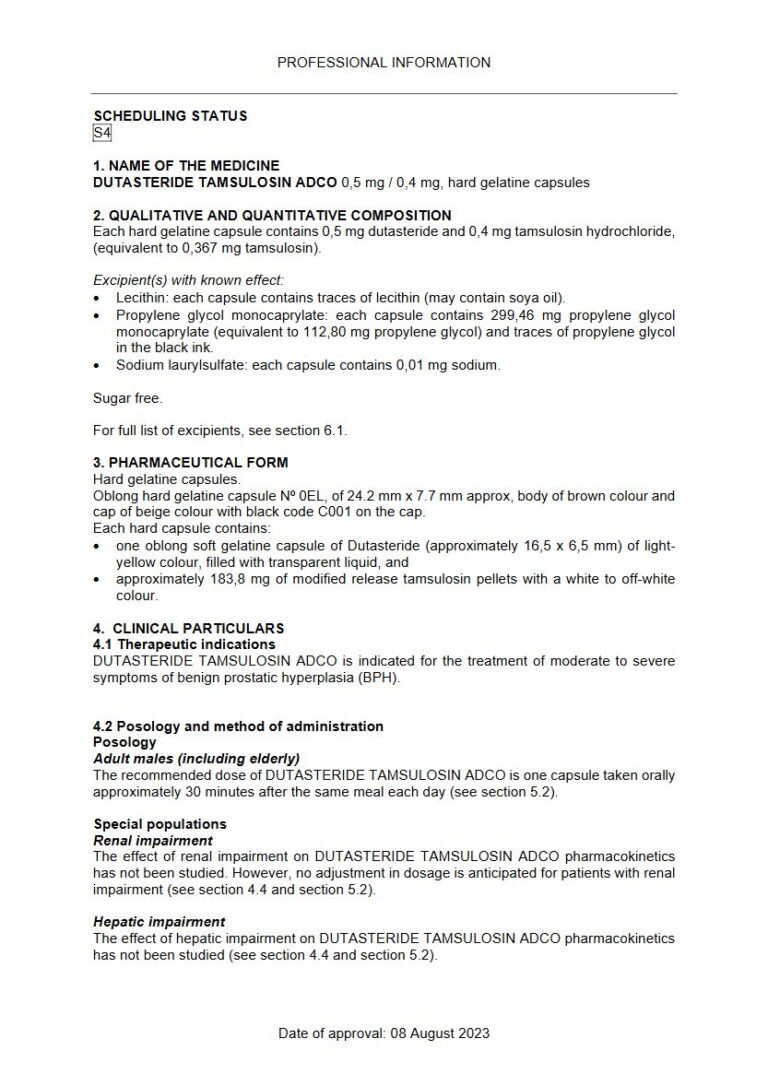
4.1 Therapeutic indications
DUTASTERIDE TAMSULOSIN ADCO is indicated for the treatment of moderate to severe symptoms of benign prostatic hyperplasia (BPH).
4.2 Posology and method of administration
Posology
Adult males (including elderly)
The recommended dose of DUTASTERIDE TAMSULOSIN ADCO is one capsule taken orally approximately 30 minutes after the same meal each day (see section 5.2).
Special populations
Renal impairment
The effect of renal impairment on DUTASTERIDE TAMSULOSIN ADCO pharmacokinetics has not been studied. However, no adjustment in dosage is anticipated for patients with renal impairment (see section 4.4 and section 5.2).
Hepatic impairment
The effect of hepatic impairment on DUTASTERIDE TAMSULOSIN ADCO pharmacokinetics has not been studied (see section 4.4 and section 5.2).
Method of administration
For oral use. The capsules should be swallowed whole and not chewed or opened. Contact with the contents of the dutasteride capsule contained within the hard-shell capsule may result in irritation of the oropharyngeal mucosa.
4.3 Contraindications
- Hypersensitivity to the dutasteride, tamsulosin, other 5-alpha reductase inhibitors, soya, peanut or to any of the excipients of DUTASTERIDE TAMSULOSIN ADCO listed in section 6.1.
- Women, children and adolescents.
- Patients with a history of orthostatic hypotension.
- Patients with severe hepatic impairment.
4.4 Special warnings and precautions for use
Dutasteride is absorbed through the skin, therefore, women and children must avoid contact with leaking capsules (see section 4.6). If contact is made with leaking capsules, the contact area should be washed immediately with soap and water.
Prostate cancer and high-grade tumour
The clinical study investigated the effect of dutasteride 0,5 mg daily on patients with a high risk for prostate cancer (including men 50 to 75 years of age with PSA levels of 2,5 to 10 ng/mL and a negative prostate biopsy 6 months before study enrolment) compared to placebo. Results of this study revealed a higher incidence of Gleason 8 u2013 10 prostate cancers in dutasteride treated men (0,9 %) compared to placebo (0,6 %). The relationship between dutasteride and Gleason 8 u2013 10 prostate cancers is not clear. Thus, men taking DUTASTERIDE TAMSULOSIN ADCO should be regularly evaluated for prostate cancer.
Prostate specific antigen (PSA)
Serum prostate-specific antigen (PSA) concentration is an important component in the detection of prostate cancer. DUTASTERIDE TAMSULOSIN ADCO causes a decrease in mean serum PSA levels by approximately 50 %, after 6 months of treatment. Patients receiving DUTASTERIDE TAMSULOSIN ADCO should have a new PSA baseline established after 6 months of treatment with DUTASTERIDE TAMSULOSIN ADCO. It is recommended to monitor PSA values regularly thereafter. Any confirmed increase from lowest PSA level while on DUTASTERIDE TAMSULOSIN ADCO may signal the presence of prostate cancer or noncompliance to therapy with DUTASTERIDE TAMSULOSIN ADCO and should be carefully evaluated, even if those values are still within the normal range for men not taking a 5-alpha reductase inhibitor. In the interpretation of a PSA value for a patient taking dutasteride, previous PSA values should be sought for comparison.
Treatment with DUTASTERIDE TAMSULOSIN ADCO does not interfere with the use of PSA as a tool to assist in the diagnosis of prostate cancer after a new baseline has been established. Total serum PSA levels return to baseline within 6 months of discontinuing treatment. The ratio of free to total PSA remains constant even under the influence of DUTASTERIDE TAMSULOSIN ADCO. If medical practitioners elect to use percent free PSA as an aid in the detection of prostate cancer in men undergoing DUTASTERIDE TAMSULOSIN ADCO therapy, no adjustment to its value appears necessary.
Digital rectal examination, as well as other evaluations for prostate cancer or other conditions which can cause the same symptoms as BPH, must be performed on patients prior to initiating therapy with DUTASTERIDE TAMSULOSIN ADCO and periodically thereafter.
Cardiovascular adverse events
In clinical studies, the incidence of cardiac failure (a composite term of reported events, primarily cardiac failure and congestive cardiac failure) was higher among subjects taking the combination of dutasteride and an alpha1-adrenoceptor antagonist, primarily tamsulosin, than it was among subjects not taking the combination.
Breast neoplasia
There have been reports of male breast cancer reported in men taking dutasteride in clinical trials and during the post-marketing period. However, epidemiological studies showed no increase in the risk of developing male breast cancer with the use of 5-alpha reductase inhibitors. Medical practitioners should instruct their patients to promptly report any changes in their breast tissue such as lumps or nipple discharge.
Renal impairment
The treatment of patients with severe renal impairment (creatinine clearance of less than 10 mL/min) should be approached with caution as these patients have not been studied.
Hypotension
Orthostatic: A reduction in blood pressure can occur during treatment with tamsulosin, as a result of which, syncope can occur. Patients beginning treatment with DUTASTERIDE TAMSULOSIN ADCO should be cautioned to sit or lie down at the first signs of orthostatic hypotension (dizziness, weakness) until the symptoms have resolved. In order to minimise the potential for developing postural hypotension the patient should be haemodynamically stable on an alpha1-adrenoceptor antagonist prior to initiating use of PDE5 inhibitors.
Symptomatic: Caution is advised when alpha-adrenergic blocking medicines including tamsulosin are co-administered with PDE5 inhibitors (e.g. sildenafil, tadalafil, vardenafil). Alpha 1 -adrenoceptor antagonists and PDE5 inhibitors are both vasodilators that can lower blood pressure. Concomitant use of these two medicine classes can potentially cause symptomatic hypotension (see section 4.5).
Intraoperative Floppy Iris Syndrome
Intraoperative Floppy Iris Syndrome (IFIS, a variant of small pupil syndrome) has been observed during cataract surgery in some patients on or previously treated with tamsulosin. IFIS may increase the risk of eye complications during and after the operation. The initiation of therapy with DUTASTERIDE TAMSULOSIN ADCO in patients for whom cataract surgery is scheduled is therefore not recommended. During pre-operative assessment, cataract surgeons and ophthalmic teams should consider whether patients scheduled for cataract surgery are being or have been treated with DUTASTERIDE TAMSULOSIN ADCO in order to ensure that appropriate measures will be in place to manage the IFIS during surgery. Discontinuing tamsulosin 1 u2013 2 weeks prior to cataract surgery is anecdotally considered helpful, but the benefit and duration of stopping therapy prior to cataract surgery has not yet been established.
4.5 Interactions with other medicines and other forms of interaction
No interaction studies have been performed for DUTASTERIDE TAMSULOSIN ADCO. The following statements reflect the information available on the individual components.
Dutasteride
For information on the decrease of serum PSA levels during treatment with dutasteride and guidance concerning prostate cancer detection, please see section 4.4.
Effects of other medicines on the pharmacokinetics of dutasteride
Dutasteride is mainly eliminated via metabolism. In vitro studies indicate that this metabolism is catalysed by CYP3A4 and CYP3A5. No formal interaction studies have been performed with potent CYP3A4 inhibitors. However, in a population pharmacokinetic study, dutasteride serum concentrations were on average 1,6 to 1,8 times greater, respectively, in a small number of patients treated concurrently with verapamil or diltiazem (moderate inhibitors of CYP3A4 and inhibitors of P-glycoprotein) than in other patients. Long-term combination of dutasteride with medicines that are potent inhibitors of the enzyme CYP3A4 (e.g., ritonavir, indinavir, nefazodone, itraconazole, ketoconazole administered orally) may increase serum concentrations of dutasteride. Further inhibition of 5-alpha reductase at increased dutasteride exposure, is not likely. However, a reduction of the dutasteride dosing frequency can be considered if side effects are noted. It should be noted that in the case of enzyme inhibition, the long half-life may be further prolonged and it can take more than 6 months of concurrent therapy before a new steady state is reached.
Administration of 12 g cholestyramine one hour after a 5 mg single dose of dutasteride did not affect the pharmacokinetics of dutasteride.
Effects of dutasteride on the pharmacokinetics of other medicines
In a small study in healthy men, dutasteride (0,5 mg daily) had no effect on the pharmacokinetics of tamsulosin or terazosin. There was also no indication of a pharmacodynamic interaction in this study. Dutasteride has no effect on the pharmacokinetics of warfarin or digoxin. This indicates that dutasteride does not inhibit/induce CYP2C9 or the transporter P-glycoprotein. In vitro interaction studies indicate that dutasteride does not inhibit the enzymes CYP1A2, CYP2D6, CYP2C9, CYP2C19 or CYP3A4.
Tamsulosin
Concomitant administration of tamsulosin hydrochloride with medicines which can reduce blood pressure, including anaesthetic medicines, PDE5 inhibitors and other alpha 1 -adrenoceptor antagonists could lead to enhanced hypotensive effects. Dutasteride-tamsulosin should not be used in combination with other alpha 1 -adrenoceptor antagonists. Concomitant administration of tamsulosin hydrochloride and ketoconazole (a strong CYP3A4 inhibitor) resulted in an increase of the C max and AUC of tamsulosin hydrochloride by a factor of 2,2 and 2,8 respectively. Concomitant administration of tamsulosin hydrochloride and paroxetine (a strong CYP2D6 inhibitor) resulted in an increase of the C max and AUC of tamsulosin hydrochloride by a factor of 1,3 and 1,6 respectively. A similar increase in exposure is expected in CYP2D6 poor metabolisers as compared to extensive metabolisers when co-administered with a strong CYP3A4 inhibitor. The effects of co-administration of both CYP3A4 and CYP2D6 inhibitors with tamsulosin hydrochloride have not been evaluated clinically, however there is a potential for significant increase in tamsulosin exposure (see section 4.4).
Concomitant administration of tamsulosin hydrochloride (0,4 mg) and cimetidine (400 mg every six hours for six days) resulted in a decrease in the clearance (26 %) and an increase in the AUC (44 %) of tamsulosin hydrochloride. Caution should be used when dutasteride-tamsulosin is used in combination with cimetidine. A definitive medicine interaction study between tamsulosin hydrochloride and warfarin has not been conducted. Results from limited in vitro and in vivo studies are inconclusive. Diclofenac and warfarin, however, may increase the elimination rate of tamsulosin. Caution should be exercised with concomitant administration of warfarin and tamsulosin hydrochloride. No interactions have been seen when tamsulosin hydrochloride was given concomitantly with either atenolol, enalapril, nifedipine or theophylline. Concomitant furosemide brings about a fall in plasma levels of tamsulosin, but as levels remain within the normal range posology need not be adjusted. In vitro neither diazepam nor propranolol, trichlormethiazide, chlormadinon, amitryptyline, diclofenac, glibenclamide and simvastatin changes the free fraction of tamsulosin in human plasma. Neither does tamsulosin change the free fractions of diazepam, propranolol, trichlormethiazide, and chlormadinone.
4.6 Fertility, pregnancy and lactation
DUTASTERIDE TAMSULOSIN ADCO is contraindicated for use by women (see section 4.3). There have been no studies to investigate the effect of DUTASTERIDE TAMSULOSIN ADCO on pregnancy, lactation and fertility. The following statements reflect the information available from studies with the individual components.
Pregnancy
Dutasteride inhibits the conversion of testosterone to dihydrotestosterone and may, if administered to a woman carrying a male foetus, inhibit the development of the external genitalia of the foetus (see section 4.4). Small amounts of dutasteride have been recovered from the semen in subjects receiving dutasteride. It is not known whether a male foetus will be adversely affected if his mother is exposed to the semen of a patient being treated with dutasteride (the risk of which is greatest during the first 16 weeks of pregnancy). When the patient's partner is or may potentially be pregnant it is recommended that the patient avoids exposure of his partner to semen by use of a condom.
Breastfeeding
It is not known whether dutasteride or tamsulosin are excreted in human milk.
Fertility
Dutasteride has been reported to affect semen characteristics (reduction in sperm count, semen volume, and sperm motility) in healthy men. The possibility of reduced male fertility cannot be excluded. Effects of tamsulosin hydrochloride on sperm counts or sperm function have not been evaluated.
4.7 Effects on ability to drive and use machines
No studies on the effects of DUTASTERIDE TAMSULOSIN ADCO on the ability to drive and use machines have been performed. However, patients should be informed about the possible occurrence of symptoms related to orthostatic hypotension such as dizziness when taking DUTASTERIDE TAMSULOSIN ADCO. It is not always possible to predict to what extent DUTASTERIDE TAMSULOSIN ADCO may interfere with the daily activities of a patient. Patients should ensure that they do not engage in the above activities until they are aware of the measure to which DUTASTERIDE TAMSULOSIN ADCO affects them.
4.8 Undesirable effects
Tabulated summary of adverse reactions
System organ class
Adverse reactions
Dutasteride + tamsulosin a
Dutasteride
Tamsulosin c
- Psychiatric disorders
Depression - Frequency not known - - Nervous system disorders
Syncope - - Less frequent
Dizziness Frequent - Frequent
Headache - - Less frequent - Cardiac disorders
Cardiac failure (Composite term 1) Less frequent Less frequent d -
Palpitations - - Less frequent - Vascular disorders
Orthostatic hypotension - - Less frequent - Respiratory, thoracic and mediastinal disorders
Rhinitis - - Less frequent - Gastro-intestinal disorders
Constipation - - Less frequent
Diarrhoea - - Less frequent
Nausea - - Less frequent
Vomiting - - Less frequent - Skin and sub-cutaneous disorders
Angioedema - Frequency not known Less frequent
Localised oedema - Frequency not known -
Stevens-Johnson syndrome - - Less frequent
Urticaria - Frequency not known Less frequent
Rash - Frequency not known Less frequent
Pruritus - Frequency not known Less frequent
Alopecia - Less frequent -
Hypertrichosis - Less frequent - - Reproductive system and breast disorders
Priapism - - Less frequent
Impotence 3 Frequent Frequent b -
Altered (decreased) libido 3 Frequent Frequent b -
Ejaculation disorders 3^ Frequent Frequent b Frequent
Breast disorders 2 Frequent Frequent b -
Testicular pain - Frequency not known -
Testicular swelling - Frequency not known - - General disorders and administration site disorders
Asthenia - - Less frequent
a. Dutasteride + tamsulosin: from CombAT study - the frequencies of these adverse events decrease over time of treatment, from year 1 to year 4.
b. Dutasteride: from BPH monotherapy clinical studies.
c. Tamsulosin: from EU Core Safety Profile for tamsulosin.
d. REDUCE study. 1. Cardiac failure composite term comprised of cardiac failure congestive, cardiac failure, left ventricular failure, cardiac failure acute, cardiogenic shock, left ventricular failure acute, right ventricular failure acute, ventricular failure, cardiopulmonary failure, congestive cardiomyopathy.
2. Includes breast tenderness and breast enlargement.
3. These sexual adverse events are associated with dutasteride treatment (including monotherapy and combination with tamsulosin). These adverse events may persist after treatment discontinuation. The role of dutasteride in this persistence is not known.
^ . Includes semen volume decreased.
Description of selected adverse reactions
Other data
The REDUCE study revealed a higher incidence of Gleason 8-10 prostate cancers in dutasteride treated men compared to placebo (see sections 4.4 and 5.1). Whether the effect of dutasteride to reduce prostate volume, or study related factors, impacted the results of this study has not been established. The following has been reported in clinical trials and post-marketing use: male breast cancer (see section 4.4).
Post marketing data
Adverse events from world-wide post-marketing experience are identified from spontaneous post-marketing reports; therefore, the true incidence is not known.
Tamsulosin (monotherapy)
During post-marketing surveillance, reports of Intraoperative Floppy Iris Syndrome (IFIS), a variant of small pupil syndrome, during cataract surgery have been associated with alpha 1 -adrenoceptor antagonists, including tamsulosin (see section 4.4). In addition, atrial fibrillation, arrhythmia, tachycardia, dyspnoea, epistaxis, vision blurred, visual impairment, erythema multiforme, dermatitis exfoliative, ejaculation disorder, retrograde ejaculation, ejaculation failure and dry mouth have been reported in association with tamsulosin use. The frequency of events and the role of tamsulosin in their causation cannot be reliably determined.
Reporting of suspected adverse reactions
Reporting suspected adverse reactions after authorisation of the medicine is important. It allows continued monitoring of the benefit/risk balance of the medicine. Health care professionals are asked to report any suspected adverse reactions to SAHPRA via the u201c6.04 Adverse Drug Reaction Reporting Formu201d, found online under SAHPRAu2019s publications: https://www.sahpra.org.za/Publications/Index/ 8.
4.9 Overdose
No data are available with regard to overdosage of DUTASTERIDE TAMSULOSIN ADCO. The following statements reflect the information available on the individual components.
Dutasteride
There is no specific antidote for dutasteride, therefore, in suspected overdosage symptomatic and supportive treatment should be given as appropriate.
Tamsulosin
Acute overdose with 5 mg tamsulosin hydrochloride has been reported. Acute hypotension (systolic blood pressure 70 mm Hg), vomiting and diarrhoea were observed which were treated with fluid replacement and the patient could be discharged the same day. In case of acute hypotension occurring after overdosage cardiovascular support should be given. Blood pressure can be restored, and heart rate brought back to normal by lying the patient down. If this does not help then volume expanders, and when necessary, vasopressors could be employed. Renal function should be monitored, and general supportive measures applied. Dialysis is unlikely to be of help as tamsulosin is very highly bound to plasma proteins. Measures, such as emesis, can be taken to impede absorption. When large quantities are involved, activated charcoal and an osmotic laxative, such as sodium sulphate, can be administered.
