
Effortil 10 Mg/1 Ml Injection
PDF Leaflet Revision Date: 27 May 2022
Clinical Summary
Quick overview from the medicine insert
Indication
To correct hypotension in circulatory failure, during anaesthesia, and post-operatively.
Dosage (summary)
Adults: 3 to 6 ampoules daily; Children: varies by age.
Special Populations
- Elderly
- Diabetes
- Cardiac disorders
Pregnancy & Breastfeeding
Contraindicated in first trimester; safety in later trimesters not established; avoid during lactation.
Key Drug Interactions
- Guanethidine
- Mineralocorticoids
- Thyroid hormones
- Sympathomimetics
- MAO inhibitors
Contraindications
- Hypersensitivity
- Thyrotoxicosis
- Phaeochromocytoma
- Narrow-angle glaucoma
- Hypertension
- Coronary heart failure
- Decompensated heart failure
Common side effects
- Headache
- Dizziness
- Tachycardia
- Nausea
Counselling Points
- Avoid driving if experiencing dizziness
- Report any adverse reactions
- Monitor for signs of hypotension
Serious warnings
- Caution in severe cardiovascular disorders
- May cause positive doping test results
Important Disclaimer
The Effortil 10 Mg/1 Ml Injection professional information leaflet below is the property of Pharmaco Distribution and is provided on Medinsert exactly as issued, with no.. alterations or editorial changes. We make every effort to keep content current by updating documents as soon as new versions become available. Medinsert serves as a trusted access point for healthcare professionals, but does not replace official sources or clinical judgement. For more details, please read our full disclaimer. read more>>
 Healthcare Professionals Only
This content is for registered healthcare professionals
Sign in or create a free account to read the full package insert.
Free for HPCSA-registered professionals. Powered by Medinsert.
Clinical Particulars
Section 4 of the official insert — extracted exactly as issued, no alterations
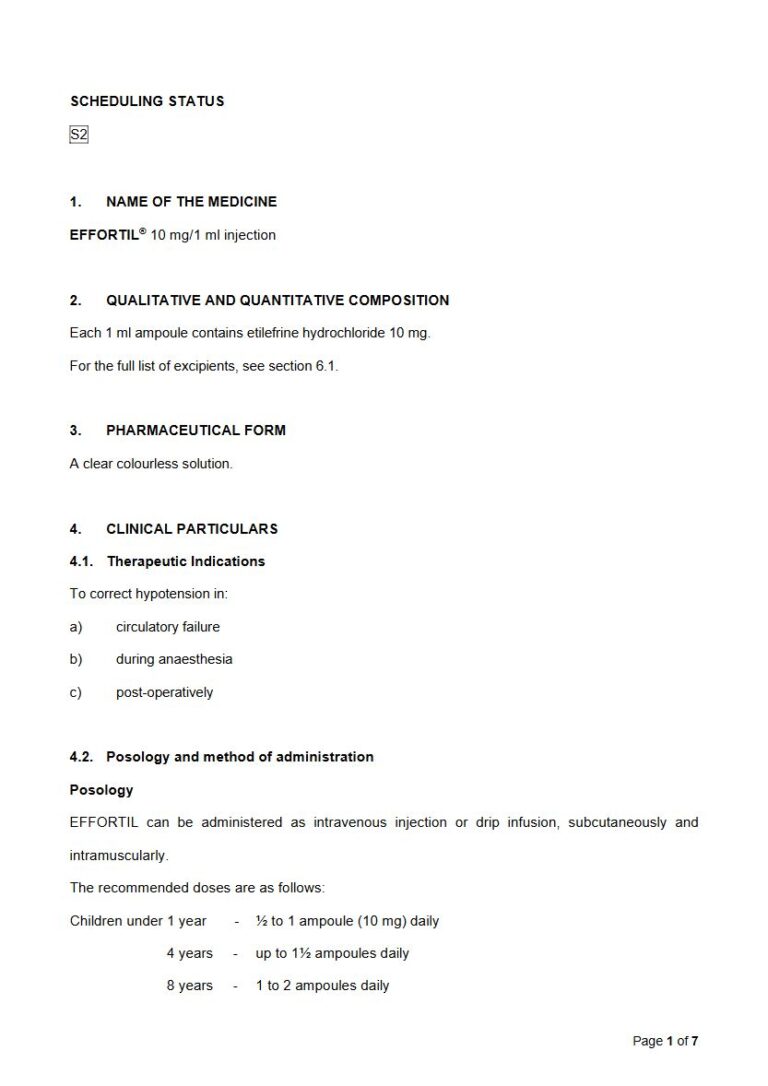
4.1. Therapeutic Indications
To correct hypotension in:
- circulatory failure
- during anaesthesia
- post-operatively
4.2. Posology and method of administration
Posology
EFFORTIL can be administered as intravenous injection or drip infusion, subcutaneously and intramuscularly. The recommended doses are as follows:
- Children under 1 year - u00bd to 1 ampoule (10 mg) daily
- 4 years - up to 1u00bd ampoules daily
- 8 years - 1 to 2 ampoules daily
- 13 years - 1u00bd to 3 ampoules daily
- Adults - 3 to 6 ampoules daily
For infusion physiological saline solution, lactated Ringeru2019s solution, 5 % glucose solution or 10 % xylitol solution without any further additives should be used.
4.3. Contraindications
- Hypersensitivity to the active substance (etilefrine) or to any of the excipients listed in section 6.1.
- Thyrotoxicosis
- Phaeochromocytoma
- Narrow-angle glaucoma
- Prostatic hypertrophy or prostatic adenoma with urinary retention
- Hypertension
- Coronary heart failure
- Hypertrophic obstructive cardiomyopathy
- Hypotensive dysregulation (produce for a patient a hypertensive reaction upon standing)
- The first trimester of pregnancy (see section 4.6)
- Lactation (see section 4.6)
- Decompensated heart failure
- Stenosis of the heart valves or central arteries
4.4. Special warnings and precautions for use
Stenosis of the heart valves or central arteries must be ruled out as a cause of hypotension before starting treatment with EFFORTIL. Caution should be exercised in patients with tachycardia, cardiac arrhythmias or severe cardiovascular disorders, diabetes (see section 4.5) or hyperthyroidism. The product can cause positive results in athlete doping tests.
4.5. Interaction with other medicines and other forms of interaction
- The effects of EFFORTIL may be enhanced by concomitant use of guanethidine, mineralocorticoids, reserpine, thyroid hormones, other sympathomimetics or any substance with sympathomimetic activity such as tricyclic antidepressants, MAO inhibitors, antihistamines.
- Halogenated aliphatic hydrocarbons in inhalational anaesthetics and cardiac glycosides in higher doses may enhance the effects of sympathomimetic agents on the heart and thus lead to the development of cardiac arrhythmias.
- Dihydroergotamine increases the enteral absorption of EFFORTIL and thereby enhances its action.
- Atropine may lead to an enhanced effect of EFFORTIL and to an increased heart rate.
- Adrenergic blocking agents (u03b1-blockers and u03b2-blockers) may partially or completely abolish the effects of etilefrine. Treatment with u03b2-blockers can induce reflex bradycardia.
- The blood sugar lowering effect of antidiabetic medication may be decreased (see section 4.4).
4.6. Fertility, pregnancy and lactation
Pregnancy
EFFORTIL is contraindicated during the first trimester of pregnancy (see section 4.3). Safety of its use during the second and third trimesters has not yet been established. EFFORTIL may impair uteroplacental perfusion and cause uterine relaxation.
Breastfeeding
Entering of the drug into breast milk cannot be excluded, therefore EFFORTIL should not be administered during lactation (see section 4.3).
Fertility
No studies on the effects on human fertility have been conducted.
4.7. Effects on ability to drive and use machines
No studies on the effects on the ability to drive and use machines have been performed. However, patients should be advised that they may experience undesirable effects such as dizziness during treatment. Therefore, caution should be recommended when driving or operating machinery. If patients experience the above-mentioned side effects, they should avoid potentially hazardous tasks such as driving or operating machinery.
4.8. Undesirable effects
Within each frequency grouping, adverse reactions are presented in order of decreasing seriousness: Very common (u2265 1/10); common (u2265 1/100 to < 1/10); uncommon (u2265 1/1 000 to < 1/100); rare (u2265 1/10 000 to < 1/1 000); very rare (< 1/10 000); not known (cannot be estimated from the available data).
Immune system disorders
- Not known: Hypersensitivity (allergic reaction)
Psychiatric disorders
- Uncommon: Anxiety, insomnia
Nervous system disorders
- Common: Headache, a sensation of pressure in the head
- Uncommon: Restlessness, dizziness, tremor
Cardiac disorders
- Uncommon: Tachycardia, palpitations, cardiac arrhythmia
- Not known: anginal pain (angina pectoris), unwanted increase in blood pressure
Gastrointestinal disorders
- Uncommon: Nausea
General disorders and administration site conditions
- Not known: Sweating (hyperhidrosis)
The dose of EFFORTIL should be reduced in patients experiencing these symptoms.
4.9. Overdose
Symptoms
Acute overdosage or excessively rapid intravenous injection intensifies the adverse effects previously described. In addition, agitation and vomiting may occur. In babies and small children, overdosage may cause central respiratory paralysis and coma.
Treatment
Symptomatic and supportive treatment should be given as appropriate. Intensive care measures should be taken in cases of severe overdosage. Symptoms which are due to u03b21-sympathomimetic activity may be treated with u03b2-blockers administered in accordance with the usual therapeutic guidelines for this class of medicines.
