
Epipen Auto-Injector And Junior Auto-Injector 0,3 mg Solution
PDF Leaflet Revision Date: 07 September 2022
Clinical Summary
Quick overview from the medicine insert
Indication
Emergency treatment of severe anaphylactic reactions.
Dosage (summary)
EPIPEN 0.3 mg for patients u226530 kg; EPIPEN JUNIOR 0.15 mg for patients 15-30 kg.
Special Populations
- Elderly
- Pregnant women
- Children under 25 kg
Pregnancy & Breastfeeding
First-line treatment for anaphylaxis; use as in non-pregnant patients.
Key Drug Interactions
- Cardiac glycosides
- Beta-blockers
- Tricyclic antidepressants
Common side effects
- Palpitations
- Tachycardia
- Hypertension
- Nausea
- Vomiting
Counselling Points
- Seek immediate medical help after use
- Educate caregivers on administration
- Inspect solution for discoloration
Serious warnings
- Injection-related complications
- Risk of serious infections
- Cerebral hemorrhage from overdose
Important Disclaimer
The Epipen Auto-Injector And Junior Auto-Injector 0,3 mg Solution professional information leaflet below is the property of Viatris Healthcare and is provided on Medinsert exactly as issued, with no.. alterations or editorial changes. We make every effort to keep content current by updating documents as soon as new versions become available. Medinsert serves as a trusted access point for healthcare professionals, but does not replace official sources or clinical judgement. For more details, please read our full disclaimer. read more>>
 Healthcare Professionals Only
This content is for registered healthcare professionals
Sign in or create a free account to read the full package insert.
Free for HPCSA-registered professionals. Powered by Medinsert.
Clinical Particulars
Section 4 of the official insert — extracted exactly as issued, no alterations
4.1 Therapeutic indications
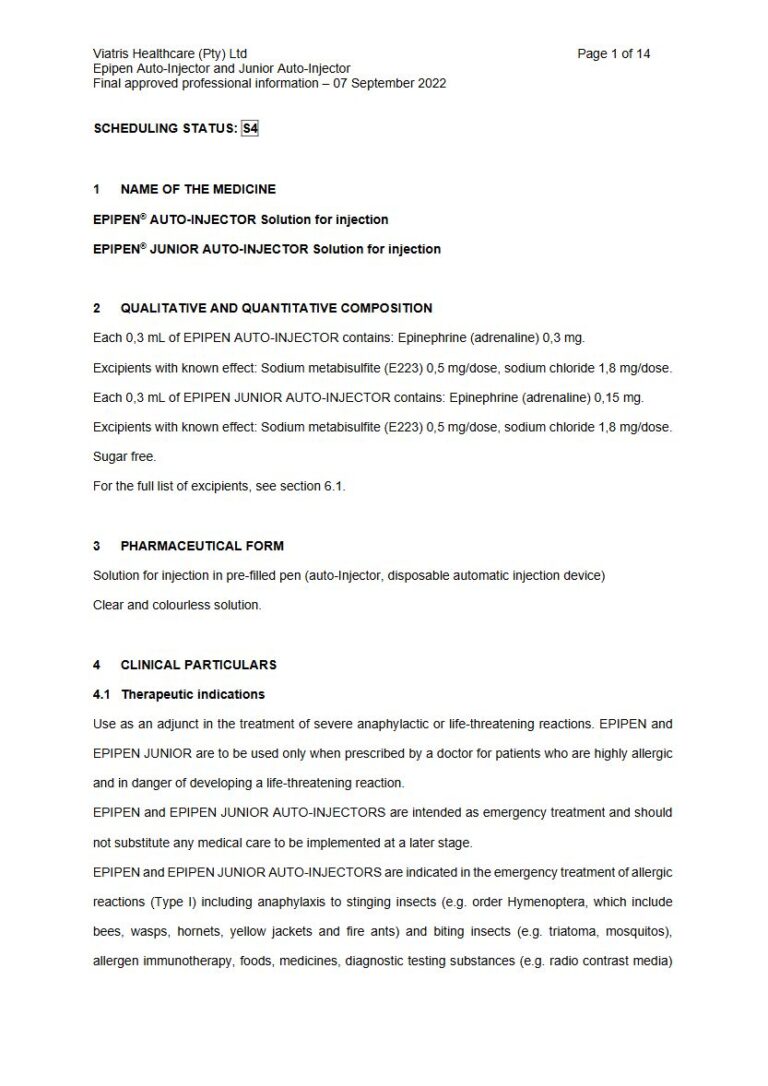
Use as an adjunct in the treatment of severe anaphylactic or life-threatening reactions. EPIPEN and EPIPEN JUNIOR are to be used only when prescribed by a doctor for patients who are highly allergic and in danger of developing a life-threatening reaction.
EPIPEN and EPIPEN JUNIOR AUTO-INJECTORS are intended as emergency treatment and should not substitute any medical care to be implemented at a later stage. EPIPEN and EPIPEN JUNIOR AUTO-INJECTORS are indicated in the emergency treatment of allergic reactions (Type I) including anaphylaxis to stinging insects (e.g. order Hymenoptera, which include bees, wasps, hornets, yellow jackets and fire ants) and biting insects (e.g. triatoma, mosquitos), allergen immunotherapy, foods, medicines, diagnostic testing substances (e.g. radio contrast media) and other allergens, as well as idiopathic anaphylaxis or exercise-induced anaphylaxis.
EPIPEN and EPIPEN JUNIOR AUTO-INJECTORS are intended for immediate administration in patients, who are determined to be at increased risk for anaphylaxis, including individuals with a history of anaphylactic reactions. Anaphylactic reactions may occur within minutes after exposure and consist of flushing, apprehension, syncope, tachycardia, thready or unobtainable pulse with a fall in blood pressure, convulsions, vomiting, diarrhoea and abdominal cramps, involuntary voiding, wheezing, dyspnoea due to laryngeal spasm, pruritus, rashes, urticaria or angioedema. EPIPEN and EPIPEN JUNIOR AUTO-INJECTORS are intended for immediate self-administration as emergency supportive therapy only and are not a substitute for immediate medical care.
4.2 Posology and method of administration
Posology
EPIPEN or EPIPEN JUNIOR should be administered immediately in the case of the development of a life-threatening reaction. Selection of the appropriate dosage strength (EPIPEN 0,3 mg or EPIPEN JUNIOR 0,15 mg) is determined according to patient body weight.
- Patients greater than or equal to 30 kg: EPIPEN 0,3 mg
- Patients 15 to 30 kg: EPIPEN JUNIOR 0,15 mg
The medical practitioner should consider using other forms of injectable epinephrine (adrenaline) if lower doses are felt to be necessary for small children. An initial dose should be administered as soon as symptoms of anaphylaxis are recognised. In the absence of clinical improvement or if deterioration occurs after the initial treatment, a second injection with an additional EPIPEN AUTO INJECTOR may be administered 5 u2013 15 minutes after the first injection. It is recommended that patients are prescribed two EPIPEN AUTO INJECTORS which they should carry at all times. As EPIPEN AUTO INJECTOR is designed as emergency treatment only, the patient should be advised to always seek medical help immediately.
Method of administration
EPIPEN and EPIPEN JUNIOR are for single dose administration only and the unused portion must be discarded. Inject EPIPEN or EPIPEN JUNIOR intramuscularly or subcutaneously into the anterolateral aspect of the thigh, through clothing if necessary. Instruct caregivers of young children who are prescribed an EPIPEN or EPIPEN JUNIOR and who may be uncooperative and kick or move during an injection to hold the leg firmly in place and limit movement prior to and during an injection (see section 4.4). Each EPIPEN or EPIPEN JUNIOR contains a single dose of epinephrine for single-use injection. Since the doses of epinephrine delivered from EPIPEN or EPIPEN JUNIOR are fixed, consider using other forms of injectable epinephrine if doses lower than 0,15 mg are deemed necessary. The prescriber should carefully assess each patient to determine the most appropriate dose of epinephrine, recognizing the life-threatening nature of the reactions for which EPIPEN or EPIPEN JUNIOR is indicated. With severe persistent anaphylaxis, repeat injections with an additional EPIPEN or EPIPEN JUNIOR may be necessary. More than two sequential doses of epinephrine should only be administered under direct medical supervision (see section 4.4). The epinephrine solution in the clear window of the EPIPEN AUTO-INJECTOR should be inspected visually for particulate matter and discoloration. Epinephrine is light sensitive and should be stored in the carrier tube provided to protect it from light. Never put thumb, fingers or hand over orange tip. The needle comes out of the orange tip. Do not remove blue safety release until ready to use. A dose of 0,3 mL (0,23 u2013 0,37 mL) injection fluid is automatically injected intramuscularly by the auto-injector. Grasp unit with the orange tip pointing downward, form a fist around the unit (orange tip down). With your other hand, pull off the blue safety release. Hold the orange tip near outer thigh. DO NOT INJECT INTO BUTTOCK. Take the shaft firmly in the hand with the orange plastic tip directed to the upper thigh whilst pushing hard against the skin until the mechanism releases the injection needle. The device should be held in position for at least 3 seconds. Remove the unit from thigh (the orange needle cover will extend to cover needle). After this the device is removed from the thigh and the injection area massaged for 10 seconds. A clinical practitioner should be consulted as soon as possible, and the used device taken along if you need a second injection. Intravascular injection should be avoided at all costs.
4.3 Contraindications
There are no absolute contraindications to the use of EPIPEN and EPIPEN JUNIOR AUTO-INJECTORS in a life-threatening situation.
4.4 Special warnings and precautions for use
All patients who are prescribed EPIPEN and EPIPEN JUNIOR should be thoroughly instructed to understand the indications for use and the correct method of administration. It is strongly advised also to educate the patient's immediate associates (e.g. parents, caregivers, teachers) for the correct usage of EPIPEN and EPIPEN JUNIOR in case support is needed in the emergency situation.
Emergency treatment
EPIPEN and EPIPEN JUNIOR AUTO-INJECTORS are intended for immediate administration as emergency supportive therapy and are not intended as a substitute for immediate medical care. In conjunction with the administration of epinephrine, the patient should seek immediate medical or hospital care.
Injection-related complications
EPIPEN and EPIPEN JUNIOR AUTO-INJECTORS should only be injected into the anterolateral aspect of the thigh (see section 4.2).
- Do not inject intravenously. Large doses or accidental intravenous injection of EPIPEN or EPIPEN JUNIOR may result in cerebral haemorrhage due to sharp rise in blood pressure. Rapidly acting vasodilators can counteract the marked pressor effects of epinephrine (adrenaline) if there is such inadvertent administration.
- Do not inject into buttock. Injection into the buttock may not provide effective treatment of anaphylaxis. Advise the patient to go immediately to the nearest emergency room for further treatment of anaphylaxis. Additionally, injection into the buttock has been associated with clostridial infections (gas gangrene). Cleansing with alcohol does not kill bacterial spores, and therefore, does not lower this risk.
- Do not inject into digits, hands or feet. Since epinephrine is a strong vasoconstrictor, should the patient accidentally inject him or herself, in the hands, feet, fingers or toes; immediate hospitalization together with the appropriate treatment is recommended.
Hold leg firmly during injection. Lacerations, bent needles, and embedded needles have been reported when EPIPEN and EPIPEN JUNIOR have been injected into the thigh of young children who are uncooperative and kick or move during an injection. To minimize the risk of injection related injury when administering EPIPEN to young children, instruct caregivers to hold the childu2019s leg firmly in place and limit movement prior to and during injection. In patients with a thick subcutaneous fat layer, there is risk for adrenaline not reaching the muscle tissue resulting in a suboptimal effect (see section 5.2). A second injection with an additional EPIPEN may be needed (see section 4.2).
Serious infections at the injection site
Rare cases of serious skin and soft tissue infections, including necrotizing fasciitis and myonecrosis caused by Clostridia (gas gangrene), have been reported at the injection site following epinephrine injection for anaphylaxis. Clostridium spores can be present on the skin and introduced into the deep tissue with subcutaneous or intramuscular injection. While cleansing with alcohol may reduce presence of bacteria on the skin, alcohol cleansing does not kill Clostridium spores. To decrease the risk of Clostridium infection, do not inject EPIPEN into the buttock. Advise patients to seek medical care if they develop signs or symptoms of infection, such as persistent redness, warmth, swelling, or tenderness, at the epinephrine injection site.
Allergic reactions associated with sulfite
The presence of a sulfite in this medicine should not deter administration of the medicine for treatment of serious allergic or other emergency situations even if the patient is sulfite-sensitive. Epinephrine (adrenaline) is the preferred treatment for serious allergic reactions or other emergency situations even though EPIPEN and EPIPEN JUNIOR AUTO-INJECTORS contains sodium metabisulfite, a sulfite that may, in other products, cause allergic-type reactions including anaphylactic symptoms or life-threatening or less severe asthmatic episodes in certain susceptible persons. Patients with concomitant asthma may be at increased risk of a severe anaphylactic reaction.
The alternatives to using EPIPEN and EPIPEN JUNIOR AUTO-INJECTORS in a life-threatening situation may not be satisfactory.
Disease interactions
Some patients may be at greater risk for developing adverse reactions after epinephrine administration. Despite these concerns, it should be recognized that the presence of these conditions is not a contraindication to epinephrine administration in an acute, life-threatening situation. Therefore, patients with these conditions, and/or any other person who might be in a position to administer EPIPEN or EPIPEN JUNIOR to a patient experiencing anaphylaxis should be carefully instructed in regard to the circumstances under which epinephrine should be used.
Patients with heart disease
EPIPEN and EPIPEN JUNIOR AUTO-INJECTORS should be administered with caution in patients who have heart disease, including patients with cardiac dysrhythmias, coronary artery or organic heart disease, or hypertension. In such patients, or in patients who are on medicines that may sensitise the heart to dysrhythmias e.g. digitalis, diuretics, or anti-dysrhythmics, administration of EPIPEN or EPIPEN JUNIOR AUTO-INJECTORS may precipitate or aggravate angina pectoris as well as produce ventricular dysrhythmias.
Other patients and diseases
Epinephrine should be administered with caution to patients with hyperthyroidism, diabetes, elderly individuals, pregnant women and children under 25 kg body weight as they may theoretically be at greater risk of developing adverse reactions. There is a risk of adverse reactions following epinephrine (adrenaline) administration in patients with high intraocular pressure, severe renal impairment, prostatic adenoma leading to residual urine, hypercalcaemia and hypokalaemia. Patients with Parkinsonu2019s disease may notice a transient worsening of symptoms. The epinephrine (adrenaline) solution should be checked every 14 days to make sure the solution in the autoinjector is clear and colourless. Replace the auto-injector if the solution is discoloured (pinkish or brown colour), cloudy, or contains particles. The patient/caregiver should be informed about the possibility of biphasic anaphylaxis which is characterized by initial resolution followed by recurrence of symptoms some hours later. Patients should be warned regarding related allergens and should be investigated whenever possible so that their specific allergens can be characterized. Children under 15 kg in body weight should be carefully monitored for signs of epinephrine (adrenaline) overdosage (see section 4.9).
4.5 Interaction with other medicines and other forms of interaction
Patients who receive EPIPEN or EPIPEN JUNIOR while concomitantly taking cardiac glycosides, diuretics, or anti-dysrhythmics (including digitalis and quinidine) should be observed carefully for the development of cardiac dysrhythmias. The effects of EPIPEN and EPIPEN JUNIOR may be potentiated by tricyclic antidepressants, monoamine oxidase inhibitors, thyroid hormones (such as levothyroxine sodium), catechol-O-methyl-transferase inhibitors (COMT-inhibitors), theophylline, oxytocin, parasympatholytics, levodopa, alcohol and certain antihistamines, notably chlorpheniramine, tripelennamine and diphenhydramine. The cardio-stimulating and bronchodilating effects of EPIPEN and EPIPEN JUNIOR are antagonised by beta-adrenergic blocking medicines, such as propranolol. The vasoconstricting and hypertensive effects of EPIPEN and EPIPEN JUNIOR are antagonized by rapidly acting vasodilators or alpha-adrenergic blocking medicines, such as phentolamine. If prolonged hypotension follows such measures, it may be necessary to administer another pressor medicine, such as levarterenol. Ergot alkaloids may also reverse the pressor effects of EPIPEN and EPIPEN JUNIOR. Epinephrine (adrenaline) inhibits the secretion of insulin, thus increasing the blood glucose level. It may be necessary for diabetic patients receiving epinephrine (adrenaline) to increase their dosage of insulin or oral hypoglycaemic medicines. The u03b2 - stimulating effect can be inhibited by simultaneous treatment with u03b2 -blocking medicines.
4.6 Fertility, pregnancy and lactation
Pregnancy
There are no adequate and well-controlled studies of the acute effect of epinephrine in pregnant women. In animal reproductive studies, epinephrine administered by the subcutaneous route to rabbits, mice and hamsters during the period of organogenesis was teratogenic at doses 7 times and higher than the maximum recommended human intramuscular and subcutaneous dose on a mg/m2 basis. Epinephrine is the first-line medication of choice for the treatment of anaphylaxis during pregnancy in humans. Epinephrine (adrenaline) should be used for treatment of anaphylaxis during pregnancy in the same manner as it is used in non-pregnant patients.
Breastfeeding
There is no information on the presence of epinephrine in human milk, the effects on breastfed infants, or the effects on milk production. Epinephrine (adrenaline) is the first line-medication of choice for treatment of anaphylaxis; it should be used in the same manner in breastfeeding and non-breastfeeding patients.
Fertility
As epinephrine (adrenaline) is a substance that naturally occurs in the body, it is unlikely that this medicine would have any detrimental effect on fertility.
4.7 Effects on ability to drive and use machines
The patient's ability to drive and use machines may be affected by the anaphylactic reaction as well as by possible adverse reactions to epinephrine (adrenaline). Therefore, it is not recommended that patients drive or use machines following the administration of EPIPEN and EPIPEN JUNIOR.
4.8 Undesirable effects
a. Summary of the safety profile
Side effects associated with adrenalineu2019s alpha and beta-receptor activity may include symptoms such as palpitations, tachycardia and hypertension as well as undesirable effects on the central nervous system, sweating, nausea and vomiting, respiratory difficulty, pallor, dizziness, weakness, tremor, headache, apprehension, nervousness and anxiety. Cardiac arrhythmias may follow administration of adrenaline.
Tabulated list of adverse reactions
Frequency u2018Not knownu2019 (Frequency cannot be estimated from the available data)
MedDRA system organ class
Frequency
Adverse reactions
- Infections and infestations
- Frequency not known
- Injection site infection.*
- Endocrine disorders
- Frequency not known
- Hypersalivation, altered metabolism including disturbances of glucose metabolism.
- Psychiatric disorders
- Frequency not known
- Psychotic states, anxiety.
- Nervous system disorders
- Frequency not known
- Fear, restlessness, insomnia, confusion, irritability, headaches, apprehensiveness, dizziness, tremor.
- Cardiac disorders
- Less frequent
- Stress cardiomyopathy.
- Frequency not known
- Tachycardia, cardiac arrhythmias including fatal ventricular fibrillation, anginal pain, palpitations, cardiac arrest, hypotension with dizziness and fainting.
- Vascular disorders
- Less frequent
- Cerebral haemorrhage.
- Frequency not known
- Hypertension, peripheral ischaemia following accidental injection of the pens in hands or feet.
- Respiratory, thoracic and mediastinal disorders
- Frequency not known
- Pulmonary oedema, dyspnoea.
- Gastrointestinal disorders
- Frequency not known
- Loss of appetite, nausea, vomiting.
- Skin and subcutaneous tissue disorders
- Frequency not known
- Hyperhidrosis.
- Musculoskeletal, connective tissue and bone disorders
- Frequency not known
- Tremors, weakness.
- Renal and urinary disorders
- Frequency not known
- Difficulty in micturition, urinary retention.
- General disorders and administrative site conditions
- Frequency not known
- Asthenia, pallor.
Accidental injections can lead to injury at the injection site resulting in bruising, bleeding, discoloration, erythema or skeletal injury. * Less frequent cases of serious skin and soft tissue infections, including necrotizing fasciitis and myonecrosis caused by Clostridia (gas gangrene) are known from post-marketing experience.
Reporting of suspected adverse reactions
Reporting suspected adverse reactions after authorisation of the medicine is important. It allows continued monitoring of the benefit/risk balance of the medicine. Health care providers are asked to report any suspected adverse reactions to SAHPRA via the u201c6.04 Adverse Drug Reactions & Quality Problem Reporting Formu201d, found online under SAHPRAu2019s publications: https://www.sahpra.org.za/wp-content/uploads/2021/05/2.33_Post-Marketing-Reporting-of-ADRs-to-Human-Medicines-in-SA_Version-8_May2021.pdf.
4.9 Overdose
Epinephrine (adrenaline) is rapidly inactivated in the body and treatment of overdosage is symptomatic and supportive. Overdosage of epinephrine (adrenaline) may produce extremely elevated arterial pressure, which may result in cerebrovascular haemorrhage, particularly in elderly patients. Overdosage may also result in fatalities from pulmonary oedema because of peripheral vascular constriction together with cardiac stimulation. Treatment consists of a rapidly acting vasodilators or alpha-adrenergic blocking medicine and/or respiratory support. If prolonged hypotension follows such measures, it may be necessary to administer another pressor medicine such as levarterenol. If an epinephrine (adrenaline) overdose induces pulmonary oedema that interferes with respiration, treatment consists of a rapidly acting alpha-adrenergic blocking medicine such as phentolamine and/or intermittent positive-pressure respiration. Epinephrine (adrenaline) overdosage can also cause transient bradycardia followed by tachycardia and these may be accompanied by potentially fatal cardiac dysrhythmias. Premature ventricular contractions may appear within one minute after injection and may be followed by multifocal ventricular tachycardia (prefibrillation rhythm). Subsidence of the ventricular effects may be followed by atrial tachycardia and occasionally be atrioventricular block. Treatment of dysrhythmias consists of administration of a beta-blocking medicine such as propranolol. Overdosage sometimes results in extreme pallor and coldness of the skin, metabolic acidosis and kidney failure. Suitable corrective measures must be taken in such situations.
