
Adrenaline Fresenius 1mg/1ml injection
PDF Leaflet Revision Date: 10 March 2022
Clinical Summary
Quick overview from the medicine insert
Indication
Treatment of acute allergy and anaphylactic shock.
Dosage (summary)
Adults: 0.2 to 0.5 ml; Children: 0.1 to 0.3 ml.
Special Populations
- Elderly
- Renal impairment
- Hepatic impairment
Pregnancy & Breastfeeding
Use only if benefits justify risks; avoid breastfeeding.
Key Drug Interactions
- Monoamine oxidase inhibitors
- Non-cardioselective beta-blockers
- Halogenated anesthetics
Contraindications
- Hypersensitivity to sympathomimetics
- Ischaemic tissue necrosis risk in extremities
Common side effects
- Tachycardia
- Hypertension
- Anxiety
- Dizziness
Counselling Points
- Monitor continuously after administration.
- Avoid use in fingers/toes due to necrosis risk.
- Educate on signs of overdose.
Serious warnings
- Risk of severe hypertension and dysrhythmias
- Cerebral hemorrhage from IV use
Important Disclaimer
The Adrenaline Fresenius 1mg/1ml injection professional information leaflet below is the property of Fresenius Kabi Manufacturing Sa and is provided on Medinsert exactly as issued, with no.. alterations or editorial changes. We make every effort to keep content current by updating documents as soon as new versions become available. Medinsert serves as a trusted access point for healthcare professionals, but does not replace official sources or clinical judgement. For more details, please read our full disclaimer. read more>>
 Healthcare Professionals Only
This content is for registered healthcare professionals
Sign in or create a free account to read the full package insert.
Free for HPCSA-registered professionals. Powered by Medinsert.
Clinical Particulars
Section 4 of the official insert — extracted exactly as issued, no alterations
4.1 Therapeutic indications
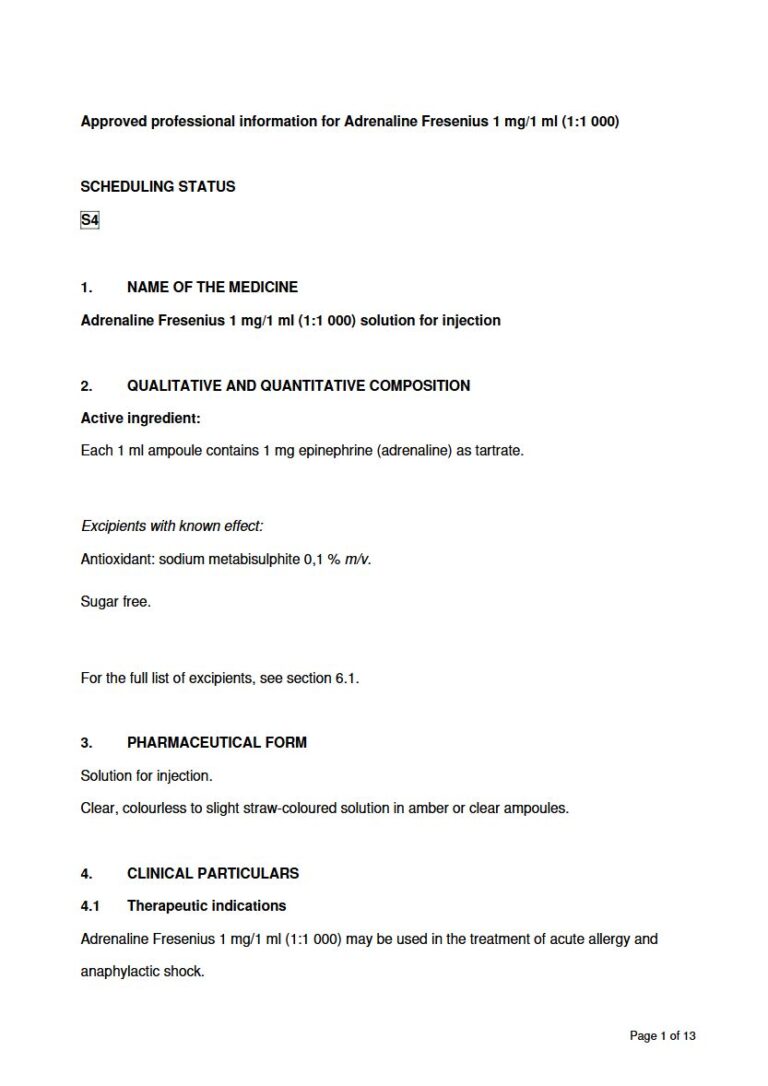
Adrenaline Fresenius 1 mg/1 ml (1:1 000) may be used in the treatment of acute allergy and anaphylactic shock.
4.2 Posology and method of administration
Discard contents if discoloured. By subcutaneous or intramuscular injection.
Adults: 0,2 to 0,5 ml
Children: 0,1 to 0,3 ml
Adults : Bronchodilator : Subcutaneous injection: 0,2 to 0,5 mg every 20 minutes to 4 hours if necessary (maximum of 1 mg per dose).
Anaphylactic reaction: Intramuscular or subcutaneous injection: 0,2 to 0,5 mg repeated every 10 to 15 min if necessary (maximum 1 mg per dose).
Children : Bronchodilator or anaphylactic reactions: Subcutaneous 0,01 mg per kg body weight (maximum of 0,5 mg per dose) every 15 min for 2 doses and then every 4 hours as needed. The patient must be continuously monitored.
Adults : Vasopressor (anaphylactic shock) : 0,1 mg to 0,25 mg (base) administered slowly. May be repeated every five to fifteen minutes as needed.
Children: Vasopressor (anaphylactic shock): 0,01 mg (base) per kg of body weight every five to fifteen minutes as needed, if an inadequate response to IM or SC administration.
4.3 Contraindications
- Hypersensitivity to sympathomimetics, including epinephrine (adrenaline), or to any of the other ingredients of Adrenaline Fresenius 1 mg/1 ml (1:1 000) (see section 6.1).
- Adrenaline Fresenius 1 mg/1 ml (1:1 000) should not be used in fingers, toes, ears, nose or genitalia owing to the risk of ischaemic tissue necrosis.
- Adrenaline is frequently used in emergency situations and any contraindications are therefore relative.
- Adrenaline Fresenius 1 mg/1 ml (1:1 000) interacts with monoamine oxidase inhibitors and should not be given to patients receiving such treatment or within 14 days of its termination.
4.4 Special warnings and precautions for use
Adrenaline Fresenius 1 mg/1 ml (1:1 000) should be used with caution in patients with:
- Parkinsonu2019s disease, hyperthyroidism, psychoneurosis, phaeochromocytoma (diagnosed or suspected), narrow angle glaucoma (or predisposition to), diabetes mellitus, hypokalaemia or hypercalcaemia;
- severe renal impairment, prostatic hypertrophy or urination difficulty;
- cerebrovascular disease, organic brain damage or arteriosclerosis;
- autonomic dysreflexia (hyperreflexia), particularly in spinal cord injury (e.g., tetraplegics);
- shock (other than anaphylactic shock; cardiogenic, traumatic, or haemorrhagic);
- organic heart disease, cardiovascular disease, or cardiac dilatation (severe angina pectoris, obstructive cardiomyopathy, hypertension) as well as most patients with dysrhythmias. Anginal pain may be induced when coronary insufficiency is present;
- congestive heart failure, coronary artery disease, degenerative heart disease, ischaemic heart disease, phenothiazine-induced circulatory collapse or hypotension.
Adrenaline Fresenius 1 mg/1 ml (1:1 000) should be used with caution in older patients.
Epinephrine (adrenaline) should be used with extreme caution in patients with long-standing bronchial asthma and emphysema who have developed degenerative heart disease.
Adrenaline Fresenius 1 mg/1 ml (1:1 000) should be avoided or used with caution in patients undergoing anaesthesia with cyclopropane, halothane, or other halogenated anaesthetics, as they may induce ventricular fibrillation (see section 4.5).
Adrenaline Fresenius 1 mg/1 ml (1:1 000) should not be used during the second stage of labour (see section 4.6).
Accidental intravascular (IV) injection may result in cerebral haemorrhage due to the sudden rise in blood pressure. The intramuscular (IM) route is generally preferred in the initial treatment of anaphylaxis, the IV route is generally more appropriate in the Intensive Care Unit or Emergency Department setting. Epinephrine (adrenaline) 1 mg/ml (1:1 000) solution for injection is not suitable for IV use. If the adrenaline 0,1 mg/ml (1:10 000) injection is not available, adrenaline 1 mg/ml (1:1 000) solution must be diluted to 0,1 mg/ml (1:10 000) before IV use. The IV route for injection of adrenaline must be used with extreme caution and is best reserved for specialists familiar with IV use of adrenaline. Monitor the patient as soon as possible (pulse, blood pressure, electrocardiogram (ECG), pulse oximetry) in order to assess the response to epinephrine (adrenaline). The best site for IM injection is the anterolateral aspect of the middle third of the thigh. The needle used for injection needs to be sufficiently long to ensure that the epinephrine (adrenaline) is injected into muscle. Intramuscular injections of Adrenaline Fresenius 1 mg/1 ml (1:1 000) into the buttocks should be avoided because of the risk of tissue necrosis.
Prolonged use of Adrenaline Fresenius 1 mg/1 ml (1:1 000) can result in severe metabolic acidosis (because of elevated blood concentrations of lactic acid), renal necrosis and tachyphylaxis. Adrenaline Fresenius 1 mg/1 ml (1:1 000) contains sodium metabisulphite, which can rarely cause severe hypersensitivity reactions and bronchospasm. The presence of sodium metabisulphite in parenteral Adrenaline Fresenius 1 mg/1 ml (1:1 000) and the possibility of allergic-type reactions should not deter use of the medicine when indicated for the treatment of serious allergic reactions or for other emergency situations.
4.5 Interaction with other medicines and other forms of interaction
Sympathomimetic medicines: Adrenaline Fresenius 1 mg/1 ml (1:1 000) should not be administered concomitantly with other sympathomimetic medicines because of the possibility of additive effects and increased toxicity.
Alpha-adrenergic medicines: The vasoconstrictor and pressor effects of epinephrine (adrenaline), mediated by its alpha-adrenergic action, may be enhanced by concomitant administration of medicines with similar effects, such as ergot alkaloids or oxytocin.
Alpha-adrenergic blocking medicines: Alpha-blockers, such as phentolamine, antagonise the vasoconstriction and hypertension effects of epinephrine (adrenaline). This effect may be beneficial in epinephrine (adrenaline) overdose (see section 4.9). Adrenaline Fresenius 1 mg/1 ml (1:1 000) specifically reverses the antihypertensive effects of adrenergic neurone blockers, such as guanethidine with the risk of severe hypertension.
Beta-adrenergic blocking medicines: Severe hypertension and reflex bradycardia may occur with non-cardioselective beta-blocking medicines, such as propranolol, due to alpha-mediated vasoconstriction. Beta-blockers, especially non-cardioselective medicines, also antagonise the cardiac and bronchodilator effects of epinephrine (adrenaline). Patients with severe anaphylaxis who are taking non-cardioselective beta-blockers may not respond to Adrenaline Fresenius 1 mg/1 ml (1:1 000) treatment.
General anaesthetics: Administration of Adrenaline Fresenius 1 mg/1 ml (1:1 000) in patients receiving halogenated hydrocarbon general anaesthetics that increase cardiac irritability and seem to sensitise the myocardium to epinephrine (adrenaline) may result in dysrhythmias including ventricular premature contractions, tachycardia or fibrillation (see section 4.4).
Antihypertensive medicines: Epinephrine (adrenaline) specifically reverses the antihypertensive effects of adrenergic neurone blockers, such as guanethidine, with the risk of severe hypertension. Adrenaline Fresenius 1 mg/1 ml (1:1 000) increases blood pressure and may antagonise the effects of antihypertensive medicines.
Antidepressant medicines: Tricyclic antidepressants, such as imipramine, inhibit reuptake of directly acting sympathomimetic medicines, and may potentiate the effect of adrenaline, increasing the risk of development of hypertension and cardiac dysrhythmias. Concurrent use or use within 2 weeks of a monoamine oxidase inhibitor increases the risk of adverse events (see section 4.3).
Phenothiazines: Phenothiazines block alpha-adrenergic receptors (see above). Adrenaline Fresenius 1 mg/1 ml (1:1 000) should not be used to counteract circulatory collapse or hypotension caused by phenothiazines; a reversal of the pressor effects of Adrenaline Fresenius 1 mg/1 ml (1:1 000) may result in further lowering of blood pressure.
Other medicines: Adrenaline Fresenius 1 mg/1 ml (1:1 000) should not be used in patients receiving high dosage of other medicines (e.g. cardiac glycosides) that can sensitise the heart to dysrhythmias. Some antihistamines (e.g. diphenhydramine) and thyroid hormones may potentiate the effects of Adrenaline Fresenius 1 mg/1 ml (1:1 000), especially on heart rhythm and rate. Adrenaline Fresenius 1 mg/1 ml (1:1 000) increases the risk of cardiac adverse effects of levodopa. Use of entacapone may potentiate the chronotropic and dysrhythmogenic effects of epinephrine (adrenaline).
Hypokalaemia: The hypokalaemic effect of epinephrine (adrenaline) may be potentiated by other medicines that cause potassium loss, including corticosteroids, potassium-depleting diuretics, aminophylline and theophylline.
Hyperglycaemia: Epinephrine (adrenaline)-induced hyperglycaemia may lead to loss of blood-sugar control in diabetic patients treated with insulin or oral hypoglycaemic medicines.
4.6 Fertility, pregnancy and lactation
Pregnancy: Epinephrine (adrenaline) crosses the placenta. There is some evidence of a slightly increased evidence of congenital abnormalities. Injection of epinephrine (adrenaline) may cause anoxia to the fetus, fetal tachycardia, cardiac irregularities, extrasystoles and louder heart sounds. Epinephrine (adrenaline) usually inhibits spontaneous or oxytocin induced contractions of the pregnant human uterus and may delay the second stage of labour. In dosage sufficient to reduce uterine contractions, the medicine may cause a prolonged period of uterine atony with haemorrhage. For this reason parenteral epinephrine (adrenaline) should not be used during the second stage of labour (see section 4.4). Adrenaline Fresenius 1 mg/1 ml (1:1 000) should only be used during pregnancy if the potential benefits justify the possible risks to the fetus.
Lactation: Epinephrine (adrenaline) is distributed into breast milk. Breastfeeding should be avoided in mothers receiving Adrenaline Fresenius 1 mg/1 ml (1:1 000).
4.7 Effects on ability to drive and use machines
The ability of a patient to drive and use machines may be affected by the anaphylactic reaction, as well as by possible adverse reactions to epinephrine (adrenaline) (see section 4.8).
4.8 Undesirable effects
The adverse events of Adrenaline Fresenius 1 mg/1 ml (1:1 000) mainly relate to the stimulation of both alpha- and beta-adrenergic receptors. The occurrence of undesirable effects depends on the sensitivity of the individual patient and the dose involved.
Immune system disorders: Anaphylaxis, possibly with severe bronchospasm (see section 4.4).
Metabolism and nutrition disorders: Hypokalaemia, metabolic acidosis (see section 4.4). Disturbances of glucose metabolism, inhibition of insulin secretion and hyperglycaemia even with low doses, gluconeogenesis, glycolysis, lipolysis and ketogenesis.
Psychiatric disorders: Psychotic states, anxiety, fear, confusion, irritability, insomnia, restlessness.
Nervous system disorders: Headache, dizziness, tremors. In patients with Parkinsonian syndrome, Adrenaline Fresenius 1 mg/1 ml (1:1 000) increases rigidity and tremor. Subarachnoid haemorrhage and hemiplegia have resulted from hypertension, even following subcutaneous administration of usual doses of Adrenaline Fresenius 1 mg/1 ml (1:1 000).
Cardiac disorders: Disturbances of cardiac rhythm and rate may result in palpitation and tachycardia. There may also be a reflex bradycardia, but stimulation of u03b21-adrenergic receptors of the heart may produce cardiac dysrhythmias, anginal pain and cardiac arrest. Adrenaline Fresenius 1 mg/1 ml (1:1 000) can cause potentially fatal ventricular dysrhythmias including fibrillation, especially in patients with organic heart disease or those receiving other medicines that sensitise the heart to dysrhythmias. Myocardial ischaemia and myocardial infarction have been reported. Epinephrine (adrenaline) causes electrocardiogram (ECG) changes including a decrease in T-wave amplitude in all leads in normal subjects.
In rare cases stress cardiomyopathy has been seen in patients treated with epinephrine (adrenaline).
Vascular disorders: Stimulation of u03b1-adrenergic receptors produces vasoconstriction with resultant hypertension. This vasoconstriction is sometimes sufficiently severe to produce gangrene when Adrenaline Fresenius 1 mg/1 ml (1:1 000) is infiltrated into the digits. The rise in blood pressure may produce cerebral haemorrhage and pulmonary oedema. Coldness of extremities may occur even with small doses of Adrenaline Fresenius 1 mg/1 ml (1:1 000). Bowel necrosis, hypotension with dizziness and fainting, and flushing may occur.
Respiratory, thoracic and mediastinal disorders: Dyspnoea. Pulmonary oedema may occur after excessive doses or in extreme sensitivity.
Gastrointestinal disorders: Dry mouth, reduced appetite, nausea, vomiting, hypersalivation.
Renal and urinary disorders: Difficulty in micturition, urinary retention.
General disorders and administration site conditions: Sweating, weakness, pallor. Extravasation of parenterally-administered catecholamines may result in tissue necrosis and sloughing. Repeated injections of Adrenaline Fresenius 1 mg/1 ml (1:1 000) can cause necrosis as a result of vascular constriction at the injection site. Tissue necrosis may also occur in the extremities, kidneys and liver.
Reporting of suspected adverse reactions: Reporting suspected adverse reactions after authorisation of Adrenaline Fresenius 1 mg/1 ml (1:1 000) is important. It allows continued monitoring of the benefit/risk balance of Adrenaline Fresenius 1 mg/1 ml (1:1 000). Health care providers are asked to report any suspected adverse reactions to SAHPRA via the u201c6.04 Adverse Drug Reactions Reporting Formu201d, found online under SAHPRAu2019s publications: https://www.sahpra.org.za/Publications/Index/8.
4.9 Overdose
Symptoms: See section 4.8. After overdosage or inadvertent intravenous administration of usual intramuscular subcutaneous doses of Adrenaline Fresenius 1 mg/1 ml (1:1 000), systolic and diastolic blood pressure rise sharply; venous pressure also rises. Cerebrovascular or other haemorrhages and hemiplegia may result, especially in elderly patients. Pulmonary oedema may occur. Adrenaline Fresenius 1 mg/1 ml (1:1 000) overdosage causes transient bradycardia followed by tachycardia and may cause other potentially fatal cardiac dysrhythmias. Kidney failure, metabolic acidosis and cold white skin may also occur.
Treatment: Treatment of overdosage is symptomatic and supportive. Because of the short duration of the adverse effects of Adrenaline Fresenius 1 mg/1 ml (1:1 000), due to inactivation in the body, treatment of severe toxic reactions in hypersensitive patients or after overdose is primarily supportive. Prompt injection of a rapidly acting alpha-adrenoceptor blocking medicine, such as phentolamine, followed by a beta blocker, such as propranolol, has been tried to counteract the pressor and dysrhythmogenic effects of Adrenaline Fresenius 1 mg/1 ml (1:1 000); rapidly-acting vasodilators, such as glyceryl trinitrate have also been used.
