
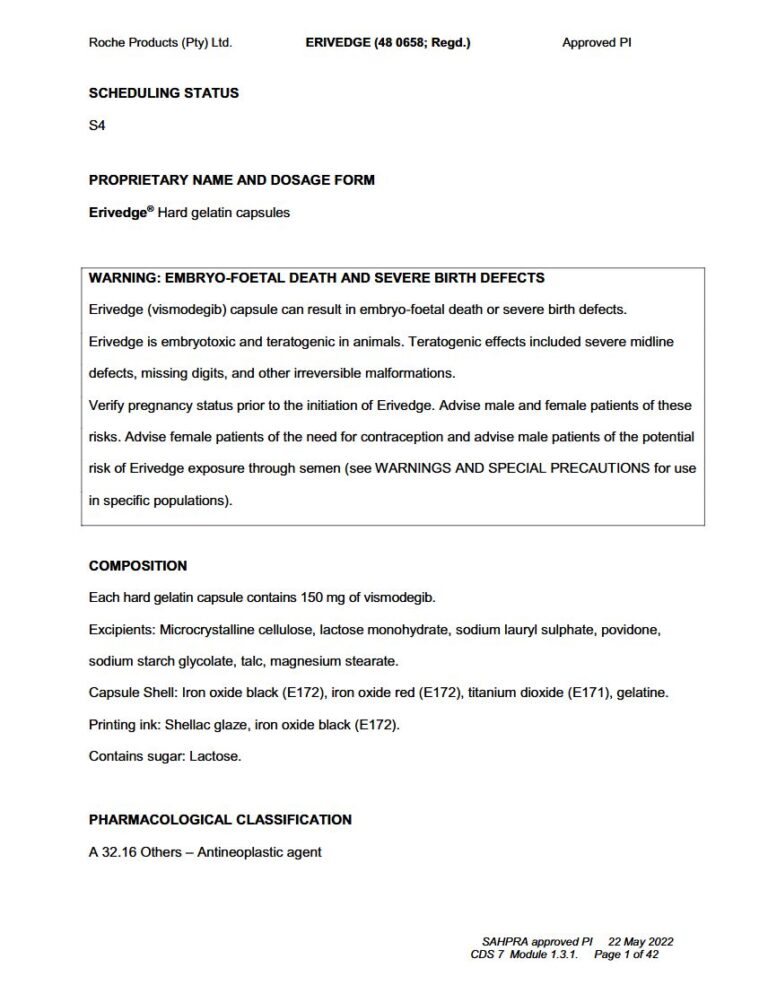
Erivedge 150 mg Hard gelatin capsules
PDF Leaflet Revision Date: 22 May 2022
Clinical Summary
Quick overview from the medicine insert
Indication
Treatment of adult patients with symptomatic metastatic and locally advanced basal cell carcinoma.
Dosage (summary)
150 mg orally once daily.
Special Populations
- Older people
- Renal impairment
- Hepatic impairment
- Paediatric population
Pregnancy & Breastfeeding
Contraindicated in pregnancy and breastfeeding; teratogenic risks.
Key Drug Interactions
- Strong CYP inducers
- P-glycoprotein inhibitors
- CYP2C9 inhibitors
- CYP3A4 inhibitors
Contraindications
- Hypersensitivity to vismodegib
- Pregnancy
- Breastfeeding
- Non-compliance with Pregnancy Prevention Programme
Common side effects
- Muscle spasms
- Alopecia
- Dysgeusia
- Weight decreased
- Fatigue
- Nausea
Counselling Points
- Use effective contraception during treatment and for 24 months after
- Notify healthcare provider of pregnancy or missed periods
- Do not donate blood or semen during and after treatment
Serious warnings
- Embryo-foetal death
- Severe birth defects
- Potential for short stature and tooth deformities in children
Important Disclaimer
The Erivedge 150 mg Hard gelatin capsules professional information leaflet below is the property of Roche Products and is provided on Medinsert exactly as issued, with no.. alterations or editorial changes. We make every effort to keep content current by updating documents as soon as new versions become available. Medinsert serves as a trusted access point for healthcare professionals, but does not replace official sources or clinical judgement. For more details, please read our full disclaimer. read more>>
 Healthcare Professionals Only
This content is for registered healthcare professionals
Sign in or create a free account to read the full package insert.
Free for HPCSA-registered professionals. Powered by Medinsert.
Clinical Particulars
Section 4 of the official insert — extracted exactly as issued, no alterations
4.1 Therapeutic indications
Erivedge is indicated for the treatment of adult patients with:
- symptomatic metastatic basal cell carcinoma
- locally advanced basal cell carcinoma inappropriate for surgery or radiotherapy.
4.2 Posology and method of administration
Erivedge should only be prescribed by or under the supervision of a specialist healthcare professional experienced in the management of the approved indication.
Standard dose: Erivedge is for oral use. The recommended dose is one 150 mg capsule taken once daily, with or without food. The capsules must be swallowed whole with water and must not be opened or crushed under any circumstances. Erivedge should be continued until disease progression or until unacceptable toxicity.
Missed doses: If a dose is missed, patients should be instructed not to take the missed dose but to resume with the next scheduled dose.
Duration of treatment: In clinical trials, treatment with Erivedge was continued until disease progression or until unacceptable toxicity. Treatment interruptions of up to 4 weeks were allowed based on individual tolerability. Benefit of continued treatment should be regularly assessed, with the optimal duration of therapy varying for each individual patient.
4.3 Contraindications
- Hypersensitivity to vismodegib or to any of the excipients of Erivedge.
- Women who are pregnant or breastfeeding (see WARNINGS AND SPECIAL PRECAUTIONS).
- Women of childbearing potential who do not comply with the Erivedge Pregnancy Prevention Programme (see sections WARNINGS AND SPECIAL PRECAUTIONS and PREGNANCY AND LACTATION).
- Co-administration of St. John's wort (Hypericum perforatum) (see INTERACTIONS).
4.4 Special warnings and precautions for use
Embryo-foetal death or severe birth defects: Erivedge may cause embryo-foetal death or severe birth defects when administered to a pregnant woman (see PREGNANCY AND LACTATION). Hedgehog pathway inhibitors, (see PHARMACOLOGICAL ACTION) such as vismodegib, have been demonstrated to be embryotoxic and/or teratogenic in multiple animal species and can cause severe malformations, including craniofacial anomalies, midline defects and limb defects. Erivedge must not be used during pregnancy.
Criteria for a woman of childbearing potential (WCBP): A WCBP is defined in the Erivedge Pregnancy Prevention Programme as:
- a sexually mature female who - has menstruated at any time during the previous 12 consecutive months,
- has not undergone a hysterectomy or a bilateral oophorectomy,
- does not have medically confirmed permanent premature ovarian failure,
- does not have a XY genotype, Turneru2019s syndrome, or uterine agenesis,
- becomes amenorrhoeic following cancer therapy, including treatment with Erivedge.
Counselling: For a WCBP Erivedge is contraindicated in a WCBP who does not comply with the Erivedge Pregnancy Prevention Programme. A WCBP must understand that:
- Erivedge exposes a teratogenic risk to the unborn child,
- She must not take Erivedge if she is pregnant or plans to become pregnant,
- She must have a negative pregnancy test, conducted by a health care provider within 7 days before starting Erivedge treatment,
- She must have a negative pregnancy test monthly during treatment, even if she has become amenorrhoeic,
- She must not become pregnant while taking Erivedge and for 24 months after her final dose,
- She must be able to comply with effective contraceptive measures,
- She must use 2 methods of recommended contraception (see the u2018Contraception' section below and section PREGNANCY AND LACTATION) while she is taking Erivedge, unless she commits to not having sexual intercourse (abstinence),
- She must tell her healthcare provider if any of the following occur during treatment and for 24 months after her final dose:
- If she becomes pregnant or think for any reason that she may be pregnant,
- If she misses her expected menstrual period,
- If she stops using contraception unless she commits to not having sexual intercourse (abstinence),
- If she needs to change contraception during treatment.
- She must not breastfeed while taking Erivedge and for 24 months after the final dose.
4.5 Interactions with other medicines
Concomitant treatment with strong CYP inducers (e.g. rifampicin, carbamazepine or phenytoin) should be avoided, as a risk for decreased plasma concentrations and decreased efficacy of vismodegib cannot be excluded (see also INTERACTIONS).
Effects of concomitant medicinal products on vismodegib: Medicines that alter the pH of the upper gastrointestinal (GI) tract (e.g., proton pump inhibitors, H2-receptor antagonists, and antacids) may alter the solubility of vismodegib and reduce its bioavailability. Patients with achlorhydria would be subject to the same potential effect.
In vitro studies indicate that Erivedge is a substrate of the efflux transporter P-glycoprotein (P-gp) and the drug metabolising enzymes CYP2C9 and CYP3A4. When Erivedge is co-administered with medicines that inhibit P-gp (e.g. clarithromycin, erythromycin, azithromycin, verapamil, cyclosporin), CYP2C9 (amiodarone, fluconazole or miconazole), or CYP3A4 (boceprevir, clarithromycin, conivaptan, indinavir, itraconazole, ketoconazole, lopinavir/ritonavir, nelfinavir, posaconazole, ritonavir, saquinavir, telaprevir, telithromycin, or voriconazole), systemic exposure of Erivedge and incidence of adverse events of Erivedge may be increased. When Erivedge is administered with CYP inducers (rifampicin, carbamazepine, phenytoin, St. Johnu00b4s wort), exposure to Erivedge may be decreased (see CONTRAINDICATIONS and WARNINGS AND SPECIAL PRECAUTIONS).
4.6 Fertility, pregnancy and lactation
Women of childbearing potential (WCBP): Due to the risk of embryo-foetal death or severe birth defects caused by vismodegib, women taking Erivedge must not be pregnant or become pregnant during treatment and for 24 months after the final dose (see sections CONTRAINDICATIONS and WARNINGS AND SPECIAL PRECAUTIONS). Erivedge is contraindicated in WCBP who do not comply with the Erivedge Pregnancy Prevention Programme.
In case of pregnancy or missed menstrual periods: If the patient does become pregnant, misses a menstrual period, or suspects for any reason that she may be pregnant, she must notify her treating doctor immediately. Persistent lack of menses during treatment with Erivedge should be assumed to indicate pregnancy until medical evaluation and confirmation.
Contraception in males and females: Women of childbearing potential (WCBP): WCBP must be able to comply with effective contraceptive measures. She must use two methods of recommended contraception including one highly effective method and a barrier method during Erivedge therapy and for 24 months after the final dose. WCBP, whose periods are irregular or stopped, must follow all the advice on effective contraception.
Men: Erivedge is contained in semen. To avoid potential foetal exposure during pregnancy, male patients must always use a condom (with spermicide, if available), even after a vasectomy, when having sex with a female partner while taking Erivedge and for 6 months after the final dose.
The following are recommended forms of highly effective methods:
- Oral contraceptives,
- Hormonal depot injection,
- Tubal sterilisation,
- Vasectomy,
- Intrauterine device (IUD).
The following are recommended forms of barrier methods:
- Any male condom (with spermicide, if available),
- Diaphragm (with spermicide, if available).
Pregnancy: Erivedge is contraindicated in pregnant women. Erivedge may cause embryo-foetal death or severe birth defects when administered to a pregnant woman (see WARNINGS AND SPECIAL PRECAUTIONS). Hedgehog pathway inhibitors (see PHARMACOLOGICAL ACTION - Pharmacodynamic Properties) such as vismodegib, have been demonstrated to be embryotoxic and/or teratogenic in multiple animal species and can cause severe malformations, including craniofacial anomalies, midline defects and limb defects. In case of pregnancy in a woman treated with Erivedge, treatment must be stopped immediately.
Breastfeeding: The extent to which vismodegib is excreted in breast milk is not known. Due to its potential to cause serious developmental defects women must not breastfeed while taking Erivedge and for 24 months after the final dose (see CONTRAINDICATIONS).
Fertility: Data from studies in rats and dogs indicate that male and female fertility may be irreversibly compromised by treatment with Erivedge (see SIDE EFFECTS). Additionally, amenorrhoea has been observed in clinical trials in WCBP (see SIDE EFFECTS). Fertility preservation strategies should be discussed with WCBP prior to starting treatment with Erivedge.
4.7 Effects on ability to drive and use machines
Erivedge may cause fatigue and muscle pain that may influence the ability to drive and use machines.
4.8 Undesirable effects
The most common adverse drug reactions (ADR), were muscle spasms (74,6 %), alopecia (65,2 %), dysgeusia (57,2 %), weight decreased (48,6 %), fatigue (44,9 %) and nausea (34,8 %). ADRs are presented in Table 2 below by system organ class (SOC) and absolute frequency. Frequencies are defined as: Very common (u2265 1/10); Common (u2265 1/100 to < 1/10); Uncommon (u2265 1/1 000 to < 1/100); Rare (u2265 1/10 000 to < 1/1 000) and Very rare (< 1/10 000). Within each frequency grouping, ADRs are presented in the order of decreasing seriousness. The safety of Erivedge has been evaluated in clinical trials with 138 patients treated for advanced basal cell carcinoma (aBCC), which includes both metastatic BCC (mBCC) and locally advanced BCC (laBCC). In general the safety profile observed was consistent in both mBCC and laBCC patients as described below.
4.9 Overdose
Erivedge has been administered at doses 3,6 times higher than the recommended 150 mg daily dose. No increases in plasma vismodegib levels or toxicity were observed during these clinical trials.
