
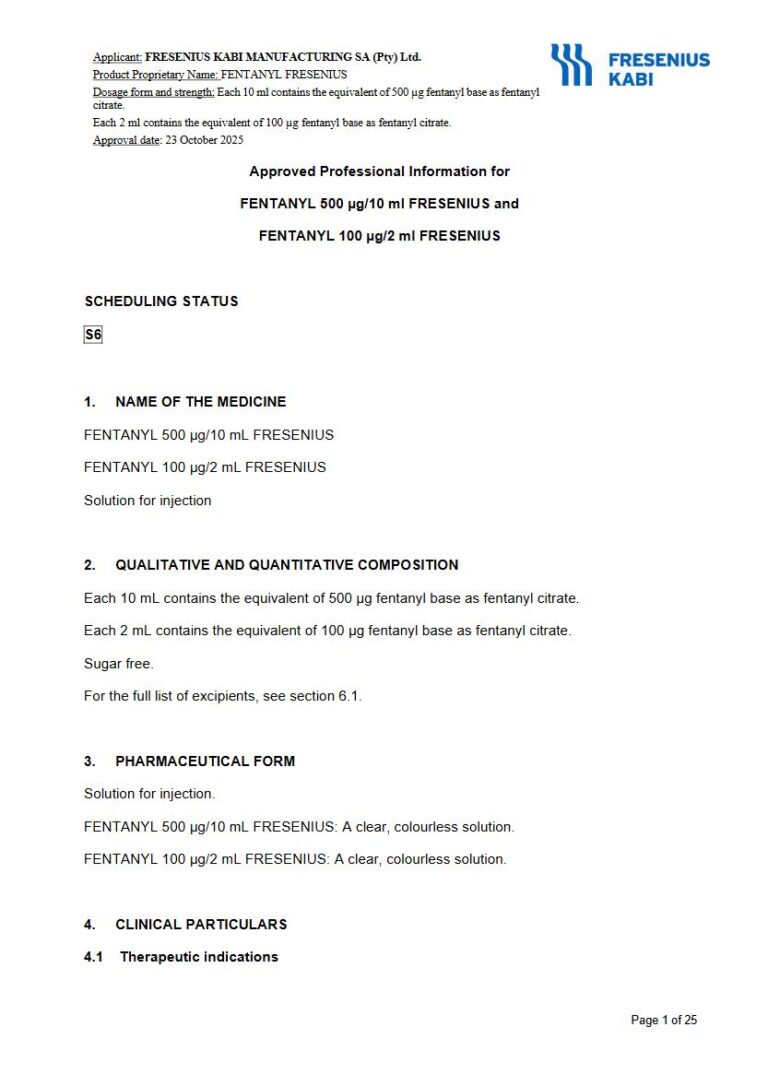
Fentanyl 10 Ml/2 Ml Solution
PDF Leaflet Revision Date: 23 October 2025
Clinical Summary
Quick overview from the medicine insert
Indication
Opioid analgesic supplement during anesthesia.
Dosage (summary)
1-10 u03bcg/kg for induction; 0.5-10 u03bcg/kg bolus; 0.5-5 u03bcg/kg continuous infusion.
Onset of Action / Duration
Onset: Immediate, Duration: 30-60 mins
Special Populations
- Elderly
- Renal impairment
- Obese patients
- Children (2-12 years)
Pregnancy & Breastfeeding
Not recommended in pregnancy; may cause respiratory depression in neonates; avoid breastfeeding for 24 hours post-administration.
Key Drug Interactions
- CNS depressants
- MAO inhibitors
- CYP3A4 inhibitors
- Serotonergic medications
Contraindications
- Hypersensitivity to fentanyl or opioids
- Respiratory depression
- Acute alcoholism
- Head injuries
- Bronchial asthma
- Comatose patients
Common side effects
- Respiratory depression
- Bradycardia
- Nausea
- Dizziness
- Muscle rigidity
Counselling Points
- Avoid driving for 24 hours post-administration.
- Monitor for signs of respiratory depression.
- Discuss risks of dependence and withdrawal.
Serious warnings
- Risk of respiratory depression
- Potential for abuse and dependence
- Monitor for serotonin syndrome
Important Disclaimer
The Fentanyl 10 Ml/2 Ml Solution professional information leaflet below is the property of Fresenius Kabi South Africa and is provided on Medinsert exactly as issued, with no.. alterations or editorial changes. We make every effort to keep content current by updating documents as soon as new versions become available. Medinsert serves as a trusted access point for healthcare professionals, but does not replace official sources or clinical judgement. For more details, please read our full disclaimer. read more>>
 Healthcare Professionals Only
This content is for registered healthcare professionals
Sign in or create a free account to read the full package insert.
Free for HPCSA-registered professionals. Powered by Medinsert.
Clinical Particulars
Section 4 of the official insert — extracted exactly as issued, no alterations
4.1 Therapeutic indications
FENTANYL FRESENIUS is indicated:
- for use as an opioid analgesic supplement during intravenous,
- inhalation or regional anaesthesia.
- as a co-induction anaesthetic for intravenous or inhalation anaesthesia.
4.2 Posology and method of administration
Posology
FENTANYL FRESENIUS should only be used in facilities where immediate access to life support is available. The dosage of FENTANYL FRESENIUS should be individualised according to age, body mass, physical status, underlying pathological condition, use of other medicine, and type of surgery and anaesthesia. The effect of the initial dose should be taken into account in determining supplemental doses. To avoid bradycardia, a small intravenous dose of an anti-cholinergic just before induction may be administered.
Use as an analgesic supplement to intravenous or inhalation anaesthesia
Analgesia during anaesthetic induction 1 u2013 10 u03bcg/kg.
Analgesia during maintenance of anaesthesia
For both balanced anaesthesia and total intravenous anaesthesia (TIVA), dose amounts and the intervals between doses should be adjusted to account for the duration and severity of the surgical procedure.
Bolus administration 0,5 u2013 10 u03bcg/kg.
Continuous infusion 0,5 u2013 5 u03bcg/kg.
Use as an anaesthetic medicine
When attenuation of the response to surgical stress is especially important, doses of 50 u2013 100 u03bcg/kg may be administered with oxygen and a muscle relaxant. This technique provides anaesthesia without necessitating the use of additional anaesthetic medicines. In certain cases, doses up to 150 u03bcg/kg may be required to produce this anaesthetic effect. Fentanyl as in FENTANYL FRESENIUS has been used in this fashion for open heart surgery and certain other major surgical procedures in patients for whom protection of the myocardium from excess oxygen demand is particularly indicated.
Special populations
Use in the elderly and debilitated patients The dose should be reduced in the elderly (> 65 years of age) and in debilitated patients. The effect of the initial dose should be taken into account in determining supplemental doses.
Obese patients In obese patients there is a risk of overdosing if the dose is calculated based on the body mass. Obese patients should be dosed based on estimated lean body mass rather than on body mass only.
Renal impairment In patients with renal impairment reduced dosing of FENTANYL FRESENIUS should be considered and these patients should be observed carefully for signs of fentanyl toxicity (see section 5.2).
Use in children For the induction and maintenance in children aged 2 - 12 years, a reduced dose as low as 1 - 3 u03bcg/kg in divided doses is recommended.
Method of administration FENTANYL FRESENIUS is administered by the intravenous route.
4.3 Contraindications
FENTANYL FRESENIUS is contraindicated in the following conditions:
- Hypersensitivity to fentanyl or to other opioids.
- Respiratory depression, (especially in the presence of cyanosis and excessive bronchial secretion) and obstructive airway disease.
- After biliary tract operations.
- Acute alcoholism.
- Head injuries and conditions in which intracranial pressure is raised.
- An attack of bronchial asthma.
- Heart failure secondary to chronic lung disease.
- Patients taking mono-amine oxidase inhibitors or within 14 days of stopping such treatment.
- Pre-operative use in babies less than one year of age.
- Convulsive disorders.
- Comatose patients.
4.4 Special warnings and precautions for use
Secondary respiratory depression after the operation has been observed. FENTANYL FRESENIUS should be administered only by healthcare professionals specifically trained in the use of intravenous anaesthetics and management of the respiratory effects of potent opioids.
Respiratory depression Respiratory depression may result with intravenous administration of FENTANYL FRESENIUS. The risk of respiratory depression is increased if FENTANYL FRESENIUS is administered in high dose or too rapidly. Respiratory depression is related to the dose and rate of administration and can be reversed by specific antagonists (naloxone), but additional doses of the latter may be necessary because the respiratory depression may last longer than the duration of the action of the opioid antagonist. Profound analgesia is accompanied by marked respiratory depression and diminished sensitivity to CO2 stimulation, which can persist or recur in the postoperative period. Respiratory depression secondary to chest wall rigidity has been reported in the postoperative period. Intraoperative hyperventilation may further alter postoperative response to CO2. Patients who have received FENTANYL FRESENIUS should remain under appropriate surveillance. Resuscitation equipment, oxygen and an opioid antagonist should be readily available to manage apnoea. Care should be taken after injection of large doses of FENTANYL FRESENIUS to ensure adequate spontaneous breathing has been established and maintained before the patient is released from the recovery area. Adequate facilities should be available for postoperative monitoring and ventilation of patients administered anaesthetic doses of FENTANYL FRESENIUS, in particular where doses above 10 u03bcg/kg are used. These facilities should be fully equipped to handle all degrees of respiratory depression. If respiratory depression does occur during anaesthesia, assisted or controlled ventilation will provide adequate respiratory support without reversing analgesia. Respiratory depression can be reversed by administration of the opioid antagonist, naloxone, which may also reverse analgesia.
Risk from concomitant use of central nervous system (CNS) depressants, especially benzodiazepines or related medicines Concomitant use of FENTANYL FRESENIUS and CNS depressants, especially benzodiazepines or related medicines, in spontaneously breathing patients, may increase the risk of profound sedation, respiratory depression, coma and death. If a decision is made to administer FENTANYL FRESENIUS concomitantly with a CNS depressant, especially a benzodiazepine or a related medicine, the lowest effective dose of both medicines should be administered, for the shortest period of concomitant use. Patients should be carefully monitored for signs and symptoms of respiratory depression and profound sedation. In this respect, it is strongly recommended to inform patients and their caregivers to be aware of these symptoms (see section 4.5).
Tolerance and Opioid Use Disorder (abuse and dependence) For all patients, prolonged use of this product may lead to drug dependence (addiction), even at therapeutic doses. Repeated use of opioids such as FENTANYL FRESENIUS may lead to Opioid Use Disorder (OUD). Abuse or intentional misuse of opioids may result in overdose and/or death. The risk of developing OUD is increased in patients with a personal or a family history (parents or siblings) of substance use disorders (including alcohol use disorder), in current tobacco users or in patients with a personal history of other mental health disorders (eg. major depression, anxiety and personality disorders). Additional support and monitoring may be necessary when prescribing for patients at risk of opioid misuse. A comprehensive patient history should be taken to document concomitant medicines, including over-the-counter medicines and medicines obtained on-line, and past and present medical and psychiatric conditions. Patients may find that treatment is less effective with chronic use and express a need to increase the dose to obtain the same level of pain control as initially experienced. The risk of developing tolerance should be explained to the patient. Overuse or misuse may result in overdose and/or death. Patients should be closely monitored for signs of misuses, abuse, or addiction. Before initiating treatment with FENTANYL FRESENIUS, a treatment strategy including treatment duration and treatment goals, and a plan for end of the treatment, should be agreed together with the patient. Drug withdrawal syndrome may occur upon abrupt cessation of therapy or dose reduction. When a patient no longer requires therapy, it may be advisable to taper the dose gradually to prevent symptoms of withdrawal. Tapering from a high dose may take weeks to months.
Muscle rigidity Induction of muscle rigidity which may also involve the thoracic muscles, can occur, but can be minimised by the following measures: slow intravenous injection (ordinarily sufficient for lower doses), premedication with benzodiazepines and the use of muscle relaxants. Non-epileptic (myo)clonic movements can occur.
Cardiac disease FENTANYL FRESENIUS has weak cholinergic activity and should be used with caution in patients with cardiac dysrhythmias. Bradycardia and possibly cardiac arrest with asystole can occur if the patient has received an insufficient amount of anticholinergic medicine, or when FENTANYL FRESENIUS is combined with non-vagolytic muscle relaxants. Bradycardia can be treated with atropine.
Nitrous oxide has been reported to produce cardiovascular depression when given with FENTANYL FRESENIUS. In the supine position, therapeutic doses of opioids such as FENTANYL FRESENIUS have minimal effect on blood pressure or cardiac rate and rhythm. FENTANYL FRESENIUS may induce hypotension, especially in hypovolaemic patients. Appropriate measures to maintain a stable arterial pressure should be taken.
Special dosing conditions The use of rapid bolus injections of opioids should be avoided in patients with compromised intracerebral compliance; in such patients the transient decrease in the mean arterial pressure has occasionally been accompanied by a short-lasting reduction of the cerebral perfusion pressure. FENTANYL FRESENIUS can produce dependence of the morphine type and therefore has the potential for being abused. Patients on chronic opioid therapy or with a history of opioid abuse, may require higher doses. It is recommended to reduce the dosage in the elderly and in debilitated patients. FENTANYL FRESENIUS should be titrated with caution in patients with the following conditions:
- uncontrolled hypothyroidism
- pulmonary disease
- decreased respiratory reserve, asthma
- alcoholism
- adrenocortical insufficiency
- impaired liver or kidney function
- prostatic hyperplasia
Such patients also require prolonged post-operative monitoring. Care should be taken when FENTANYL FRESENIUS is given to patients with myasthenia gravis. Careful consideration should be applied in the use of certain anticholinergic medicines and neuromuscular-blocking medicines prior to, and during, the administration of a general anaesthetic regimen which includes administering intravenous FENTANYL FRESENIUS. As with other opioids, due to the anticholinergic effects, administration of FENTANYL FRESENIUS may lead to increases of bile duct pressure and, less frequently, spasms of the Sphincter of Oddi might be observed.
Interaction with neuroleptics If FENTANYL FRESENIUS is administered with a neuroleptic medicine such as droperidol, the user should be familiar with the special properties of each medicine, particularly the difference in duration of action. When such a combination is used, there is a higher incidence of hypotension and fluids, and other countermeasures should be available to manage hypotension. Neuroleptic medicines such as droperidol can induce extrapyramidal symptoms that can be controlled with anti-Parkinson medicines. Vital signs should be monitored routinely. When FENTANYL FRESENIUS is used with a tranquilliser such as droperidol, hypotension may occur. If it occurs, the possibility of hypovolaemia should also be considered and managed with appropriate parenteral fluid therapy. Repositioning the patient to improve venous return to the heart should be considered when operative conditions permit. Care should be exercised in moving and positioning of patients because of the possibility of orthostatic hypotension. If volume expansion with fluids plus other countermeasures do not correct hypotension, the administration of pressor medicines other than epinephrine (adrenaline) should be considered. Because of the alpha-adrenergic blocking action of droperidol, epinephrine (adrenaline) may paradoxically decrease the blood pressure in patients treated with droperidol. Elevated blood pressure, with or without pre-existing hypertension, has been reported following administration of FENTANYL FRESENIUS combined with droperidol. This might be due to alterations in sympathetic activity following large doses of droperidol; however, it is also frequently attributed to anaesthetic and surgical stimulation during light anaesthesia. It is imperative to discontinue MAO inhibitors 2 weeks prior to any surgical or anaesthetic procedure.
Serotonin syndrome Caution is advised when FENTANYL FRESENIUS is co-administered with medicines that affect the serotonergic neurotransmitter systems. The development of a potentially life-threatening serotonin syndrome may occur with the concomitant use of serotonergic medicines such as selective serotonin re-uptake inhibitors (SSRIs) and serotonin norepinephrine re-uptake inhibitors (SNRIs), and with medicines which impair metabolism of serotonin (including monoamine oxidase inhibitors (MAOIs)). This may occur within the recommended dose (see sections 4.3 and 4.5). Serotonin syndrome may include mental status changes (e.g., agitation, hallucinations, coma), autonomic instability (e.g., tachycardia, labile blood pressure, hyperthermia), neuromuscular abnormalities (e.g., hyperreflexia, incoordination, rigidity), and/or gastrointestinal symptoms (e.g., nausea, vomiting, diarrhoea). If serotonin syndrome is suspected, rapid discontinuation of FENTANYL FRESENIUS should be considered (see sections 4.3 and 4.5).
When a tranquilliser is used with FENTANYL FRESENIUS, pulmonary arterial pressure may be decreased. This fact should be considered by those who conduct diagnostic and surgical procedures where interpretation of pulmonary arterial pressure measurements might determine final management of the patient. When high dose or anaesthetic doses of FENTANYL FRESENIUS are used, even relatively small dosages of diazepam may cause cardiovascular depression. The use of FENTANYL FRESENIUS should be avoided in patients with raised intracranial pressure. An antidiuretic effect and hypothermia may occur. FENTANYL FRESENIUS increases tone in smooth muscle, especially the sphincters of the gastrointestinal tract. Contact dermatitis has been reported, and pain and irritation may occur on injection. It should be used with caution in patients with inflammatory or obstructive bowel disorders.
4.5 Interaction with other medicines and other forms of interaction
Effect of other medicines on FENTANYL FRESENIUS
Central nervous system (CNS) depressants Medicines such as barbiturates, benzodiazepines, tricyclic antidepressants, sedatives, phenothiazines, hypnotics, meprobamate, anxiolytics, antipsychotics, opioid pre-medication, neuroleptics, general anaesthetics, halogenic gases and other non-selective central nervous system depressants (e.g., alcohol) may potentiate the respiratory depression of FENTANYL FRESENIUS. When patients have received such medicines, the dose of FENTANYL FRESENIUS required will be less than usual. Concomitant use with FENTANYL FRESENIUS in spontaneously breathing patients may increase the risk of respiratory depression, profound sedation, coma and death (see section 4.4).
Cyclizine may counteract the haemodynamic benefits of FENTANYL FRESENIUS.
Cytochrome P450 3A4 (CYP3A4) inhibitors FENTANYL FRESENIUS, a high clearance medicine, is rapidly and extensively metabolised mainly by CYP3A4. When FENTANYL FRESENIUS is used, the concomitant use of a CYP3A4 inhibitor may result in a decrease in fentanyl clearance. With single-dose FENTANYL FRESENIUS administration, the period of risk for respiratory depression may be prolonged, which may require special patient care and longer observation. Oral ritonavir (one of the most potent CYP3A4 inhibitors) reduced the clearance of a single IV FENTANYL FRESENIUS by two thirds; however, peak plasma concentrations after a single dose of IV FENTANYL FRESENIUS were not affected. With multiple-dose FENTANYL FRESENIUS administration, the risk for acute and/or delayed respiratory depression may be increased, and a dose reduction of FENTANYL FRESENIUS may be required to avoid accumulation of fentanyl. When FENTANYL FRESENIUS is used in a single dose, the concomitant use of potent CYP3A4 inhibitors such as ritonavir requires special patient care and observation. Itraconazole (a potent CYP3A4 inhibitor) at 200 mg/day given orally for 4 days had no significant effect on the pharmacokinetics of a single IV FENTANYL FRESENIUS dose. Co-administration of fluconazole or voriconazole and FENTANYL FRESENIUS may result in an increased exposure to fentanyl. With continuous treatment, dose reduction of FENTANYL FRESENIUS may be required to avoid accumulation of FENTANYL FRESENIUS, which may increase the risk of prolonged or delayed respiratory depression.
Although clinical data are lacking, in vitro data suggest that other potent CYP3A4 enzyme inhibitors (e.g., fluconazole, ketoconazole, erythromycin, diltiazem and cimetidine) may inhibit the metabolism of fentanyl.
Bradycardia and possibly cardiac arrest with asystole can occur when FENTANYL FRESENIUS is combined with non-vagolytic muscle relaxants.
Serotonergic medicines Co-administration of fentanyl with a serotonergic medicine, such as a selective serotonin re-uptake inhibitor (SSRI) or a serotonin norepinephrine re-uptake inhibitor (SNRI), and with medicines which impair metabolism of serotonin (including monoamine oxidase inhibitors (MAOIs), may increase the risk of serotonin syndrome, a potentially life-threatening condition (see sections 4.3 and 4.4).
Effect of FENTANYL FRESENIUS on other medicines The actions of FENTANYL FRESENIUS may in turn affect the activities of other medicines. For instance, their gastrointestinal effects may delay absorption as with mexiletine or may be counteractive as with cisapride, metoclopramide, or domperidone. Opioid premedicants have been reported to reduce serum concentrations of ciprofloxacin. Following the administration of FENTANYL FRESENIUS, the dose of other CNS-depressant medicines should be reduced. This is particularly important after surgery, because profound analgesia is accompanied by marked respiratory depression, which can persist or recur in the post-operative period. Administration of a CNS depressant, such as a benzodiazepine or related medicines, during this period may disproportionally increase the risk for respiratory depression (see section 4.4). The total plasma clearance and volume of distribution of etomidate is decreased by a factor 2 to 3 without a change in half-life when administered with FENTANYL FRESENIUS. Simultaneous administration of FENTANYL FRESENIUS and intravenous midazolam results in an increase in the terminal plasma half-life and a reduction in the plasma clearance of midazolam. When these medicines are co-administered with FENTANYL FRESENIUS their dose may need to be reduced.
4.6 Fertility, pregnancy and lactation
Safety in pregnancy and lactation has not been established.
Pregnancy There are no adequate data from the use of FENTANYL FRESENIUS in pregnant women. FENTANYL FRESENIUS crosses the placenta. Studies in animals have shown some reproductive toxicity. The potential risk for humans is unknown. Administration during childbirth (including caesarean section) is not recommended prior to delivery because FENTANYL FRESENIUS crosses the placenta and because the neonatal respiratory centre is particularly sensitive to opiates. If FENTANYL FRESENIUS is nevertheless administered, assisted ventilation equipment must be immediately available for the mother and infant, if required. An antidote (opioid antagonist) for the newborn should always be at hand. Babies born to opioid-dependant mothers may suffer withdrawal symptoms.
Breastfeeding FENTANYL FRESENIUS is excreted into breast milk and may cause sedation or respiratory depression in breastfed infants. Breastfeeding is not recommended for 24 hours following the administration of FENTANYL FRESENIUS.
Fertility There are no clinical data on the effects of FENTANYL FRESENIUS on male or female fertility. In animal studies, some tests on rats showed reduced female fertility at maternal toxic doses.
4.7 Effects on ability to drive and use machines
Patients should only drive or operate machinery if 24 hours have elapsed after administration of FENTANYL FRESENIUS.
4.8 Undesirable effects
Tabulated summary of adverse reactions
MedDRA system organ class Frequency Adverse reactions
Immune system disorders Less frequent Hypersensitivity (such as anaphylactic shock, anaphylactic reaction, urticaria)
Psychiatric disorders Frequent Agitation Less frequent Euphoric mood
Frequency unknown Change of mood, delirium, drug dependence
Nervous system disorders Frequent Dizziness, drowsiness, vertigo, sedation, dyskinesia Less frequent Hallucinations, confusion, convulsions, headache, loss of consciousness, myoclonus Frequency unknown Restlessness, raised intracranial pressure
Eye disorders Frequent Miosis, visual disturbances
Cardiac disorders Frequent Bradycardia (can be prevented by administration of Atropine), tachycardia, dysrhythmia Less frequent Circulatory depression which may lead to cardiac arrest Frequency unknown Palpitations.
Vascular disorders Frequent Hypotension, hypertension, vein pain Less frequent Blood pressure fluctuation, phlebitis
Respiratory, thoracic and mediastinal disorders Frequent Respiratory depression, apnoea, bronchospasm, laryngospasm Less frequent Hiccups, hyperventilation
Gastrointestinal disorders Frequent Nausea, vomiting, constipation Less frequent Abdominal pain (biliary spasm) Frequence unknown Dysphagia
Skin and subcutaneous tissue disorders Frequent Allergic dermatitis Less frequent Pruritis
Musculoskeletal and connective tissue disorders Frequent Muscle rigidity (which can be alleviated by muscle relaxants), muscle rigidity involving the thoracic muscles
Renal and urinary disorders Less frequent Difficulty in micturition Frequency unknown Ureteric spasm, antidiuretic effect.
General disorders and administration site conditions Less frequent Chills, hypothermia, drug withdrawal syndrome Frequency unknown Dry mouth, sweating, facial flushing, decreased libido or potency
Injury, poisoning and procedural complications Frequent Post-operative confusion, neurological anaesthetic complications Less frequent Post-operative agitation, procedural complication, airway complication of anaesthesia
Description of selected adverse reactions When FENTANYL FRESENIUS is used with a neuroleptic such as droperidol, chills and/or shivering, restlessness, post-operative hallucinatory episodes, and extrapyramidal symptoms may be observed. Extrapyramidal symptoms may be controlled with anti-Parkinson medicines (see section 4.3).
Post-marketing data Less frequent: increased risk of abdominal pain, including pancreatitis has been reported.
Reporting of suspected adverse reactions Healthcare providers are asked to report any suspected adverse drug reactions to the Holder of the Certificate of Registration at the following email address: [email protected] and to the relevant medicineu2019s regulatory authority in the country where the product is marketed. Reporting suspected adverse reactions after authorisation of the medicine is important. It allows continued monitoring of the benefit/risk balance of the medicine. Healthcare providers are requested to report any suspected adverse drug reactions to SAHPRA via the Med Safety APP (Medsafety X SAHPRA) and eReporting platform (who-umc.org) found on SAHPRA website.
4.9 Overdose
Signs and symptoms Overdosage produces respiratory depression and hypotension, with circulatory failure and deepening coma. Death may occur from respiratory failure. Toxic doses vary considerably between individuals whilst addicts may tolerate doses well above the average. Pulmonary oedema sometimes associated with opioid overdosage may be countered by positive-pressure respiration. Rhabdomyolysis progressing to renal failure has been reported in overdosage. The triad of coma, pinpoint pupils and respiratory depression is considered indicative of opioid overdosage; dilatation of the pupils occurs as hypoxia develops. Toxic leukoencephalopathy has been observed with fentanyl overdose.
Treatment In the presence of hypoventilation or apnoea, oxygen should be administered, and lung ventilation should be assisted or controlled as indicated. In addition, the specific antagonist, naloxone hydrochloride is used to counteract severe respiratory depression and coma. A dose of 400 u03bcg is given intravenously, subcutaneously or intramuscularly, repeated at intervals of 2 to 3 minutes if necessary. In children, a dose of 5 to 10 u03bcg per kg body-mass may be given, while in neonates a dose of 10 u03bcg per kg may be given. Repeated doses may be necessary since the respiratory depression may last longer than the effect of the antagonist. If impaired breathing is associated with muscular rigidity, an intravenous neuromuscular medicine might be required to facilitate assisted or controlled respiration.
The patient should be carefully observed; body warmth and adequate fluid intake should be maintained. If hypotension is severe or if it persists, the possibility of hypovolaemia should be considered, and if present, it should be controlled with appropriate parenteral fluid administration.
