
Fidicid 200 mg FC tablets.
PDF Leaflet Revision Date: 18 March 2025
Clinical Summary
Quick overview from the medicine insert
Indication
Treatment of Clostridium difficile infections (CDI).
Dosage (summary)
200 mg twice daily for 10 days.
Special Populations
- Renal impairment
- Hepatic impairment
Pregnancy & Breastfeeding
Safety in pregnancy and lactation not established.
Key Drug Interactions
- Potent P-glycoprotein inhibitors (e.g., ciclosporin, ketoconazole)
Contraindications
- Hypersensitivity to fidaxomicin or excipients
Common side effects
- Vomiting
- Nausea
- Constipation
- Dizziness
Counselling Points
- Take with or without food
- Report any allergic reactions
- May cause dizziness
Serious warnings
- Hypersensitivity reactions including angioedema
- Caution in severe renal or hepatic impairment
Important Disclaimer
The Fidicid 200 mg FC tablets. professional information leaflet below is the property of Equity Pharmaceuticals and is provided on Medinsert exactly as issued, with no.. alterations or editorial changes. We make every effort to keep content current by updating documents as soon as new versions become available. Medinsert serves as a trusted access point for healthcare professionals, but does not replace official sources or clinical judgement. For more details, please read our full disclaimer. read more>>
 Healthcare Professionals Only
This content is for registered healthcare professionals
Sign in or create a free account to read the full package insert.
Free for HPCSA-registered professionals. Powered by Medinsert.
Clinical Particulars
Section 4 of the official insert — extracted exactly as issued, no alterations
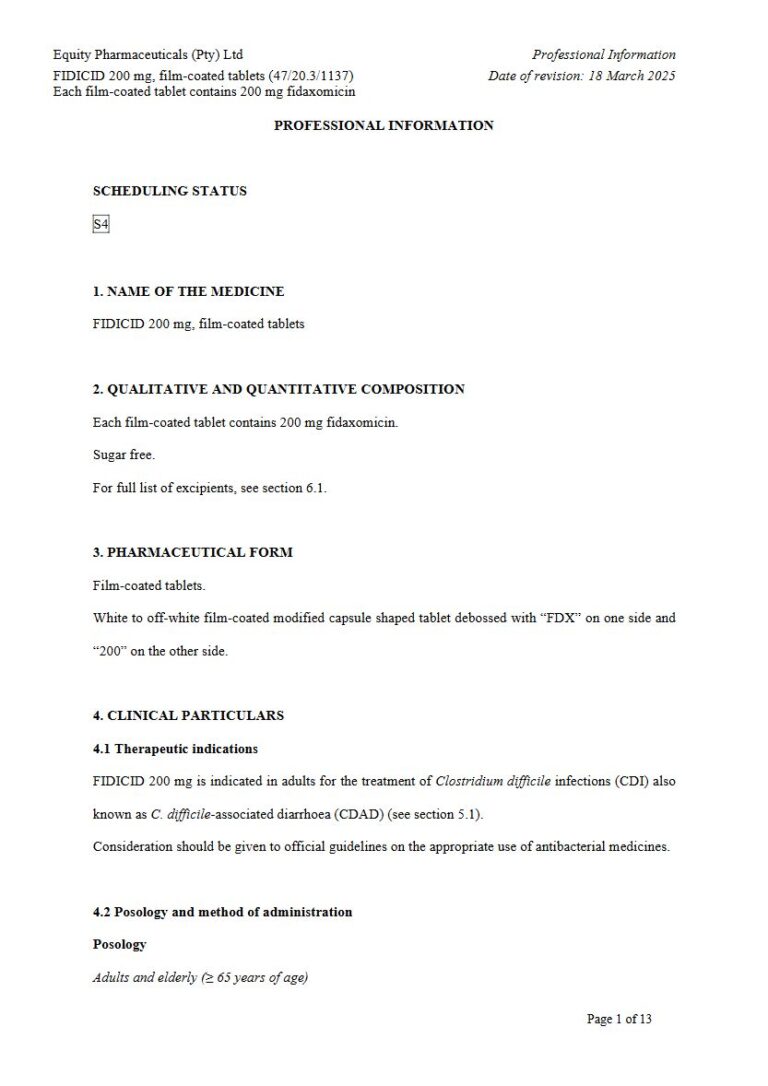
4.1 Therapeutic indications
FIDICID 200 mg is indicated in adults for the treatment of Clostridium difficile infections (CDI) also known as C. difficile-associated diarrhoea (CDAD) (see section 5.1). Consideration should be given to official guidelines on the appropriate use of antibacterial medicines.
4.2 Posology and method of administration
Posology
Adults and elderly (u2265 65 years of age)
The recommended dose is 200 mg (one tablet) administered twice daily (once every 12 hours) for 10 days.
Special populations
Renal impairment
No dose adjustment is considered necessary. Due to limited clinical data in this population, FIDICID 200 mg should be used with caution in patients with severe renal impairment (< 30 ml/min eGFR) (see section 4.4 and 5.2).
Hepatic impairment
No dose adjustment is considered necessary. Due to the limited clinical data in this population, FIDICID 200 mg should be used with caution in patients with moderate (serum total bilirubin 34 u2013 50 u03bcmol/L) to severe hepatic impairment (serum total bilirubin > 50 u03bcmol/L) (see sections 4.4 and 5.2).
Paediatric population
The safety and efficacy of FIDICID 200 mg in children aged below 18 years has not yet been established. No data are available.
Method of administration
FIDICID 200 mg is intended for oral administration. FIDICID 200 mg can be taken with or without food.
4.3 Contraindications
- Hypersensitivity to the active substance, fidaxomicin or to any of the excipients listed in section 6.1.
4.4 Special warnings and precautions for use
Hypersensitivity reactions
Hypersensitivity reactions including severe angioedema have been reported (see section 4.8). If a severe allergic reaction occurs during treatment with FIDICID 200 mg, the medicine should be discontinued, and appropriate measures taken.
Some patients with hypersensitivity reactions reported a history of allergy to macrolides. Fidaxomicin, such as contained in FIDICID 200 mg should be used with caution in patients with a known macrolide (e.g. erythromycin or azithromycin) allergy.
Renal and Hepatic Impairment:
Due to limited clinical data FIDICID 200 mg should be used with caution in patients with severe renal impairment (creatinine clearance u2264 30 mL/min) or moderate to severe hepatic impairment (serum total bilirubin 34 u2013 > 50 u03bcmol/L) (see section 5.2).
Pseudomembranous colitis, fulminant or life threatening CDI
Due to limited clinical data, FIDICID 200 mg should be used with caution in patients with pseudomembranous colitis, fulminant or life threatening CDI.
Co-administration of potent P-glycoprotein inhibitors
Co-administration of potent P-glycoprotein inhibitors such as ciclosporin, ketoconazole, erythromycin, clarithromycin, verapamil, dronedarone and amiodarone is not recommended (see section 4.5). In case fidaxomicin, such as contained in FIDICID 200 mg is administered concomitantly with potent P-glycoprotein inhibitors, caution is advised.
4.5 Interaction with other medicines and other forms of interaction
Effect of P-gp inhibitors on FIDICID 200 mg
Fidaxomicin (the active ingredient in FIDICID 200 mg) is a substrate of P-glycoprotein (P-gp). Co-administration of single doses of the P-gp inhibitor ciclosporin A and FIDICID 200 mg in healthy volunteers resulted in a 4- and 2-fold increase in fidaxomicin, such as contained in FIDICID 200 mg, C max and AUC, respectively and a 9.5- and 4-fold increase in C max and AUC, respectively, of the main active metabolite OP-1118. As the clinical relevance of this increase in exposure is unclear, co-administration of potent inhibitors of P-gp, such as ciclosporin, ketoconazole, erythromycin, clarithromycin, verapamil, dronedarone and amiodarone is not recommended (see section 4.4).
Effect of FIDICID 200 mg on P-gp substrates
When digoxin, a P-gp substrate, was co-administered with FIDICID (200 mg twice daily) in healthy volunteers, digoxin C max increased by 14 % and AUC by 12 %. Fidaxomicin such as contained in FIDICID 200 mg may be a mild to moderate inhibitor of intestinal P-gp. Fidaxomicin (200 mg twice daily) had a small but not clinically relevant effect on digoxin, a P-gp substrate, exposure. However, a larger effect on P-gp substrates with lower bioavailability more sensitive to intestinal P-gp inhibition, such as dabigatran etexilat, cannot be excluded.
P450 (CYP) enzymes
FIDICID 200 mg is not metabolised by human cytochrome P450 (CYP) enzymes and does not induce or inhibit these enzymes in vitro. In vivo in healthy volunteers, FIDICID 200 mg did not have a clinically relevant effect on the CYP2C9 substrates warfarin, CYP3A4 substrate midazolam, and CYP2C19 substrate omeprazole. Based on these results, no dose adjustment of either medicine is warranted when FIDICID 200 mg is co-administered with CYP substrate compounds.
Effect of FIDICID 200 mg on other transporters
FIDICID 200 mg does not have a clinically significant effect on the exposure of a single dose of rosuvastatin, a substrate for the transporters OATP2B1 and BCRP. Co-administration of FIDICID 200 mg twice daily with a single dose of 10 mg rosuvastatin to healthy subjects did not have a clinically significant effect on the AUCinf of rosuvastatin.
4.6 Fertility, pregnancy and lactation
Pregnancy
The safety and efficacy in pregnancy has not been established.
Lactation
The safety and efficacy in lactation has not been established.
Fertility
Non-clinical data revealed no special hazard for humans based on conventional studies of reproductive toxicity (see section 5.3).
4.7 Effects on ability to drive and use machines
FIDICID 200 mg causes dizziness (see section 4.8). This may influence the ability to drive and use machines.
4.8 Undesirable effects
a. Summary of the safety profile
The most common treatment related adverse reactions were vomiting (1.2 %), nausea (2.7 %) and constipation (1.2 %).
b. Tabulated list of adverse reactions
The frequency of adverse reactions is defined as follows: very common (u22651/10); common (u22651/100 to <1/10); uncommon (u22651/1,000 to <1/100); rare (u22651/10,000 to <1/1,000); very rare (<1/10,000), not known (cannot be estimated from the available data). Within each frequency grouping, adverse reactions are presented in order of decreasing seriousness.
Table 1: Adverse reactions
| MedDRA system organ class | Common (u2265 1/100 to <1/10) | Uncommon (u2265 1/1,000 to <1/100) | Frequency not known |
|---|---|---|---|
| Immune system disorders | rash, pruritus | hypersensitivity reactions (angioedema, dyspnoea) | |
| Metabolism and nutrition disorders | decreased appetite | ||
| Nervous system disorders | dizziness, headache, dysgeusia | ||
| Gastrointestinal disorders | vomiting, nausea, constipation | abdominal distention, flatulence, dry mouth | |
| Hepatobiliary disorders | increased alanine aminotransferase |
c. Description of selected adverse reactions
Acute hypersensitivity reactions, such as angioedema and dyspnoea, have been reported during post marketing (see section 4.3 and 4.4).
Reporting of suspected adverse reactions
Reporting suspected adverse reactions after authorisation of the medicine is important. It allows continued monitoring of the benefit/risk balance of the medicine. Healthcare providers are asked to report any suspected adverse reactions to SAHPRA via the Med Safety APP (Medsafety X SAHPRA) and eReporting platform (who-umc.org) found on SAHPRA website.
4.9 Overdose
In overdose, side effects will be exaggerated and exacerbated. Treatment is supportive and symptomatic.
