
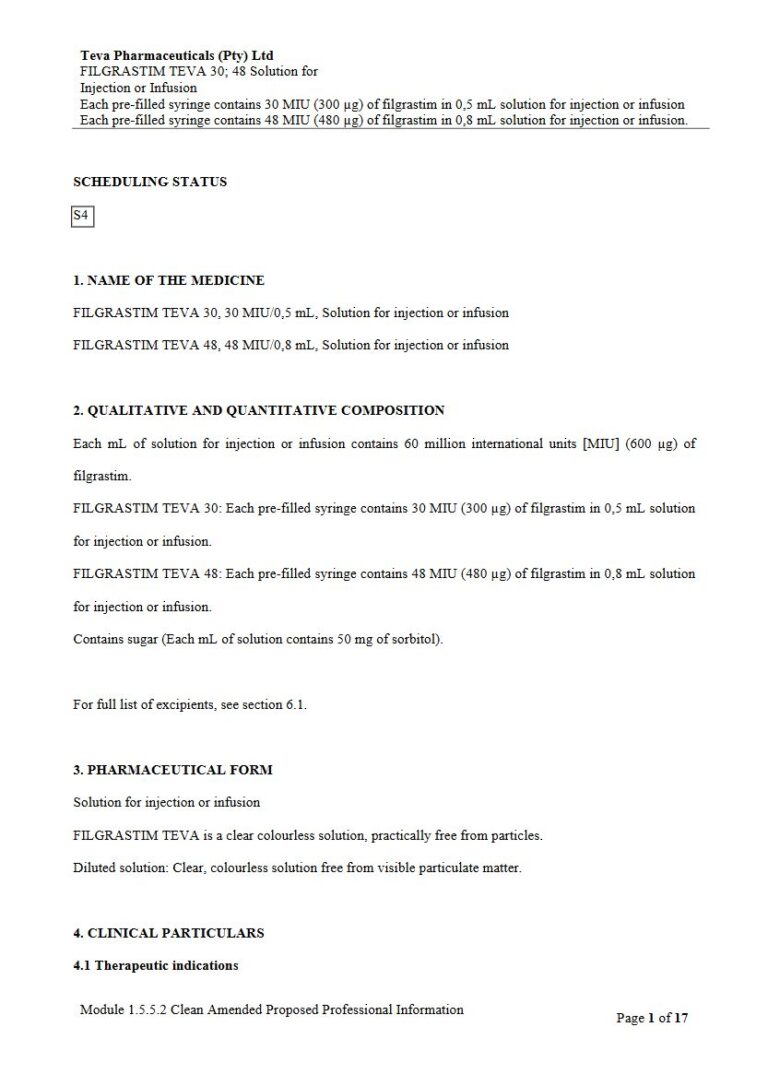
Filgrastim Teva 0.5 mL/0.8 mL Solution
PDF Leaflet Revision Date: 23 November 2017
Clinical Summary
Quick overview from the medicine insert
Indication
Reduction of neutropenia duration in chemotherapy patients.
Dosage (summary)
0.5 MIU (5 u03bcg)/kg/day, starting 24 hours post-chemotherapy.
Onset of Action / Duration
Onset: 1-2 days, Duration: up to 14-38 days depending on chemotherapy.
Special Populations
- Elderly patients
- Paediatric population
- Renal impairment
- Hepatic impairment
Pregnancy & Breastfeeding
Contraindicated in pregnancy and lactation; reproductive toxicity observed.
Key Drug Interactions
- Lithium may potentiate effects
- Avoid use with myelosuppressive chemotherapy within 24 hours
Contraindications
- Hypersensitivity to filgrastim
- Chronic myeloid leukaemia
- Severe congenital neutropenia
- Impaired renal or hepatic function
Common side effects
- Musculoskeletal pain
- Fatigue
- Nausea
- Diarrhoea
- Headache
Counselling Points
- Monitor for allergic reactions
- Avoid driving if fatigued
- Report any respiratory symptoms immediately
Serious warnings
- Sickle cell crisis risk
- Leucocytosis
- Interstitial pneumonia
- Graft versus Host Disease
Important Disclaimer
The Filgrastim Teva 0.5 mL/0.8 mL Solution professional information leaflet below is the property of Teva Pharmaceuticals and is provided on Medinsert exactly as issued, with no.. alterations or editorial changes. We make every effort to keep content current by updating documents as soon as new versions become available. Medinsert serves as a trusted access point for healthcare professionals, but does not replace official sources or clinical judgement. For more details, please read our full disclaimer. read more>>
 Healthcare Professionals Only
This content is for registered healthcare professionals
Sign in or create a free account to read the full package insert.
Free for HPCSA-registered professionals. Powered by Medinsert.
Clinical Particulars
Section 4 of the official insert — extracted exactly as issued, no alterations
4.1 Therapeutic indications
Established cytotoxic chemotherapy FILGRASTIM TEVA is indicated for the reduction in the duration of neutropenia in patients on chemotherapy, except in patients with chronic myeloid leukaemia and myelodysplastic syndromes.
4.2 Posology and method of administration
Posology FILGRASTIM TEVA therapy should only be given in collaboration with an oncology centre which has experience in granulocyte-colony stimulating factor (G-CSF) treatment and haematology and has the necessary diagnostic facilities.
Established cytotoxic chemotherapy: The recommended dose of FILGRASTIM TEVA is 0,5 MIU (5 u03bcg)/kg/day. The first dose of FILGRASTIM TEVA should not be administered less than 24 hours following cytotoxic chemotherapy. Daily dosing with FILGRASTIM TEVA should continue until the expected neutrophil nadir is passed and the neutrophil count has recovered to the normal range. Following established chemotherapy for solid tumours, lymphomas and lymphoid leukaemias, it is expected that the duration of treatment required to fulfil these criteria will be up to 14 days. Following induction and consolidation treatment for acute myeloid leukaemia, the duration of treatment may be substantially longer (up to 38 days) depending on the type, dose and schedule of cytotoxic chemotherapy used. In patients receiving cytotoxic chemotherapy, a transient increase in neutrophil counts is typically seen 1 to 2 days after initiation of FILGRASTIM TEVA therapy. However, for a sustained therapeutic response, FILGRASTIM TEVA therapy should not be discontinued before the expected nadir has passed and the neutrophil count has recovered to the normal range. Premature discontinuation of FILGRASTIM TEVA therapy prior to the time of the expected neutrophil nadir is not recommended.
Special populations Elderly patients: Clinical trials with FILGRASTIM TEVA have included a small number of elderly patients but special studies have not been performed in this group and therefore specific dosage recommendations cannot be made. Paediatric population Data from clinical studies in paediatric patients indicate that the safety and efficacy of FILGRASTIM TEVA are similar in both adults and children receiving cytotoxic chemotherapy.
Method of administration FILGRASTIM TEVA may be given as a daily subcutaneous injection or as a daily intravenous infusion diluted in 5 % glucose solution, given over 30 minutes (refer to Instructions for dilution, section 6.6) The subcutaneous route is preferred in most cases.
4.3 Contraindications
- FILGRASTIM TEVA should not be administered to:
- Patients with known hypersensitivity to filgrastim or any of the excipients listed in section 6.1.
- Patients with chronic myeloid leukaemia and myelodysplastic syndromes.
- Patients with severe congenital neutropenia (Kostmannu2019s syndrome) with abnormal cytogenics.
- To increase the dose of cytotoxic chemotherapy beyond established dosage regimens.
- FILGRASTIM TEVA should not be used in patients with impaired renal or hepatic function.
4.4 Special warnings and precautions for use
- Sickle cell crisis (see section 4.8): Sickle cell crisis, in some cases fatal, have been reported with the use of FILGRASTIM TEVA in patients with sickle cell trait or sickle cell disease. Physicians should exercise caution when considering the use of FILGRASTIM TEVA in patients with sickle cell trait or disease, and only initiate treatment after careful evaluation of the potential risks and benefits.
- Malignant cell growth: Granulocyte-colony stimulating factor can promote growth of myeloid cells in vitro and similar effects may also be seen on some non-myeloid cells in vitro. The safety and efficacy of FILGRASTIM TEVA administration in patients with myelodysplastic syndrome or chronic myelogenous leukaemia has not been established. FILGRASTIM TEVA is not indicated for use in these conditions (see section 4.3). Particular care should be taken to distinguish the diagnosis of blast transformation of chronic myeloid leukaemia from acute myeloid leukaemia (AML). In view of limited safety and efficacy data in patients with secondary acute myeloid leukaemia, FILGRASTIM TEVA should be administered with caution. The safety and efficacy of FILGRASTIM TEVA administration in de novo AML patients aged < 55 years with good cytogenetics [t(8;21), t(15;17), and inv(16)] have not been established.
- Osteopenia: Monitoring of bone density may be indicated in patients with underlying osteoporotic bone disease who undergo continuous therapy with FILGRASTIM TEVA for more than 6 months. Of note, increased haematopoietic activity of the bone marrow in response to growth factor therapy has been associated with transient abnormal bone-scans. This should be considered when interpreting bone-imaging results.
- Interstitial pneumonia: Rare pulmonary undesirable effects, in particular interstitial pneumonia, have been reported after FILGRASTIM TEVA administration. Patients with recent history of pulmonary infiltrates or pneumonia may be at higher risk. The onset of pulmonary signs, such as cough, fever and dyspnoea in association with radiological signs of pulmonary infiltrates and deterioration in pulmonary function may be preliminary signs of Adult Respiratory Distress Syndrome (ARDs). FILGRASTIM TEVA should be discontinued and appropriate treatment given (See section 4.8).
- Leucocytosis: FILGRASTIM TEVA can cause severe leucocytosis. In view of the potential risks associated with severe leucocytosis, the white blood cell count should be performed at regular intervals during FILGRASTIM TEVA therapy. If leucocyte counts exceed 50 x 109/L after the expected nadir, FILGRASTIM TEVA should be discontinued immediately.
- Pre-existing bone marrow suppression: The effects of FILGRASTIM TEVA in patients with substantially reduced myeloid progenitors have not been studied. FILGRASTIM TEVA acts primarily on neutrophil precursors to exert its effect in elevating neutrophil counts. Therefore, in patients with reduced precursors, neutrophil response may be diminished (such as those treated with extensive radiotherapy or chemotherapy, or those with bone marrow infiltration by tumour).
- Graft rejections: There have been reports of Graft versus Host Disease (GvHD) and fatalities in patients receiving G-CSF after allogeneic bone marrow transplantation.
- Known cases of Hereditary Fructose Intolerance (HFI): The additive effect of concomitantly administered products containing sorbitol (or fructose) and dietary intake of sorbitol (or fructose) should be taken into account. Patients with rare hereditary fructose intolerance not be given FILGRASTIM TEVA unless strictly necessary. Babies and young children (below 2 years of age) may not yet be diagnosed with hereditary fructose intolerance (HFI). Medicines (containing sorbitol/fructose) given intravenously may be life-threatening and should be contraindicated in this population unless there is an overwhelming clinical need and no alternatives are available. A detailed history with regard to HFI symptoms has to be taken of each patient prior to being given FILGRASTIM TEVA.
4.5 Interaction with other medicines and other forms of interaction
The safety and efficacy of FILGRASTIM TEVA given on the same day as myelosuppressive cytotoxic chemotherapy has not been established. In view of the sensitivity of rapidly dividing myeloid cells to myelosuppressive cytotoxic chemotherapy, the use of FILGRASTIM TEVA is not recommended in the period from 24 hours before to 24 hours after chemotherapy. Possible interactions with other haematopoietic growth factors and cytokines have not been investigated in clinical trials. Since lithium promotes the release of neutrophils, it may potentiate the effect of FILGRASTIM TEVA. Although this interaction has not been formally investigated, there is no evidence that such an interaction is harmful.
4.6 Fertility, pregnancy and lactation
Pregnancy FILGRASTIM TEVA is contraindicated in pregnancy and lactation. The safety of FILGRASTIM TEVA has not been established in pregnant women. Studies in animals have shown reproductive toxicity.
Breastfeeding The safety of FILGRASTIM TEVA has not been established in lactating women. It is unknown whether the active ingredient, filgrastim, is excreted in human breast milk. Women on FILGRASTIM TEVA should not breastfeed their babies.
4.7 Effects on ability to drive and use machines
FILGRASTIM TEVA can cause fatigue which may affect the ability to drive and use machines. Patients experiencing fatigue may not drive or operate machinery. Patients should be advised not to drive or operate machinery until they know how the FILGRASTIM TEVA affects them.
4.8 Undesirable effects
The most frequent undesirable effects attributable to filgrastim at the recommended dose were mild or moderate musculoskeletal pain, occurring in 10 %, and severe musculoskeletal pain in 3 % of patients. Musculoskeletal pain is usually controlled with standard analgesics. Less frequent undesirable effects include urinary abnormalities predominantly mild or moderate dysuria. In randomised, placebo-controlled clinical trials, filgrastim did not increase the incidence of undesirable effects associated with cytotoxic chemotherapy. In those clinical trials, undesirable effects reported with equal frequency in patients treated with filgrastim/chemotherapy and placebo/chemotherapy included nausea and vomiting, alopecia, diarrhoea, fatigue, anorexia (decreased appetite), mucosal inflammation, headache, cough, rash, chest pain, asthenia, pharyngolaryngeal pain (oropharyngeal pain) and constipation.
Blood and lymphatic system disorders: Less frequent: Splenomegaly, splenic rupture, sickle cell crisis.
Immune system disorders: Frequent: Hypersensitivity. Less frequent: Graft versus Host Disease.
Metabolism and nutrition disorders: Frequent: Blood uric acid increased, blood lactate dehydrogenase increased, anorexia. Less frequent: Pseudogout.
Nervous system disorders: Frequent: Headache.
Vascular disorders: Frequent: Hypotension. Less frequent: Veno-occlusive disease, fluid volume disturbances, capillary leak syndrome.
Respiratory, thoracic and mediastinal disorders: Frequent: Oropharyngeal pain, cough, dyspnoea, haemoptysis. Less frequent: Acute respiratory distress syndrome, respiratory failure, pulmonary oedema, interstitial lung disease, lung infiltration, pulmonary haemorrhage.
Gastrointestinal disorders: Frequent: Diarrhoea, vomiting, constipation, nausea, mucositis.
Hepatobiliary disorders: Frequent: Gamma-glutamyl transferase increased, blood alkaline phosphatase increased.
Skin and subcutaneous tissue disorders: Frequent: Alopecia, skin rash. Less frequent: Sweets syndrome, cutaneous vasculitis.
Musculoskeletal and connective tissue disorders: Frequent: Musculoskeletal pain, chest pain. Less frequent: Exacerbation of rheumatoid arthritis.
Renal and urinary disorders: Frequent: Dysuria. Less frequent: Urine abnormality, glomerulonephritis.
General disorders and administration site conditions: Frequent: Asthenia, fatigue, mucosal inflammation, pain. Less frequent: unspecified pain, allergic reaction.
Post-marketing: Cases of capillary leak syndrome have been reported in the post marketing setting with granulocyte colony stimulating factor use. These have generally occurred in patients with advanced malignant diseases, sepsis, taking multiple chemotherapy medications or undergoing apheresis. In the post-marketing setting cutaneous vasculitis has been reported in patients treated with filgrastim. The mechanism of vasculitis in patients receiving filgrastim is unknown. Less frequent cases of Sweets syndrome (acute febrile dermatosis) have been reported in the post-marketing setting. However, since a significant percentage of these patients were suffering from leukaemia, a condition known to be associated with Sweets syndrome, a causal relationship with FILGRASTIM TEVA has not been established. In the post-marketing setting, less frequent cases of sickle cell crisis have been reported in patients with sickle cell trait or sickle cell disease (see section 4.4). Hypersensitivity-type reactions including anaphylaxis, rash, urticaria, angioedema, dyspnoea and hypotension occurring on initial or subsequent treatment have been reported in clinical studies and in post marketing experience and were more frequent after IV administration. In some cases, symptoms have recurred with rechallenge, suggesting a causal relationship with filgrastim. FILGRASTIM TEVA should be permanently discontinued in patients who experience a serious allergic reaction. In clinical studies and the post-marketing setting pulmonary adverse effects including interstitial lung disease, pulmonary oedema, and lung infiltration have been reported in some cases with an outcome of respiratory failure or acute respiratory distress syndrome (ARDS), which may be fatal (see section 4.4).
4.9 Overdose
The effects of FILGRASTIM TEVA overdosage have not been established. Discontinuation of FILGRASTIM TEVA therapy usually results in a 50 % decrease in circulating neutrophils within 1 to 2 days, with a return to normal levels in 1 to 7 days. Treatment is symptomatic and supportive.
