
Finetive 10 Mg/20 Mg Film-Coated Tablets
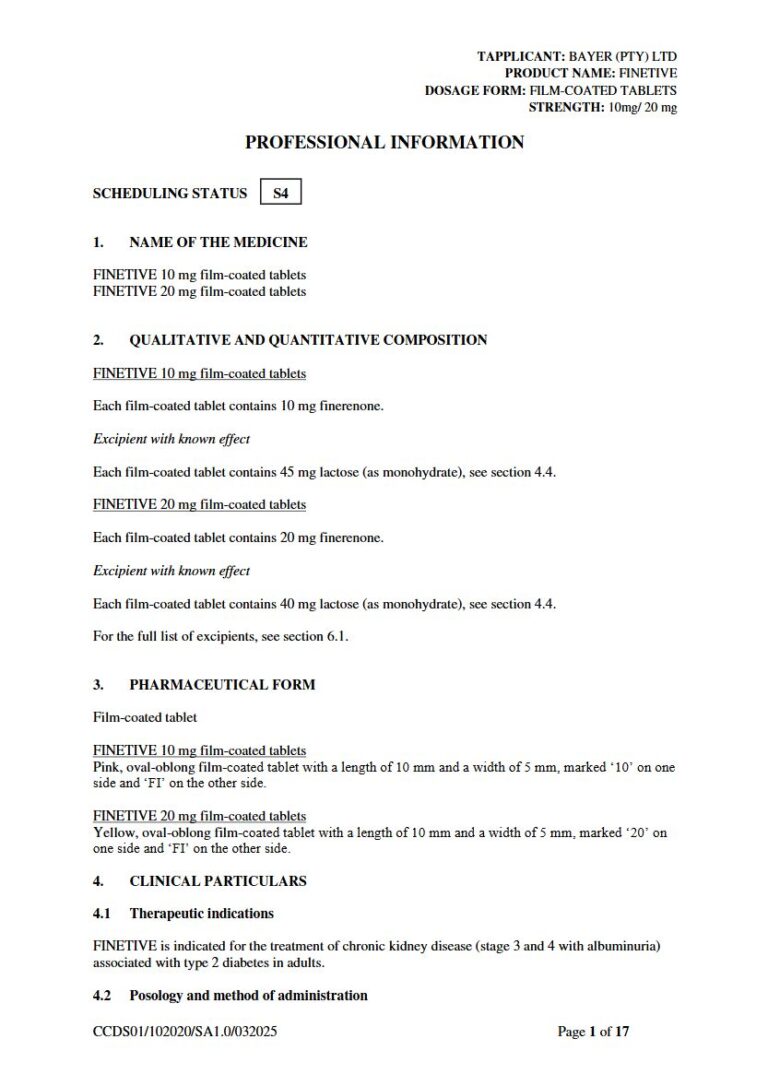
PDF Leaflet Revision Date: 18 March 2025
Clinical Summary
Quick overview from the medicine insert
Indication
Treatment of chronic kidney disease stage 3 and 4 with albuminuria associated with type 2 diabetes in adults.
Dosage (summary)
20 mg once daily; starting dose based on eGFR.
Special Populations
- Elderly
- Renal impairment
- Hepatic impairment
Pregnancy & Breastfeeding
Not recommended during pregnancy; avoid breastfeeding.
Key Drug Interactions
- Strong CYP3A4 inhibitors
- Potassium-sparing diuretics
- Trimethoprim
Contraindications
- Hypersensitivity
- Severe hepatic impairment
- eGFR < 25 mL/min
Common side effects
- Hyperkalaemia
- Hypotension
- Pruritus
Counselling Points
- Take with water; avoid grapefruit juice.
- Monitor potassium levels regularly.
- Use effective contraception during treatment.
Serious warnings
- Risk of hyperkalaemia
- Monitoring of serum potassium required
Important Disclaimer
The Finetive 10 Mg/20 Mg Film-Coated Tablets professional information leaflet below is the property of Teva Pharmaceuticals and is provided on Medinsert exactly as issued, with no.. alterations or editorial changes. We make every effort to keep content current by updating documents as soon as new versions become available. Medinsert serves as a trusted access point for healthcare professionals, but does not replace official sources or clinical judgement. For more details, please read our full disclaimer. read more>>
 Healthcare Professionals Only
This content is for registered healthcare professionals
Sign in or create a free account to read the full package insert.
Free for HPCSA-registered professionals. Powered by Medinsert.
Clinical Particulars
Section 4 of the official insert — extracted exactly as issued, no alterations
4.1 Therapeutic indications
FINETIVE is indicated for the treatment of chronic kidney disease (stage 3 and 4 with albuminuria) associated with type 2 diabetes in adults.
4.2 Posology and method of administration
Posology
The recommended target dose is 20 mg finerenone once daily. The maximum recommended dose is 20 mg finerenone once daily. Initiation of treatment Serum potassium and estimated glomerular filtration rate (eGFR) have to be measured to determine if finerenone treatment can be initiated and to determine the starting dose. If serum potassium u2264 4.8 mmol/L, finerenone treatment can be initiated. For monitoring of serum potassium, see below u2018Continuation of treatmentu2019. If serum potassium > 4.8 to 5.0 mmol/L, initiation of finerenone treatment may be considered with additional serum potassium monitoring within the first 4 weeks based on patient characteristics and serum potassium levels (see section 4.4). If serum potassium > 5.0 mmol/L, finerenone treatment should not be initiated (see section 4.4). The recommended starting dose of finerenone is based on eGFR and is presented in table 1.
Table 1 : Initiation of finerenone treatment and recommended dose
eGFR (mL/min/1.73 m2) Starting dose (once daily) u2265 60 20 mg u2265 25 to u2264 60 10 mg < 25 Not recommended
Continuation of treatment Serum potassium and eGFR have to be remeasured 4 weeks after initiation or re-start of finerenone treatment or increase in dose (see table 2 to determine continuation of finerenone treatment and dose adjustment). Thereafter, serum potassium has to be remeasured periodically and as needed based on patient characteristics and serum potassium levels. See sections 4.4 and 4.5 for more information.
Table 2: Continuation of finerenone treatment and dose adjustment
Current finerenone dose (once daily) 10 mg 20 mg Current serum potassium (mmol/L) u2264 4.8 Increase to 20 mg finerenone once daily* Maintain 20 mg once daily > 4.8 to 5.5 Maintain 10 mg once daily Maintain 20 mg once daily > 5.5 Withhold finerenone. Consider re-starting at 10 mg once daily when serum potassium u2264 5.0 mmol/L. Withhold finerenone. Re-start at 10 mg once daily when serum potassium u2264 5.0 mmol/L. * maintain 10 mg once daily, if eGFR has decreased > 30% compared to the previous measurement
Missed dose A missed dose should be taken as soon as the patient notices, but only on the same day. The patient should not take 2 doses to make up for a missed dose.
Special populations
Elderly No dose adjustment is necessary in elderly patients (see section 5.2).
Renal impairment Initiation of treatment In patients with eGFR < 25 mL/min/1.73 m2, finerenone treatment should not be initiated due to limited clinical data (see sections 4.4 and 5.2). Continuation of treatment In patients with eGFR u2265 15 mL/min/1.73 m2, finerenone treatment can be continued with dose adjustment based on serum potassium. eGFR should be measured 4 weeks after initiation to determine whether the starting dose can be increased to the recommended daily dose of 20 mg (see u2018Posology, Continuation of treatmentu2019 and table 2). Due to limited clinical data, finerenone treatment should be discontinued in patients who have progressed to end-stage renal disease (eGFR < 15 mL/min/1.73 m2) (see section 4.4).
Hepatic impairment Patients with - severe hepatic impairment: Finerenone should not be initiated (see sections 4.4 and 5.2). No data are available. - moderate hepatic impairment: No initial dose adjustment is required. Consider additional serum potassium monitoring and adapt monitoring according to patient characteristics (see sections 4.4 and 5.2). - mild hepatic impairment: No initial dose adjustment is required.
Concomitant medication In patients taking finerenone concomitantly with moderate or weak CYP3A4 inhibitors, potassium supplements, trimethoprim, or trimethoprim/sulfamethoxazole, additional serum potassium monitoring and adaptation of monitoring according to patient characteristics should be considered (see section 4.4). Finerenone treatment decisions should be made as directed in table 2 (u2018Posology, Continuation of treatmentu2019). Temporary discontinuation of finerenone may be necessary, when patients have to take trimethoprim, or trimethoprim/sulfamethoxazole. See sections 4.4 and 4.5 for more information.
Body weight No dose adjustment is necessary based on body weight (see section 5.2).
Paediatric population The safety and efficacy of finerenone in children and adolescents aged under 18 years have not yet been established. No data are available.
Method of administration Oral use Tablets may be taken with a glass of water and with or without food (see section 5.2). Tablets should not be taken with grapefruit or grapefruit juice (see section 4.5).
Crushing of tablets For patients who are unable to swallow whole tablets, FINETIVE tablets may be crushed and mixed with water or soft foods, such as apple sauce, directly before oral use (see section 5.2).
4.3 Contraindications
- Hypersensitivity to the active substance or to any of the excipients listed in section 6.1
- Concomitant treatment with strong inhibitors of CYP3A4 (see section 4.5), e.g.,
- itraconazole
- ketoconazole
- ritonavir
- nelfinavir
- cobicistat
- clarithromycin
- telithromycin
- nefazodone
- Addison's disease
4.4 Special warnings and precautions for use
Hyperkalaemia Hyperkalaemia has been observed in patients treated with finerenone (see section 4.8). Some patients are at a higher risk to develop hyperkalaemia. Risk factors include low eGFR, higher serum potassium and previous episodes of hyperkalaemia. In these patients more frequent monitoring has to be considered. Initiation and continuation of treatment (see section 4.2) If serum potassium > 5.0 mmol/L, finerenone treatment should not be initiated. If serum potassium > 4.8 to 5.0 mmol/L, initiation of finerenone treatment may be considered with additional serum potassium monitoring within the first 4 weeks based on patient characteristics and serum potassium levels. If serum potassium > 5.5 mmol/L, finerenone treatment has to be withheld. Local guidelines for the management of hyperkalaemia have to be followed. Once serum potassium u2264 5.0 mmol/L, finerenone treatment can be restarted at 10 mg once daily.
Monitoring Serum potassium and eGFR have to be remeasured in all patients 4 weeks after initiation, re-start or increase in dose of finerenone. Thereafter, serum potassium has to be assessed periodically and as needed based on patient characteristics and serum potassium levels (see section 4.2).
Concomitant medications The risk of hyperkalaemia also may increase with the intake of concomitant medications that may increase serum potassium (see section 4.5.). See also u2018Concomitant use of substances that affect finerenone exposureu2019 in this section. Finerenone should not be given concomitantly with - potassium-sparing diuretics (e.g., amiloride, triamterene) and - other mineralocorticoid receptor antagonists (MRAs), e.g., eplerenone, esaxerenone, spironolactone, canrenone. Finerenone should be used with caution and serum potassium should be monitored when taken concomitantly with - potassium supplements. - trimethoprim, or trimethoprim/sulfamethoxazole. Temporary discontinuation of finerenone may be necessary.
Renal impairment The risk of hyperkalaemia increases with decreasing renal function. Ongoing monitoring of renal function should be performed as needed according to standard practice (see section 4.2).
Initiation of treatment Finerenone treatment should not be initiated in patients with eGFR < 25 mL/min/1.73 m2 as clinical data are limited (see sections 4.2 and 5.2).
Continuation of treatment Due to limited clinical data, finerenone treatment should be discontinued in patients who have progressed to end-stage renal disease (eGFR < 15 mL/min/1.73 m2).
Hepatic impairment Finerenone treatment should not be initiated in patients with severe hepatic impairment (see section 4.2). These patients have not been studied (see section 5.2) but a significant increase in finerenone exposure is expected. The use of finerenone in patients with moderate hepatic impairment may require additional monitoring due to an increase in finerenone exposure. Additional serum potassium monitoring and adaptation of monitoring have to be considered according to patient characteristics (see sections 4.2 and 5.2).
Heart failure Patients with diagnosed heart failure with reduced ejection fraction and New York Heart Association II-IV were excluded from the phase III clinical study (see section 5.1).
4.5 Interactions with other medicines
Interaction studies have only been performed in adults. Finerenone is cleared almost exclusively via cytochrome P450 (CYP)-mediated oxidative metabolism (mainly CYP3A4 [90%] with a small contribution of CYP2C8 [10%]).
Concomitant use contraindicated Strong CYP3A4 inhibitors Concomitant use of FINETIVE with itraconazole, clarithromycin and other strong CYP3A4 inhibitors (e.g., ketoconazole, ritonavir, nelfinavir, cobicistat, telithromycin or nefazodone) is contraindicated (see section 4.3), since a marked increase in finerenone exposure is expected.
Concomitant use not recommended Strong and moderate CYP3A4 inducers FINETIVE should not be used concomitantly with rifampicin and other strong CYP3A4 inducers (e.g., carbamazepine, phenytoin, phenobarbital, St Johnu2019s Wort) or with efavirenz and other moderate CYP3A4 inducers. These CYP3A4 inducers are expected to markedly decrease finerenone plasma concentration and result in reduced therapeutic effect (see section 4.4).
Certain medicine that increase serum potassium FINETIVE should not be used concomitantly with potassium-sparing diuretics (e.g., amiloride, triamterene) and other MRAs (e.g., eplerenone, esaxerenone, spironolactone, canrenone). It is anticipated that these medicines increase the risk for hyperkalaemia (see section 4.4)
Grapefruit Grapefruit or grapefruit juice should not be consumed during finerenone treatment, as it is expected to increase the plasma concentrations of finerenone through inhibition of CYP3A4 (see sections 4.2 and 4.4).
Concomitant use with precautions Moderate CYP3A4 inhibitors In a clinical study, concomitant use of erythromycin (500 mg three times a day) led to a 3.5-fold increase in finerenone AUC and 1.9-fold increase in its Cu2098u2090u2093. In another clinical study, verapamil (240 mg controlled-release tablet once daily) led to a 2.7- and 2.2-fold increase in finerenone AUC and Cu2098u2090u2093, respectively. Serum potassium may increase, and therefore, monitoring of serum potassium is recommended, especially during initiation or changes to dosing of finerenone or the CYP3A4 inhibitor (see sections 4.2 and 4.4).
Weak CYP3A4 inhibitors The PBPK simulations suggest that fluvoxamine (100 mg twice daily), increases finerenone AUC (1.6-fold) and Cu2098u2090u2093 (1.4-fold). Serum potassium may increase, and therefore, monitoring of serum potassium is recommended, especially during initiation or changes to dosing of finerenone or the CYP3A4 inhibitor (see sections 4.2 and 4.4).
Certain medicines that increase serum potassium (see section 4.4) Concomitant use of FINETIVE with potassium supplements and trimethoprim, or trimethoprim/sulfamethoxazole is anticipated to increase the risk of hyperkalaemia. Monitoring of serum potassium is required. Temporary discontinuation of FINETIVE during trimethoprim, or trimethoprim/sulfamethoxazole treatment may be necessary. Antihypertensive medicines The risk for hypotension increases with concomitant use of multiple other antihypertensive medicines. In these patients, blood pressure monitoring is recommended.
4.6 Fertility, pregnancy and lactation
Contraception in females Women of childbearing potential should use effective contraception during finerenone treatment (see section 4.4).
Pregnancy There are no data from the use of finerenone in pregnant women. Studies in animals have shown reproductive toxicity (see section 5.3). FINETIVE should not be used during pregnancy. If the woman becomes pregnant while taking finerenone, she should be informed of potential risks to the foetus (see section 4.4).
Breast-feeding It is unknown whether finerenone/metabolites are excreted in human milk. Available pharmacokinetic/toxicological data in animals have shown excretion of finerenone and its metabolites in milk. Rat pups exposed via this route showed adverse reactions (see section 5.3). A risk to the newborns/infants cannot be excluded. Women who breastfeed their babies should not take FINETIVE.
Fertility There are no data on the effect of finerenone on human fertility. Animal studies have shown impaired female fertility at exposures considered in excess to the maximum human exposure, indicating low clinical relevance (see section 5.3).
4.7 Effects on ability to drive and use machines
FINETIVE has no influence on the ability to drive and use machines.
4.8 Undesirable effects
Summary of the safety profile The most frequently reported adverse reaction under treatment with finerenone was hyperkalaemia (18.3%). See u2018Description of adverse reactions, Hyperkalaemiau2019 below and section 4.4. Tabulated list of adverse reactions The safety of finerenone in patients with chronic kidney disease (CKD) and type 2 diabetes (T2D) was evaluated in the pivotal phase III study FIDELIO-DKD (diabetic kidney disease). In this study 2,827 patients received finerenone (10 or 20 mg once daily) with a mean duration of treatment of 2.2 years. The adverse reactions observed are listed in table 3. They are classified according to MedDRA`s system organ class database and frequency convention. Adverse reactions are grouped according to their frequencies in the order of decreasing seriousness. Frequencies are defined, as follows: Very common (u2265 1/10), common (u2265 1/100 to < 1/10), uncommon (u2265 1/1,000 to < 1/100), rare (u2265 1/10,000 to < 1/1,000), very rare (< 1/10,000), not known (cannot be estimated from the available data)
Table 3: Adverse reactions
System Organ Class (MedDRA) Very common Common Uncommon Metabolism and nutrition disorders Hyperkalaemia Hyponatraemia Vascular disorders Hypotension Skin and subcutaneous tissue disorders Pruritus Investigations Glomerular filtration rate decreased Haemoglobin decreased
Description of selected adverse reactions Hyperkalaemia In the FIDELIO-DKD study, hyperkalaemia events were reported in 18.3% of finerenone-treated patients compared with 9.0% of placebo-treated patients. In patients treated with finerenone, the majority of hyperkalaemia events were mild to moderate and resolved. Serious events of hyperkalaemia were reported more frequently for finerenone (1.6%) than for placebo (0.4%). Serum potassium concentrations > 5.5 mmol/L and > 6.0 mmol/L were reported in 21.7% and 4.5% of finerenone-treated patients and in 9.8% and 1.4% of placebo-treated patients, respectively. Hyperkalaemia leading to permanent discontinuation in patients who received finerenone was 2.3% versus 0.9% in the placebo group. Hospitalisation due to hyperkalaemia in the finerenone group was 1.4% versus 0.3% in the placebo group. An increase from baseline in mean serum potassium was observed in the first month of finerenone treatment compared to placebo and a maximum between-group difference of 0.23 mmol/L at month 4. The difference in serum potassium between finerenone and placebo remained stable thereafter.
For specific recommendations, refer to sections 4.2 and 4.4. Hypotension In the FIDELIO-DKD study, hypotension events were reported in 4.8% of finerenone-treated patients compared with 3.4% of placebo-treated patients. In patients treated with finerenone, the majority of hypotension events were mild or moderate and resolved. In one patient (<0.1%), finerenone treatment was permanently discontinued due to hypotension. Hospitalisation due to hypotension in the finerenone group was 0.2% versus 0.2% in the placebo group. In patients treated with finerenone, the mean systolic blood pressure decreased by 2-4 mm Hg and the mean diastolic blood pressure decreased by 1-2 mm Hg at month 1, remaining stable thereafter. Glomerular filtration rate (GFR) decreased In the FIDELIO-DKD study, GFR decreased events were reported in 6.3% of finerenone-treated patients compared with 4.7% of placebo-treated patients. In patients treated with finerenone, the majority of GFR decreased events were mild or moderate and resolved. GFR decreased events leading to permanent discontinuation in patients who received finerenone were 0.2% versus 0.3% in the placebo group. Hospitalisation due to decreased GFR in the finerenone group was 0.1% versus 0.1% in the placebo group. Patients on finerenone experienced an initial decrease in eGFR (mean 2 mL/min/1.73 m2) that attenuated over time compared to placebo. This decrease appeared to be reversible during continuous treatment. Haemoglobin decreased After 4 months of treatment, finerenone was associated with a change in mean haemoglobin of - 0.18 g/dL and mean haematocrit of -0.46% compared with -0.04 g/dL and -0.01% under placebo, respectively. Changes in haemoglobin and haematocrit were transient and reached comparable levels to those observed in the placebo-treated group after about 24 months. Anaemia was slightly increased in finerenone-treated patients (7.4%) compared with placebo-treated patients (6.7%). The frequency of serious events of anaemia was low and balanced (0.5% in finerenone-treated patients versus 0.7% in placebo-treated patients).
4.9 Overdose
The most likely manifestation of overdose is anticipated to be hyperkalaemia. If hyperkalaemia develops, standard treatment should be initiated. Finerenone is unlikely to be efficiently removed by haemodialysis given its fraction bound to plasma proteins of about 90%.
