
Firazyr 30 Mg Solution
PDF Leaflet Revision Date: 04 August 2025
Clinical Summary
Quick overview from the medicine insert
Indication
Symptomatic treatment of acute attacks of hereditary angioedema (HAE).
Dosage (summary)
Adults: 30 mg subcutaneously; may repeat after 6 hours if needed (max 3 injections/24 hours).
Onset of Action / Duration
Onset: 1-2 hours, Duration: 6-8 hours
Special Populations
- Elderly
- Hepatic impairment
- Renal impairment
Pregnancy & Breastfeeding
Use in pregnancy only if benefits outweigh risks; avoid breastfeeding for 12 hours post-treatment.
Key Drug Interactions
- ACE inhibitors contraindicated
Contraindications
- Hypersensitivity to icatibant or excipients
Common side effects
- Injection site reactions
- Dizziness
- Nausea
Counselling Points
- Train in injection technique
- Seek medical advice if symptoms persist
- Avoid driving if feeling dizzy
Serious warnings
- Monitor patients with laryngeal attacks
- Caution in ischemic heart disease
Important Disclaimer
The Firazyr 30 Mg Solution professional information leaflet below is the property of Takeda and is provided on Medinsert exactly as issued, with no.. alterations or editorial changes. We make every effort to keep content current by updating documents as soon as new versions become available. Medinsert serves as a trusted access point for healthcare professionals, but does not replace official sources or clinical judgement. For more details, please read our full disclaimer. read more>>
 Healthcare Professionals Only
This content is for registered healthcare professionals
Sign in or create a free account to read the full package insert.
Free for HPCSA-registered professionals. Powered by Medinsert.
Clinical Particulars
Section 4 of the official insert — extracted exactly as issued, no alterations
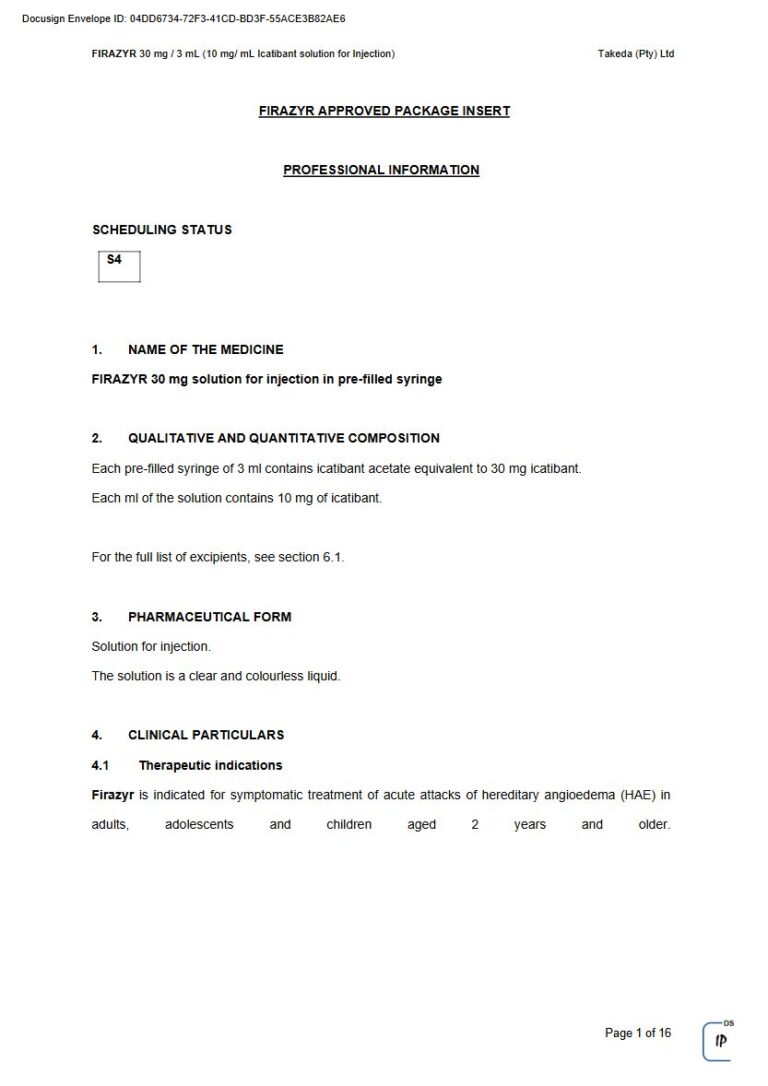
4.1 Therapeutic indications
Firazyr is indicated for symptomatic treatment of acute attacks of hereditary angioedema (HAE) in adults, adolescents and children aged 2 years and older.
4.2 Posology and method of administration
Firazyr is intended for use under the guidance of a healthcare professional.
Posology
Adults
The recommended dose for adults is a single subcutaneous injection of Firazyr 30 mg. In the majority of cases a single injection of Firazyr is sufficient to treat an attack. In case of insufficient relief or recurrence of symptoms, a second injection of Firazyr can be administered after 6 hours. If the second injection produces insufficient relief or a recurrence of symptoms is observed, a third injection of Firazyr can be administered after a further 6 hours. No more than 3 injections of Firazyr should be administered in a 24 hour period. In the clinical trials, not more than 8 injections of Firazyr per month have been administered.
Paediatric population
The recommended dose of Firazyr based on body weight in children and adolescents (aged 2 to 17 years) is provided in table 1 below.
Table 1: Dosage regimen for paediatric patients
- 12 kg to 25 kg: 10 mg (1,0 ml)
- 26 kg to 40 kg: 15 mg (1,5 ml)
- 41 kg to 50 kg: 20 mg (2,0 ml)
- 51 kg to 65 kg: 25 mg (2,5 ml)
- >65 kg: 30 mg (3,0 ml)
In the clinical trial, not more than 1 injection of Firazyr per HAE attack has been administered. No dosage regimen for children aged less than 2 years or weighing less than 12 kg can be recommended as the safety and efficacy in this paediatric group has not been established.
Elderly
Limited information is available on patients older than 65 years of age. Elderly people have been shown to have increased systemic exposure to icatibant. The relevance of this to the safety of Firazyr is unknown (see section 5.2).
Hepatic impairment
No dose adjustment is required in patients with hepatic impairment.
Renal impairment
No dose adjustment is required in patients with renal impairment.
Method of administration
Firazyr is intended for subcutaneous administration preferably in the abdominal area. Firazyr solution for injection should be injected slowly due to the volume to be administered. Each Firazyr syringe is intended for single use only. Refer to the patient information leaflet for instructions for use.
Caregiver/self-administration
The decision on initiating caregiver or self-administration of Firazyr should only be taken by a medical practitioner experienced in the diagnosis and treatment of hereditary angioedema (see section 4.4).
Adults
Firazyr may be self-administered or administered by a caregiver only after training in subcutaneous injection technique by a healthcare professional.
Children and adolescents aged 2 - 17 years
Firazyr may be administered by a caregiver only after training in subcutaneous injection technique by a healthcare professional.
4.3 Contraindications
Hypersensitivity to the active substance or to any of the excipients listed in section 6.1.
4.4 Special warnings and precautions for use
Laryngeal attacks
Patients with laryngeal attacks should be managed in an appropriate medical institution after injection until the healthcare professional considers discharge to be safe.
Ischaemic heart disease
Under ischaemic conditions, a deterioration of cardiac function and a decrease in coronary blood flow could theoretically arise from antagonism of bradykinin receptor type 2. Caution should therefore be observed in the administration of Firazyr to patients with acute ischaemic heart disease or unstable angina pectoris (see section 5.3).
Stroke
Although there is evidence to support a beneficial effect of B2 receptor blockade immediately following a stroke, there is a theoretical possibility that icatibant may attenuate the positive late phase neuroprotective effects of bradykinin. Accordingly, caution should be observed in the administration of icatibant to patients in the weeks following a stroke.
Caregiver/self-administration
For patients who have never received Firazyr previously, the first treatment should be given in a medical institution or under the guidance of a healthcare professional. In case of insufficient relief or recurrence of symptoms after self-treatment or administration by a caregiver, it is recommended that the patient or caregiver should seek medical advice. For adults, subsequent doses that may be required for the same attack should be administered within a medical institution (see section 4.2). There are no data on administering subsequent doses for the same attack in adolescents or children. Patients experiencing a laryngeal attack should always seek medical advice and be observed in a medical institution also after having taken the injection at home.
Paediatric population
There is limited experience with treatment of more than one HAE attack with Firazyr in the paediatric population.
4.5 Interaction with other medicinal products and other forms of interaction
Pharmacokinetic medicine interactions involving CYP450 are not expected (see section 5.2). Co-administration of Firazyr with angiotensin-converting-enzyme (ACE) inhibitors has not been studied. ACE inhibitors are contraindicated in HAE patients due to possible enhancement of bradykinin levels.
Paediatric population
Interaction studies have only been performed in adults.
4.6 Fertility, pregnancy and lactation
Pregnancy
For icatibant, no clinical data on exposed pregnancies are available. Animal studies showed effects on uterine implantation and parturition (see section 5.3), but the potential risk for humans is unknown. Firazyr should be used during pregnancy only if the potential benefit justifies the potential risk for the foetus (e.g., for treatment of potentially life threatening laryngeal attacks).
Breast-feeding
Icatibant is excreted in the milk of lactating rats at concentrations similar to those in maternal blood. No effects were detected in the post-natal development of rat pups. It is unknown whether icatibant is excreted in human breast milk but it is recommended that breast-feeding women, who wish to take Firazyr, should not breast-feed for 12 hours after treatment.
Fertility
In both rats and dogs, repeated use of icatibant resulted in effects on reproductive organs. Icatibant had no effect on the fertility of male mice and rats (see section 5.3). In a study of 39 healthy adult men and women treated with 30 mg every 6 hours for 3 doses every 3 days for a total of 9 doses, there were no clinically significant changes from baseline in basal and GnRH-stimulated concentration of reproductive hormones in either females or males. There were no significant effects of icatibant on the concentration of luteal phase progesterone and luteal function, or on menstrual cycle length in females and there were no significant effects of icatibant on sperm count, motility and morphology in males. The dosing regimen used for this study is unlikely to be sustained in the clinical setting.
4.7 Effects on ability to drive and use machines
Firazyr has minor influence on the ability to drive and use machines. Fatigue, lethargy, tiredness, somnolence, and dizziness have been reported following the use of Firazyr. These symptoms may occur as a result of an attack of HAE. Patients should be advised not to drive and use machines if they feel tired or dizzy.
4.8 Undesirable effects
Summary of the safety profile
In clinical studies used for registration, a total of 999 HAE attacks have been treated with 30 mg Firazyr administered subcutaneously by a healthcare professional. Firazyr 30 mg subcutaneous has been administered by a healthcare professional to 129 healthy subjects and 236 patients with HAE. Almost all subjects who were treated with subcutaneous icatibant in clinical trials developed reactions at the site of injection (characterised by skin irritation, swelling, pain, itchiness, erythema, burning sensation). These reactions were generally mild to moderate in severity, transient, and resolved without further intervention.
Tabulated list of adverse reactions
The frequency of adverse reactions listed in Table 2 is defined using the following convention: Very common (u22651/10); common (u22651/100 to <1/10); uncommon (u22651/1 000 to <1/100); rare (u22651/10 000 to <1/1 000); very rare (<1/10 000). All adverse reactions from post-marketing experience are italicised.
Table 2: Adverse reactions reported with icatibant
System Organ Class (incidence category)
Preferred Term
Nervous system disorders (Common, u22651/100 to <1/10)
- Dizziness
- Headache
Gastrointestinal disorders (Common, u22651/100 to <1/10)
- Nausea
Skin and subcutaneous tissue disorders (Common, u22651/100 to <1/10)
- Rash
- Erythema
- Pruritus
- (Unknown) Urticaria
General disorders and administration site conditions (Very Common, u22651/10)
- Injection site reactions*
(Common, u22651/100 to <1/10)
- Pyrexia
Investigations (Common, u22651/100 to <1/10)
- Transaminases increased
* Injection site bruising, Injection site hematoma, Injection site burning, Injection site erythema, Injection site hypoesthesia, Injection site irritation, Injection site numbness, Injection site edema, Injection site pain, Injection site pressure sensation, Injection site pruritus, Injection site swelling, Injection site urticaria, and Injection site warmth.
Paediatric Population
A total of 32 paediatric patients (8 children aged 2 to 11 years and 24 adolescents aged 12 to 17 years) with HAE were exposed to treatment with icatibant during clinical studies. Thirty-one patients received a single dose of icatibant and 1 patient (an adolescent) received icatibant for two HAE attacks (in total, two doses). Firazyr was administered by subcutaneous injection at a dose of 0,4 mg/kg based on body weight to a maximum dose of 30 mg. The majority of paediatric patients who were treated with subcutaneous icatibant experienced injection site reactions such as erythema, swelling, burning sensation, skin pain and itching/pruritus; these were found to be mild to moderate in severity and consistent with reactions that have been reported in adults. Two paediatric patients experienced injection site reactions which were assessed as severe and which were completely resolved within 6 hours. These reactions were erythema, swelling, burning and warm sensation. No clinically significant changes in reproductive hormones were observed during clinical studies.
Description of selected adverse reactions
Immunogenicity Across repeated treatment in adults in the controlled phase III trials, transient positivity to anti-icatibant antibodies was observed in rare cases. All patients maintained efficacy. One Firazyr-treated patient tested positive for anti-icatibant antibodies before and after treatment with Firazyr. This patient was followed for 5 months and further samples were negative for anti-icatibant antibodies. No hypersensitivity or anaphylactic reactions were reported with Firazyr.
Reporting of suspected adverse reactions
Reporting suspected adverse reactions after authorisation of the medicine is important. It allows continued monitoring of the benefit/risk balance of the medicine. Healthcare providers are asked to report any suspected adverse reactions to SAHPRA via u201c6.04 Adverse Drug Reactions Reporting Formu201d found online under SAHPRAu2019s publications: http://www.sahpra.org.za/Publications/Index/8.
4.9 Overdose
No clinical information on overdose is available. A dose of 3,2 mg/kg intravenously (approximately 8 times the therapeutic dose) caused transient erythema, itching, flushing or hypotension in healthy subjects. No therapeutic intervention was necessary.
