
Flamugo 150 G Gel
PDF Leaflet Revision Date: 20 June 2023
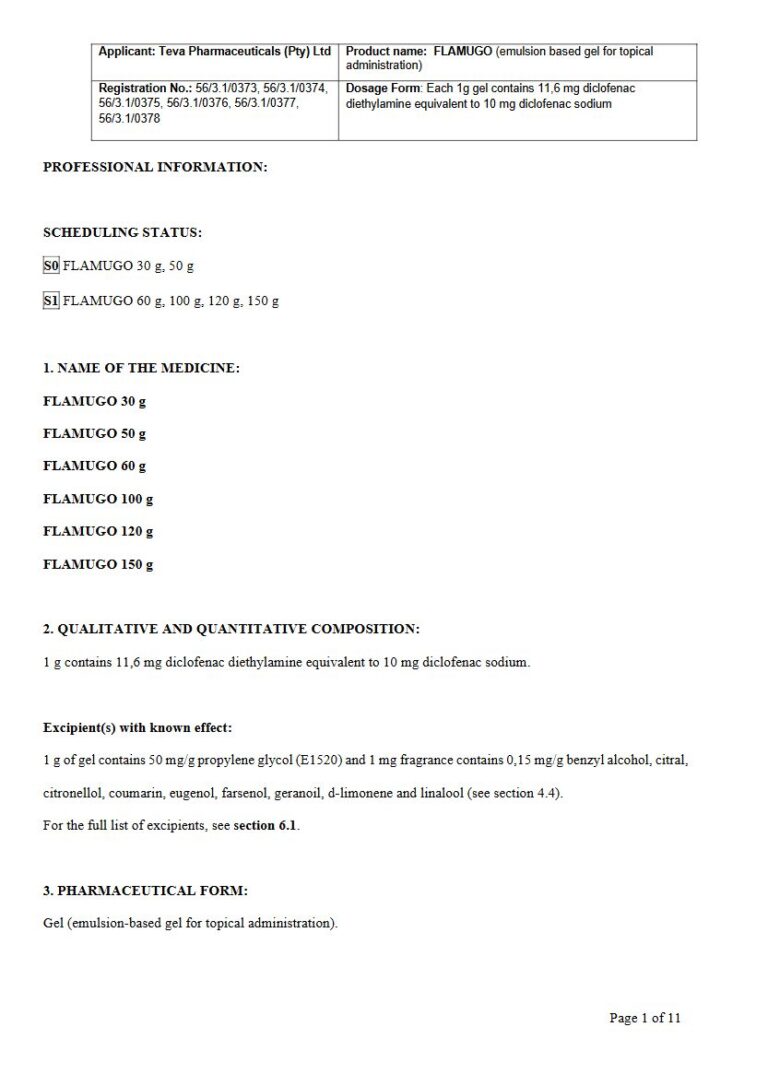
Clinical Summary
Quick overview from the medicine insert
Indication
Symptomatic relief of localized traumatic inflammation and pain.
Dosage (summary)
Apply 2 to 4 g 3 to 4 times daily to affected areas.
Special Populations
- Elderly
- Children under 12
Pregnancy & Breastfeeding
Contraindicated in third trimester; use with caution in early pregnancy and breastfeeding.
Key Drug Interactions
- Acetylsalicylic acid
- Lithium
Contraindications
- Hypersensitivity to diclofenac
- History of asthma or urticaria
- Porphyria
Common side effects
- Dermatitis
- Rash
- Erythema
- Pruritus
- Hypersensitivity
Counselling Points
- Wash hands after application
- Avoid occlusive dressings
- Limit sun exposure
Serious warnings
- Risk of serious skin reactions
- Bronchospasm in asthmatics
- Avoid contact with eyes
Important Disclaimer
The Flamugo 150 G Gel professional information leaflet below is the property of Teva Pharmaceuticals and is provided on Medinsert exactly as issued, with no.. alterations or editorial changes. We make every effort to keep content current by updating documents as soon as new versions become available. Medinsert serves as a trusted access point for healthcare professionals, but does not replace official sources or clinical judgement. For more details, please read our full disclaimer. read more>>
 Healthcare Professionals Only
This content is for registered healthcare professionals
Sign in or create a free account to read the full package insert.
Free for HPCSA-registered professionals. Powered by Medinsert.
Clinical Particulars
Section 4 of the official insert — extracted exactly as issued, no alterations
4.1 Therapeutic indications
For the symptomatic relief of localized traumatic inflammation and pain.
4.2 Posology and method of administration
Posology: Depending on the size of the painful site to be treated, apply 2 to 4 g FLAMUGO gel 3 to 4 times daily to the affected parts and rub in gently. After application, the hands should be washed, unless they are the site being treated. Patients should consult their doctor if the condition does not improve or worsens within 7 days of starting treatment. The duration of treatment depends on the indication and the response obtained. It is recommended that treatment be reviewed after 2 weeks.
Paediatric population: The safety and efficacy in children 12 years and under have not been established.
Method of administration: For cutaneous use only.
4.3 Contraindications
- hypersensitivity to diclofenac, acetylsalicylic, other non-steroidal anti-inflammatory drugs or to any of the excipients listed in section 6.1
- patients with a history of hypersensitivity reactions, such as asthma, urticaria, acute rhinitis or angioedema in response to acetylsalicylic acid or non-steroidal anti-inflammatory drugs (NSAIDS)
- in the third trimester of pregnancy (see section 4.6)
- in patients with porphyria.
4.4 Special warnings and precautions for use
The possibility of systemic undesirable effects those associated with the use of systemic forms of diclofenac from application of topical FLAMUGO cannot be excluded if the preparation is used on large areas of skin and over a prolonged period (see Professional Information on systemic forms of diclofenac, e.g oral or injection).
Concomitant use of systemic NSAIDs should be cautioned since the possibility of an increase in incidence of untoward effects, particularly systemic side effects, cannot be ruled out.
FLAMUGO can precipitate bronchospasm if administered to patients suffering from or with a previous history of bronchial asthma.
Serious skin reactions, some of fatal, including exfoliative dermatitis, Stevens-Johnson syndrome, and toxic epidermal necrolysis have been reported. FLAMUGO should be discontinued at the first appearance of skin rash, mucosal lesions, or any other sign of hypersensitivity.
FLAMUGO must only be applied to intact, not diseased or injured skin. FLAMUGO must not come into contact with eyes and mucous membranes and should not be ingested. Discontinue FLAMUGO treatment if a skin rash develops after application.
Occlusion can lead to an increase in the amount of diclofenac absorbed and may thus cause an increase in side effects. FLAMUGO topical gel may be used with a non-occlusive bandage but not with an airtight occlusive dressing (see section 5.2).
Some possibility of gastro-intestinal bleeding in those with a significant history of this condition has been reported in isolated cases.
Patients should be warned against excessive exposure to sunlight in order to reduce the incidence of photosensitivity.
Instruct patients not to smoke or go near naked flames - risk of severe burns. Fabric (clothing, bedding, dressings etc) that has been in contact with FLAMUGO burns more easily and is a serious fire hazard. Washing clothing and bedding may reduce product build-up but not totally remove it.
FLAMUGO contains fragrance with benzyl alcohol (0,15 mg/g), citral, citronellol, coumarin, eugenol, farnesol, geraniol, d-limonene and linalool which may cause allergic reactions. In addition, benzyl alcohol may cause mild local irritation.
4.5 Interaction with other medicines and other forms of interaction
Since the systemic absorption of diclofenac is very low with topical application, interactions are very unlikely in use as intended. The bioavailability of FLAMUGO is reduced by acetylsalicylic acid, and that of acetylsalicylic acid by FLAMUGO, when the two medicines are administered together. When given concomitantly with lithium, non-steroidal anti-rheumatic medicines raise the concentration of lithium in the blood.
4.6 Fertility, pregnancy and lactation
The safety of FLAMUGO in pregnancy and lactation has not been established.
Pregnancy: The systemic concentration of diclofenac is lower after topical administration, compared to oral formulations. With reference to experience from treatment with NSAIDs with systemic uptake, the following is recommended: Inhibition of prostaglandin synthesis may adversely affect the pregnancy and/or the embryo/foetal development. Data from epidemiological studies suggest an increased risk of miscarriage and of cardiac malformation and gastroschisis after use of a prostaglandin synthesis inhibitor in early pregnancy. The absolute risk for cardiovascular malformation was increased from less than 1 %, up to approximately 1,5 %. The risk is believed to increase with dose and duration of therapy. In animals, administration of a prostaglandin synthesis inhibitor has been shown to result in increased pre-and post-implantation loss and embryo-foetal lethality. In addition, increased incidences of various malformations, including cardiovascular, have been reported in animals given a prostaglandin synthesis inhibitor during the organogenetic period.
If FLAMUGO is used by a woman attempting to conceive, or during the first and second trimester of pregnancy, the dose should be kept as low and duration of treatment as short as possible.
During the third trimester of pregnancy, FLAMUGO may expose the foetus to:
- cardiopulmonary toxicity (with premature closure of the ductus arteriosus and pulmonary hypertension)
- renal dysfunction, which may progress to renal failure with oligo hydroamniosis
the mother and the neonate, at the end of pregnancy to:
- possible prolongation of bleeding time, an anti-aggregating effect which may occur even at very low doses
- inhibition of uterine contractions resulting in delayed or prolonged labour.
Consequently, FLAMUGO is contraindicated during the third trimester of pregnancy.
Breastfeeding: Diclofenac passes into breast milk in small amounts. However, at therapeutic doses of FLAMUGO no effects on the breast-fed child are anticipated. Because of a lack of controlled studies in breast-feeding women, FLAMUGO should only be used during breastfeeding under advice from a healthcare professional. Under this circumstance, FLAMUGO should not be applied on the breasts of breastfeeding mothers, nor elsewhere on large areas of skin or for a prolonged period of time (see section 4.4).
Fertility: There are no data available on the use of topical formulations of diclofenac such as FLAMUGO and its effects on fertility in humans.
4.7 Effects on ability to drive and use machines
The cutaneous application of FLAMUGO has no or negligible influence on the ability to drive and use machines.
4.8 Undesirable effects
System Organ Class Adverse reaction and frequency
Infections and infestations: Less frequent : Rash pustular.
Immune system disorders: Less frequent: Hypersensitivity (including urticaria), angioedema.
Respiratory, thoracic and mediastinal disorders: Less frequent : Asthma.
Skin and subcutaneous tissue disorders: Frequent : Dermatitis (including contact dermatitis), rash, erythema, eczema, pruritus. Less frequent : Desquamation, skin discolouration, dermatitis bullous, photosensitivity reaction.
Reporting of suspected adverse reactions: Reporting suspected adverse reactions after authorisation of the medicine is important. It allows continued monitoring of the benefit/risk balance of the medicine. Healthcare providers are asked to report any suspected adverse reactions to SAHPRA via the Adverse drug reaction and quality problem reporting form found online under SAHPRAu2019s publications : https://www.sahpra.org.za/document/adverse-drug-reactions-and-quality-problem-reporting-form/
4.9 Overdose
Signs and symptoms: The low systemic absorption of FLAMUGO renders overdose very unlikely. However, undesirable effects, similar to those observed following an overdose of diclofenac tablets, can be expected if FLAMUGO is inadvertently ingested (e.g. 1 tube of 100 g contains the equivalent of 1000 mg of diclofenac sodium).
Treatment: Management of overdosage with FLAMUGO essentially consists of supportive and symptomatic measures. There is no typical clinical picture resulting from FLAMUGO overdosage. Supportive and symptomatic treatment should be given for complications such as hypotension, renal failure, convulsions, gastrointestinal irritation, and respiratory depression; specific therapies such as forced diuresis, dialysis or haemoperfusion are probably of no help in eliminating NSAIDs such as contained in FLAMUGO due to their high rate of protein binding and extensive metabolism.
In the event of accidental ingestion, resulting in significant systemic adverse effects, general therapeutic measures normally adopted to treat poisoning with non-steroidal anti-inflammatory drugs should be used. The use of activated charcoal should be considered, especially within a short time (within one hour) of ingestion of a toxic dose.
