
Fludarabine 2 ml Solution
PDF Leaflet Revision Date: 16 May 2025
Clinical Summary
Quick overview from the medicine insert
Indication
Treatment of B-cell chronic lymphocytic leukaemia.
Dosage (summary)
25 mg/mu00b2 daily for 5 days every 28 days, IV.
Special Populations
- Renal impairment
- Elderly (>75 years)
- Paediatric population
Pregnancy & Breastfeeding
Contraindicated in pregnancy and breastfeeding; teratogenic.
Key Drug Interactions
- Allopurinol
- Colchicine
- Probenecid
- Bone marrow depressants
- Corticosteroids
Contraindications
- Hypersensitivity to fludarabine
- Severe renal impairment (creatinine clearance <30 ml/min)
- Haemolytic anaemia
- Chickenpox or herpes zoster
Common side effects
- Anaemia
- Neutropenia
- Thrombocytopenia
- Nausea
- Skin rash
Counselling Points
- Avoid pregnancy during treatment and for 6 months after.
- Use effective contraception.
- Monitor for signs of infection and bleeding.
Serious warnings
- Severe neurotoxicity
- Transfusion-associated graft-versus-host disease
- Myelosuppression
Important Disclaimer
The Fludarabine 2 ml Solution professional information leaflet below is the property of Teva Pharmaceuticals and is provided on Medinsert exactly as issued, with no.. alterations or editorial changes. We make every effort to keep content current by updating documents as soon as new versions become available. Medinsert serves as a trusted access point for healthcare professionals, but does not replace official sources or clinical judgement. For more details, please read our full disclaimer. read more>>
 Healthcare Professionals Only
This content is for registered healthcare professionals
Sign in or create a free account to read the full package insert.
Free for HPCSA-registered professionals. Powered by Medinsert.
Clinical Particulars
Section 4 of the official insert — extracted exactly as issued, no alterations
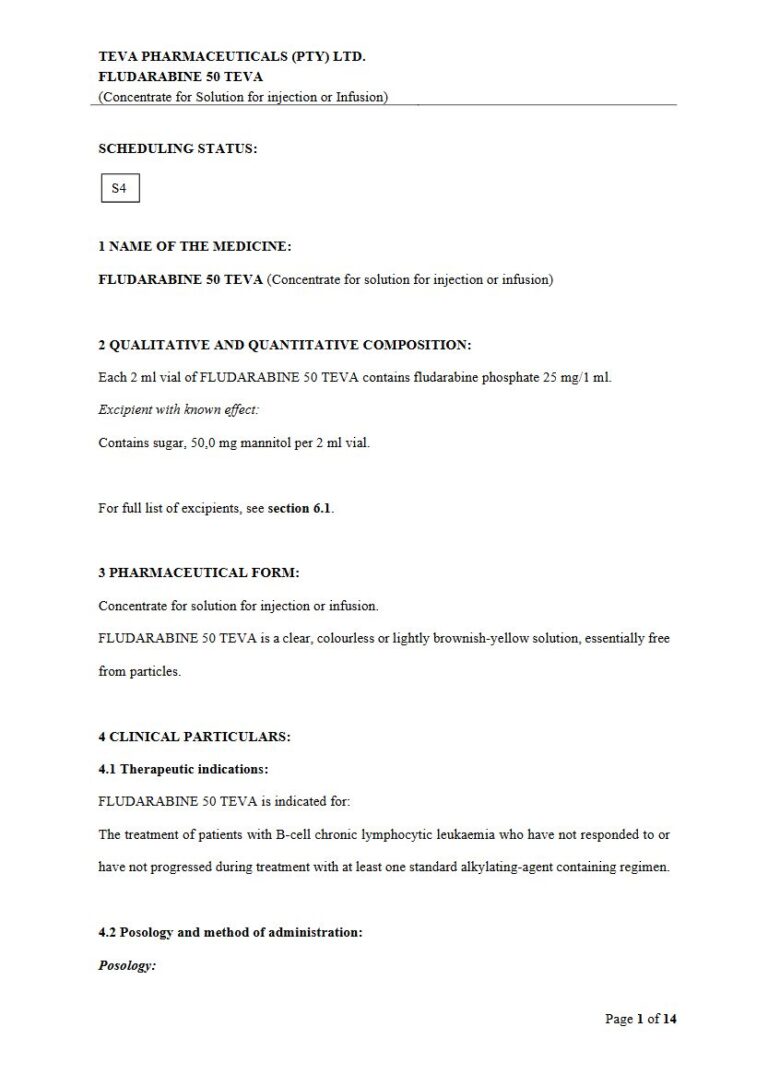
4.1 Therapeutic indications
FLUDARABINE 50 TEVA is indicated for:
The treatment of patients with B-cell chronic lymphocytic leukaemia who have not responded to or have not progressed during treatment with at least one standard alkylating-agent containing regimen.
4.2 Posology and method of administration
Posology:
Adults: The recommended dose is 25 mg/mu00b2 body surface given daily for 5 consecutive days every 28 days by the intravenous route. The dose should not be exceeded as severe neurotoxicity may occur. The required dose (calculated on the basis of the patientu2019s body surface) is drawn up into a syringe. For intravenous bolus injection this dose is further diluted into 10 ml of physiological saline. Alternatively, the required dose drawn up in a syringe may be diluted into 100 ml physiological saline and infused over approximately 30 minutes. Depending on the treatment success and the tolerability of the medicine, FLUDARABINE 50 TEVA should be administered in chronic lymphocytic leukaemia patients up to the achievement of best response (complete or partial remission, usually 6 cycles) and then the medicine should be discontinued.
Special populations:
Renal impairment: Doses should be adjusted for patients with reduced kidney function. If creatinine clearance is between 30 and 70 ml/min, the dose should be reduced by up to 50 % and close haematological monitoring should be used to assess toxicity. For further information see section 4.4. FLUDARABINE 50 TEVA treatment is contraindicated if creatinine clearance is <30 ml/min (see section 4.3).
Elderly: Caution should be exercised with the administration of FLUDARABINE 50 TEVA in elderly persons (>75 years), since there are limited data for the use of FLUDARABINE 50 TEVA in this patient group.
Paediatric population: The safety and effectiveness of FLUDARABINE 50 TEVA in children has not been established (see section 4.3).
Method of administration: FLUDARABINE 50 TEVA should be administered under the supervision of a qualified medical practitioner experienced in the use of antineoplastic therapy. It is strongly recommended that FLUDARABINE 50 TEVA should be only administered intravenously. Unintentional paravenous administration must be avoided. For instructions on handling and reconstitution of the medicine before administration, see section 6.6.
4.3 Contraindications
- Hypersensitivity to fludarabine or to any of the excipients of FLUDARABINE 50 TEVA listed in section 6.1
- Pregnancy and breastfeeding (see section 4.6)
- Severe renal function impairment (patients with creatinine clearance <30 ml/minute) (see section 4.3)
- Haemolytic anaemia
- Chickenpox or herpes zoster
- The safety and effectiveness of FLUDARABINE 50 TEVA in children has not been established.
4.4 Special warnings and precautions for use
Transfusion - associated graft - versus - host disease: Transfusion-associated graft-versus-host disease (reaction by the transfused immunocompetent lymphocytes to the host) has been observed rarely after transfusion of non-irradiated blood in FLUDARABINE 50 TEVA treated patients. Fatal outcome as a consequence of this disease has been reported with a high frequency. Therefore patients who require blood transfusion and who are undergoing, or who have received, treatment with FLUDARABINE 50 TEVA should receive irradiated blood only.
FLUDARABINE 50 TEVA is teratogenic.
Renal impairment: FLUDARABINE 50 TEVA treatment is contraindicated if creatinine clearance is <30 ml/minute (see section 4.3). The total body clearance of the principal plasma metabolite 2-F-ara-A shows a correlation with creatinine clearance, indicating the importance of the renal excretion pathway for the elimination of the compound. Therefore, if renal impairment is clinically suspected, or in patients over the age of 70 years, creatinine clearance should be measured. If creatinine clearance is between 30 and 70 ml/min, the dose should be reduced by up to 50 % and close haematological monitoring should be used to assess toxicity.
Neurotoxicity: Patients should be closely observed for signs of neurologic side-effects. The effect of chronic administration of FLUDARABINE 50 TEVA on the central nervous system is unknown.
Impaired state of health: In patients with impaired state of health, FLUDARABINE 50 TEVA should not be given. This applies especially for patients with severe impairment of bone marrow function (thrombocytopenia, anaemia, and/or granulocytopenia), immunodeficiency or with a history of opportunistic infection.
Myelosuppression: Severe bone marrow suppression, notably anaemia, thrombocytopenia and neutropenia, has been reported in patients treated with FLUDARABINE 50 TEVA. While chemotherapy-induced myelosuppression is often reversible, administration of FLUDARABINE 50 TEVA requires careful haematologic monitoring. FLUDARABINE 50 TEVA is a potent antineoplastic medicine with potentially significant toxic side-effects. Patients undergoing therapy should be closely observed for signs of haematologic and non-haematologic toxicity. Periodic assessment of peripheral blood counts is recommended to detect the development of anaemia, neutropenia and thrombocytopenia.
Skin cancer lesions: In some patients during or after FLUDARABINE 50 TEVA therapy, reversible worsening or flare up of pre-existing skin cancer lesions has been reported.
Tumour lysis syndrome: Tumour lysis syndrome associated with FLUDARABINE 50 TEVA treatment has been reported in patients with large tumour burdens. Since FLUDARABINE 50 TEVA can induce a response as early as the first week of treatment, precautions should be taken in those patients at risk of developing this complication.
Autoimmune phenomena: Patients undergoing treatment with FLUDARABINE 50 TEVA should be closely monitored for signs of autoimmune haemolytic anaemia (decline in haemoglobin linked with haemolysis and positive Coombs test). Discontinuation of therapy with FLUDARABINE 50 TEVA is recommended in the case of haemolysis. Blood transfusion (irradiated) and adrenocorticoid preparations are the most common treatment measures for autoimmune haemolytic anaemia.
The elderly: Caution should be exercised with the administration of FLUDARABINE 50 TEVA in elderly persons (>75 years), since there are limited data for the use of FLUDARABINE 50 TEVA in this patient group (see section 4.2).
4.5 Interaction with other medicines and other forms of interaction
FLUDARABINE 50 TEVA may have interactions with the following medicines:
- Allopurinol
- Colchicine
- Probenecid
- Sulfinpyrazone
- Bone marrow depressants
- Dipyridamole and other inhibitors of adenosine uptake
- Pentostatin
- Corticosteroids
- Aminoglycosides
Immunisation (using of vaccines) by patients using FLUDARABINE 50 TEVA should generally be avoided. It should only be undertaken with extreme caution after careful review of the patientu2019s haematologic status and only with the knowledge and consent of the medical practitioner managing the FLUDARABINE 50 TEVA therapy. The interval between discontinuation of FLUDARABINE 50 TEVA and restoration of the patientu2019s ability to respond to the vaccine depends on the intensity and type of immunosuppression-causing medication used, the underlying disease and other factors; estimates vary from 3 months to 1 year.
4.6 Fertility, pregnancy and lactation
Women of childbearing potential / Contraception in males and females: Women of childbearing potential should be advised not to become pregnant. FLUDARABINE 50 TEVA is considered teratogenic (see section 4.4). Women should use effective contraceptive measures during treatment and for 6 months after stopping treatment. Men are recommended to use effective contraceptive measures and to not father a child while receiving FLUDARABINE 50 TEVA and for 3 months following completion of treatment.
Pregnancy: FLUDARABINE 50 TEVA is contraindicated during pregnancy (see section 4.3).
Breastfeeding: FLUDARABINE 50 TEVA is contraindicated during lactation (see section 4.3). It is not known if FLUDARABINE 50 TEVA is excreted in breastmilk. Because of the potential for serious adverse reactions in infants, breastfeeding should be discontinued before starting treatment with FLUDARABINE 50 TEVA.
Fertility: Due to the genotoxic risk of fludarabine phosphate women of childbearing potential must be apprised of the potential hazard to the foetus.
4.7 Effects on ability to drive and use machines
FLUDARABINE 50 TEVA has minor or moderate influence on the ability to drive and use machines. Headaches, blurred vision and nausea have been reported during treatment with FLUDARABINE 50 TEVA, for this reason the patient should refrain from driving or using machines until the effects of FLUDARABINE 50 TEVA have been established.
4.8 Undesirable effects
Blood and lymphatic system disorders:
Frequent: Anaemia, leukopenia or neutropenia (black tarry stools, unusual bleeding or bruising, sores, ulcers or white spots on lips or in mouth), thrombocytopenia.
Less Frequent: Haemorrhage (bleeding gums, coughing up blood, prolonged bleeding from cuts), haemolytic anaemia, epistaxis.
Frequency unknown: Pancytopenia.
Gastrointestinal disorders:
Frequent: Gastro-intestinal bleeding (bloody or black tarry stools), diarrhoea, nausea or vomiting, stomatitis.
Less Frequent: Constipation, cholelithiasis, dysphagia, oesophagitis, mucositis.
Skin and subcutaneous tissue disorders:
Frequent: Skin rash.
Less Frequent: Pruritus, seborrhoea, loss of hair, Stevens-Johnson syndrome or toxic epidermal necrolysis.
Psychiatric disorders:
Frequent: Depression.
Nervous system disorders:
Frequent: Paraesthesia.
Less Frequent: Neurological effects including agitation or confusion, peripheral neuropathy and delayed neurological effects (blindness or coma), sleep disorder, life-threatening neurotoxicity.
Frequency unknown: Multifocal leukoencephalopathy, demyelinating disease.
Musculoskeletal and connective tissue disorders:
Frequent: Myalgia.
Less Frequent: Arthralgia, osteoporosis.
Respiratory, thoracic and mediastinal disorders:
Frequent: Haemoptysis, pneumonia, allergic pneumonitis, cough, dyspnoea, pharyngitis.
Less Frequent: Sinusitis, bronchitis, hypoxaemia resulting in hypoxia.
Frequency unknown: Severe pulmonary toxicity, pneumocystis pneumonia, fibrosis.
Eye disorders:
Less Frequent: Blurred vision, optic neuritis, optic neuropathy and blindness.
Vascular disorders:
Frequent: Oedema.
Less Frequent: Cerebrovascular accident, deep vein thrombosis, hypoxia, phlebitis.
Metabolism and nutrition disorders:
Frequent: Anorexia, hyperglycaemia, dehydration.
Less Frequent: Hyperphosphatemia, hypocalcaemia, metabolic acidosis, hyperkalaemia.
Ear and labyrinth disorders:
Less Frequent: Loss of hearing.
Renal and urinary disorders:
Frequent: Urinary infection.
Less Frequent: Haematuria, urinary hesitancy, haemorrhagic cystitis, urate crystalluria, tumour lysis syndrome including hyperuricemia, renal failure, dysuria, proteinuria.
Infections and infestations:
Frequency unknown: Listeriosis, mycobacterial infections and opportunistic fungal and viral infections.
Hepato-biliary disorders:
Less Frequent: Liver failure.
Frequency unknown: Changes in hepatic and pancreatic enzyme levels.
Cardiac disorders:
Frequent: Angina.
Less Frequent: Aneurysm, dysrhythmia, congestive heart failure, supraventricular tachycardia.
General disorders and administration site conditions:
Frequent: Pain, chills, diaphoresis, fatigue, fever, malaise, weakness.
Less frequent: Anaphylaxis, headache.
Reporting of suspected adverse reactions: Reporting suspected adverse reactions after authorisation of the medicine is important. It allows continued monitoring of the benefit/risk balance of the medicine. Healthcare providers are asked to report any suspected adverse reactions to SAHPRA via the u201c6.04 Adverse Drug Reactions Reporting Formu201d, found online under SAHPRAu2019s publications: https://www.sahpra.org.za/Publications/Index/8.
4.9 Overdose
There is no known specific antidote for FLUDARABINE 50 TEVA. High doses of FLUDARABINE 50 TEVA have been associated with an irreversible central nervous system toxicity characterised by delayed blindness, coma, and death. High doses are also associated with severe thrombocytopenia and neutropenia due to bone marrow suppression. Treatment consists of discontinuation of treatment and supportive therapy.
