
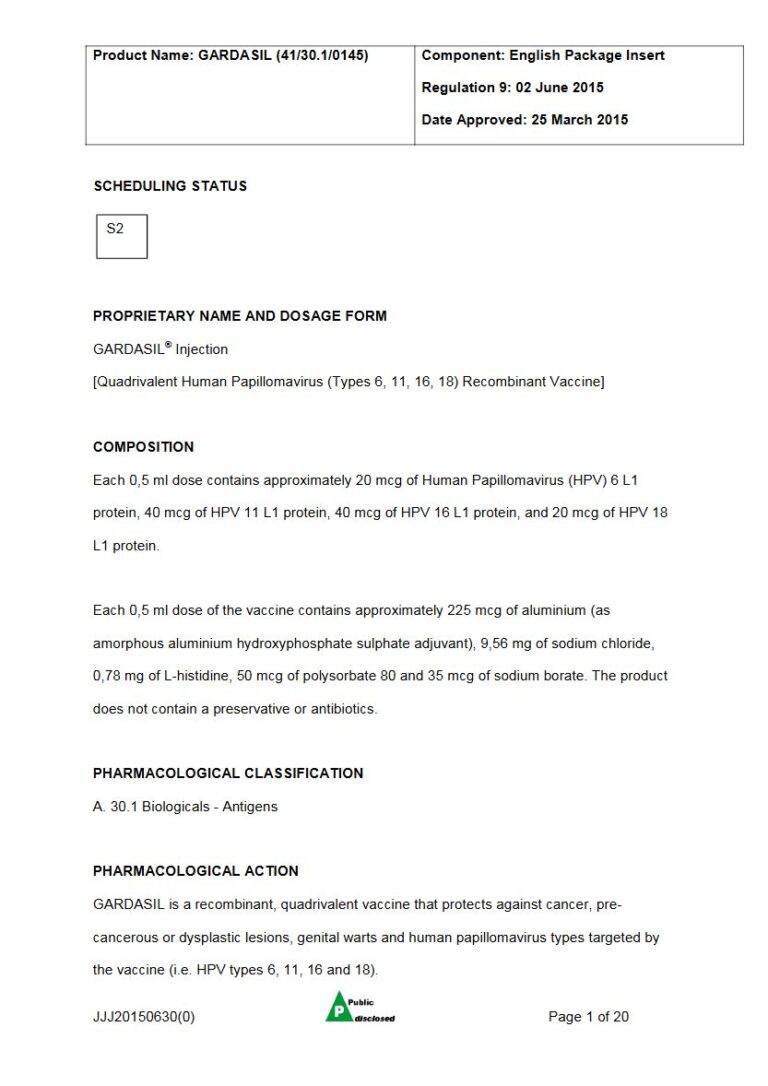
Gardasil 20 mcg Injection
PDF Leaflet Revision Date: 02 June 2015
Clinical Summary
Quick overview from the medicine insert
Indication
Prevention of cervical, vulvar, vaginal, and anal cancers, genital warts, and HPV infections.
Dosage (summary)
3 doses of 0.5 ml IM: 0, 2, and 6 months; 2 doses for ages 9-13.
Special Populations
- HIV-infected individuals
- Elderly (above 45 years)
- Children under 9 years
Pregnancy & Breastfeeding
Safety not established; avoid during pregnancy; may be given during lactation.
Key Drug Interactions
- Concomitant use with hepatitis B vaccine
- Analgesics
- Anti-inflammatory drugs
Contraindications
- Hypersensitivity to vaccine components
Common side effects
- Headache
- Dizziness
- Nausea
- Erythema
- Pain at injection site
Counselling Points
- Complete vaccination course
- Monitor for 15 mins post-injection
- Inform about potential side effects
Serious warnings
- Caution in individuals with coagulation disorders
- Risk of anaphylaxis
- Not for treatment of active HPV diseases
Important Disclaimer
The Gardasil 20 mcg Injection professional information leaflet below is the property of Msd and is provided on Medinsert exactly as issued, with no.. alterations or editorial changes. We make every effort to keep content current by updating documents as soon as new versions become available. Medinsert serves as a trusted access point for healthcare professionals, but does not replace official sources or clinical judgement. For more details, please read our full disclaimer. read more>>
 Healthcare Professionals Only
This content is for registered healthcare professionals
Sign in or create a free account to read the full package insert.
Free for HPCSA-registered professionals. Powered by Medinsert.
Clinical Particulars
Section 4 of the official insert — extracted exactly as issued, no alterations
4.1 Therapeutic indications
GARDASIL is a vaccine indicated in girls and women 9 through 45 years for the prevention of cervical, vulvar, vaginal and anal cancer, pre-cancerous or dysplastic lesions, genital warts and infections caused by the Human Papillomavirus (HPV).
GARDASIL is indicated to prevent the following diseases:
- Cervical, vulvar, vaginal and anal cancer caused by HPV types 16 and 18.
- Genital warts (condyloma acuminata) caused by HPV 6 and 11.
- And infections and the following pre-cancerous or dysplastic lesions caused by HPV types 6, 11, 16 and 18:
- Cervical intraepithelial neoplasia (CIN) grade 2 and 3 and Cervical adenocarcinoma in situ (AIS).
- Cervical intraepithelial neoplasia (CIN) grade 1.
- Vulvar intraepithelial neoplasia (VIN) grade 2 and grade 3.
- Vaginal intraepithelial neoplasia (VaIN) grade 2 and grade 3.
- VIN grade 1 and VaIN grade 1.
- Anal intraepithelial neoplasia (AIN) grades 1, 2 and 3.
GARDASIL also provides protection in girls and women 9 through 26 years of age against HPV 31-, 33-, 52- and 58-related CIN grades.
4.2 Posology and method of administration
GARDASIL should be administered as soon as possible after being removed from refrigeration.
Dosage
GARDASIL should be administered intramuscularly as 3 separate 0,5 ml doses according to the following schedule:
- First dose: At elected date.
- Second dose: 2 months after the first dose.
- Third dose: 6 months after the first dose.
Individuals are encouraged to adhere to the 0, 2, and 6 months vaccination schedule. However in clinical studies, efficacy has been demonstrated in individuals who have received all 3 doses within a 1-year period. The second dose should be administered at least 1 month after the first dose, and the third dose should be administered at least 3 months after the second dose. All three doses should be given within a 1-year period.
Alternatively, in individuals 9 through 13 years of age, GARDASIL can be administered according to a 2-dose (0, 6 months or 0, 12 months) schedule.
The use of GARDASIL should be in accordance with official recommendations.
It is recommended that individuals who receive a first dose of GARDASIL complete the vaccination course with GARDASIL. The need for a booster dose has not been established.
Method of Administration
GARDASIL should be administered intramuscularly in the deltoid region of the upper arm or in the higher anterolateral area of the thigh. GARDASIL must not be injected intravascularly. Neither subcutaneous nor intradermal administration has been studied. These methods of administration are not recommended.
The pre-filled syringe is for single use only and should not be used for more than one individual. For single-use vials, a separate sterile syringe and needle must be used for each individual. The vaccine should be used as supplied; no dilution or reconstitution is necessary. The full recommended dose of the vaccine should be used. Shake well before use. Thorough agitation immediately before administration is necessary to maintain suspension of the vaccine. After thorough agitation, GARDASIL is a white, cloudy liquid. Parenteral drug products should be inspected visually for particulate matter and discoloration prior to administration. Discard the product if particulates are present or if it appears discoloured.
4.3 Contraindications
Hypersensitivity to the active substances or to any of the excipients of the vaccine. Individuals who develop symptoms indicative of hypersensitivity after receiving a dose of GARDASIL should not receive further doses of GARDASIL.
4.4 Special warnings and precautions for use
This vaccine should not be used interchangeably with other Human Papillomavirus (HPV) vaccines (as such use has not been studied). This vaccine should be given with caution to individuals with either thrombocytopenia or any coagulation disorder because bleeding may occur following an intramuscular administration in these individuals.
Appropriate medical treatment should always be readily available in case of anaphylactic reactions following the administration of GARDASIL.
General
Vaccination with GARDASIL may not result in protection in all vaccine recipients. This vaccine is not intended to be used for treatment of active external genital lesions; cervical, vulvar, vaginal or anal cancers; CIN, VIN, VaIN or AIN. GARDASIL will not protect against diseases that are not caused by HPV. Syncope (fainting) may follow any vaccination, especially in adolescents and young adults. Syncope, sometimes associated with falling, has occurred after vaccination with GARDASIL. Therefore, vaccinees should be carefully observed for approximately 15 minutes after administration of GARDASIL (see u201cSIDE EFFECTS, Post-Marketing Reportsu201d). The decision to administer or delay vaccination, because of a current or recent febrile illness depends largely on the severity of the symptoms and their aetiology. Low-grade fever itself and mild upper respiratory infection are not generally contra-indications to vaccination. Individuals with impaired immune responsiveness, whether due to the use of immunosuppressive therapy, a genetic defect, Human Immunodeficiency Virus (HIV) infection, or other causes, may have reduced antibody response to active immunisation (see u201cINTERACTIONSu201d).
4.5 Interactions with other medicines
Use with Other Vaccines
Results from clinical studies indicate that GARDASIL may be administered concomitantly (at a separate injection site) with hepatitis B vaccine (recombinant).
Use with Common Medications
In clinical studies for girls and women (aged 16 to 26 years), 11,9 %, 9,5 %, 6,9 %, and 4,3 % of individuals used analgesics, anti-inflammatory drugs, antibiotics and vitamin preparations, respectively. In a clinical study in women (aged 24 to 45 years), 30,6 %, 20,2 %, 11,6 %, and 7,5 % of individuals used analgesics, anti-inflammatory drugs, antibiotics, and vitamin preparations, respectively. Conversely in a clinical study in boys and men (aged 16 to 26 years), 10,3 %, 7,8 %, 6,8 %, 3,4 % and 2,6 % of individuals used analgesics, anti-inflammatory drugs, antibiotics, antihistamines, and vitamin preparations, respectively. The efficacy, immunogenicity, and safety of the vaccine were not impacted by the use of these medications.
Use with Hormonal Contraceptives
In clinical studies, 50,2 % of women (aged 16 to 45 years) who received GARDASIL used hormonal contraceptives during the vaccination period. Use of hormonal contraceptives did not appear to affect the immune responses to GARDASIL.
Use with Steroids
In clinical studies for girls and women (aged 16 to 26 years), 1,7 % (n=158), 0,6 % (n=56), and 1,0 % (n=89) of individuals used inhaled, topical, and parenteral immunosuppressants, respectively. In a clinical study in women (aged 24 to 45 years), 1,4 % (n=27) used corticosteroids for systemic use. In a clinical study in boys and men (aged 16 to 26 years), 1,0 % (n=21) used corticosteroids for systemic use. The corticosteroids for all individuals were administered close to the time of administration of a dose of GARDASIL. These medicines did not appear to affect the immune responses to GARDASIL. Very few individuals in the clinical studies were taking steroids, and the amount of immunosuppression is presumed to have been low.
Use with Systemic Immunosuppressive Medications
There are no data on the concomitant use of potent immunosuppressants with GARDASIL. Individuals receiving therapy with immunosuppressive agents (systemic doses of corticosteroids, anti-metabolites, alkylating agents, cytotoxic agents) may not respond to active immunisation (see u201cWARNINGS AND SPECIAL PRECAUTIONS, Generalu201d).
4.6 Fertility, pregnancy and lactation
Safety in pregnancy and lactation has not been established in well-controlled clinical studies.
Pregnancy
Studies in Female Rats
Animal studies do not indicate direct or indirect harmful effects with respect to pregnancy, embryonic/foetal development, parturition or postnatal development. GARDASIL induced a specific antibody response against HPV Types 6, 11, 16 and 18 in pregnant rats, and antibodies against all 4 HPV types were transferred to the offspring during gestation and possibly during lactation.
Clinical Studies in Humans
There are however, no adequate and well-controlled studies in pregnant women. Because animal reproduction studies are not always predictive of human response, pregnancy should be avoided during the vaccination regimen for GARDASIL. Women who are found to be pregnant before completion of a 3-dose regimen of GARDASIL should be instructed to defer completion of their vaccination regimen until resolution of the pregnancy. During clinical trials, 3 819 women (vaccine n=1 894 vs. placebo n=1 925) reported at least one pregnancy. The overall proportions of pregnancies that resulted in an adverse outcome defined as the combined numbers of spontaneous abortion, late foetal death and congenital anomaly cases out of the total number of pregnancy outcomes for which an outcome was known (and excluding elective terminations), were 22,6 % (446/1 973) in individuals who received GARDASIL and 23,1 % (460/1 994) in individuals who received placebo.
Further sub-analyses were done to evaluate pregnancies with estimated onset within 30 days, or more than 30 days from administration of a dose of GARDASIL or placebo. For pregnancies with estimated onset within 30 days of vaccination, 5 cases of congenital anomaly were observed in the group that received GARDASIL, compared to 1 case of congenital anomaly in the group that received placebo. Conversely, in pregnancies with onset more than 30 days following vaccination, 40 cases of congenital anomaly were observed in the group that received GARDASIL, compared with 33 cases of congenital anomaly in the group that received placebo. The types of anomalies observed were consistent (regardless of when pregnancy occurred in relation to vaccination) with those generally observed in pregnancies in women aged 16 through 45 years. Thus, there is no evidence to suggest that administration of GARDASIL adversely affects fertility, pregnancy or infant outcomes.
Lactation
It is not known whether vaccine antigens or antibodies induced by the vaccine are excreted in human milk. Because many pharmaceutical products are excreted in human milk, caution should be exercised when GARDASIL is administered to a nursing woman. GARDASIL may be administered to lactating women. GARDASIL or placebo were given to a total of 1 133 women who were breastfeeding at any time during the relevant Phase III clinical studies. In these studies, the rates of adverse experiences in the mother and the nursing infant were comparable between vaccination groups. In addition, vaccine immunogenicity was comparable among nursing mothers and women who did not nurse during the vaccine administration.
4.8 Undesirable effects
In 7 clinical trials (6 placebo-controlled), individuals were administered GARDASIL or placebo on the day of enrollment, and approximately 2 and 6 months thereafter. Few individuals (0,2 %) discontinued due to adverse experiences. In all except one of the clinical trials, safety was evaluated using vaccination report card (VRC)-aided surveillance for 14 days after each injection of GARDASIL or placebo. The individuals who were monitored using VRC-aided surveillance, included 10 088 individuals (6 995 females 9 through 45 years of age and 3 093 boys and men 9 through 26 years of age at enrollment) who received GARDASIL, and 7 995 individuals who received placebo.
The vaccine-related adverse experiences that were observed among recipients of GARDASIL at a frequency of at least 1,0 %, and also at a greater frequency than that observed among placebo recipients are listed according to frequency and system organ class.
The frequency classifications are as follows: Very Common (u2265 1/10); Common (u2265 1/100, < 1/10); Uncommon (u2265 1/1 000, < 1/100); Rare (u2265 1/10 000, < 1/1 000); Very Rare (< 1/10 000)
Vaccine-Related Adverse Experiences in 9 through 45 Year-Old Girls and Women
Nervous system disorders
Very common : Headache
Common: Dizziness
Gastrointestinal disorders
Common: Nausea
Musculoskeletal and connective tissue disorders
Common: Pain in extremity
General disorders and administration site conditions
Common: Pyrexia
Injection site reactions
Very common : Erythema, pain and swelling.
Common: Pruritus and haematoma
Most injection site reactions were mild to moderate. In addition, bronchospasm was reported very rarely as a serious adverse experience.
Vaccine-Related Adverse Experiences in 9 through 26 Year-Old Boys and Men
Nervous system disorders
Common: Headache
General disorders and administration site conditions: Common: Pyrexia
Injection site reactions
Very common: Erythema, pain and swelling.
Common: Haematoma
Most injection site reactions were mild to moderate.
4.9 Overdose
There have been reports of administration of higher than recommended doses of GARDASIL. In general, the adverse event profile reported with overdose was comparable to recommended single doses of GARDASIL.
