
Gavreto 100 mg Capsule
PDF Leaflet Revision Date: 17 October 2023
Clinical Summary
Quick overview from the medicine insert
Indication
Treatment of adult patients with RET fusion-positive NSCLC, RET-mutant MTC, and RET-fusion positive thyroid cancer.
Dosage (summary)
400 mg orally once daily; adjust for adverse reactions.
Special Populations
- Elderly: No adjustment needed
- Renal impairment: No adjustment for mild/moderate
- Hepatic impairment: No adjustment for mild
Pregnancy & Breastfeeding
Potential for fetal harm; effective contraception required during treatment and for 2 weeks after.
Key Drug Interactions
- Avoid strong CYP3A4 inhibitors
- Avoid strong CYP3A4 inducers
Contraindications
- Hypersensitivity to pralsetinib or excipients
Common side effects
- Fatigue
- Hypertension
- Pneumonitis
- Nausea
- Vomiting
Counselling Points
- Take on an empty stomach
- Monitor for respiratory symptoms
- Report any signs of bleeding
- Use effective contraception
Serious warnings
- Severe pneumonitis/ILD
- Severe hypertension
- Severe hepatic transaminase elevations
- Severe hemorrhagic events
Important Disclaimer
The Gavreto 100 mg Capsule professional information leaflet below is the property of Roche Products and is provided on Medinsert exactly as issued, with no.. alterations or editorial changes. We make every effort to keep content current by updating documents as soon as new versions become available. Medinsert serves as a trusted access point for healthcare professionals, but does not replace official sources or clinical judgement. For more details, please read our full disclaimer. read more>>
 Healthcare Professionals Only
This content is for registered healthcare professionals
Sign in or create a free account to read the full package insert.
Free for HPCSA-registered professionals. Powered by Medinsert.
Clinical Particulars
Section 4 of the official insert — extracted exactly as issued, no alterations
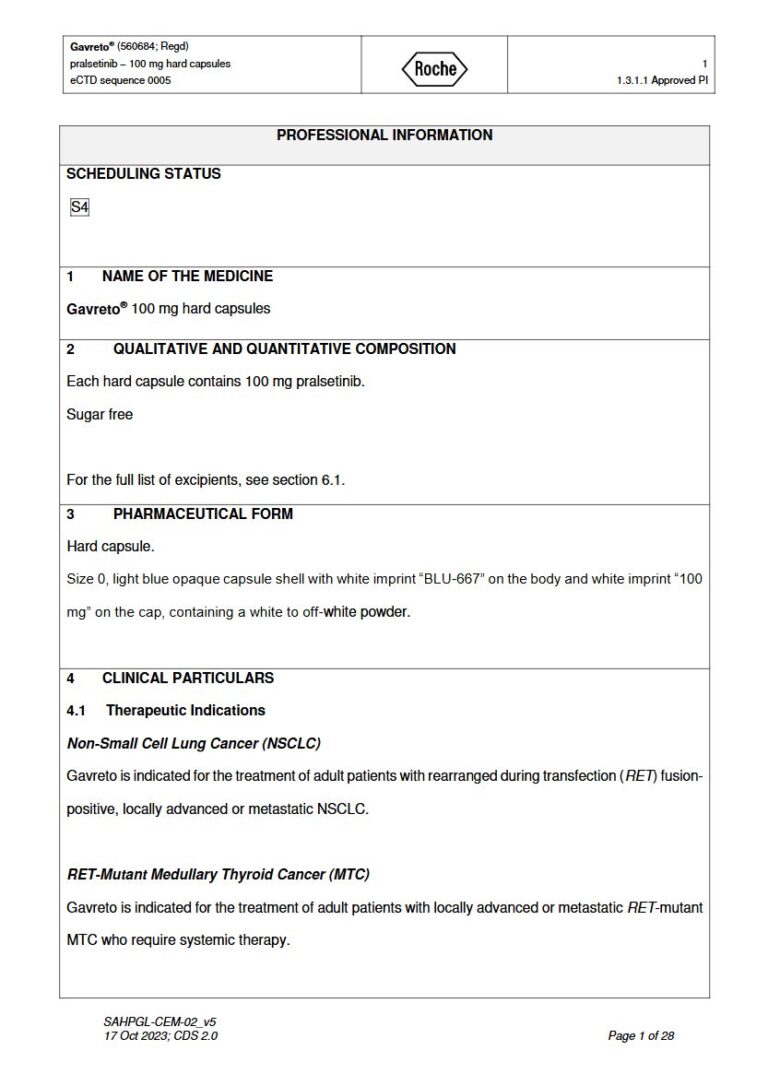
4.1 Therapeutic Indications
Non-Small Cell Lung Cancer (NSCLC)
Gavreto is indicated for the treatment of adult patients with rearranged during transfection (RET) fusion-positive, locally advanced or metastatic NSCLC.
RET-Mutant Medullary Thyroid Cancer (MTC)
Gavreto is indicated for the treatment of adult patients with locally advanced or metastatic RET-mutant MTC who require systemic therapy.
RET-Fusion Positive Thyroid Cancer
Gavreto is indicated for the treatment of adult patients with locally advanced or metastatic RET-fusion positive thyroid cancer who require systemic therapy and who are radioactive iodine-refractory (if radioactive iodine is appropriate).
4.2 Posology and method of administration
General
A validated assay is required for the selection of patients with a RET-gene fusion (NSCLC or thyroid cancer) or a RET-gene mutation (MTC).
Posology
Adults
The recommended dose of Gavreto for adults is 400 mg given orally, once daily.
Duration of Treatment
It is recommended that patients are treated with Gavreto until disease progression or unmanageable toxicity.
Delayed or Missed Doses
If a planned dose of Gavreto is missed, patients can make up that dose unless the next dose is due within 12 hours. Resume the regular daily dose schedule for Gavreto the next day. If vomiting occurs after taking a dose of Gavreto, patients should take the next dose at the scheduled time.
Dose Modifications
Adverse Reactions
Management of adverse reactions may require temporary interruption, dose reduction, or discontinuation of treatment with Gavreto, based on the medical practitioneru2019s assessment of the patientu2019s safety or tolerability.
Table 1 provides recommended dose reduction advice. Recommendations for dose modifications for the management of specific adverse reactions are provided in Table 2. Treatment should be permanently discontinued if a patient is unable to tolerate the 100 mg once daily dose.
4.3 Contraindications
Gavreto is contraindicated in patients with a known hypersensitivity to pralsetinib or any of the excipients of Gavreto. Listed in section 6.1.
4.4 Special warnings and precautions for use
General
Pneumonitis/Interstitial Lung Disease
Cases of severe, life-threatening, and fatal pneumonitis/interstitial lung disease (ILD) have been reported in clinical trials with Gavreto. Patients should be monitored for acute or worsening of pulmonary symptoms indicative of pneumonitis/ILD (e.g., dyspnoea, cough, and fever). Based on the severity of confirmed pneumonitis/ILD, Gavreto should be withheld, dose reduced, or permanently discontinued (see section 4.2).
Hypertension
Hypertension has been reported in clinical trials with Gavreto. Do not initiate Gavreto in patients with uncontrolled hypertension. Optimise blood pressure prior to initiating Gavreto. Monitor blood pressure after 1 week, at least monthly thereafter and as clinically indicated. Initiate or adjust anti-hypertensive therapy as appropriate. In case of severe and persistent hypertension, Gavreto should be withheld, dose reduced, or permanently discontinued (see section 4.2).
Hepatic Transaminase Elevations
Severe hepatic laboratory abnormalities including increased AST and increased ALT have been reported in clinical trials with Gavreto. Monitor AST and ALT prior to initiating Gavreto, every 2 weeks during the first 3 months, then monthly thereafter and as clinically indicated. See section 4.2 for dose modification based on the severity of the hepatic laboratory abnormality.
Haemorrhagic events
Severe, including fatal, haemorrhagic events can occur with Gavreto. In patients with life-threatening or recurrent severe bleeding, Gavreto should be permanently discontinued (see section 4.2).
4.5 Interaction with other medicines and other forms of interaction
In vitro data indicate that pralsetinib is primarily metabolised by CYP3A4 and transported by P-gp. Therefore, inducers and inhibitors of CYP3A4 and P-gp may alter the plasma concentrations of pralsetinib.
Effects of Other Medicines on Gavreto
Strong CYP3A4 Inhibitors and Combined P-gp and Strong CYP3A4 Inhibitors
Coadministration of itraconazole (200 mg twice daily on Day 1 followed by 200 mg once daily for 13 days) with a single 200 mg dose of pralsetinib on Day 4 in healthy subjects increased pralsetinib Cmax by 84 % and AUC0-inf by 251 %, relative to a 200 mg dose of pralsetinib administered alone. Coadministration of pralsetinib with a strong CYP3A4 inhibitor or combined P-gp and strong CYP3A4 inhibitor may increase pralsetinib plasma concentrations and may result in increased adverse reactions. Avoid coadministration of Gavreto with strong CYP3A4 inhibitors or with combined P-gp and strong CYP3A4 inhibitors. If coadministration with a combined P-gp and strong CYP3A4 inhibitor cannot be avoided, reduce the Gavreto dose (see Section 4.2).
Strong CYP3A4 Inducers
Coadministration of rifampin (600 mg once daily for 16 days) with a single 400 mg dose of pralsetinib on Day 9 in healthy subjects decreased pralsetinib Cmax by 30 % and AUC0-inf by 68 %, relative to a 400 mg dose of pralsetinib administered alone. Coadministration of pralsetinib with a strong CYP3A4 inducer may decrease pralsetinib plasma concentrations and may result in decreased efficacy of pralsetinib. Avoid coadministration of Gavreto with strong CYP3A4 inducers. If coadministration cannot be avoided, increase the Gavreto dose (see Section 4.2).
4.6 Fertility, pregnancy and lactation
Women of childbearing potential / Contraception in males and females
Pregnancy testing
Verify the pregnancy status of females of reproductive potential prior to initiating Gavreto.
Contraception
Female patients of reproductive potential must use effective non-hormonal contraception during treatment with Gavreto and for 2 weeks after the final dose. Gavreto may render hormonal contraceptives ineffective. Male patients with female partners of reproductive potential must use effective contraception during treatment with Gavreto and for at least 1 week after the final dose.
Pregnancy
Female patients of reproductive potential must be advised to avoid pregnancy while receiving Gavreto (see section 4.4). Patients receiving Gavreto should be advised of the potential hazard to the foetus. Female patients should be advised to contact their doctor, should pregnancy occur.
Breastfeeding
It is not known whether Gavreto is excreted in human breast milk. No studies have been conducted to assess the impact of Gavreto on milk production or its presence in breast milk. As the potential for harm to the nursing infant is unknown, mothers should be advised to discontinue breastfeeding during treatment with Gavreto and for 1 week following the final dose.
4.7 Effects on ability to drive and use machines
Caution should be exercised when driving or operating machines as patients may experience fatigue and dizziness while taking Gavreto (see section 4.8).
4.8 Undesirable effects
a. Summary of the safety profile : Clinical Trials
Summary of the safety profile
The safety of Gavreto was evaluated in 471 patients treated with 400 mg QD in an open-label, single-arm study (u201cARROWu201d). Patients with RET-fusion positive NSCLC, RET-mutant medullary thyroid cancer, and other RET-altered advanced solid tumours were included in the study. Patients received a starting dose of 400 mg once daily until intolerance to therapy, disease progression, or investigator determination that the patient was no longer benefiting from treatment.
b. Tabulated list of adverse reactions
Tabulated summary of adverse drug reactions from clinical trials
Adverse drug reactions from clinical trials (Table 4) are listed by MedDRA 19.1 system organ class. The corresponding frequency category for each adverse drug reaction is based on the following convention: very common (u22651/10), common (u22651/100 to <1/10), uncommon (u22651/1,000 to <1/100), rare (u22651/10,000 to <1/1000), very rare (<1/10,000).
4.9 Overdose
Patients who experience overdose should be closely supervised and supportive care instituted. There is no specific antidote for overdose with Gavreto.
