
Glycomin 5 Mg Tablets
PDF Leaflet Revision Date: 26 April 2022
Clinical Summary
Quick overview from the medicine insert
Indication
Adjunct treatment for Type II diabetes when diet alone is insufficient.
Dosage (summary)
Initial dose: 2.5 mg daily, may increase to 15 mg daily.
Special Populations
- Elderly may require smaller doses
- Renal impairment
- Hepatic impairment
Pregnancy & Breastfeeding
Contraindicated in pregnancy and breastfeeding.
Key Drug Interactions
- Increased risk of cardiovascular mortality with biguanides
- Hypoglycaemic effects enhanced by antibiotics and anticoagulants
Contraindications
- Hypersensitivity to sulphonylureas
- Insulin-dependent diabetes
- Severe renal or hepatic impairment
- Diabetes with ketoacidosis
Common side effects
- Hypoglycaemia
- Weight gain
- Gastrointestinal disturbances
Counselling Points
- Take with or immediately after meals to reduce hypoglycaemia risk
- Report signs of hypoglycaemia immediately
- Avoid alcohol consumption
Serious warnings
- Increased cardiovascular mortality risk
- May impair ability to drive or operate machinery
Important Disclaimer
The Glycomin 5 Mg Tablets professional information leaflet below is the property of Adcock Ingram and is provided on Medinsert exactly as issued, with no.. alterations or editorial changes. We make every effort to keep content current by updating documents as soon as new versions become available. Medinsert serves as a trusted access point for healthcare professionals, but does not replace official sources or clinical judgement. For more details, please read our full disclaimer. read more>>
 Healthcare Professionals Only
This content is for registered healthcare professionals
Sign in or create a free account to read the full package insert.
Free for HPCSA-registered professionals. Powered by Medinsert.
Clinical Particulars
Section 4 of the official insert — extracted exactly as issued, no alterations
4.1 Therapeutic indications
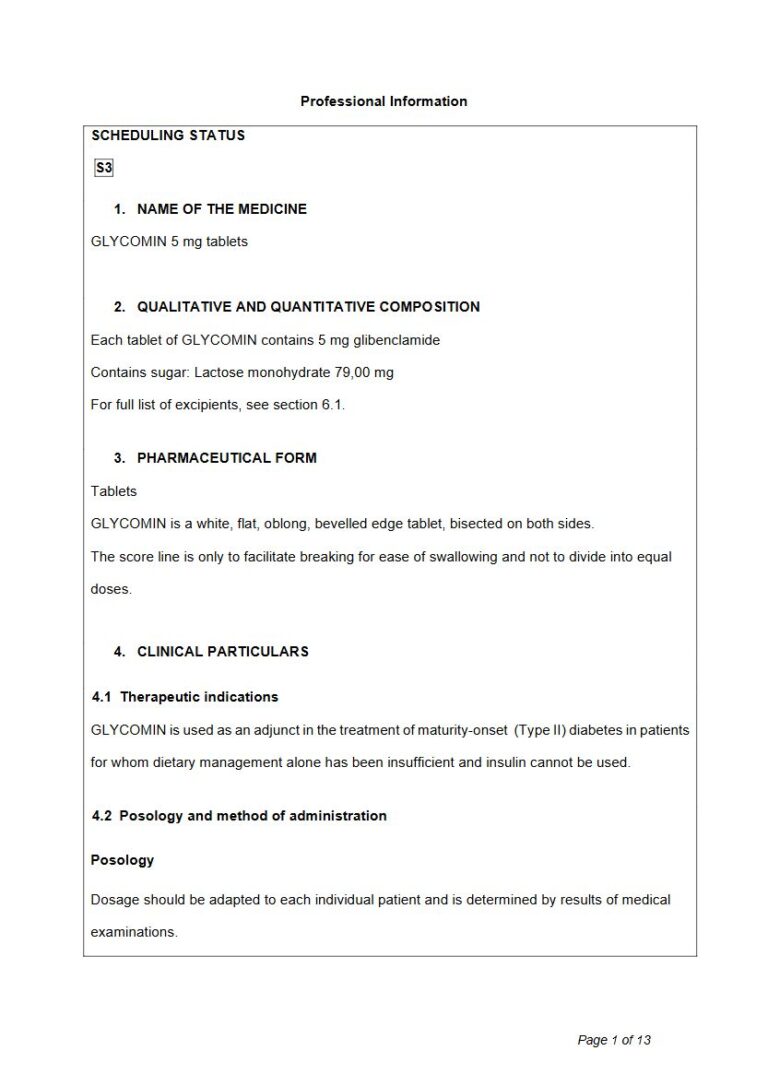
GLYCOMIN is used as an adjunct in the treatment of maturity-onset (Type II) diabetes in patients for whom dietary management alone has been insufficient and insulin cannot be used.
4.2 Posology and method of administration
Posology
Dosage should be adapted to each individual patient and is determined by results of medical examinations.
The usual initial dose is 2,5 mg daily, with or immediately before breakfast, adjusted after about 7 days by amounts of 2,5 mg daily up to 15 mg daily. Daily doses in excess of 10 mg may be given in two divided doses. When changing over from another oral antidiabetic preparation, with a similar mode of action, the dosage of GLYCOMIN is determined by the amount of the previously administered dose and the medical examination. In combination with a biguanide, there may be greater risk of cardiovascular mortality than with the use of GLYCOMIN alone (see section 4.5)
Special populations
Elderly population
Elderly patients may require smaller doses.
Renal impairment
GLYCOMIN is contraindicated in those with severe impairment of renal function (see section 4.3).
Hepatic impairment
GLYCOMIN is contraindicated in those with severe impairment of hepatic function (see section 4.3).
Other
GLYCOMIN is contraindicated in diabetes mellitus complicated by ketoacidosis, severe infection, stress, trauma and severe impairment of adrenal or thyroid function (see section 4.3).
Paediatric population
The safety and efficacy of GLYCOMIN in children has not yet been established. No data are available (see section 4.3 and 4.4)
Method of administration
For oral administration.
4.3 Contraindications
- Hypersensivity to sulphonylureas and any of the GLYCOMIN excipients (see section 6.1).
- Insulin-dependent diabetics.
- Diabetes in young people (see section 4.2 and 4.4)
- Diabetes mellitus complicated by ketoacidosis and in those with severe infection, stress, trauma and severe impairment of renal, hepatic or thyroid function. (see section 4.2)
- Chronic liver disease including that caused by uncompensated cardiac failure or alcoholism.(see section 4.4 and 4.5)
- Patients with seriously impaired adrenal function
- Diabetes mellitus in patients with a history of metabolic decompensation e.g. acidosis, diabetic pre-coma and coma.
- Pregnancy and lactation (see section 4.6)
4.4 Special warnings and precautions for use
A reduction in dosage may be necessary in patients with renal dysfunction.
The administration of GLYCOMIN may be associated with increased cardiovascular mortality compared to treatment with diet alone or diet plus insulin. Adjustment of the dosage of GLYCOMIN may be required in patients suffering from recurrent infections, traumas, shock or after anaesthesia. When major surgery is to be performed, insulin therapy should be substituted for GLYCOMIN. Intolerance to alcohol, characterised by facial flushing, may occur (see section 4.3 and 4.5). Hypoglycaemic reactions may be experienced. The incidence of hypoglycaemia can be reduced if GLYCOMIN is taken with or immediately after a meal.
Paediatric population
GLYCOMIN is not indicated in children as safety and efficacy has not been established (see section 4.2 and 4.3)
Excipients
Lactose warning: Patients with rare hereditary problems of galactose intolerance, total lactase deficiency or glucose galactose malabsorption should not take this medicine.
4.5 Interaction with other medicines and other forms of interaction
Contraindicated combinations:
In combination with biguanides, there may be greater risk of cardiovascular mortality than with the use of GLYCOMIN alone. (see section 4.2)
Combinations requiring potential dose reduction:
The hypoglycaemic effects of GLYCOMIN may be enhanced by: antibiotics or anti-infectives such as chloramphenicol and sulphonamides including co-trimoxazole, coumarin anticoagulants, anti-inflammatory medicines and analgesics including azapropazone, phenylbutazone, and salicylates, lipid regulating medicines such as clofibrate and halofenate, cimetidine and ranitidine, fenfluramine, indobufen, methyldopa, miconazole and sulphinpyrazone. An increased hypoglycaemic effect may also be expected with angiotensin-converting enzyme inhibitors, angiotensin receptor blockers, allopurinol, azole antifungals, cyclophosphamide, dicoumarol, fluoroquinolones, heparin, octreotide, tetracycline and tricyclic antidepressants. Monoamine oxidase inhibitors, quinidine and quinine have intrinsic hypoglycaemic activity in both diabetic and non-diabetic patients. The risk of hypoglycaemia may be increased or prolonged if moderate or large amounts of alcohol are consumed concomitantly with GLYCOMIN (see section 4.3 and 4.4). In all of the above, a potential dose reduction may thus be required.
Combinations requiring potential dose increases:
The hypoglycaemic effects may be diminished by aminoglutethimide, asparaginase chlorpromazine, corticosteroids, diazoxide, epinephrine (adrenaline), oral contraceptives, rifamycins, thiazide diuretics and thyroid hormones. The effects caused by asparaginase, corticosteroids, lithium and thiazide diuretics is due to the intrinsic hyperglycaemic activity of these medicines in both diabetics and non-diabetics. Beta-blockers may mask some of the symptoms of hypoglycaemia. Beta-adrenergic blockers may also decrease the hypoglycaemic effects of GLYCOMIN by inhibition of insulin secretion, modification of carbohydrate metabolism, and increased peripheral insulin resistance, leading to hyperglycaemia. In all of the above an increased dose of GLYCOMIN may thus be required.
Others:
Concomitant administration of GLYCOMIN with anticoagulants can increase the anticoagulant and hypoglycaemic effects. Interactions due to displacement from binding sites may be less likely with GLYCOMIN than with other sulphonylureas. The absorption of GLYCOMIN from the GIT may be reduced if it is taken together with guar gum.
4.6 Fertility, pregnancy and lactation
GLYCOMIN is contraindicated during pregnancy and breastfeeding (see section 4.3).
Pregnancy
First signs of pregnancy must be reported to the doctor without delay, because a change to insulin and/or dietary treatment is necessary.
Breastfeeding
GLYCOMIN is contraindicated in breastfeeding (see section 4.3)
Fertility
No data are available.
4.7 Effects on ability to drive and use machines
GLYCOMIN has a moderate influence on the ability to drive and use machines. Until optimal glycaemic control is achieved, or when changing from one medicine to another, or when tablets are not taken routinely, the patient's alertness and capacity to react may be impaired to such an extent that he or she may not be fit to drive, or to operate machinery.
4.8 Undesirable effects
a) Tabulated list of adverse reactions
System organ class Frequent Less frequent Frequency unknown (cannot be estimated from the available data)
Blood and the lymphatic system disorders Hypoglycaemia (mild, including nocturnal hypoglycaemia) Anaemia (aplastic or haemolytic), blood dyscrasias (agranulocytosis, leukopenia, pancytopenia), eosinophilia, thrombocytopenia. Severe hypoglycaemia that leads to convulsions and coma.
-
Metabolism and nutrition disorders Weight gain - Hyponatraemia, lactic acidosis
Psychiatric disorders - - Acute psychosis, confusion, convulsions (other than withdrawal), encephalopathy
Nervous system disorders - - Cerebrovascular disorders, tremor.
Eye disorders Blindness, diplopia, temporary visual impairment (at the start of treatment)
Ear and labyrinth disorders - - Deafness, tinnitus
Gastrointestinal disorders Constipation, diarrhoea, flatulence, heartburn, loss of or increase in appetite, nausea, stomach fullness, vomiting, epigastric pain. - Pancreatitis
Hepato-biliary disorders - Cholestasis, cholestatic jaundice, hepatic function impairment, hepatic porphyria, hepatitis or porphyria cutanea tarda. Acute porphyria exacerbation, increased liver enzymes (AST, ALT),
Skin and subcutaneous tissue disorders - Erythema multiforme or exfoliative dermatitis; photosensitivity. Allergic skin reactions that may progress to more serious disorders, alopecia/hypotrichosis, erythema nodosum, pruritis, facial oedema, angioedema, urticaria, allergic vasculitis.
Musculoskeletal and connective tissue disorders - - Arthralgia, arthritis
Renal and urinary disorders Polyuria - Acute renal failure, mild diuresis; syndrome of inappropriate secretion of antidiuretic hormone (SIADH)
General disorders and administrative site conditions Changes in sensation of taste, dizziness, drowsiness, headache, weakness, and paraesthesia - Intolerance to alcohol characterised by facial flushing, increased sweating
b) Description of selected adverse reactions
Gastrointestinal effects: These are the most common adverse reactions, appear to be dose related and may subside following a reduction in dosage. Dermatologic reactions: These are often transient and may disappear despite continued use. If they persist, GLYCOMIN use should be discontinued. In isolated cases, mild reactions in the form of urticaria may develop into serious and even life-threatening reactions with dyspnoea and fall in blood pressure, sometimes progressing to shock. In the event of urticaria, a physician must be notified immediately. In isolated cases, allergic vasculitis may arise which in some circumstances, may be life-threatening.
Blood and the lymphatic system reactions: The mild to severe thrombopaenia (can present as purpura), haemolytic anaemia, erythrocytopaenia, granulocytopaenia, agranulocytosis and pancytopaenia can be potentially life-threatening. In principle, these reactions are reversible once GLYCOMIN has been withdrawn.
Hepato-biliary reactions: The infrequent cases of hepatitis, elevation of liver enzymes and/or cholestasis and jaundice may progress to life-threatening liver failure but is reversed after withdrawal of the medicine.
Reporting of suspected adverse reactions: Reporting suspected adverse reactions after authorisation of the medicine is important. It allows continued monitoring of the benefit/risk balance of the medicine. Healthcare providers are asked to report any suspected adverse reactions to SAHPRA via the u201c6.04 Adverse Drug Reactions Reporting Formu201d, found online under SAHPRAu2019s publications: https://www.sahpra.org.za/Publications/Index/8 Reporting can also be done directly to Adcock Ingram Limited at: E-mail: [email protected] Tel: 011 635 0134
4.9 Overdose
Symptoms
Hypoglycaemia or hypoglycaemic coma, due to low blood sugar. If untreated, hypoglycaemia may lead to convulsions, coma and/or death. (see section 4.4 and 4.8)
Treatment
In acute poisoning the stomach should be emptied by aspiration and lavage. Treatment is symptomatic and supportive. Hypoglycaemic symptoms, e.g. excessive perspiration, light-headedness, etc. can be treated by giving the patient a glucose load.
