
Hemlibra 30 mg/1 mL/60 mg/0.4 mL/105 mg/0.7 mL/150 mg Solution
PDF Leaflet Revision Date: 30 October 2025
Clinical Summary
Quick overview from the medicine insert
Indication
Routine prophylaxis to prevent bleeding in haemophilia A patients.
Dosage (summary)
Loading dose: 3 mg/kg weekly for 4 weeks; Maintenance: 1.5 mg/kg weekly, 3 mg/kg biweekly, or 6 mg/kg every four weeks.
Special Populations
- Paediatric patients
- Elderly patients
- Renal impairment
- Hepatic impairment
Pregnancy & Breastfeeding
Not recommended during pregnancy or breastfeeding.
Key Drug Interactions
- Activated prothrombin complex concentrate (aPCC)
- Recombinant factor VIIa (rFVIIa)
Contraindications
- Hypersensitivity to emicizumab or excipients
Common side effects
- Injection site reactions
- Headache
- Pyrexia
- Arthralgia
- Myalgia
Counselling Points
- Monitor for signs of thrombotic events
- Do not use aPCC unless necessary
- Proper injection technique is crucial
Serious warnings
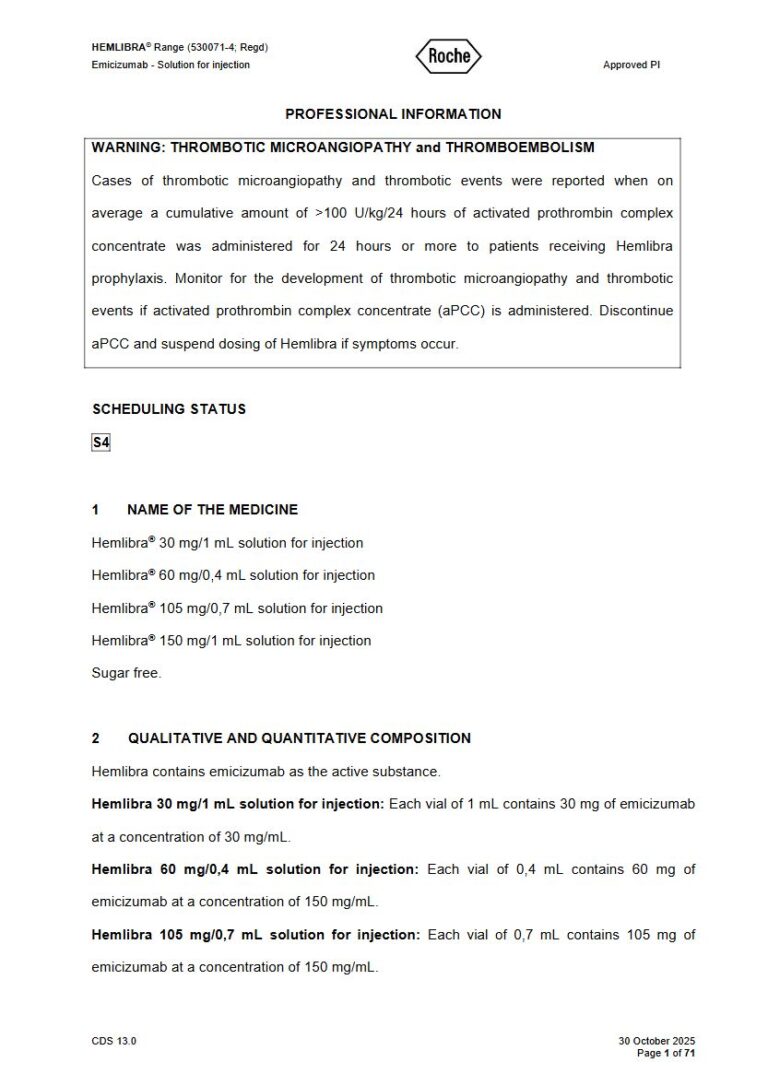
- Thrombotic microangiopathy
- Thromboembolism
Important Disclaimer
The Hemlibra 30 mg/1 mL/60 mg/0.4 mL/105 mg/0.7 mL/150 mg Solution professional information leaflet below is the property of Roche Products and is provided on Medinsert exactly as issued, with no.. alterations or editorial changes. We make every effort to keep content current by updating documents as soon as new versions become available. Medinsert serves as a trusted access point for healthcare professionals, but does not replace official sources or clinical judgement. For more details, please read our full disclaimer. read more>>
 Healthcare Professionals Only
This content is for registered healthcare professionals
Sign in or create a free account to read the full package insert.
Free for HPCSA-registered professionals. Powered by Medinsert.
Clinical Particulars
Section 4 of the official insert — extracted exactly as issued, no alterations
4.1 Therapeutic Indications
Hemlibra is indicated for routine prophylaxis to prevent bleeding or reduce the frequency of bleeding episodes in adults and children with haemophilia A (congenital factor VIII deficiency) with or without factor VIII inhibitors. There are limited data in infants less than 1 year of age.
4.2 Posology and method of administration
General
Treatment should be initiated under the supervision of a medical practitioner experienced in the treatment of haemophilia and/or bleeding disorders.
Posology
Treatment with bypassing agents should be discontinued 24 hours before starting Hemlibra therapy (see section 4.4). Factor VIII (FVIII) prophylaxis may be continued for the first 7 days of Hemlibra treatment.
Recommended dosage (all patients)
The recommended loading dose is 3 mg/kg administered as a subcutaneous injection once weekly for the first 4 weeks, followed by a maintenance dose from week 5 of either:
u2022 1,5 mg/kg once weekly, or
u2022 3 mg/kg every two weeks, or
u2022 6 mg/kg every four weeks
The maintenance dose regimen should be selected based on the medical practitioner and patient/caregiver dosing regimen preference to support adherence.
Method of administration
Hemlibra solution is a sterile, preservative-free, and ready to use solution for subcutaneous injection that does not need to be diluted. Hemlibra solution should be inspected visually to ensure there is no particulate matter or discolouration prior to administration. Hemlibra is for subcutaneous use only. Hemlibra should be administered using appropriate aseptic technique (see section 6.6). The injection should be restricted to the recommended injection sites: the abdomen, the upper outer arms and the thighs (see section 5.1). No data are available on injection at other sites of the body. Administration of Hemlibra subcutaneous injection in the upper outer arm should be performed by a trained caregiver or healthcare professional. Alternating the site of injection may help prevent or reduce injection site reactions (see section 4.8). Hemlibra subcutaneous injection should not be administered into areas where the skin is red, bruised, tender or hard, or areas where there are moles or scars. During treatment with Hemlibra, other medicinal products for subcutaneous administration should, preferably, be injected at different anatomical sites.
A 1 mL syringe should be used for an injection up to 1 mL of Hemlibra solution. Administer doses of Hemlibra greater than 1 mL and up to 2 mL with a 2 mL or 3 mL syringe. Recommended criteria for syringes, needles and vial adaptor are defined to ensure correct and safe administration of Hemlibra. These criteria are based on handling considerations (e.g. dosing accuracy, subcutaneous injection), Hemlibra characteristics (e.g. viscosity), and compatibility between Hemlibra and device materials.
Administration by the patient and/or caregiver:
Hemlibra is intended for use under the guidance of a healthcare professional. After proper training in subcutaneous injection technique, a patient may self-inject Hemlibra, or the patientu2019s caregiver may administer Hemlibra, if their medical practitioner determines that it is appropriate, see Patient Instructions for Use below. The medical practitioner and the caregiver should determine the appropriateness of the child self-injecting Hemlibra. However, self-administration is not recommended for children below 7 years of age.
Duration of treatment
Hemlibra is intended for long-term prophylactic treatment.
Dosage adjustments during treatment
No dosage adjustments of Hemlibra are recommended.
Delayed or missed doses
If a patient misses a scheduled weekly subcutaneous injection of Hemlibra, the patient should be instructed to take the missed dose as soon as possible, approximately 24 hours before the next scheduled dose. The patient should then administer the next dose on the usual scheduled dosing day. The patient should not take two doses on the same day to make up for a missed dose.
4.3 Contraindications
Hemlibra is contraindicated in patients with known hypersensitivity to emicizumab or to any of the excipients.
4.4 Special warnings and precautions for use
Thrombotic microangiopathy associated with Hemlibra and activated prothrombin complex concentrate
Cases of thrombotic microangiopathy (TMA) were reported from a clinical trial in patients receiving Hemlibra prophylaxis when on average a cumulative amount of > 100 U/kg/24 hours of activated prothrombin complex concentrate (aPCC) for 24 hours or more were administered (see section 4.8). Treatment for the TMA events included supportive care with or without plasmapheresis and haemodialysis. Evidence of improvement was seen within one week following discontinuation of aPCC. This rapid clinical improvement is distinct from the usual clinical course observed in atypical haemolytic uremic syndrome and classic TMAs, such as thrombotic thrombocytopenic purpura, (see section 4.8). Patients receiving Hemlibra prophylaxis should be monitored for the development of TMA when administering aPCC. The medical practitioner should immediately discontinue aPCC and interrupt Hemlibra therapy if clinical symptoms and/or laboratory findings consistent with TMA occur, and manage as clinically indicated. Medical practitioners should consider the risks of resuming Hemlibra prophylaxis following complete resolution of TMA on a case-by-case basis. In case a bypassing agent is indicated in a patient receiving Hemlibra prophylaxis, see below for dosing recommendations for the use of bypassing agents.
Thromboembolism associated with Hemlibra and activated prothrombin complex concentrate
Thrombotic events were reported from a clinical trial in patients receiving Hemlibra prophylaxis when on average a cumulative amount of > 100 U/kg/24 hours of aPCC for 24 hours or more were administered (see section 4.8). No cases required anticoagulation therapy, which is distinct from the usual treatment of thrombotic events. Evidence of improvement or resolution was seen after discontinuation of aPCC (see section 4.8). Patients receiving Hemlibra prophylaxis should be monitored for the development of thromboembolism when administering aPCC. The medical practitioner should immediately discontinue aPCC and interrupt Hemlibra therapy if clinical symptoms, imaging, and/or laboratory findings consistent with thrombotic events occur, and manage as clinically indicated. Medical practitioners should consider the risks of resuming Hemlibra prophylaxis following complete resolution of thrombotic events on a case-by-case basis. In case a bypassing agent is indicated in a patient receiving Hemlibra prophylaxis, see below for dosing recommendations for the use of bypassing agents.
Guidance on the use of bypassing agents in patients receiving Hemlibra prophylaxis
Treatment with bypassing agents should be discontinued the day before starting Hemlibra therapy. Medical practitioners should discuss with all patients and/or caregivers the exact dose and schedule of bypassing agents to use, if required while receiving Hemlibra prophylaxis. Hemlibra increases the patientsu2019 coagulation potential. The bypassing agent dose required may therefore be lower than that used without Hemlibra prophylaxis. The dose and duration of treatment with bypassing agents will depend on the location and extent of bleeding and on the patientu2019s clinical condition. Avoid use of aPCC unless no other treatment options/alternatives are available. If aPCC is indicated in a patient receiving Hemlibra prophylaxis, the initial dose should not exceed 50 U/kg. If bleeding is not controlled with the initial dose of aPCC up to 50 U/kg, additional aPCC doses should be administered under medical guidance or supervision, and the total aPCC dose should not exceed 100 U/kg in the first 24-hours of treatment. Treating medical practitioners must carefully weigh the risk of TMA and thromboembolism against the risk of bleeding when considering aPCC treatment beyond a maximum of 100 U/kg in the first 24-hours.
In clinical trials, no cases of thrombotic microangiopathy (TMA) or thrombotic events were observed with use of activated recombinant human FVII (rFVIIa) alone in patients receiving Hemlibra prophylaxis. Bypassing agent dosing guidance should be followed for at least 6 months following discontinuation of Hemlibra prophylaxis (see section 5.2).
Immunogenicity
Anti-hemlibra antibodies have been reported in a small number of patients treated with Hemlibra in clinical trials. Most patients found to have anti-hemlibra antibodies did not experience a change in Hemlibra plasma concentrations or an increase in bleeding events; however, in uncommon (u2265 1/1,000 to < 1/100) cases, the presence of neutralising anti-hemlibra antibodies with decreasing Hemlibra concentration may be associated with loss of efficacy (see section 4.8). In case of clinical signs of loss of efficacy (e.g. increase in breakthrough bleeding events), prompt evaluation by a medical practitioner should be sought to assess the etiology and a possible change in treatment should be considered.
Laboratory coagulation test interference
Hemlibra affects intrinsic pathway clotting-based laboratory tests, including the activated clotting time (ACT), activated partial thromboplastin time (aPTT) and all assays based on aPTT, such as one-stage factor VIII activity (see Table 1 below). Therefore, intrinsic pathway clotting-based laboratory test results in patients treated with Hemlibra prophylaxis should not be used to monitor Hemlibra activity, determine dosing for factor replacement or anti-coagulation, or measure factor VIII inhibitor titres. Laboratory tests affected and unaffected by Hemlibra are also shown in Table 1 below (see section 4.5).
4.5 Interactions with other medicines
No adequate or well-controlled interaction studies have been conducted with Hemlibra. Clinical experience suggests that a medicine interaction exists with Hemlibra and aPCC (see sections 4.3 and 4.8). There is a possibility for hypercoagulability with rFVIIa or FVIII with Hemlibra based on preclinical experiments. Hemlibra increases coagulation potential, therefore the coagulation factor dose required to achieve haemostasis may be lower than when used without Hemlibra prophylaxis.
Effect of Hemlibra on coagulation tests
Hemlibra restores the tenase cofactor activity of missing activated factor VIII (FVIIIa). Coagulation laboratory tests based on intrinsic clotting (e.g. aPTT) measure the total clotting time including time needed for activation of FVIII to FVIIIa by thrombin. Such intrinsic pathway-based tests will yield overly shortened clotting times with Hemlibra, which does not require activation by thrombin. The overly shortened intrinsic clotting time will then disturb all single-factor assays based on aPTT, such as the one-stage FVIII activity assay (see section 4.4, Table 1). However, single-factor assays utilising chromogenic or immuno-based methods are unaffected by Hemlibra and may be used to monitor coagulation parameters during treatment, with specific considerations for FVIII chromogenic activity assays as described below. Chromogenic FVIII activity tests may be manufactured with either human or bovine coagulation proteins. Assays containing human coagulation factors are responsive to Hemlibra but may overestimate the clinical haemostatic potential of Hemlibra. In contrast, assays containing bovine coagulation factors are insensitive to Hemlibra (no activity measured) and can be used to monitor endogenous or infused factor VIII activity, or to measure anti-FVIII inhibitors. Hemlibra remains active in the presence of inhibitors against factor VIII and so will produce a false-negative result in clotting-based Bethesda assays for functional inhibition of FVIII. Instead, a chromogenic Bethesda assay utilising a bovine-based FVIII chromogenic test that is insensitive to Hemlibra may be used.
Due to the long half-life of Hemlibra, effects on coagulation assays may persist for up to 6 months after the last dose (see section 5.2).
4.6 Fertility, pregnancy and lactation
Pregnancy
Safe use during pregnancy has not been established. It is not known whether Hemlibra can cause foetal harm when administered to a pregnant woman or can affect reproductive capacity. As antibodies, such as Hemlibra, crosses the placenta, pregnant women are advised not to use Hemlibra.
Contraception
Women of childbearing potential receiving Hemlibra should use effective contraception during, and for at least 6 months after cessation of Hemlibra treatment (see section 5.2).
Lactation
Women should not breastfeed while using Hemlibra.
4.7 Effects on ability to drive and use machines
There is no evidence that treatment with Hemlibra results in an increase in adverse reactions that might lead to the impairment of the ability to drive and use machines.
4.8 Undesirable effects
a) Summary of the safety profile
Clinical Trials
The following adverse drug reactions (ADRs) are based on pooled data from five phase III clinical trials (three adult and adolescent studies, a paediatric study, and an all-age group study [HAVEN 6]. A total of 444 patients with haemophilia A received at least one dose of Hemlibra as routine prophylaxis. Three hundred and seven (69,1 %) patients were adults (of which two were female) (u2265 18 years), 61 (13,7 %) were adolescents (u226512 to <18 years), 71 (16,0 %) were children (u2265 2 to < 12 years) and five (1,1 %) were infants (u2265 1 month to < 2 years). The median duration of exposure across the studies was 32,0 weeks (range: 0,1 to 94,3 weeks). Three patients (0,7 % in the pooled phase III clinical trials receiving Hemlibra prophylaxis withdrew from treatment due to ADRs, which were thrombotic microangiopathy, skin necrosis contemporaneous with superficial thrombophlebitis, and headache.
b) Tabulated list of adverse reactions
Adverse drug reactions (ADRs) from the pooled phase III clinical trials in patients who received Hemlibra are listed by MedDRA system organ class (see Table 2 below). The corresponding frequency categories for each ADR are based on the following convention: very common (u2265 1/10), common (u2265 1/100 to < 1/10), and uncommon (u2265 1/1,000 to < 1/100).
Table 2: Summary of Adverse Drug Reactions from Pooled Clinical Trials with Hemlibra
| System Organ Class | Number of patients (N = 444) | Percentage of patients | Frequency | ADR (preferred term, MedDRA) |
|---|---|---|---|---|
| General disorders and administration site conditions | Injection site reactions | 86 | 19,4 % | Very common |
| Pyrexia | 23 | 5,2 % | Common | |
| Nervous system disorders | Headache | 62 | 14,0 % | Very common |
| Gastrointestinal disorders | Diarrhoea | 21 | 4,7 % | Common |
| Musculoskeletal and connective tissue disorders | Arthralgia | 63 | 14,2 % | Very Common |
| Myalgia | 13 | 2,9 % | Common | |
| Blood and Lymphatic system disorders | Thrombotic microangiopathy | 3 | < 1 % | Uncommon |
| Infections and Infestations | Cavernous sinus thrombosis | 1 | <1 % | Uncommon |
| Skin and subcutaneous tissue disorders | Skin necrosis | 1 | <1 % | Uncommon |
| Vascular Disorders | Superficial thrombophlebitis | 1 | <1 % | Uncommon |
Post Marketing
The following adverse drug reactions have been identified from post marketing surveillance with Hemlibra (see Table 4). Adverse drug reactions from post marketing surveillance are listed by MedDRA system organ class.
Table 3 Adverse Drug Reactions from Post marketing Surveillance
| System Organ Class | Frequency | ADR (preferred term, MedDRA) |
|---|---|---|
| Immune system disorders | Hypersensitivity | Uncommon |
| Skin and subcutaneous tissue disorders | Angioedema | Uncommon |
| Urticaria | Common | |
| Rash | Common |
c) Description of selected adverse drug reactions:
The most serious adverse drug reactions reported from the pooled phase III clinical trials with Hemlibra were TMA and thrombotic events, including cavernous sinus thrombosis and superficial vein thrombosis contemporaneous with skin necrosis (see below and section 4.4). Thrombotic microangiopathy: In the pooled phase III clinical trials, thrombotic microangiopathy events were reported in 100 U/Kg/24 hours of aPCC for 24 hours or more while receiving Hemlibra prophylaxis prior to the development of TMA events (presenting with thrombocytopenia, microangiopathic haemolytic anaemia, and acute kidney injury, without severe deficiencies in ADAMTS13 activity). One patient resumed Hemlibra following resolution of TMA without recurrence (see section 4.4). Thrombotic events: In the pooled phase III clinical trials, serious thrombotic events were reported in 100 U/Kg/24 hours of aPCC for 24 hours or more while receiving Hemlibra prophylaxis, prior to the development of the thrombotic events. One patient resumed Hemlibra following resolution of the thrombotic event without recurrence (see section 4.4).
4.9 Overdose
Accidental overdose may result in hypercoagulability. Patients who receive an accidental overdose should be immediately contact their medical practitioner/ medicine control centre and be monitored closely. Treatment should be symptomatic and supportive.
