
Hydrea 500 mg CAPSULES
PDF Leaflet Revision Date: 31 October 2024
Clinical Summary
Quick overview from the medicine insert
Indication
Treatment of chronic myeloid leukaemia and squamous cell carcinoma of the head and neck.
Dosage (summary)
20-30 mg/kg daily or 80 mg/kg every 3 days based on weight.
Special Populations
- Renal impairment
- Hepatic impairment
- Elderly
Pregnancy & Breastfeeding
Contraindicated in pregnancy and lactation; may cause fetal harm.
Key Drug Interactions
- Myelosuppressive agents
- Didanosine and stavudine
- Live vaccines
Contraindications
- Hypersensitivity to hydroxyurea
- Bone marrow depression
- Pregnancy and lactation
Common side effects
- Leukopenia
- Thrombocytopenia
- Anaemia
- Nausea
- Vomiting
Counselling Points
- Handle with care; avoid skin contact.
- Use contraception during and after treatment.
- Monitor for signs of infection or respiratory symptoms.
Serious warnings
- Myelosuppression risk
- Secondary malignancies
- Severe gastrointestinal distress
Important Disclaimer
The Hydrea 500 mg CAPSULES professional information leaflet below is the property of Equity Pharmaceuticals and is provided on Medinsert exactly as issued, with no.. alterations or editorial changes. We make every effort to keep content current by updating documents as soon as new versions become available. Medinsert serves as a trusted access point for healthcare professionals, but does not replace official sources or clinical judgement. For more details, please read our full disclaimer. read more>>
 Healthcare Professionals Only
This content is for registered healthcare professionals
Sign in or create a free account to read the full package insert.
Free for HPCSA-registered professionals. Powered by Medinsert.
Clinical Particulars
Section 4 of the official insert — extracted exactly as issued, no alterations
4.1 Therapeutic indications
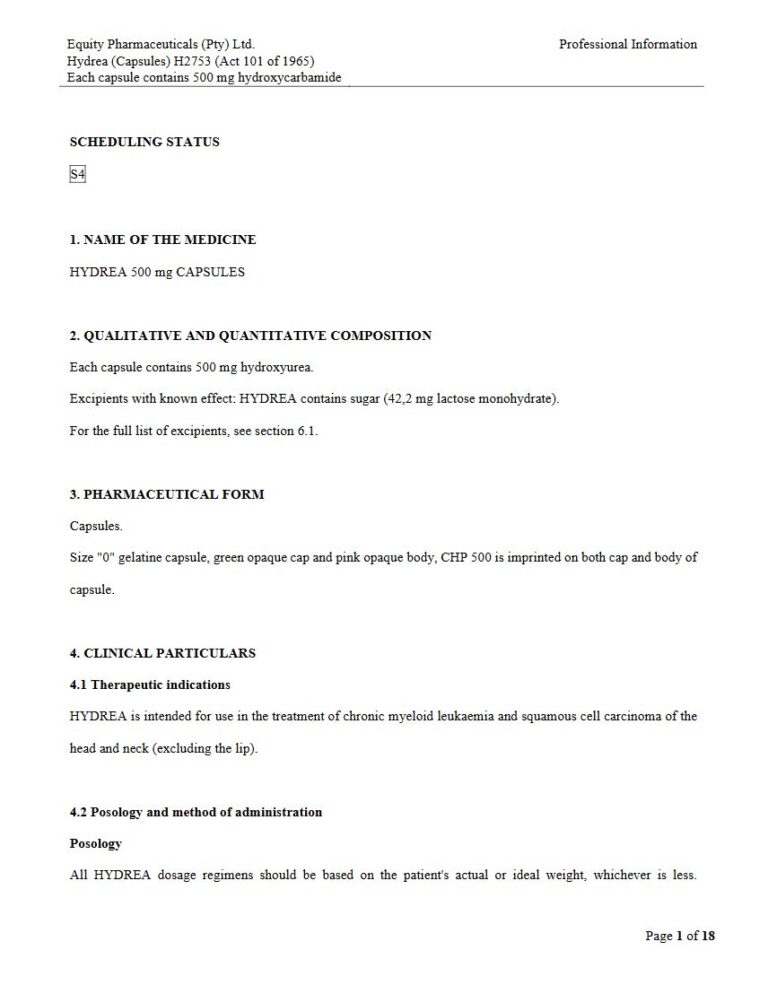
HYDREA is intended for use in the treatment of chronic myeloid leukaemia and squamous cell carcinoma of the head and neck (excluding the lip).
4.2 Posology and method of administration
Posology
All HYDREA dosage regimens should be based on the patient's actual or ideal weight, whichever is less. Concurrent use of HYDREA with other myelosuppressive medicines may require adjustments of dosages.
INSTRUCTIONS FOR HANDLING: If the patient prefers, or is unable to swallow capsules, the contents of the capsules may be emptied into a glass of water and taken immediately. Some inert material used as a vehicle in the capsule may not dissolve and float on the surface. Patients who take HYDREA by emptying the contents of the capsule into water should be reminded that this is a potent medicine that must be handled with care. Patients must be cautioned not to allow the powder to come in contact with the skin and mucous membranes, including avoidance of inhaling the powder when opening the capsules. People who are not taking HYDREA should not be exposed to it. To decrease the risk of exposure, wear disposable gloves when handling HYDREA or bottles containing HYDREA. Anyone handling HYDREA should wash their hands before and after contact with the bottle or capsules. If the powder is spilled, it should be immediately wiped up with a damp disposable towel and discarded in a closed container, such as a plastic bag, as should the empty capsules. HYDREA should be kept away from children and pets. To minimise the risk of dermal exposure, always wear impervious gloves when handling bottles containing HYDREA. This includes all handling activities, activities in clinical settings, pharmacies, storerooms, and home healthcare settings, including during unpacking and inspection, transport within a facility, and dose preparation and administration. Procedures for proper handling and disposal of anticancer medicines should be considered. Several guidelines on this subject have been published. There is no general agreement that all of the procedures recommended in the guidelines are necessary or appropriate.
SOLID TUMORS
Intermittent therapy
80 mg/kg administered orally as a single dose every third day.
Continuous therapy
20 to 30 mg/kg administered orally as a single dose daily. The intermittent dosage schedule offers the advantage of reduced toxicity (e.g. bone marrow depression). Patients on this dosage regimen have rarely required complete discontinuance of therapy because of toxicity.
Concomitant therapy with irradiation (Carcinoma of the head and neck)
80 mg/kg administered orally as a single dose every third day. Administration of HYDREA should begin at least seven days before initiation of irradiation and be continued during radiotherapy as well as indefinitely afterwards provided that the patient is kept under adequate observation and shows no unusual or severe reactions. Irradiation should be given at the maximum dose considered appropriate for the particular therapeutic situation; adjustment of irradiation dosage is not usually necessary when HYDREA is used concomitantly.
RESISTANT CHRONIC MYELOCYTIC LEUKAEMIA
Continuous therapy
20 to 30 mg/kg administered orally as a single dose daily. An adequate trial period for determining the antineoplastic effectiveness of HYDREA is six weeks of therapy. When there is significant clinical response, therapy should be continued indefinitely. Therapy should be interrupted if the white blood cell count drops below 2 500/mm3 or the platelet count below 100 000/mm3. In these cases, the counts should be rechecked after three days and therapy resumed when the counts rise above these trigger levels (WBC u2265 2 500/mm3 or Pit u2265 100 000/mm3. If rapid rebound has not occurred during combined HYDREA and irradiation therapy, irradiation may also be interrupted. However, the need for postponement of irradiation has been rare; radiotherapy has usually been continued using the recommended dosage and technique. Anaemia, if it occurs, should be corrected without interrupting HYDREA therapy.
Special populations
Renal insufficiency
Since renal excretion is a pathway of elimination, consideration should be given to decreasing the dosage in this population. Close monitoring of haematologic parameters is advised (see section 4.4).
Hepatic insufficiency
There are no data that support specific guidance for dosage adjustment in patients with impaired hepatic function. Close monitoring of haematologic parameters is advised.
Elderly
Elderly patients may require a lower dose regimen (see section 4.4).
Paediatric population
Safety and effectiveness in children have not been established.
Method of administration
Oral. NOTE: If the patient prefers, or is unable to swallow capsules, the contents of the capsules may be emptied into a glass of water and taken immediately. Procedures for proper handling and disposal of HYDREA should be adhered to (see section 4.2 - INSTRUCTIONS FOR HANDLING).
4.3 Contraindications
HYDREA is contraindicated in:
- patients who have demonstrated a previous hypersensitivity to hydroxyurea or to any of the excipients in HYDREA listed in section 6.1.
- patients with bone marrow depression, i.e. leukopenia (< 2 500 WBC/mm3) or thrombocytopenia (< 100 000/mm3), or severe anaemia.
- patients concomitantly using antiretroviral (ARV) medicines (see section 4.4).
- pregnancy and lactation (see section 4.6).
4.4 Special warnings and precautions for use
Myelosuppression:
Treatment with HYDREA should not be initiated if bone marrow function is depressed (see section 4.3). Bone marrow suppression may occur during treatment with HYDREA, and leukopenia is generally its first and most common manifestation. Thrombocytopenia and anaemia occur less often and are seldom seen without a preceding leukopenia. However, the recovery from myelosuppression is rapid when therapy is interrupted. It should be borne in mind that bone marrow depression is more likely in patients who have previously received radiotherapy or cytotoxic cancer chemotherapeutic medicines; HYDREA should be used cautiously in such patients (see section 4.5).
Anaemia:
Severe anaemia must be corrected with whole blood replacement before initiating therapy with HYDREA. If, during treatment, anaemia occurs, correct without interrupting HYDREA therapy. Erythrocytic abnormalities; megaloblastic erythropoiesis, which is self-limiting, is often seen early in the course of hydroxycarbamide therapy. The morphologic change resembles pernicious anaemia, but is not related to Vitamin B12 or folic acid deficiency. The macrocytosis may mask the incidental development of folic acid deficiency; regular determinations of serum folic acid are recommended. Hydroxycarbamide may also delay plasma iron clearance and reduce the rate of iron utilisation by erythrocytes but it does not appear to alter the red blood cell survival time. Cases of haemolytic anaemia in patients treated with HYDREA for myeloproliferative diseases have been reported (see section 4.8). Patients who develop persistent anaemia should have laboratory tests evaluated for haemolysis. In the setting of confirmed diagnosis of haemolytic anaemia, HYDREA should be discontinued.
Radiation recall:
Patients who have received irradiation therapy in the past may have an exacerbation of post irradiation erythema when HYDREA is given.
Macrocytosis:
Erythrocytic abnormalities: macrocytic anaemia, which is self-limiting, is often seen early in the course of HYDREA therapy. The morphologic change is not related to vitamin B12 or folic acid deficiency. The macrocytosis may mask the incidental development of folic acid deficiency, thus prophylactic administration of folic acid may be warranted. HYDREA may also delay plasma iron clearance and reduce the rate of iron utilisation by erythrocytes, but it does not appear to alter the erythrocyte survival time.
Renal impairment:
HYDREA should be used with caution in patients with marked renal dysfunction (see section 4.2).
Use in the elderly:
Elderly patients may be more sensitive to the effects of HYDREA and may require a lower dose regimen.
Secondary malignancies:
In patients receiving long-term therapy with HYDREA for myeloproliferative disorders such as polycythemia vera and thrombocythemia, secondary leukaemia has been reported. It is unknown whether this leukomogenic effect is secondary to HYDREA or associated with the patients' underlying disease. Skin cancer has also been reported in patients receiving long-term HYDREA.
Use with radiation therapy and/or chemotherapy:
Because haematopoiesis may be compromised by extensive irradiation or by antineoplastic medicines, it is recommended that HYDREA be administered cautiously to patients who have recently received extensive radiation therapy with other cytotoxic medicines. Pain or discomfort from inflammation of the mucous membranes at the irradiated site (mucositis) is usually controlled by measures such as topical anaesthetics and orally administered analgesics. If the reaction is severe, HYDREA therapy may be temporarily interrupted; if it is extremely severe, irradiation dosage may, in addition, be temporarily postponed.
Severe gastric distress, such as nausea, vomiting, and anorexia, resulting from combined therapy may be controlled by interruption of HYDREA administration. However, the additional interruption of irradiation therapy is necessary as well.
Use in HIV-infected patients:
Fatal and non-fatal pancreatitis has occurred in HIV-infected patients during therapy with HYDREA and didanosine with or without stavudine. Hepatotoxicity and hepatic failure resulting in death were reported during post marketing surveillance in HIV-infected patients treated with HYDREA and other antiretroviral medicines. Fatal hepatic events were reported most often in patients treated with the combination of HYDREA, didanosine and stavudine (see section 4.3).
Peripheral neuropathy, which may be severe, has been reported in HIV-infected patients receiving HYDREA in combination with antiretroviral medicines, including didanosine with or without stavudine (see section 4.3).
Vasculitic toxicities:
Cutaneous vasculitic toxicities including vasculitic ulcerations and gangrene have occurred in patients with myeloproliferative disorders during therapy with HYDREA. These vasculitic toxicities were reported also in patients with a history of, or currently receiving, interferon therapy. Due to potentially severe clinical outcomes for the cutaneous vasculitic ulcers reported in patients with myeloproliferative disease, HYDREA should be discontinued if cutaneous vasculitic ulcerations develop and alternative cytoreductive medicines should be initiated as indicated. Patients should be advised to maintain adequate fluid intake.
Live vaccinations:
The use of live vaccines in patients taking HYDREA should be avoided during treatment and for at least six months after treatment has finished and individual specialist advice sought (see section 4.5). Concomitant use of HYDREA with a live virus vaccine may potentiate the replication of the virus and/or may increase the adverse reaction of the vaccine because normal defence mechanisms may be suppressed by HYDREA. Vaccination with a live vaccine in a patient taking HYDREA may result in severe infection. The patientu2019s antibody response to vaccines may be decreased.
Respiratory disorders:
Interstitial lung disease including pulmonary fibrosis, lung infiltration, pneumonitis, and alveolitis/allergic alveolitis have been reported in patients treated for myeloproliferative neoplasm and may be associated with fatal outcome. Patient developing pyrexia, cough, dyspnoea or other respiratory symptoms should be closely monitored, investigated and treated. Promptly discontinue of HYDRA and treatment with corticosteroids appears to be associated with resolution of the pulmonary events (see section 4.8).
Interference with Continuous Glucose Monitoring Systems:
Hydroxyurea (i.e., HYDREA) may falsely elevate sensor glucose results from certain continuous glucose monitoring (CGM) systems and may lead to hypoglycaemia if sensor glucose results are relied upon to dose insulin. If a patient using a CGM is to be prescribed hydroxyurea, consult with the CGM prescriber about alternative glucose monitoring methods.
Lactose
HYDREA contains lactose. Patients with rare hereditary problems of galactose intolerance, total lactase deficiency or glucose-galactose malabsorption should not take HYDREA.
Paediatric population
Safety and effectiveness in children have not been established.
4.5 Interaction with other medicines and other forms of interaction
Since HYDREA may raise the serum uric acid level, dosage adjustment of uricosuric medication may be necessary. Vasculitic toxicities were reported in patients with a history of, or currently receiving, interferon therapy (see section 4.4). In vitro studies have shown a significant increase in cytarabine cytotoxic activity in HYDREA-treated cells. Whether this interaction will lead to synergistic toxicity in the clinical setting or the need to modify cytarabine doses has not been established. Studies have shown that there is an analytical interference of hydroxyurea with the enzymes (urease, uricase, and lactic dehydrogenase) used in the determination of urea, uric acid and lactic acid, rendering falsely elevated results of these in patients treated with HYDREA. Concurrent use of HYDREA and other myelosuppressive medicines or radiation therapy may increase the likelihood of bone marrow depression or other adverse events (see section 4.4). Fatal and non-fatal pancreatitis has occurred in HIV-infected patients during therapy with HYDREA and didanosine, with or without stavudine. Fatal hepatic events were reported most often in patients treated with the combination of HYDREA, didanosine and stavudine (see section 4.3). Vaccinations: There is increased risk of fatal systemic vaccine disease with the concomitant use of live vaccines. Live vaccines are not recommended in immunosuppressed patients (see section 4.4)
4.6 Fertility, pregnancy and lactation
HYDREA is contraindicated in pregnancy and lactation (see section 4.3).
Pregnancy
HYDREA can cause foetal harm when administered to pregnant women and has been demonstrated to be a potent teratogen in a wide variety of animal models. There are no adequate and well-controlled studies in pregnant women. Women of childbearing potential should avoid becoming pregnant while taking HYDREA. They should continue with their contraception treatment for not less than 6 months after therapy with HYDREA has ended. Males on HYDREA who have partners who are women of childbearing potential should continue using reliable methods of contraception for at least 12 months after therapy with HYDREA has ended. They should not attempt to father children during this period. When appropriate, patients should be counselled concerning the use of contraceptive measures during therapy. Medicines which affect DNA synthesis, such as HYDREA, may be mutagenic, and this should be considered before administering HYDREA to male or female patients who may still contemplate conception.
Breastfeeding
HYDREA is secreted in human milk. Women receiving HYDREA should not breastfeed their infants (see section 4.3).
Fertility
HYDREA is unequivocally genotoxic and a presumed transspecies carcinogen, which implies a carcinogenic risk to humans. Men under therapy are advised to use effective contraceptive measures during and at least 1 year after therapy. Male fertility may be compromised with the use of HYDREA. Azoospermia or oligospermia, sometimes reversible, have been observed in men. Male patients should be informed about the possibility of sperm conservation before the start of therapy.
4.7 Effects on ability to drive and use machines
HYDREA may cause drowsiness and other neurologic effects (see section 4.8), that may affect a patient's ability to drive and use machines.
4.8 Undesirable effects
Hypersensitivity
Drug induced fever. High fever (> 39 u00b0C) requiring hospitalisation in some cases has been reported concurrently with gastrointestinal, pulmonary, musculoskeletal, hepatobiliary, dermatological or cardiovascular manifestations. Onset typically occurred within 6 weeks of initiation and resolved promptly after discontinuation of hydroxycarbamide. Upon re-administration fever re-occurred within 24 hours. The list is presented by system organ class, MedDRA preferred term, and frequency using the following frequency categories: very common (u22651/10), common (u22651/100, < 1/10), uncommon (u22651/1 000, <1/100), rare (u22651/10 000, <1/1 000), very rare (< 1/10 000), and not known (cannot be estimated from the available data).
System Organ Class Frequency Adverse Reaction Term Infections and infestations Rare Gangrene Neoplasms benign and malignant (including cysts and polyps) Common Skin cancer Blood and lymphatic system disorders Very common Bone marrow failure, decreased CD4 lymphocytes, leukopenia, thrombocytopenia, decreased platelet count, anaemia Not known Haemolytic anaemia Metabolism and nutrition disorders Very common Anorexia Rare Tumour lysis syndrome Psychiatric disorders Common Hallucination, disorientation Nervous system disorders Common Convulsions, dizziness, peripheral neuropathy, somnolence, headache Respiratory, thoracic and mediastinal disorders Common Pulmonary fibrosis, lung infiltration, dyspnoea Not known Interstitial lung disease, pneumonitis, alveolitis, allergic alveolitis, cough Gastrointestinal disorders Very common Pancreatitis 1, nausea, vomiting, diarrhoea, stomatitis, constipation, mucositis, stomach discomfort, dyspepsia Hepatobiliary disorders Common Hepatotoxicity 1, increased hepatic enzyme, cholestasis, hepatitis Skin and subcutaneous tissue disorders Very common Cutaneous vasculitis, dermatomyositis, alopecia, maculopapular rash, skin exfoliation, skin atrophy, skin ulcer, erythema, skin hyperpigmentation, nail disorder. Systemic and cutaneous lupus erythematosus Not known Nail pigmentation Renal and urinary disorders Very common Dysuria, increased blood creatinine, increased blood urea, increased blood uric acid General disorders and administration site conditions Very common Pyrexia, asthenia, chills, malaise Reproductive system and breast disorders Very Azoospermia, oligospermia
1 Fatal and non-fatal pancreatitis and hepatotoxicity have been reported in HIV-infected patients who received hydroxyurea in combination with antiretroviral medicines, in particular didanosine plus stavudine. Combined HYDREA and irradiation therapy Adverse reactions observed with combined HYDREA and irradiation therapy were similar to those reported with the use of HYDREA alone, primarily bone marrow depression (anaemia and leukopenia), and gastric irritation. Nearly all patients receiving an adequate course of combined HYDREA and irradiation therapy will develop leukopenia. Decreased platelet counts (<100 000/mm3) have occurred less frequently and usually in the presence of marked leukopenia. HYDREA may potentiate some adverse reactions usually seen with radiation alone, such as gastric distress and mucositis.
Reporting of suspected adverse reactions
Reporting suspected adverse reactions after authorisation of the medicine is important. It allows continued monitoring of the benefit/risk balance of the medicine. Health care providers are asked to report any suspected adverse reactions to SAHPRA via the Med Safety APP (Medsafety X SAHPRA) and eReporting platform (who- umc.org) found on SAHPRA website.
4.9 Overdose
In overdose, side effects will be exacerbated and exaggerated (see section 4.8). Acute mucocutaneous toxicity has been reported in patients receiving HYDREA at a dosage several times the therapeutic dose. Soreness, violet erythema, oedema on palms and foot soles followed by scaling of hands and feet, severe generalised hyperpigmentation of skin, and stomatitis have also been observed. Treatment of overdosage should be symptomatic and supportive.
